EEM 3117 Introduction Dr. Sezai Taskin Department of - - PowerPoint PPT Presentation

eem 3117
SMART_READER_LITE
LIVE PREVIEW

EEM 3117 Introduction Dr. Sezai Taskin Department of - - PowerPoint PPT Presentation

Automatic Control EEM 3117 Introduction Dr. Sezai Taskin Department of Electrical&Electronics Engineering Faculty of Engineering, Manisa Celal Bayar University Instructor Instructor: Sezai Taskin, Ph.D Prof. Department of the Head


slide-1
SLIDE 1

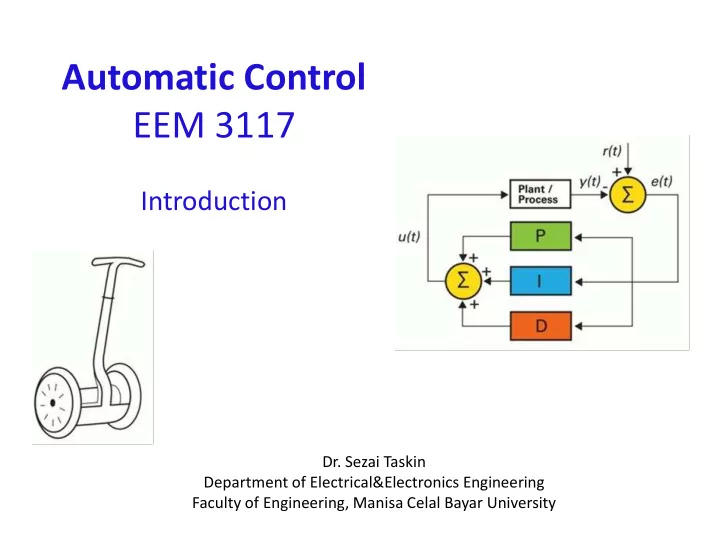
Automatic Control EEM 3117

Introduction

  • Dr. Sezai Taskin

Department of Electrical&Electronics Engineering Faculty of Engineering, Manisa Celal Bayar University
slide-2
SLIDE 2

Instructor

  • Instructor: Sezai Taskin, Ph.D

Prof. Department of the Head

  • Classes and office hours: Every Tuesday
  • Email: sezai.taskin@cbu.edu.tr
  • Lab. Assistant:
  • M. Ali Ustuner, PhD Student

Slides 1: Introduction 2

slide-3
SLIDE 3

Course Materials

Slides: Will be available online. http://sezaitaskin.cbu.edu.tr/ Text Books: K. Ogata, Modern Control Engineering Ibrahim Yuksel, Otomatik Kontrol References:

  • N. Nise, Control Systems Engineering, John Wiley

& Sons, Inc., 2011.

  • R.C. Dorf and R.H. Bishop, Modern Control

Systems, 11th ed. Pearson Education Inc., 2008.

Slides 1: Introduction 3

slide-4
SLIDE 4

Grading

  • Class participation, quizzes and assignments
  • Midterm exam (30%)
  • Quiz (10%)
  • Lab. Reports (10%)
  • Final examination (50%)

Slides 1: Introduction 4

slide-5
SLIDE 5

Why to study “Automatic Control”?

  • The study of automatic control is essential for

students pursuing degrees in many engineering disciplines (mechanical, electrical, structural, aerospace, biomedical, or chemical).

  • Applications of automatic control include, but not

limited to, aircraft, robots, civil engineering structures, process control, …., etc.

  • Automatic control has played a vital role in the

advance of engineering and science.

Slides 1: Introduction 5

slide-6
SLIDE 6

What is “Control”?

  • Make some object (called system, or plant)

behave as we desire.

  • Imagine “control” around you!

Room temperature control Car driving Voice volume control “Control” (move) the position of the pointer etc.

Slides 1: Introduction 6

slide-7
SLIDE 7

What is “Automatic Control”?

  • Not manual!
  • Why do we need automatic control?

Convenient (room temperature, laundry machine) Dangerous (hot/cold places, space, bomb removal) Impossible for human (nanometer scale precision positioning, work inside the small space that human cannot enter, huge antennas control, elevator) It exists in nature. (human body temperature control) High efficiency (engine control)

  • Many examples of automatic control around us

Slides 1: Introduction 7

slide-8
SLIDE 8

Example: temple doors opened by fire

  • n an altar

Heron of Alexandria (c. 10–85 AD) When a fire is lit, the air in the altar is heated and, as it expands, it enters a hollow sphere full of water. Due to the rising pressure in the sphere, some of the water is displaced into the bucket. As the bucket becomes more heavy, it is lowered, opening the doors of the temple

Slides 1: Introduction 8 Heron of Alexandria was a mathematician, physicist and engineer who lived around 10–85 AD. He taught at Alexandria’s Musaeum and wrote many books on Mathematics, Geometry and Engineering, which were in use till the medieval times. His most important invention was the Aeolipile, the first steam

  • turbine. Other inventions include automated machines for

temples and theaters, surveying instruments, and military machines and weapons.

slide-9
SLIDE 9

Example: vending machine

Slides 1: Introduction 9

Heron's COIN automat

slide-10
SLIDE 10

Example: laundry machine

A laundry machine washes clothes, by setting a program. A laundry machine does not measure how clean the clothes become. Control without measuring devices (sensors) are called open-loop control.

Slides 1: Introduction 10

Laundry Machine Program setting (Input) Washed clothes (Output)

slide-11
SLIDE 11

Open-loop control systems

Advantages:

  • Simple construction and ease of maintenance.
  • There is no stability concern.
  • Convenient when output is hard to measure or measuring

the output precisely is economically not feasible. (For example, in the washer system, it would be quite expensive to provide a device to measure the quality of the washer's

  • utput, cleanliness of the clothes).

Disadvantages:

  • Disturbances and changes in calibration cause errors, and

the output may be different from what is desired.

  • Recalibration is necessary from time to time.

Slides 1: Introduction 11

slide-12
SLIDE 12

Closed-loop (feedback) control

In this approach, control action is dependent on the output.

Slides 1: Introduction 12

slide-13
SLIDE 13

Example: autopilot mechanism

Its purpose is to maintain a specified airplane heading, despite atmospheric changes. It performs this task by continuously measuring the actual airplane heading, and automatically adjusting the airplane control surfaces so as to bring the actual airplane heading into correspondence with the specified heading.

Slides 1: Introduction 13

slide-14
SLIDE 14

Example: antenna azimuth

Slides 1: Introduction 14

slide-15
SLIDE 15

Example: antenna azimuth

Slides 1: Introduction 15

slide-16
SLIDE 16

Basic elements of control loop

The role of the controller is to make the output following the reference in a “satisfactory” manner even under disturbances.

Slides 1: Introduction 16

Controller Actuator Plant Sensor

Ref. Input Output Error Disturbance

slide-17
SLIDE 17

playing sport

Slides 1: Introduction 17

Better Sensors Provide better Vision Better Control Provides more finesse by combining sensors and actuators in more intelligent ways

Example:

Better Actuators Provide more Muscle

slide-18
SLIDE 18

Course goals

Slides 1: Introduction 18

Controller Actuator Plant Sensor

Ref. Input Output Error Disturbance

Mathematical model

Modeling

Controller

Design Implementation Analysis

slide-19
SLIDE 19

Procedure

Slides 1: Introduction 19

slide-20
SLIDE 20

Summary

  • Introduction:

Control essentiality Examples of control systems Open loop versus closed loop control systems

  • Next Lecture:

Laplace Transformation Review

Slides 1: Introduction 20