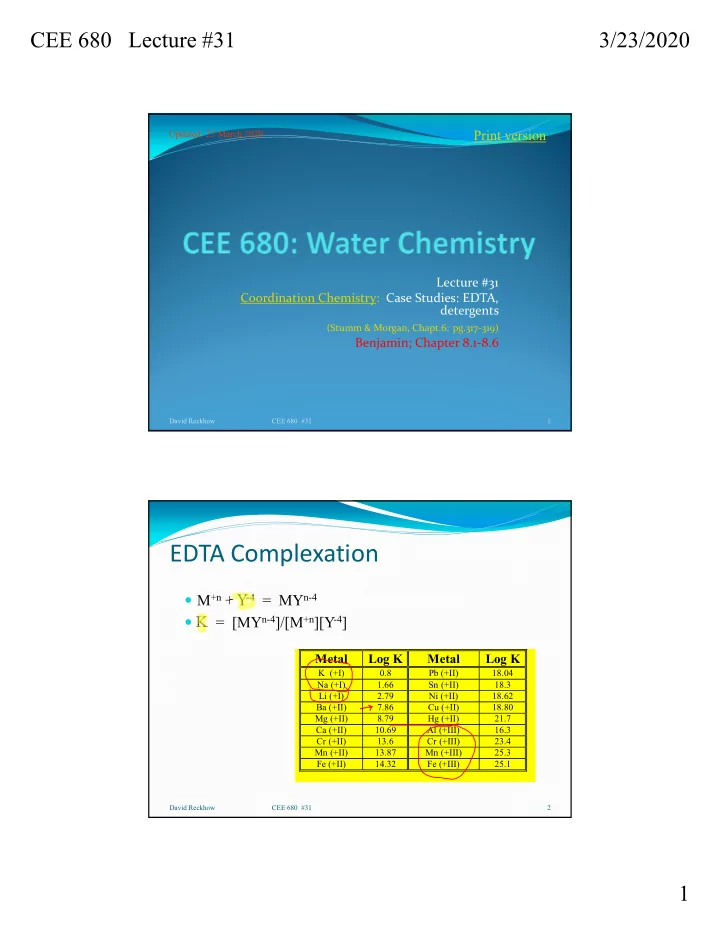
EDTA Complexation M +n + Y -4 = MY n-4 K = [MY n-4 ]/[M +n ][Y - - PDF document

edta complexation
SMART_READER_LITE
LIVE PREVIEW

EDTA Complexation M +n + Y -4 = MY n-4 K = [MY n-4 ]/[M +n ][Y - - PDF document

CEE 680 Lecture #31 3/23/2020 Print version Updated: 23 March 2020 Lecture #31 Coordination Chemistry: Case Studies: EDTA, detergents (Stumm & Morgan, Chapt.6: pg.317 319) Benjamin; Chapter 8.1 8.6 David Reckhow CEE 680 #31 1


slide-1
SLIDE 1

CEE 680 Lecture #31 3/23/2020 1

Lecture #31 Coordination Chemistry: Case Studies: EDTA, detergents

(Stumm & Morgan, Chapt.6: pg.317‐319)

Benjamin; Chapter 8.1‐8.6

David Reckhow CEE 680 #31 1

Updated: 23 March 2020

Print version

EDTA Complexation

 M+n + Y

  • 4 = MYn-4

 K = [MYn-4]/[M+n][Y

  • 4]

David Reckhow CEE 680 #31 2

Metal Log K Metal Log K

K (+I) 0.8 Pb (+II) 18.04 Na (+I) 1.66 Sn (+II) 18.3 Li (+I) 2.79 Ni (+II) 18.62 Ba (+II) 7.86 Cu (+II) 18.80 Mg (+II) 8.79 Hg (+II) 21.7 Ca (+II) 10.69 Al (+III) 16.3 Cr (+II) 13.6 Cr (+III) 23.4 Mn (+II) 13.87 Mn (+III) 25.3 Fe (+II) 14.32 Fe (+III) 25.1

slide-2
SLIDE 2

CEE 680 Lecture #31 3/23/2020 2

EDTA Protonation

 Acidic groups

 Carboxylic groups

 pK1 = 0.0 pK2 = 1.5 pK3 = 2.0 pK4 = 2.66

 Amine groups

 pK5 = 6.16 pK6 = 10.24

 Major ligand form: Y

  • 4

 6 = 1/{[H ]6/K1K2K3K4K5K6 + [H+]5/K2K3K4K5K6 +

[H+]4/K3K4K5K6 + [H+]3/K4K5K6 + [H+]2/K5K6 + [H+]/K6 + 1}

David Reckhow CEE 680 #31 3

 

   

6 4 4 6 n n nY

H Y 

EDTA: Alpha diagram

David Reckhow CEE 680 #31 4

pH

1 2 3 4 5 6 7 8 9 10 11 12 13 14

0.0 0.1 0.2 0.3 0.4 0.5 0.6 0.7 0.8 0.9 1.0

0 6=Y-4/CT 1 2 3 4 5

slide-3
SLIDE 3

CEE 680 Lecture #31 3/23/2020 3

Me:EDTA speciation

 Titration of a model fresh

water with EDTA

 Fixed pH = 8.10

 Total concentrations

 CaT = 3.7 x 10‐4 M  MgT = 1.6 x 10‐4 M  KT = 6 x 10‐5 M  NaT = 2.8 x 10‐4 M  Fe(III)T = 5 x 10‐7 M  CuT = 5 x 10‐8 M  HgT = 10‐9 M  ZnT = 1.5 x 10‐7 M  NiT = 5 x 10‐9 M  PbT = 10‐9 M  [CO3]T = 10‐3 M  [SO4]T = 10‐4 M  ClT = 2 x 10‐4 M

David Reckhow CEE 680 #31 5

Figure 6.10 from: Morel & Hering, 1993

Metal speciation EDTA speciation

Me: Cysteine speciation

David Reckhow CEE 680 #31 6

Figure 6.12 from: Morel & Hering, 1993

Metal speciation Cysteine speciation

S O N

 Titration of a

model fresh water with cysteine

 Same

concentrations as in previous EDTA figure

 Except no Cu

slide-4
SLIDE 4

CEE 680 Lecture #31 3/23/2020 4

Complexation Problems

 Metal‐Simple Monodentate Ligand

 Example: Al‐F system  Can be solved graphically

 Metal‐Multidentate Ligand (1:1 complex)

 Must consider Ligand protonation  Example: Cu‐NTA system  Can be solved algebraically

 Metal‐Multi‐ligand system

 Example: Pb‐OH‐CO3‐citrate system  Best to use computer solution (MINEQL)

David Reckhow CEE 680 #31 7

Surfactants

 Anionics

 65%

 Cationics

 7%

 Nonionics

 28%

David Reckhow CEE 680 #31 8

From: Schwarzenbach et al., 1993, pg. 38

slide-5
SLIDE 5

CEE 680 Lecture #31 3/23/2020 5

Powdered Detergents

 Typical Formulation

David Reckhow CEE 680 #31 9

Component Examples Anionic surfactants Alkylbenzene sulfonates Fatty alcohol sulfates Fatty alcohol ether sulfates Alpha-olefln sulfonates Nonionic surfactants Alkyl and nonylphenyl poly(ethylene glycol) ethers Suds-controlling agents Soaps, silicon oils, paraffins Foam boosters Fatty acid monoothanol amides Chelaters (builders) Sodium tripolyphosphate Ion exchange Zeolite 4A, poly(acrylic acids) Alkalies Sodium carbonate Cobuilders Sodium citrate Sodium Nitrilotriacetate Bleaching agents Sodium perborate Bleach activators Tetraacetylethylenediamine Bleach stabilizers Ethylenediaminetetraacetate Fabric softeners Quaternary ammonium compounds Antiredeposition agents Cellulose ethers Enzymes Proteases, amylases Optical brighteners Stilbene derivatives Anticorrosion agents Sodium silicate Fragrances Dyes and blueing Agents Formulation aids Fillers and water Sodium sulfate

NTA

See: Knud-Hansen Paper

Liquid Detergents

David Reckhow CEE 680 #31 10

Component Examples

Anionic surfactants Alkylbenzene sulfonates Fatty alcohol ether sulfates Soaps Nonionic surfactants poly(ethylene glycol) ethers, Soaps Suds-controlling agents Soaps Foam boosters Fatty acid alkanolamides Enzymes Proteases Builders Potassium diphosphate sodium tripolyphosphate sodium citrate sodium silicate Formulation aids Xylene sulfonates, ethanol, propylene glycol Optical brighteners Stilbene derivatives Stabilizers Triethanolamine Fabric softeners Quaternary ammonium salts Fragrances Dyes Water
slide-6
SLIDE 6

CEE 680 Lecture #31 3/23/2020 6

To next lecture

David Reckhow CEE 680 #31 11