EconS 424 - Strategy and Game Theory Why do we need Perfect Bayesian - - PDF document

econs 424 strategy and game theory why do we need perfect
SMART_READER_LITE
LIVE PREVIEW

EconS 424 - Strategy and Game Theory Why do we need Perfect Bayesian - - PDF document

EconS 424 - Strategy and Game Theory Why do we need Perfect Bayesian equilibrium? Asking for sequential rationality in sequential-move games with incomplete information March 28, 2013 1 Motivating example Let us consider the following


slide-1
SLIDE 1

EconS 424 - Strategy and Game Theory Why do we need Perfect Bayesian equilibrium? Asking for sequential rationality in sequential-move games with incomplete information

March 28, 2013

1 Motivating example

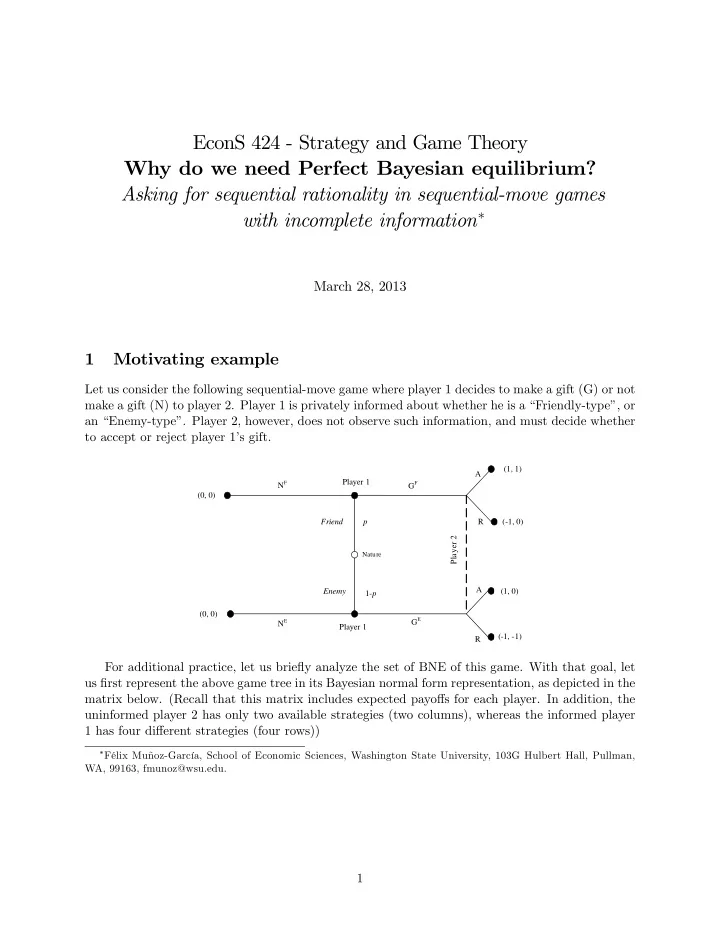
Let us consider the following sequential-move game where player 1 decides to make a gift (G) or not make a gift (N) to player 2. Player 1 is privately informed about whether he is a “Friendly-type”, or an “Enemy-type”. Player 2, however, does not observe such information, and must decide whether to accept or reject player 1’s gift.

(0, 0) (0, 0)

Nature

Friend NF p 1-p (1, 1) (-1, 0) (1, 0) (-1, -1) Player 1 Player 1 Player 2 Enemy GF NE GE A A R R

For additional practice, let us brie‡y analyze the set of BNE of this game. With that goal, let us …rst represent the above game tree in its Bayesian normal form representation, as depicted in the matrix below. (Recall that this matrix includes expected payo¤s for each player. In addition, the uninformed player 2 has only two available strategies (two columns), whereas the informed player 1 has four di¤erent strategies (four rows))

Félix Muñoz-García, School of Economic Sciences, Washington State University, 103G Hulbert Hall, Pullman,

WA, 99163, fmunoz@wsu.edu.

1

slide-2
SLIDE 2

Player 2 A R GF GE 1;p 1; p 1 Player 1 GF NE p;p p; 0 NF GE 1 p; 0 p 1; p 1 NF NE 0;0 0;0

Bayesian normal form representation

Underlining expected payo¤s in order to identify each player’s best response, we can conclude that there are two BNE in this game: (GF GE,A) and (NF NE,R). But, one second, is the BNE (NF NE,R) sequentially rational for player 2? No!! In this strategy pro…le, no type of sender makes a gift in equilibrium. Hence, if a gift is ever observed (a surprising event, that only happens o¤-the-equilibrium path), the receiver will compare the expected utility of accepting and rejecting the gift, based on the o¤-the-equilibrium belief , which denotes the probability that such a surprising gift originates from a friendly type, i.e., probability of being in the top right-hand node of the game tree. In particular, the receiver …nds that EU2(A) = 1 + 0(1 ) = , and EU2(R) = 0 + (1)(1 ) = 1 Hence, player 2 accepts the gift since > 1 ( ) 0 > 1. Importantly, this acceptance holds for any arbitrary o¤-the-equilibrium beliefs, , that player 2 might sustain upon observing a gift. Therefore, the gift rejection that the BNE (NF NE,R) prescribes cannot be sequentially rational.

2 Demanding sequential rationality to the BNEs

Can we …nd some equilibrium concept that selects equilibria predicting actions that are sequentially rational for all players, at any information set they are called to move? Yes, the Perfect Bayesian Equilibrium (PBE), which we analyze next. First, however, we must precisely de…ne three concepts that must be satis…ed in any PBE.

2.1 Conditional beliefs about types

First, note that player 2’s initial beliefs about player 1’s type coincide with nature’s probability distribution p (which we refer as prior probabilities). But when player 2 observes player 1’s action, player 2 might learn something about player 1’s type through his decisions. We say that player 2 updates his beliefs about player 1’s type. Example: If P2 thinks that P1’s optimal actions are NF and GE, and he observes that P1 is sending a gift, it must be that such gift only comes from the Enemy type (see …gure below, with shaded branches for NF and GE). In terms of notation, we say that P2’s beliefs are (FriendjG) = 0, where (FriendjG) denotes the probability that player 2 believes to be in the top right-hand node (receving a gift from a Friend) conditional on that information set being reached (i.e., conditional

  • n receiving a gift).

2

slide-3
SLIDE 3

(0, 0) (0, 0)

Nature

Friend NF p 1-p (1, 1) (-1, 0) (1, 0) (-1, -1) Player 1 Player 1 Player 2 Enemy GF NE GE A A R R

2.2 Sequential rationality in an incomplete information environment

We already encountered sequential rationality in SPNE, but now we apply it to games with incom- plete information: at every information set at which every player is called to move, every player chooses the strategy that maximizes his expected utility level, given that all other players will do the same, and given his own beliefs about the other players’ types. Example: Player 2 accepts a gift if and only if EU2(A) > EU2(R). That is, if 1 + 0(1 ) > 0 + (1)(1 )

  • >

1 which holds for all , since 2 [0; 1] by de…nition. [Note that in other exercises, we could be …nding a cuoto¤ rule, i.e., player 2 prefering to accept if is relatively high, e.g., > 2

3, but reject

  • therwise.]

2.3 Consistency of beliefs

Let us denote by F the probability that player 1 plays GF , and by E the probability that player 1 plays GE. Then, player 2’s belief that the gift coming from player 1 is in fact coming from a Friendly type, , can be expressed as = pF pF + (1 p)E That is, player 2’s beliefs are de…ned by the probability that a player 1 is a friendly type and he makes a gift, pF , over the probability that player 1 is a friendly type and makes a gift in addition to the probability that player 1 is an enemy type and makes also a gift. In other words, we divide the probability that player 1 is a friendly type and makes a gift, pF , over the probability that any type player 1 (friend or enemy) makes a gift. Hence, the consistency requirement that we imposse

  • n beliefs is that beliefs must be found by using Bayes’ rule. You may have seen this rule about

conditional probabilities in you Stats class. Don’t worry, we will just use it in the way that it is speci…ed above. Next, I present one example. 3

slide-4
SLIDE 4

Example: Let us assume that p = 1

2, F = 1 8 and E = 1 16.. Then, player 2’s posterior beliefs

about P1 being a Friend after receiving a gift, , are = pF pF + (1 p)E =

1 2 1 8 1 2 1 8 + 1 2 1 16

= 2 3 A few notes about o¤-of-equilibrium beliefs: a) If player 2’s information set is not reached (what can only happen in this example if both types of player 1 choose to make no gifts), then the denominator in the above formula for Bayes’ rule is zero (i.e., the probability of receiving a gift from any type of player 1 is zero, since F = 0 and E = 0). This makes to be indeterminate, since it especi…cally becomes

  • 0. In these cases, we are allowed to arbitrarily specify the value of (any value between zero

and one, 2 [0; 1]). We will describe how to do it as generally as possible in worked-out exercises next. b) In this case, we refer to as “o¤-of-equilibrium” beliefs, since it speci…es beliefs about the probability of being in a node belonging to an information set that is actually unreached in

  • equilibrium. In the above example, when both types of player 1 choose not to make a gift,

then player 2’s information set is never reached (i.e., it is an o¤-of-equilibrium event). Hence, in this case would specify o¤-of-equilibrium beliefs, and it can be arbitrarily speci…ed, i.e., 2 [0; 1]. c) Why do we care about o¤-of-equilibrium beliefs? Because they determine what P2 does in the event of receiving a gift. This can induce P1 to make gifts (or deter him from doing so), thereby a¤ecting our equilibrium results.

3 Perfect Bayesian Equilibrium

We are now ready to combine the above 3 requirements for a PBE into its de…nition. De…nition of PBE. A strategy pro…le for all players (s1; s2; :::; sN) and beliefs over the nodes at all information sets are a PBE if: a) Each player’s strategies specify optimal actions, given the strategies of the other players, and given his beliefs. b) The beliefs are consistent with Bayes’ rule, whenever possible. Note that the …rst bit of condition (a): “Each player’s strategies specify optimal actions, given the strategies of the other players” resembles the condition for players’ best responses in the de…- nition of NE, whereas the last bit of this condition “...given his beliefs” resembles the de…nition of BNE for incomplete information games. Finally, note that condition (b) states that beliefs must be consistent with Bayes’ rule “whenever possible”. In particular, this last element of condition (b) is related with the previous note about o¤-of-equilibrium beliefs. Indeed, it is possible to spec- ify beliefs which are consistent with Bayes’ rule only when we are dealing with information sets that are reached in equilibrium. However, when we are in information sets that are unreached in equilibrium, Bayes’ rule cannot be applied; and beliefs must be arbitrarily determined. 4

slide-5
SLIDE 5

We will encounter di¤erent types of PBE. In a separating PBE di¤erent types of the privately informed player (e.g., player 1) behave di¤erently. For instance, the friendly type makes gifts whereas the enemy type does not. In contrast, in the pooling PBE all types of the privately informed player behave similarly, e.g., all types of P1 make gifts. Procedure to …nd PBE:1

  • 1. Specify a pro…le of actions for the player with types (informed player 1), either separating or

pooling. In our above example, there can only be four possible pro…les of actions for player 1: two separating strategy pro…les, NF GE and GF F E, and two pooling strategy pro…les, GF GE and NF NE.

  • 2. Calculate the receiver’s beliefs (the beliefs of the uninformed agent) using Bayes’ rule at all

information sets, both in-equilibrium and out-of-equilibrium. In our above example, we only need to specify beliefs in one information set (that arising after player 2 receives a gift). Note however that this information set can either be reached in equilibrium (implying that speci…es equilibrium beliefs) or not be reached in equilibrium (implying that speci…es o¤-the-equilibrium beliefs).

  • 3. Given from the previous step, …nd the optimal action (the optimal action of the uninformed

player (player 2), i.e., player 2’s optimal response given his beliefs about the type of P1 he faces.

  • 4. Given the optimal action of the uninformed player, …nd the optimal action for the informed

player.

  • 5. Then check if this action pro…le for P1 coincides with the pro…le you suggested on step 1. If

this is the case, then this strategy pro…le and beliefs can be supported as a PBE of the game. Otherwise, we say that this strategy pro…le cannot be sustained as a PBE of the game.

1You can …nd a more detailed description of this producedure on the short paper posted on the course website

“A systematic procedure for …nding Perfect Bayesian Equilibria in Incomplete Information Games.” Here is the link: faculty.ses.wsu.edu/Munoz/Teaching/EconS491_Spring2011/Slides/Procedure_to_…nd_PBEs_June_2012.pdf

5

slide-6
SLIDE 6

4 Worked-out Example

4.1 Separating equilibrium with N FGE

  • 1. We …rst specify the pro…le of actions NF GE for the informed player 1, i.e., player 1 makes

gifts as an enemy but does not make gifts as a friend. For easy reference, the next …gure shades the path NF GE that this separating strategy pro…le describes.

(0, 0) (0, 0)

Nature

Friend NF p 1-p (1, 1) (-1, 0) (1, 0) (-1, -1) Player 1 Player 1 Player 2 Enemy G

F

NE GE A A R R

  • 2. We can now update player 2’s beliefs by using Bayes’ rule: Since a gift can only come from

an Enemy in this separating equilibrium, = pF pF + (1 p)E = p0 p0 + (1 p)1 = 1 p = 0

  • 3. Optimal action for the responder (player 2) is to choose A, since he puts full probability to

the event that he is called to move at the lower node of the information set, i.e., 0 > 1. We can now shade the branch labelled with A for player 2 (do it!!). Note that, since player 2 cannot distinguish player 1’s type, he accepts any gift made to him, which graphically implies that we must shade branch A both in the upper and lower node.

  • 4. Given player’s optimal action (accept), we can now move to the informed player. If player 2

accepts the gift, then player 1’s optimal action is to make a gift when he is a Friendly type, i.e., GF , since 1 > 0.

  • 5. Therefore, the separating strategy pro…le NF GE, where player 1 makes gifts only when he is

an enemy type, cannot be sustained as a PBE of this game. 6

slide-7
SLIDE 7

4.2 Separating equilibrium with GFN E

  • 1. We …rst specify the pro…le of actions GF NE for the informed player 1, i.e., player 1 makes

gifts as a friend but does not make gifts as an enemy. For easy reference, the next …gure shades the path GF NE that this separating strategy pro…le describes.

(0, 0) (0, 0)

Nature

Friend NF p 1-p (1, 1) (-1, 0) (1, 0) (-1, -1) Player 1 Player 1 Player 2 Enemy G

F

NE GE A A R R

  • 2. We can now update player 2’s beliefs by using Bayes’ rule: Since a gift can only come from

an Friend in this separating equilibrium, = pF pF + (1 p)E = p1 p1 + (1 p)0 = p p = 1

  • 3. Optimal action for the responder (player 2) is to choose A, since he puts full probability to

the even that he is called to move at the upper node of the information set, i.e., 1 > 0. We can now shade the branch labelled with A for player 2 (do it!!). Note that, since player 2 cannot distinguish player 1’s type, he accepts any gift made to him, which graphically implies that we must shade branch A both in the upper and lower node.

  • 4. Given player’s optimal action (accept), we can now move to the informed player. If player

2 accepts the gift, then player 1’s optimal action is to send a gift both when he is a Friend (1>0) and when he is an Enemy (1>0), i.e., GF GE.

  • 5. Then, the separating strategy pro…le GF NE; where player 1 makes gifts only when he is a

friendly type, cannot be sustained as a PBE of this game either. 7

slide-8
SLIDE 8

4.3 Pooling equilibrium with GFGE

  • 1. We …rst specify the pooling pro…le of actions GF GE for the informed player 1, i.e., player 1

makes gifts both as a friend and as an enemy. For easy reference, the next …gure shades the path GF GE that this pooling strategy pro…le describes.

(0, 0) (0, 0)

Nature

Friend NF p 1-p (1, 1) (-1, 0) (1, 0) (-1, -1) Player 1 Player 1 Player 2 Enemy G

F

NE GE A A R R

  • 2. Update player 2’s beliefs by using Bayes’ rule: Since a gift can come from any type of player

in this pooling equilibrium, observing a gift does not give player 2 any additional information about the actual type of player 1 he faces. Indeed, using Bayes’ rule it is easy to check that player 2’s posterior probability (his beliefs) coincide with the prior probability that player 1 is a Friendly type. = pF pF + (1 p)E = p1 p1 + (1 p)1 = p p + 1 p = p

  • 3. Optimal action for the responder (player 2) must be found by calculating player 2’s expected

utility from accepting and rejecting EU2(A) = 1p + 0(1 p) = p, and EU2(R) = 0p + (1)(1 p) = p 1 Hence, player 2 accepts the gift since p > p 1 for any value of p. We can now shade the branch labelled with A for player 2 (do it!!). Note that, since player 2 cannot distinguish player 1’s type, he accepts any gift made to him, which graphically implies that we must shade branch A both in the upper and lower node.

  • 4. Given player’s optimal action (accept), we can now move to the informed player. Since player

2 accepts the gift, player 1’s optimal action is to make a gift both when he is a Friend (1>0) and when he is an Enemy (1>0), i.e., GF GE.

  • 5. Therefore, the pooling strategy pro…le GF GE; where both types of player 1 make gifts, can

be supported as a PBE of this game. 8

slide-9
SLIDE 9

4.4 Pooling equilibrium with N FN E

  • 1. We …rst specify the pooling pro…le of actions NF NE for the informed player 1, i.e., player

1 makes no gifts regardless of his type. For easy reference, the next …gure shades the path NF NE that this pooling strategy pro…le describes.

(0, 0) (0, 0)

Nature

Friend NF p 1-p (1, 1) (-1, 0) (1, 0) (-1, -1) Player 1 Player 1 Player 2 Enemy G

F

NE GE A A R R

  • 2. Update player 2’s beliefs by using Bayes’ rule: Since a gift is never observed in this pooling

strategy pro…le, Bayes’ rule is undetermined in this case (denominator is zero). = pF pF + (1 p)E = p0 p0 + (1 p)0 = 0 0 = ) 2 [0; 1] Receiving a gift in this case is considered and out-of-equilbrium event. As a result, can be arbitrarily speci…ed in 2 [0; 1].

  • 3. Optimal action for the responder (player 2) must be found by calculating player 2’s expected

utility from accepting and rejecting (given a general value of , which speci…es his out-of- equilibrium beliefs) EU2(A) = 1 + 0(1 ) = , and EU2(R) = 0 + (1)(1 ) = 1 Hence, player 2 accepts the gift since > 1 is satis…ed for any value of . We can now shade the branch labelled with A for player 2 (do it!!). Note that, since player 2 cannot distinguish player 1’s type, he accepts any gift made to him, which graphically implies that we must shade branch A both in the upper and lower node.

  • 3. Given player’s optimal action (accept), we can now move to the informed player. Since player

2 accepts the gift, then player 1’s optimal action is to send a gift both when he is a Friend, GF , and when he is an Enemy, GE.

  • 4. Therefore, the pooling strategy pro…le NF NE; where no type of player 1 makes gifts, cannot

be supported as a PBE of this game. 9