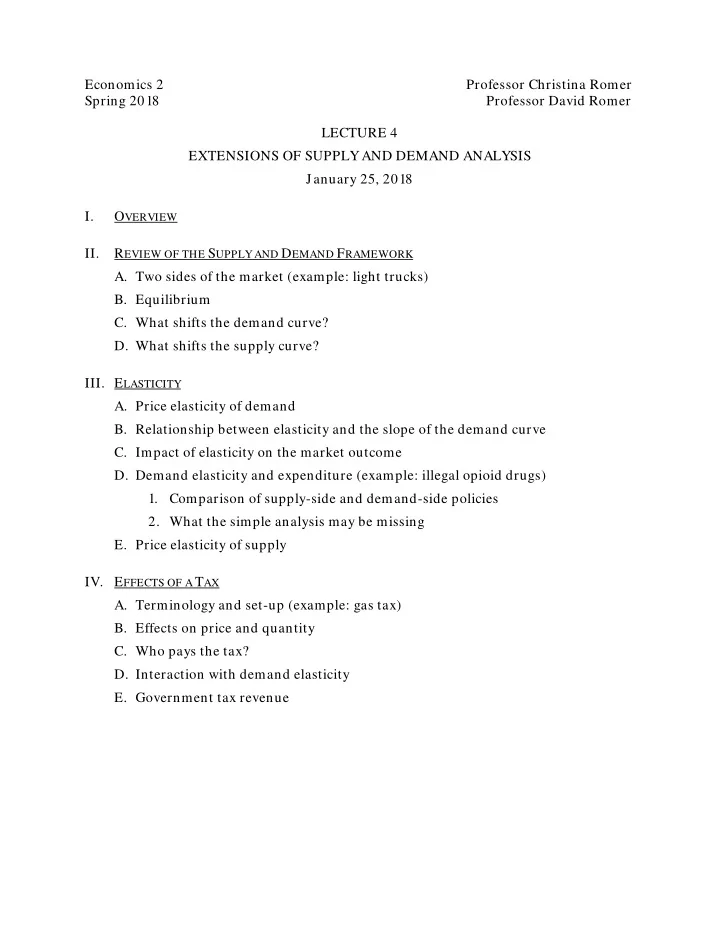
SLIDE 1 Economics 2 Professor Christina Romer Spring 2018 Professor David Romer LECTURE 4 EXTENSIONS OF SUPPLY AND DEMAND ANALYSIS January 25, 2018 I. OVERVIEW
- II. REVIEW OF THE SUPPLY AND DEMAND FRAMEWORK
- A. Two sides of the market (example: light trucks)
- B. Equilibrium
- C. What shifts the demand curve?
- D. What shifts the supply curve?
- III. ELASTICITY
- A. Price elasticity of demand
- B. Relationship between elasticity and the slope of the demand curve
- C. Impact of elasticity on the market outcome
- D. Demand elasticity and expenditure (example: illegal opioid drugs)
- 1. Comparison of supply-side and demand-side policies
- 2. What the simple analysis may be missing
- E. Price elasticity of supply
- IV. EFFECTS OF A TAX
- A. Terminology and set-up (example: gas tax)
- B. Effects on price and quantity
- C. Who pays the tax?
- D. Interaction with demand elasticity
- E. Government tax revenue
SLIDE 2 LECTURE 4
Extensions of Supply and Demand Analysis
January 25, 2018
Economics 2 Christina Romer Spring 2018 David Romer
SLIDE 3 Announcements
- Problem Set 1 is due next Tuesday (January 30).
- Problem Set Work Session this afternoon (Jan. 25)
- 4:00–6:00 in 648 Evans Hall
- Ground Rules:
- Answers must be in your own words,
handwritten, and with acknowledgements to the people you worked with.
- Graded on a scale of 1 to 10.
SLIDE 4 Announcements
- Collecting the Problem Sets:
- They are due at the beginning of lecture.
- We will have boxes with your GSIs’ names on
them in the middle of the lecture hall (both sides).
SLIDE 5 Announcements
- Journal article reading for Tuesday (by Esther Duflo):
- You can access for free through any campus
computer, or from off campus using the library proxy (see http://www.lib.berkeley.edu/using- the-libraries/connect-off-campus).
- Don’t stress over every word or parts you don’t
understand.
- Read for approach and findings; think about
relevance to consumer behavior.
SLIDE 7 Plan for the Lecture
- Review the supply and demand framework.
- Discuss elasticity.
- Examine the effect of another government
intervention in the market (a tax).
SLIDE 8
- II. REVIEW OF SUPPLY AND DEMAND
SLIDE 9
Equilibrium in the Market for Light Trucks
Q P
SLIDE 10
What Causes the Demand Curve to Shift?
SLIDE 11 Retail Price of Gasoline
Source: Bureau of Labor Statistics.
100 150 200 250 300 350 400 2011-01 2011-07 2012-01 2012-07 2013-01 2013-07 2014-01 2014-07 2015-01 2015-07 2016-01 2016-07 2017-01 2017-07
Index, 1982-84 = 100
SLIDE 12 Effect of a Fall in the Price of Gasoline
- n the Demand for Light Trucks
D1 Q P S1 P1 Q1
SLIDE 13 Source: Trucks.com
Growth of Light Trucks
SLIDE 14
What Causes the Supply Curve to Shift?
SLIDE 15 Producer Price Index for Iron and Steel
150 170 190 210 230 250 270 2012-01 2012-07 2013-01 2013-07 2014-01 2014-07 2015-01 2015-07 2016-01 2016-07 2017-01 2017-07
Index, 1982=100
Source: Bureau of Labor Statistics.
SLIDE 16 Effect of a Fall in the Price of Steel
- n the Supply of Light Trucks
D1 Q P S1 P1 Q1
SLIDE 18
Price Elasticity of Demand (εD)
Percentage change in quantity demanded εD = Percentage change in price (In absolute value) Elastic
εD > 1
Inelastic
εD < 1
Perfectly inelastic
εD = 0
Perfectly elastic
εD = ∞
SLIDE 19
Relationship between Demand Elasticity and the Slope of the Demand Curve ΔQD / QD εD = ΔP / P
ΔQD P
= • ΔP QD
1 P
= • Slope QD
SLIDE 20
Slope of the Demand Curve
Q P D
1 P
εD = •
Slope QD
SLIDE 21
Demand Curves
Q P Q P Inelastic Elastic
1 P
εD = •
Slope QD
SLIDE 22
Demand Elasticity Matters for Market Outcomes
Q P Q P Inelastic Elastic D1 D1 P1 Q1 S1 P1 Q1 S1
SLIDE 23
Demand Elasticity Matters for Market Outcomes
SLIDE 24 Source: National Institute on Drug Abuse; Center for Disease Control.
SLIDE 25
Market for Illegal Opioid Drugs
Q P
Market for Illegal Opioid Drugs
SLIDE 26
Market for Illegal Opioid Drugs (Supply Restriction)
D1 Q P S1 P1 Q1
SLIDE 27 Total Expenditure Total Expenditure = Price • Quantity
- Total expenditure and total revenue are the same
thing.
SLIDE 28 Demand Elasticity and Expenditure
- Inelastic (εD < 1): Total expenditure rises when the
supply curve shifts back.
- Elastic (εD > 1): Total expenditure falls when the
supply curve shifts back.
SLIDE 29
Market for Illegal Opioid Drugs (Increased Drug Treatment)
D1 Q P S1 P1 Q1
SLIDE 30
What are some of the complexities that we are ignoring with this analysis?
SLIDE 31
Price Elasticity of Supply (εS) Percentage change in quantity supplied
εS = Percentage change in price Elastic
εS > 1
Inelastic
εS < 1
Perfectly inelastic
εS = 0
Perfectly elastic
εS = ∞
SLIDE 32
Supply Curves
Q P Q P Inelastic Elastic
SLIDE 34
Effect of a New 50¢ per Gallon Tax on Gasoline (Levied on Sellers)
D1 Q P S1 P1 Q1
SLIDE 35
Typical Effects of a Tax
SLIDE 36 Demand Elasticity and the Effects of a Tax
Inelastic Elastic Q P Q P D1 D1
P1 Q1
S1
P1 Q1
S1 S2 S2
Tax Tax
SLIDE 37 Two Ways of Visualizing Tax Revenues
(1) (2) Q P Q P D1
P2 Q2
S1
P2 Q2
S1 S2 S2
Tax Tax
P2−tax
D1
SLIDE 38
Demand Elasticity and the Effects of a Tax