Economics 2 Professor Christina Romer Spring 2018 Professor David - - PDF document

economics 2 professor christina romer spring 2018
SMART_READER_LITE
LIVE PREVIEW

Economics 2 Professor Christina Romer Spring 2018 Professor David - - PDF document

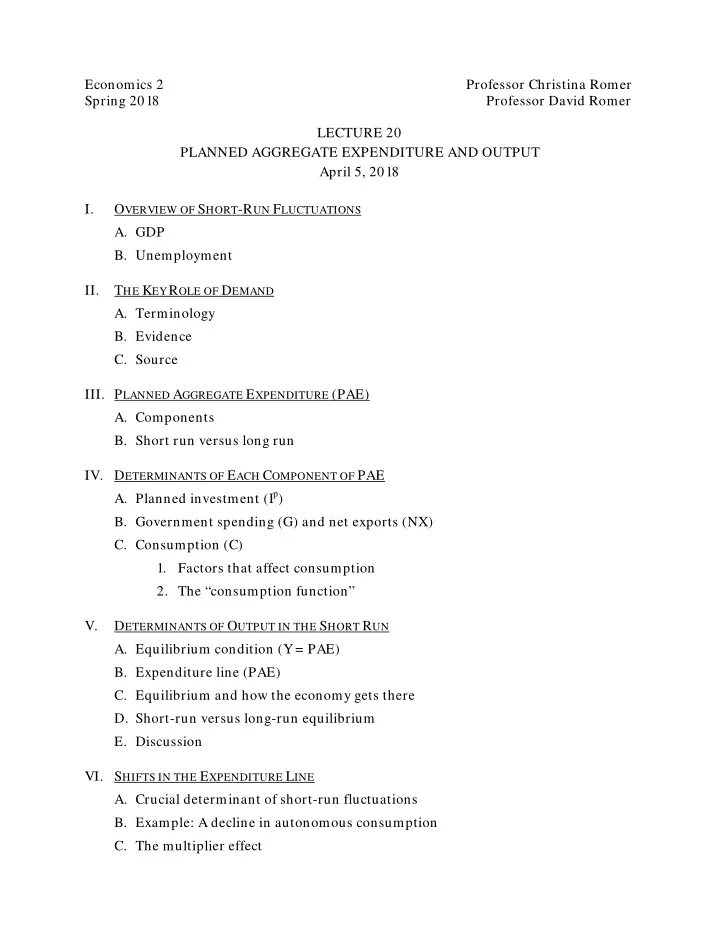
Economics 2 Professor Christina Romer Spring 2018 Professor David Romer LECTURE 20 PLANNED AGGREGATE EXPENDITURE AND OUTPUT April 5, 2018 I. O VERVIEW OF S HORT -R UN F LUCTUATIONS A. GDP B. Unemployment II. T HE K EY R OLE OF D EMAND A.


slide-1
SLIDE 1

Economics 2 Professor Christina Romer Spring 2018 Professor David Romer LECTURE 20 PLANNED AGGREGATE EXPENDITURE AND OUTPUT April 5, 2018 I. OVERVIEW OF SHORT-RUN FLUCTUATIONS

  • A. GDP
  • B. Unemployment
  • II. THE KEY ROLE OF DEMAND
  • A. Terminology
  • B. Evidence
  • C. Source
  • III. PLANNED AGGREGATE EXPENDITURE (PAE)
  • A. Components
  • B. Short run versus long run
  • IV. DETERMINANTS OF EACH COMPONENT OF PAE
  • A. Planned investment (Ip)
  • B. Government spending (G) and net exports (NX)
  • C. Consumption (C)
  • 1. Factors that affect consumption
  • 2. The “consumption function”

V. DETERMINANTS OF OUTPUT IN THE SHORT RUN

  • A. Equilibrium condition (Y = PAE)
  • B. Expenditure line (PAE)
  • C. Equilibrium and how the economy gets there
  • D. Short-run versus long-run equilibrium
  • E. Discussion
  • VI. SHIFTS IN THE EXPENDITURE LINE
  • A. Crucial determinant of short-run fluctuations
  • B. Example: A decline in autonomous consumption
  • C. The multiplier effect
slide-2
SLIDE 2

LECTURE 20

Planned Aggregate Expenditure and Output

April 5, 2018

Economics 2 Christina Romer Spring 2018 David Romer

slide-3
SLIDE 3

Announcements

  • We have handed out Problem Set 5.
  • It is due at the start of lecture on Thursday,

April 12th.

  • Problem set work session next Monday, April

9th, 6:00–8:00 p.m. in 648 Evans.

  • Research paper reading for next time.
  • Romer and Romer, “The Macroeconomic

Effects of Tax Changes.”

slide-4
SLIDE 4
  • I. OVERVIEW OF SHORT-RUN FLUCTUATIONS
slide-5
SLIDE 5

Real GDP in the United States, 1950–2017

Source: FRED (Federal Reserve Economic Data); data from Bureau of Economic Analysis.

slide-6
SLIDE 6

Short-Run Fluctuations

  • Times when output moves above or below

potential (booms and recessions).

  • Recessions are costly and very painful to the

people affected.

slide-7
SLIDE 7

The U.S. Unemployment Rate, 1948–2018

Source: FRED; data from Bureau of Labor Statistics.

slide-8
SLIDE 8

Real GDP Growth (Percent, Red) and Change in the

  • Unemp. Rate (Percentage Points, Blue), 1961–2017

Source: FRED; data from Bureau of Economic Analysis and Bureau of Labor Statistics.

slide-9
SLIDE 9
  • II. THE KEY ROLE OF DEMAND
slide-10
SLIDE 10

Key Determinant of Output in the Short Run

  • In the short run, aggregate output is determined

by demand.

  • Three terms that mean the same thing:
  • Planned aggregate expenditure
  • Planned spending
  • Planned aggregate demand
  • All three terms refer to the total amount that

people in the economy plan to buy (or spend).

slide-11
SLIDE 11

Evidence on the Key Role of Demand

  • Historical experience.
  • Academic research.
slide-12
SLIDE 12

Why is Output Determined by Demand in the Short Run?

  • Nominal rigidities (inflation doesn’t change

substantially in the short run).

  • Due to limited information, menu costs, long-term

contracts, or other factors.

slide-13
SLIDE 13
  • III. PLANNED AGGREGATE EXPENDITURE
slide-14
SLIDE 14

Components of Planned Aggregate Expenditure (PAE)

  • Consumption (C)
  • Planned investment (Ip)
  • Government purchases (G)
  • Net exports (NX)

PAE = C + Ip + G + NX

slide-15
SLIDE 15

Short Run versus Long Run

  • In the short run:
  • PAE can be more than, less than, or equal to

Y*.

  • Output responds to match PAE.
  • In the long run:
  • Output is at Y* (determined by normal

technology, capital, and employment).

  • PAE adjusts to equal Y*.
  • Movement in r brings this about.
slide-16
SLIDE 16
  • IV. DETERMINANTS OF EACH COMPONENT OF PAE
slide-17
SLIDE 17

Determinants of Planned Investment (Ip)

  • Real interest rate (r).
  • Expectations (“animal spirits”).
  • We talk about “planned investment” because we

are leaving out the unplanned investment in inventories that happens when PAE is different from actual output.

slide-18
SLIDE 18

Determinants of Government Purchases (G)

  • Politics.
  • Wars, natural disasters.

We take G as given.

slide-19
SLIDE 19

Determinants of Net Exports (NX)

  • For now we are assuming they are just given.
  • Will discuss the economic determinants later in

the course.

slide-20
SLIDE 20

Determinants of Consumption (C)

  • Real interest rate (r): A rise in the real interest rate

reduces consumption.

  • Expectations (“consumer confidence”)
  • Wealth: A rise in wealth increases consumption.
  • Disposable income (Y − T): A rise in disposable

income increases consumption (but by less than the amount of the increase in disposable income).

slide-21
SLIDE 21

Consumption and Disposable Income

  • Aggregate income: Same as aggregate output (Y)
  • Aggregate tax payments: Same as government tax

revenues (T)

  • Aggregate disposable income: Y−T
  • Consumption function: C = f(Y−T)
  • Sometimes written in the particular form:

C = C + c·(Y−T) (where C is positive and c is between 0 and 1)

slide-22
SLIDE 22

Consumption Function C = C + c·(Y−T)

slope = c Y−T C C C

slide-23
SLIDE 23

Consumption Function C = C + c·(Y−T)

  • Autonomous consumption: The part of

consumption that does not vary with income (C).

  • Marginal propensity to consume (MPC): The

change in planned consumption due to a change in disposable income (c).

slide-24
SLIDE 24

Consumption and Disposable Income

Source: Frank, Bernanke, Antonovics, and Heffetz, “Principles of Economics.”

slide-25
SLIDE 25
  • V. DETERMINATION OF OUTPUT IN THE SHORT RUN
slide-26
SLIDE 26

45-degree Line

  • Captures the equilibrium condition that Y = PAE.
  • Also reflects the empirical/behavioral reality that
  • utput responds to planned spending in the short

run.

slide-27
SLIDE 27

45-degree Line

PAE Y Y=PAE 45°

slide-28
SLIDE 28

Expenditure Line

  • Captures the fact that planned aggregate spending

is a function of total income (which is the same as total output).

  • PAE = C + Ip + G + NX, where C = f(Y−T).
slide-29
SLIDE 29

Expenditure Line

Y C PAE = C + Ip + G + NX PAE

The slope of the expenditure line (PAE) is the MPC.

slide-30
SLIDE 30

Determination of Output in the Short Run

  • Output in the short run is determined by the

intersection of the 45-degree line and the expenditure line.

slide-31
SLIDE 31

Determination of Short-Run Output

Y PAE PAE Y=PAE Y1

Sometimes called the “Keynesian Cross” diagram.

slide-32
SLIDE 32

How does the economy get to short-run equilibrium? Y PAE PAE Y=PAE Y1 Y3 Y2

At Y2, unintended inventory investment leads firms to cut production. At Y3, unintended negative inventory investment leads firms to increase production.

slide-33
SLIDE 33

Long-Run Equilibrium

Y PAE PAE Y=PAE Y*

In the long run, PAE=Y and PAE cross at Y* (potential output).

slide-34
SLIDE 34
  • VI. SHIFTS IN THE EXPENDITURE LINE
slide-35
SLIDE 35

Crucial Determinant of Short-Run Fluctuations: Shifts in the Expenditure Line

  • Expenditure line (PAE) shows how planned

spending varies with output.

  • Anything that changes planned spending other

than output, will shift the curve.

  • If the expenditure line shifts, short-run

equilibrium output will change.

slide-36
SLIDE 36

Example: A Fall in Autonomous Consumption

  • A fall in consumption not caused by a fall in
  • utput.
  • A decline in the intercept of the consumption

function (C).

slide-37
SLIDE 37

Great Crash of the Stock Market in October 1929

Source: Federal Reserve Bank of St. Louis, FRED.

50 100 150 200 250 300 350 400

Dec-14 Dec-15 Dec-16 Dec-17 Dec-18 Dec-19 Dec-20 Dec-21 Dec-22 Dec-23 Dec-24 Dec-25 Dec-26 Dec-27 Dec-28 Dec-29 Dec-30 Dec-31 Dec-32 Dec-33 Dec-34 Dec-35

Dow Jones Industrial Average (Index) September 1929

slide-38
SLIDE 38

Why Might a Fall in Stock Prices Reduce Consumer Spending (at a Given Level of Output)?

  • Reduction in wealth makes consumers feel poorer.
  • Fall in stock prices makes consumers pessimistic

(lowers consumer confidence).

  • Stock price volatility causes uncertainty and leads

to “wait and see” behavior.

slide-39
SLIDE 39

The Collapse of Consumer Spending in Late 1929

Source: Christina Romer, “The Great Crash and the Onset of the Great Depression.”

slide-40
SLIDE 40

A Fall in Autonomous Consumption

Y−T C C1 C1 C2 C2

slide-41
SLIDE 41

A Fall in Autonomous Consumption

Y PAE1 PAE Y=PAE Y* PAE2 Y2

slide-42
SLIDE 42

Real GDP, 1909–1939

Source: Christina Romer, “The Prewar Business Cycle Reconsidered,” and BEA.

400 500 600 700 800 900 1000 1100 1200 1300

1909 1911 1913 1915 1917 1919 1921 1923 1925 1927 1929 1931 1933 1935 1937 1939

Real GDP in Chained 2009 Dollars

1929

slide-43
SLIDE 43

The Multiplier Effect

Y PAE1 PAE Y=PAE Y* PAE2 Y2

The initial drop in PAE is magnified by the fact that as Y declines, C declines further.

Initial drop in PAE due to the drop in C Decline in Y is larger because

  • f the multiplier effect
slide-44
SLIDE 44

Multiplier Effect

  • A change in PAE changes output by more than the

initial change in PAE.

  • Why? Because changes in output affect consumer

spending and reinforce (or multiply) the initial change in PAE.

  • Existence of the multiplier effect explains why

moderate changes in planned spending cause more substantial changes in output.