EBW-Bootstrap Current Synergy in NSTX R.W. Harvey(CompX) and G. - - PowerPoint PPT Presentation

ebw bootstrap current synergy in nstx
SMART_READER_LITE
LIVE PREVIEW

EBW-Bootstrap Current Synergy in NSTX R.W. Harvey(CompX) and G. - - PowerPoint PPT Presentation

EBW-Bootstrap Current Synergy in NSTX R.W. Harvey(CompX) and G. Taylor(PPPL) STW2004, Kyoto, Sept 29-Oct 1, 2004 EBW presents near ideal conditions for enhanced BSCD by RF induced pitch angle scattering, particularly in Spherical Tori A


slide-1
SLIDE 1

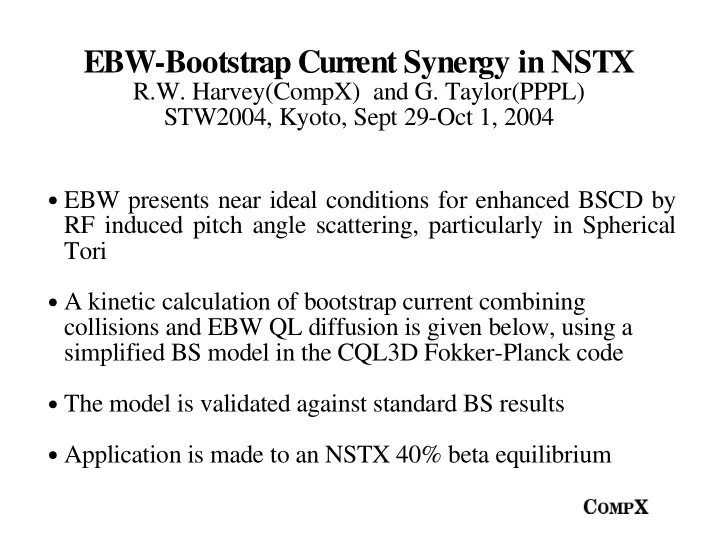
EBW-Bootstrap Current Synergy in NSTX

R.W. Harvey(CompX) and G. Taylor(PPPL) STW2004, Kyoto, Sept 29-Oct 1, 2004

  • EBW presents near ideal conditions for enhanced BSCD by

RF induced pitch angle scattering, particularly in Spherical Tori

  • A kinetic calculation of bootstrap current combining

collisions and EBW QL diffusion is given below, using a simplified BS model in the CQL3D Fokker-Planck code

  • The model is validated against standard BS results
  • Application is made to an NSTX 40% beta equilibrium
slide-2
SLIDE 2

Bootstrap Current Model, and Validation

Simple model of bootstrap based on physical picture:

  • At each radius there is a net magnetization current: co-current producing particles have average

position one-half banana width inwards, whereas counter current producing particles have average position shifted outwards ==> (due to density gradients)

  • Detrapping of the plasma particles (collisions, rf) ==> source in transitting particles, amplifying j_

{banana} to give bootstrap current

  • The CQL3D Fokker-Planck code (otherwise zero-banana) implements this model by connecting

co/counter-current passing particles to trapped particles displaced 1/2 banana inwards/outwards. Validation of simplified kinetic model of BS current:

CQL3D and accurate Sauter (PoP,'99) results agree well over outer half of ST. (Inside eps=0.3, Westerhof (CPC, '96) found refinements again giving good agreement.)

slide-3
SLIDE 3

3rd Harm absorp 3rd Harm 2nd Harm

Neg elec current ==> Positive current j due to the Ohkawa CD effect.

slide-4
SLIDE 4

EBWCD, 1MW, Bootstrap Model Off

  • Ninety percent of the EBWCD

is in the near-Maxwellian region at v < 3.5 v_te.

  • Collisions dominate the RF.
  • No substantial EBW Synergy at

this RF level (and plasma density).

slide-5
SLIDE 5

1MW EBW, Bootstrap Model On

NT energy due to EBW Plasma energy vs radius

  • Enhanced RF pitch angle scattering would yield BS current which is

symmetric about the RF heating region.

  • A this 1 MW level, Syn BS current is anti-symmetric, therefore due to the

locally enhanced plasma pressure.

  • (At 4 MW, 10% symmetric increase in net Syn BS current is obtained.)

EBW EBW+Syn BS Syn BS

slide-6
SLIDE 6

Summary of Co-Current Cases

slide-7
SLIDE 7

Summary of Counter-Current Cases

slide-8
SLIDE 8

Summary of Balanced-Injection Cases

slide-9
SLIDE 9

Conclusions

  • A 40% beta NSTX discharge has been investigated computationally

for evidence of BSCD due to EBW enhanced pitch angle scattering.

  • The effect of RF pitch angle scattering on BS current is small (<

10%), for up to 4 MW of EBW power.

  • When there is a localized enhancement of plasma pressure due to

EBW heating, anti-symmetric BS will be excited. But this depends

  • n heat transport.
  • POSTSCRIPT: The EBWCD reported here is Ohkawa CD. In

principle[Fisch, RMJ(1987); Harvey&Dendy, PF(1992)], the enhanced trapping gives, in the neoclassical transport picture, a particle pinch and a compensating BSCD due to the modified n_e-

  • profile. (But particle transport is not well understood.)