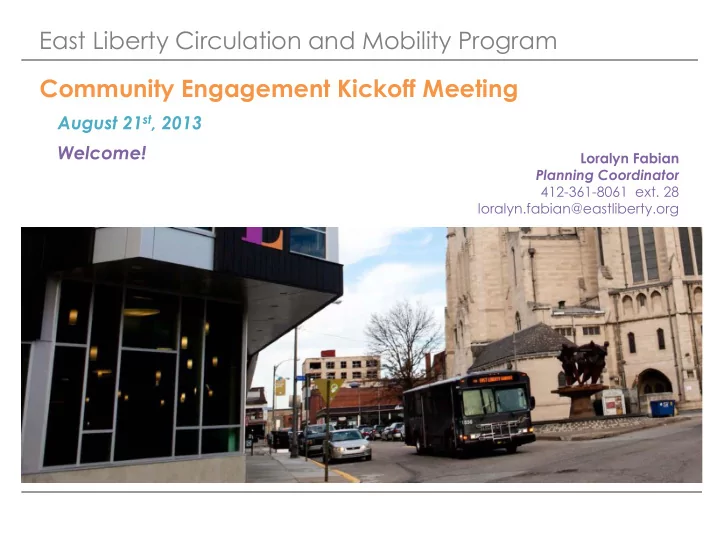
SLIDE 1
Loralyn Fabian Planning Coordinator 412-361-8061 ext. 28 loralyn.fabian@eastliberty.org
East Liberty Circulation and Mobility Program Community Engagement Kickoff Meeting
August 21st, 2013 Welcome!
SLIDE 2 Your host: East Liberty Development, Inc.
- Non-profit, community-based organization here in
East Liberty
- We work alongside many different partners
and stakeholders to help improve the quality of life of the community
Advocacy, Facilitation, and Investment
East Liberty Circulation and Mobility Program
SLIDE 3 What We’re Covering with You Tonight
- Neighborhood updates: new businesses / development projects in the works
- The “Circulation & Mobility” Action Step from the 2010 East Liberty Community Plan
- Moving Action Step forward with a Vision
- Turning Vision into Action – Two priority studies
- Guest speakers on the purpose and process of the studies
- Donald K. Carter – Director of the Remaking Cities Institute; Walkability and Accessibility Study
- Phillip Baron – Walker Parking Consultants; Parking Study
- Q & A with small groups
- East Liberty Circulation and Mobility Program
SLIDE 4 Apparel
- Culture Cloz (117 N. Highland)
- Chemistry (215 N. Highland)
- Kiya Tomlin Boutique (215 N. Highland)
Food and Drink
- Everyday’s a Sundae & Café (6014 Centre)
- Creamy Creations & More (5943 Penn)
- The Livermore (124 S. Highland)
- Notion (126 S. Highland)
- Olive & Marlow (215 N. Highland)
Furniture and Home Goods
- Luxe Home & Design (215 N. Highland)
- TOWNHOUSE (6016 Penn)
Health
- Peace, Love, & Zen Wellness Center
(6023 Broad)
New Businesses East Liberty Circulation and Mobility Program
SLIDE 5
Development Projects East Liberty Circulation and Mobility Program
SLIDE 6
- Clearly a great deal of change will be occurring, over many years, to our
streetscapes and existing parking supply
- Now is the time to work together to ensure that the future public and private
resources that are being invested into the neighborhood will deliver:
- An accessible street system for all;
- And a well-managed parking system
New Development Shapes our Built Environment East Liberty Circulation and Mobility Program
SLIDE 7 2010 East Liberty Community Plan – 1st Call to Action
- “Improve transportation infrastructure
and connectivity to drive development. Priorities include: pedestrian-friendly streetscapes, bicycling amenities, street grid reconnections, intuitive parking, transit-oriented development, and Penn Circle two-way conversion”
- “Enhance the pedestrian, cycling, transit,
and driving experience (in that order) through better streetscape design.”
Action Step: Circulation and Mobility
East Liberty Circulation and Mobility Program
SLIDE 8 2010 East Liberty Community Plan – 1st Call to Action
- “East Liberty should be Pittsburgh’s most
„walkable‟ district.”
- “East Liberty should be the most
pedestrian-friendly neighborhood in Pittsburgh!”
- “East Liberty should be the most bike
friendly neighborhood in Pittsburgh!”
- “Integrate transit as the essential
backbone of the commercial core.”
- “Develop a neighborhood-wide parking
plan to locate parking in the right places to serve existing and future needs.”
Profound Statements
[….BUT WHERE TO START?]
East Liberty Circulation and Mobility Program
SLIDE 9 2012 East Liberty Circulation and Mobility Vision
- Lays out a holistic program for our circulation and mobility needs
- Local community member and partner participation
- Calls for streets to improve our quality of life – To be safe, efficient,
and enjoyable for all people
East Liberty Circulation and Mobility Program
SLIDE 10 Priorities from the Community Plan and the Vision
- People walking or parking in East Liberty are coming
to the district as opposed to just traveling through it
- Every mode of transportation utilized in East Liberty
begins and ends as a pedestrian
- Parking and walking strategies need hyper-local
strategies (while biking, transit, and signalization/driving will need collective East End strategies at a minimum)
Walkability/Accessibility and Parking as first priority
East Liberty Circulation and Mobility Program
SLIDE 11 Turning our Vision into Action – Starting with Priorities
- East Liberty Walkability and Accessibility Study
- Allegheny County Health Department
- Pittsburgh Partnership for Neighborhood Development
- East Liberty Parking Study
- Pittsburgh Partnership for Neighborhood Development
- Richard King Mellon Foundation
- The Roy A. Hunt Foundation
Market Square – A great example of how strategic transportation planning can create a place where people will want to be Existing conditions Short-term and long-term needs Strategy options to meet needs
East Liberty Circulation and Mobility Program
SLIDE 12 Strategic Community Engagement Process
- Driven by local community and partners
- Community to use ELDI as a facilitation tool
- Community to use the research teams/consultants as educational tools
- East Liberty Walkability and Accessibility Committee and East Liberty Parking Committee -
Comprised of community members and partners willing to take a leadership role in process
East Liberty Circulation and Mobility Program
SLIDE 13 Here with us tonight: East Liberty Community Planning Committee
- Residents, and representatives of the institutional and business community
- Meet regularly to review projects
- Proposed by East Liberty Development, Inc.
- Proposed by other organizations
- Compatibility with the 2010 East Liberty Community Plan
East Liberty Circulation and Mobility Program
SLIDE 14
Here with us tonight: East Liberty Community Planning Committee
Sallyann Kluz, Chair Quianna Wasler William Marszalek Renee Knox Gary Cirincionne Ann Truxell Chris Gmiter Patricia Buddemeyer Chad Restori Wendi Miller
East Liberty Circulation and Mobility Program
SLIDE 15 Timeline for Studies
PHASE 1 (2013) – Engagement, existing conditions, best practices, prioritizing locations for improvement, and all options for improvement
- Today, August 21st, 2013 – The community engagement kickoff
- Early October 2013 – Parking Study workshop
- Late October 2013 – Walkability and Accessibility workshop
- Early December 2013 – Parking & Walkability and Accessibility joint report-out and workshop
Specific dates/times/locations TBD – Will notify via sign-in sheet contact information
PHASE 2 (2014) – After additional funds raised: Engagement, prioritizing
- ptions for improvement (determining recommendations)
- Starting in January 2014 – Several joint workshops over several months
East Liberty Circulation and Mobility Program
SLIDE 16
Donald K. Carter, FAIA FAICP LEED AP
Director, Remaking Cities Institute Chair, Master of Urban Design Program School of Architecture Carnegie Mellon University Consulting Principal Urban Design Associates Pittsburgh, PA Peabody High School graduate Bachelor of Architecture Carnegie Mellon University Post-Graduate Studies University of Edinburgh, Scotland
East Liberty Circulation and Mobility Program
SLIDE 17 Remaking Cities Institute, School of Architecture
1. International Research in Urbanism
- Sustainable Development
- Smart Growth
- Urban Systems
2. Education in Urbanism
- Urban Laboratory (B. Arch. Students)
- Master of Urban Design
3. Pittsburgh Regional Impact
- Urban Revitalization
- Transportation
- Economic Development
Remaking Cities Institute – Mission East Liberty Circulation and Mobility Program
SLIDE 18
Remaking Cities Institute, School of Architecture LED Street Lighting State of the Art Conversion to LED Technology Pittsburgh Aerotropolis Airport Related Development Strategy Innovation Oakland Wayfinding and Smart Transportation Remaking Hazelwood Redevelopment of Industrial Site
East Liberty Circulation and Mobility Program
SLIDE 19 East Liberty Circulation and Mobility Program Walkability and Accessibility Agenda
- Brief history of East Liberty’s built environment
- Additional study efforts aiming to improve programming and the built environment
- In regards to East Liberty walkability and accessibility;
- As well as for other modes of transportation in East Liberty
- What makes a community a great place to be a pedestrian
- How East Liberty compares to those best practices today
- How we will collect district-wide existing conditions information in East Liberty
- How we will prioritize locations for improvement
- How we will conduct more detailed analysis within prioritized locations to
- Determine all of our potential options for improvement
- As well as understand where resources could be directed for improvement
SLIDE 20
Walkability and Accessibility
East Liberty‟s street network today: History of our huge blocks, unaligned street grid, and one-way streets
East Liberty Circulation and Mobility Program
SLIDE 21
East Liberty Circulation and Mobility Program Additional Studies: PlanPGH
www.planpgh.com MovePGH: Patrick Roberts; 412.255.2224 DesignPGH: Kate Rakus; 412.255.2470
SLIDE 22
East Liberty Circulation and Mobility Program Additional Studies: Better Bikeways Vision
www.bikepgh.org Scott Bricker; 412.325.4334
SLIDE 23
East Liberty Circulation and Mobility Program Additional Studies: Bus Rapid Transit
www.GetTherePGH.org Port Authority: David Wolhwill; 412.566.5110 Sustainable PGH: Court Gould; 412.258.6643
Downtown – Oakland – East End Corridor
SLIDE 24
East Liberty Circulation and Mobility Program Additional Studies: Adaptive Traffic Light Signalization
www.ri.cmu.edu Stephen Smith; sfs@cs.cmu.edu Greg Barlow; gjb@cmu.edu
SLIDE 25 What makes a community a great place to be a pedestrian? East Liberty Circulation and Mobility Program
Jeff Speck, AICP, CNU-A, LEED-AP, HON, ASLA
- City planner and architectural designer
- Dedicates career to determining what makes
cities thrive and has concluded “walkability” is
- ne key factor
- In his book, Walking City: How Downtown Can
Save America, One Step at a Time, Speck
- utlines 10 steps to achieve walkability
SLIDE 26 East Liberty Circulation and Mobility Program
Step 1: Cars are put in their place
- Increasing roadway widths will not reduce
traffic congestion – It only encourages more vehicular traffic, leading to more congestion.
- Smaller road widths (paired with alternatives
like congestion pricing and improvements to transit) help to not only reduce vehicular demand, but also help to make a great place to be a pedestrian.
Embarcadero Boulevard (Today) Traffic Congestion in East Liberty
What makes a community a great place to be a pedestrian?
SLIDE 27 Step 2: Uses are mixed
- A diversity of uses (residential, commercial and office) and retail amenities in a
community make for a more pedestrian-friendly district.
East Liberty Circulation and Mobility Program
Diverse Uses on S. Highland in East Liberty Diverse uses in Lowell, MA creating walkable neighborhood Potential Baum St. mixed use in East Liberty
What makes a community a great place to be a pedestrian?
SLIDE 28 What makes a community a great place to be a pedestrian? East Liberty Circulation and Mobility Program
Old Pasadena, CA – Parking pricing / well-designed garages Surface parking lots in East Liberty break the urban fabric
Step 3: Getting the parking right
- There is often an oversupply of underpriced
parking spaces. This not only encourages the potentially multi-modal user to ultimately drive, but it can also break up the walkable urban fabric.
- Surface parking lots create “missing teeth”
in the urban fabric; discouraging the
- pedestrian. A parking garage, if poorly
designed and facing a main street, will also do the same.
- On-street parking, however, is a buffer
between moving traffic and pedestrians
SLIDE 29 East Liberty Circulation and Mobility Program
Transit in Portland, OR encourages pedestrians, and a pedestrian-friendly community supports the transit Proposed enhancements to the East Liberty busway stop
What makes a community a great place to be a pedestrian?
Step 4: Letting transit work
- Pedestrians are encouraged through efficient transit; and a transit system is
directly dependable on pedestrian-friendly communities.
SLIDE 30 Step 5: Pedestrians are protected
- Wide and one-way streets encourage drivers to speed
- Wide streets lead to dangerous pedestrian crossings at intersections
East Liberty Circulation and Mobility Program
- Edgewater Drive in Orlando: 4 lanes to 2 with
turning lane; bike lanes added Many roads in East Liberty are very wide and 3 to 4 lane; some are also one-way
What makes a community a great place to be a pedestrian?
SLIDE 31 Step 6: Bikes are welcomed
- Pedestrians are encouraged through an efficient bike infrastructure system; and a
bike share system is directly dependable on pedestrian-friendly communities.
- Bike lanes can be used as a traffic calming technique for pedestrians
East Liberty Circulation and Mobility Program
Portland with a continuous network of bike infrastructure Minimal bike infrastructure and speeding in East Liberty discourages bicycling on the street East Liberty Blvd with separate bike lanes
What makes a community a great place to be a pedestrian?
SLIDE 32 East Liberty Circulation and Mobility Program
Washington DC streets – 1:1 ratio creates an outdoor room
What makes a community a great place to be a pedestrian?
Step 7: Shaped spaces
- The right density/design of
developments will provide a sense of enclosure and a continuous urban fabric – Both conducive to encouraging pedestrian activity
SLIDE 33 East Liberty Circulation and Mobility Program
- Portland streets with tree canopy for
sidewalks Penn Ave. in East Liberty is mainly tree lined Many sections of East Liberty do not have trees
What makes a community a great place to be a pedestrian?
Step 8: Street trees
- A traffic calming technique
- Creates a more comfortable environment for pedestrians (shade, intercepts rain,
shapes space, etc.)
SLIDE 34 East Liberty Circulation and Mobility Program
- Georgetown outdoor dining and walkable streets
Minimal outdoor seating and gathering areas facing the main streets in East Liberty
What makes a community a great place to be a pedestrian?
Step 9: Presence of friendly and unique faces
- Pedestrians are encouraged when there’s already other people present and
gathering!
SLIDE 35 East Liberty Circulation and Mobility Program
Oklahoma City visual before Urban Triage Oklahoma city visual after Urban Triage
What makes a community a great place to be a pedestrian?
Step 10: Priority streets
- It only takes several very pedestrian-
friendly, main streets in a community to create the sense of a more walkable neighborhood overall
- It’s not about investing IN walkability
– It’s about investing AROUND it
- “Urban Triage” methodology to
prioritize these routes
SLIDE 36 How we will collect district-wide, existing conditions information in East Liberty East Liberty Circulation and Mobility Program
Oklahoma City Downtown Walkability Analysis and Recommendations.
Urban Triage Methodology
- Urban Triage was coined by Andres
Duany
- Must prioritize streets in the
community to achieve high levels of walkability and accessibility in times
- f limited public resources
- Urban Triage methodology was used
in downtown Oklahoma City
SLIDE 37
East Liberty Circulation and Mobility Program
Existing condition of streets Accessibility and connectivity Transit Connectivity Sidewalk Conditions Amenities in proximity Proposed Development Plan City wide Planning Interventions Highly preferred streets
How we will collect district-wide, existing conditions information in East Liberty
SLIDE 38 How we will prioritize locations for improvement East Liberty Circulation and Mobility Program
- Short-term Intervention: Streets that have existing
amenities and are relatively pedestrian friendly already. Minimum improvements are required
- Mid-term Intervention: Streets that have the potential to
become walkable and accessible over a longer period
- f time
- Into Future: These are essentially very automobile
- riented and are not likely to become walkable anytime
soon
Oklahoma City Downtown - Urban Triage Short-term intervention Mid-term intervention Long-term intervention
SLIDE 39
How we will conduct more detailed analysis within prioritized locations East Liberty Circulation and Mobility Program
Irvine-Minnesota Inventory
Determining our many options for improvement
Inventory includes: Type of street Amenities Pedestrian Crossing Sidewalk Condition Sidewalk Material Protection from Weather Mid block Crossing Steepness of Street Street Furniture Lighting Condition Street Trees Bike Lanes Types on Buildings Number of Stories Abandoned Buildings Active Frontage Parking Driveways and Curb cuts
SLIDE 40 Philip Baron East Liberty Circulation and Mobility Program
- Walker Parking Consultants, Principal
- 200+ parking planning studies in 27 states and 8
countries
- $2.5 billion in parking-related projects
- Pittsburgh International Airport, Pittsburgh Parking
Authority, Sports & Exhibition Authority, University of Pittsburgh Medical Center, Carnegie Mellon University, Mellon Arena, and Bakery Square
Institute of Transportation Engineers (ITE) International Parking Institute (IPI) National Parking Association (NPA) International Council of Shopping Centers (ICSC) International Downtown Association (IDA) Middle Eastern Parking Symposium (MEPS)
SLIDE 41
East Liberty Circulation and Mobility Program
SLIDE 42
East Liberty Circulation and Mobility Program
SLIDE 43
Parking Industry Research East Liberty Circulation and Mobility Program
SLIDE 44 East Liberty Circulation and Mobility Program Parking Agenda
- Brief history of East Liberty’s built environment as it pertains to parking
- What makes a community a great place to park
- How East Liberty compares to those best practices today
- How we will collect district-wide existing conditions information in East Liberty
- How we will communicate those existing conditions
- How we will prioritize locations for improvement
- How we will use the detailed analysis within prioritized locations to
- Determine all of our potential options for improvement
- As well as understand where resources could be directed for improvement
SLIDE 45
- East Liberty Circulation and Mobility Program
Parking
East Liberty‟s surface parking lot network today: Demolished development during urban renewal times gave way to vast parking lots on periphery
SLIDE 46 What makes a community a great place to park?
The Quality of the Destination Impacts the Perception of Parking Greater the Demand, Lower the Expectations Lower the Demand, Higher the Expectations User Groups have Different Expectations
- Residents: Long Term, Secure, Dedicated Area
- Employees: Long Term Options, Flexibility, Economical
- Visitors: Short Term Options, Proximate, Easy Payment Options
What People Generally Want from a Parking System 1. Available Spaces 2. Clear Choices 3. Safety
East Liberty Circulation and Mobility Program
SLIDE 47
- Dr. Donald Shoup
- B.E. in Electrical Engineering, Yale
Ph.D. in Economics, Yale
- Professor of Urban Planning at UCLA, where he
has served as Chair of the Department of Urban Planning and Director of the Institute of Transportation Studies.
- Fellow of the American Institute of Certified
Planners, an Honorary Professor at the Beijing Transportation Research Center, and the Editor
- f ACCESS magazine
- His book, The High Cost of Free Parking, explains
how better parking policies can improve cities, the economy, and the environment.
East Liberty Circulation and Mobility Program What makes a community a great place to park?
SLIDE 48 Three Reforms in Parking Policy
Goal: To make commercial districts and local businesses more profitable and successful, by making business districts less congested, more accessible, and more attractive. 1. Pricing: Charge the right price for curb
- parking. The lowest price that will leave
- ne or two vacant spaces on each block –
performance based pricing. 2. Community Reinvestment: Return the meter revenue to the neighborhood that generate it. 3. Off-Street Parking Requirements: Reduce
- r remove off peak parking requirements.
Allow higher density and new uses for old buildings.
Parking Price Parking Requirements Local Reinvestment
East Liberty Circulation and Mobility Program What makes a community a great place to park?
SLIDE 49 Step 1: Use Pricing to Manage Parking Demand
- Charge the right price for curb
- parking. The lowest price that will
leave one or two vacant spaces on each block – performance based pricing.
- Example: Santa Monica, CA
Pricing Strategy for on- and off- street parking Lowered prices in areas with low demand Raised prices in areas with high demand Improved employee parking and use of peripheral parking areas Saved the City $30 - $50 million by using rates to balance utilization
East Liberty Circulation and Mobility Program What makes a community a great place to park?
SLIDE 50
Parking Challenge
East Liberty Circulation and Mobility Program What makes a community a great place to park?
SLIDE 51 Step 2: Keep Parking Meter Revenue Local
- Return the meter revenue to the neighborhood
that generate it.
- Example: Old Town Pasadena
Borrowed $5 million to reinvest Pledged local meter revenue to debt service Securing funds with meter revenue to ensured revenue remained local Community members realized tangible results that improved the quality of life in downtown
Old Town Pasadena, CA (pre 1993) Old Town Pasadena, CA (Today)
East Liberty Circulation and Mobility Program What makes a community a great place to park?
SLIDE 52 Step 3: Reduce or remove off peak parking requirements
- Deregulate: Local Market will determine
parking needs. Freedom from parking requirements will allow higher density and new uses for older buildings.
Code that requires building parking Code that adds more uses and less parking Can reduce the practice of overbuilding parking
East Liberty Circulation and Mobility Program What makes a community a great place to park?
SLIDE 53
How we will collect district-wide existing conditions information in East Liberty
1. Identify Design Day Conditions 2. Inventory All Parking Spaces (Public, Private, On-Street) 3. Document Parking Regulations 4. Conduct Hourly Car Counts – Example: 7:00 a.m. to 10:00 p.m. 5. Organize Data by Block & Zone to More Clearly Understand Local Challenges
Zone Maps – Inventory, Occupancy, Block Heat Maps – Parking Occupancy Levels
East Liberty Circulation and Mobility Program
SLIDE 54 How we will prioritize locations for improvement
Parking Occupancy by Time of Day
6:00 AM 7:00 AM 8:00 AM 9:00 AM 10:00 AM 11:00 AM 11:30 AM 12:00 PM 12:30 PM 1:00 PM 1:30 PM 2:00 PM 3:00 PM 4:00 PM 5:00 PM 5:30 PM 6:00 PM 6:30 PM 7:00 PM 8:00 PM 9:00 PM On-Street 71 100 138 197 191 225 243 256 268 226 226 228 186 179 203 233 236 211 204 182 108 Off-Street 134 205 394 578 595 647 546 551 519 523 528 544 464 433 380 359 403 395 343 274 189 Total 205 305 532 775 786 872 789 807 787 749 754 772 650 612 583 592 639 606 547 456 297 200 400 600 800 1,000 1,200 1,400 1,600 1,800 2,000 Parked Cars
Weekday Parking Utilization - Typcial Wendsday
1,898 = Actual Supply 1,685 = Effective Supply
1,018 = Actual Surplus 813 = Effective Surplus
East Liberty Circulation and Mobility Program
High Demand vs. Low Demand
SLIDE 55
Recapping what we will explore together
What are the goals for public parking in East Liberty? What works well and what needs improvement? What are the current parking conditions?
Inventory Occupancy Parking Characteristics Regulations Common Practices
What best practices (options) could East Liberty implement? Is there a need for additional parking? If yes, where?
East Liberty Circulation and Mobility Program
SLIDE 56
Small group Q & A East Liberty Circulation and Mobility Program
1. Rearrange chairs to form groups of 5 – 8 people 2. Introduce yourselves (your relation to East Liberty and what you do) 3. Share your questions within the group 4. One (1) volunteer scribe to record questions and names 5. 5-10 minutes 6. Prioritize questions amongst the group 7. One (1) volunteer spokesperson per group 8. Each group to ask one (1) question at a time until end of meeting 9. For those questions unanswered, please write name and contact info next to question – Leave sheet on sign-in table – ELDI to follow-up personally
SLIDE 57
East Liberty Circulation and Mobility Program Community Engagement Kickoff Meeting
We will contact you with the dates for the October workshops!
Thank You!