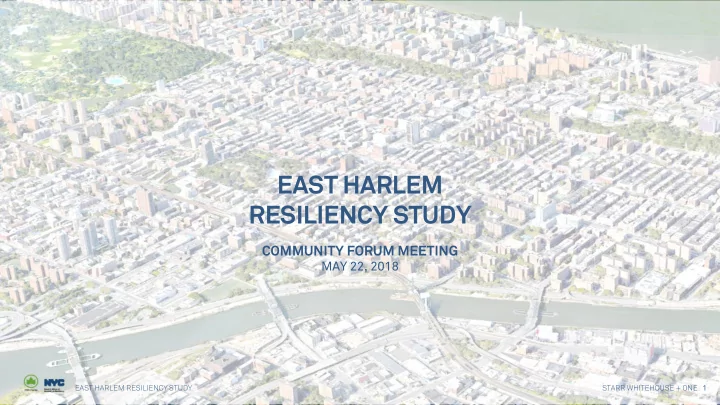
EAST HARLEM RESILIENCY STUDY COMMUNITY FORUM MEETING MAY 22, 2018 - - PowerPoint PPT Presentation

east harlem resiliency study
SMART_READER_LITE
LIVE PREVIEW

EAST HARLEM RESILIENCY STUDY COMMUNITY FORUM MEETING MAY 22, 2018 - - PowerPoint PPT Presentation

EAST HARLEM RESILIENCY STUDY COMMUNITY FORUM MEETING MAY 22, 2018 EAST HARLEM RESILIENCY STUDY STARR WHITEHOUSE + ONE 1 TONIGHTS AGENDA Welcome and Study Overview What is Climate Change? DREAM Scholars Presentation


slide-1
SLIDE 1

EAST HARLEM RESILIENCY STUDY

COMMUNITY FORUM MEETING

MAY 22, 2018

1 EAST HARLEM RESILIENCY STUDY STARR WHITEHOUSE + ONE
slide-2
SLIDE 2

TONIGHT’S AGENDA

  • Welcome and Study Overview
  • What is Climate Change?
  • DREAM Scholars Presentation
  • Table Discussions + Report Back
  • Next Steps

2 EAST HARLEM RESILIENCY STUDY STARR WHITEHOUSE + ONE

slide-3
SLIDE 3

STUDY OVERVIEW

N 0’ 1,000’ N 0’ 1,000’

3 EAST HARLEM RESILIENCY STUDY STARR WHITEHOUSE + ONE

154TH STREET 145TH STREET 125TH STREET 116TH STREET LEXINGTON AVE FIFTH AVE SECOND AVE

Harlem River

Marcus Garvey Park Thomas Jefferson Park

Community Board 10 Community Board 11 Community Board 8

The Esplanade Harlem River Park Greenway Link 92ND STREET 110TH STREET

Initial Study Area Natural Drainage Area

slide-4
SLIDE 4

STUDY PROCESS

CLIMATE RESILIENCY SOCIAL RESILIENCY OPEN SPACE PLANNING VISION PLAN

MITIGATING COASTAL AND INLAND FLOODING UNDERSTANDING SOCIAL COHESION AND COMMUNITY FACILITIES IDENTIFYING OPPORTUNITIES IN PARKS AND PUBLIC SPACES SOCIAL RESILIENCY OPEN SPACE PLANNING CLIMATE RESILIENCY

4 EAST HARLEM RESILIENCY STUDY STARR WHITEHOUSE + ONE

slide-5
SLIDE 5

RESILIENCE

The capacity of individuals, communities, institutions, businesses, and systems to survive, adapt, and grow no matter what kinds

  • f shocks or stresses they experience.

Adapted from Rockefeller Foundation and Arup’s City Resilience Framework

5 EAST HARLEM RESILIENCY STUDY STARR WHITEHOUSE + ONE

slide-6
SLIDE 6

Community Forum 2 TBC

Vision Plan

Late 2018

PAC Meeting 2 TBC Tabling at Community Events July + August Community Forum 1 May 22 PAC Meeting 1 April 10

EAST HARLEM RESILIENCY STUDY

STAKEHOLDER ENGAGEMENT PROCESS

6 EAST HARLEM RESILIENCY STUDY STARR WHITEHOUSE + ONE

slide-7
SLIDE 7

WHAT IS CLIMATE CHANGE?

slide-8
SLIDE 8

CLIMATE CHANGE

Observed increases in global average temperatures since the latter part

  • f the 20th century. Overwhelming scientifjc consensus points to human

activities, primarily from the burning of fossil fuels and subsequent increases in greenhouse gas concentrations, as the cause.

National Oceanic and Atmospheric Administration Climate Literacy: The Essential Principles of Climate Science (March 2009)

8 EAST HARLEM RESILIENCY STUDY STARR WHITEHOUSE + ONE

slide-9
SLIDE 9

WEATHER VERSUS CLIMATE

WEATHER CLIMATE

What is happening today

“It’s snowing in April!” “Winter used to start in early-November, but now it comes in late-December”

What happens over many seasons or decades

9 EAST HARLEM RESILIENCY STUDY STARR WHITEHOUSE + ONE

slide-10
SLIDE 10

THE GREENHOUSE EFFECT

CARBON DIOXIDE ABSORBS HEAT FROM THE SUN, WARMS ATMOSPHERE

10 EAST HARLEM RESILIENCY STUDY STARR WHITEHOUSE + ONE

slide-11
SLIDE 11

CLIMATE CHANGE STRESSORS

11 EAST HARLEM RESILIENCY STUDY STARR WHITEHOUSE + ONE

SEA LEVEL RISE

(TIDAL INUNDATION )

MORE AND LONGER HEAT WAVES LARGER RAIN EVENTS LARGER STORM SURGE

slide-12
SLIDE 12

HOW MIGHT CLIMATE CHANGE AFFECT EAST HARLEM?

slide-13
SLIDE 13

DEFINING EXTREME HEAT

INCREASED SUMMER TEMPERATURES AND MORE HEATWAVES

A HEATWAVE IS A PERIOD OF WEATHER OVER 90° FAHRENHEIT FOR 3 OR MORE DAYS

2018 2050

HEAT EXHAUSTION

  • Children, elderly, pets

REDUCED AIR QUALITY

  • Health and respiratory

problems STATE OF EMERGENCY

  • Businesses shut down

13 EAST HARLEM RESILIENCY STUDY STARR WHITEHOUSE + ONE

slide-14
SLIDE 14

DEFINING EXTREME HEAT

INCREASED SUMMER TEMPERATURES AND MORE HEATWAVES

14 EAST HARLEM RESILIENCY STUDY STARR WHITEHOUSE + ONE

DRAFT WORK IN PROGRESS 5/20/18

slide-15
SLIDE 15

DEFINING SEA LEVEL RISE

BY THE 2050s SEA LEVELS ARE PROJECTED TO RISE BY ABOUT 30 INCHES *

* New York Panel on Climate Change (NPCC), “NPCC 2015 Report Chapter 2: Sea Level Rise and Coastal Storms,” in Annals of the New York Academy of Sciences 1336:1 (January 2015) 15 EAST HARLEM RESILIENCY STUDY STARR WHITEHOUSE + ONE

slide-16
SLIDE 16

154TH STREET 145TH STREET 125TH STREET 116TH STREET LEXINGTON AVE FIFTH AVE SECOND AVE

Harlem River Community Board 10 Community Board 8 Community Board11

92ND STREET

Source: Langan, NYC Open Data

0’ - 2’ 2’ - 4’ 4’ - 6’ 6’ - 8’ 8’ - 10’ 10’ - 12’ 12’ - 14’ 14’ - 16’ 16’ - 18’ 18’ - 20’ 20’ - 40’ 40’ - 60’ 60’ - 80’ 80’ - 158’

ELEVATION

N 0’ 1,000’

110TH STREET 154TH STREET 145TH STREET 125TH STREET 116TH STREET LEXINGTON AVE FIFTH AVE SECOND AVE

Harlem River Community Board 8 Community Board 11

92ND STREET 110TH STREET

Community Board 0

N 0’ 1,000’

1865 VIELÉ WATER MAP

HISTORIC CONTEXT OF EAST HARLEM

1865 VIELÉ WATER MAP AND CURRENT TOPOGRAPHY

16 EAST HARLEM RESILIENCY STUDY STARR WHITEHOUSE + ONE

slide-17
SLIDE 17

DEFINING RAIN EVENTS

INCREASED STORM SIZE Calling 311 to report observed fmooding or drainage issue is an important way community members can inform the city about how to address this problem.

FLOODING

  • Parks, basements,

streets, subways TRANSIT SHUTDOWNS CLOSED BUSINESSES HEALTH PROBLEMS

  • Due to mold, bacteria

17 EAST HARLEM RESILIENCY STUDY STARR WHITEHOUSE + ONE

slide-18
SLIDE 18

DEFINING RAIN EVENTS

MARCH 2, 2018 NOR’EASTER

18 EAST HARLEM RESILIENCY STUDY STARR WHITEHOUSE + ONE

slide-19
SLIDE 19

DEFINING STORM SURGE

HURRICANES PUSH WATER FROM THE OCEAN INTO THE CITY

19 EAST HARLEM RESILIENCY STUDY STARR WHITEHOUSE + ONE

slide-20
SLIDE 20

DEFINING STORM SURGE

OCTOBER 2012 HURRICANE SANDY

20 EAST HARLEM RESILIENCY STUDY STARR WHITEHOUSE + ONE

slide-21
SLIDE 21

CURRENT INITIATIVES

slide-22
SLIDE 22

RESILIENCY INITIATIVES

PREPARING VULNERABLE NEIGHBORHOODS FOR CLIMATE CHANGE

( East Shore of Staten Island (Design) $615 million Belt Parkway Bulkhead Repair (Completed) $10 million Saw Mill Creek Wetlands Travis Ave Roadway Mitigation Bank (Construction) $14 million $1 million Resilient Neighborhood Study Areas (Completed) South Beach Midland Beach New Dorp Beach Oakwood Beach Staten Island Dune Restoration (Completed) $9 million Red Hook Integrated Flood Protection System (Planning) $104 million USACE NY Harbor and Tributaries Feasibility Study (Planning) East Side Coastal Resiliency (Design) $760 million $203 million $100+ million Battery Park Resiliency (Planning) $8 million Starlight P Resilient Neighborhood Study Area West Chelsea (Completed) ( T
  • ttenville Living Breakwaters (Design)
$60 million South Shore Shoreline Elevation (Planning) $32 million T
  • ttenville Dunes and
Coastal Dune Plantings (Planning) $9 million Southern Manhattan Multipurpose Levee Study (Completed) Resilient Neighborhood Study Area Lower East Side (Completed) Lower Manhattan Lower Manhattan Coastal Resiliency: Two Bridges (Planning) Coastal Resiliency (Planning) Wolfe’s Pond Park Berm Repair (Design) $5 million Great Kills Breakwater (Design) $1 million Oakwood Beach Tide Gate Repair (Completed) North Shore of Staten Island Resiliency (Planning) Resiliency Study (Planning) Mid Island Bluebelt (Construction) Homeport Resiliency (Design) Rockaway Reformulation (Jamaica Bay) (Planning) Head of Bay Oysters (Planning) $1 million Rockaway Peninsula Beach Nourishment & Dune Installation (Completed) Flushing Meadow Tide Gate (Design) $5 million Hart Island Shoreline Restoration (Design) $13 million Resilient Neighborhood Study Area (Planning) Sheepshead Bay Plumb Beach Nourishment and Breakwater (Completed) $5 million East Harlem Resiliency (Planning) $1 million Starlight Park Edge Restoration (Construction) $20 million Hunts Point Peninsula Resiliency & $45 million Tibbetts Brook Daylighting (Design) $2 million Rockaway Reformulation (Atlantic beaches) (Planning) Sunset Cove Marsh Restoration (Design) $8 million Beach Channel Drive Bulkhead Repair (Construction) $37 million Coney Island Creek Tidal Barrier Study (Completed) $2 million Sea Gate T-Groins (Completed) $28 million Sea Gate Bulkhead (Design) $3 million Breezy Point Double Dunes (Design) $58 million Coney Island Beach Nourishment (Completed) Coney Island Creek Shoreline Elevation (Planning) Brighton Beach/Coney Island Beach Resiliency (Planning) $32 million Rockaway Inlet Barrier Study (Planning) Resilient Neighborhood Study Area (Completed) Edgewater Park Resilient Neighborhood Study Area (Completed) Harding Park Newtown Creek and Gowanus Canal Local Storm Surge Barrier Study (Completed) $2 million Resilient Neighborhood Study Area (Planning) Canarsie Rikers Island Shoreline Restoration (Design) $63 million Howard Beach/Lower Spring Creek Flood Protection (Design) $69 million Upper Spring Creek Wetland Restoration (Planning) $19 million (Design) (Completed) Resilient Neighborhood Study Area (Planning) Gerritsen Beach Resilient Neighborhood Study Area (Planning) Rockaway Beach and Rockaway Park Resilient Neighborhood Study Area (Completed) Broad Channel Brant Point Wave Attenuation (Completed) $1 million Resilient Neighborhood Study Area (Completed) Hamilton Beach and Old Howard Beach Evaluation Pilot Project (Planning) Coney Isl. Greenstreets (Construction) Brookville Blvd Resiliency Study (Planning) (Construction)

Re

Completed Study Funded Project Funded DCP Resilient Neighborhoods Study Areas 2013 100-year Floodplain 2050s 100-year Floodplain

KEY

Source: OneNYC 2017 Progress Report

22 EAST HARLEM RESILIENCY STUDY STARR WHITEHOUSE + ONE

slide-23
SLIDE 23

RESILIENCY INITIATIVES

PREPARING VULNERABLE NEIGHBORHOODS FOR CLIMATE CHANGE

Cool Neighborhoods NYC 1

The City of New York Mayor Bill de Blasio

Mayor’s Offjce of Recovery and Resilency Anthony Shorris, First Deputy Mayor Mayor’s Offjce of Recovery and Resilency Anthony Shorris, First Deputy Mayor

The City of New York Mayor Bill de Blasio

Anthony Shorris First Deputy Mayor

Cool Neighborhoods NYC

A Comprehensive Approach to Keep Communities Safe in Extreme Heat

Cool Neighborhoods NYC

A Comprehensive Approach to Keep Communities Safe in Extreme Heat

NYC Mayor’s Offjce of Recovery and Resiliency Climate Resiliency Design Guidelines

1

PATUS, SENDAMPRA, PERTUSU LTICTUM FECTUAM IACCHUCO CONDEM ETE O EFECRI SINMOLUDEM IMIS , QUEROXIMUS

CLIMATE RESILIENCY DESIGN GUIDELINES CLIMATE RESILIENCY DESIGN GUIDELINES

April 2018 Version 2.0

23 EAST HARLEM RESILIENCY STUDY STARR WHITEHOUSE + ONE

slide-24
SLIDE 24

BUILD A STRONGER AND HEALTHIER COMMUNITY

EXAMPLES OF EAST HARLEM PROGRAMS SERVING RESIDENTS OF ALL AGES

24 EAST HARLEM RESILIENCY STUDY STARR WHITEHOUSE + ONE

CONCRETE SAFARIS PROGRAMS UPTOWN GRAND CENTRAL HARLEM HEALTH ACTION CENTER SILICON HARLEM / NYC RISE

slide-25
SLIDE 25

BUILD ON EXISTING CONVERSATIONS

EXAMPLES OF COMMUNITY DEVELOPMENT PLANNING IN EAST HARLEM

25 EAST HARLEM RESILIENCY STUDY STARR WHITEHOUSE + ONE

CIVITAS EAST RIVER ESPLANADE REPORT EAST HARLEM NEIGHBORHOOD PLAN WE ACT CLIMATE ACTION PLAN

Resilient Housing True victory in the climate struggle is not simply based on the preservation
  • f physical conditions, but also on
the achievement of lasting security for communities that are now under threat of displacement. Therefore, affordable housing should be a priority for climate advocates, just as it is for the Mayor’s offjce and many NYers. Supporting NYCHA by reinvesting in its infrastructure is a necessary fjrst step, but we must also ensure that further price hikes do not happen and that NYCHA property leased to private developers does not cause further gentrifjcation. Simultaneously, alternative models for transitional housing, such as the Sugarhill development by Broadway Housing Communities should be explored. It is particularly important to ensure that homes are cool enough for the
  • elderly. Between 2000 and 2011,
85% of those who died from heat in NYC died in their own homes. “NYCHA has an important role to play in reducing this city’s carbon footprint and I look forward to [making] our public housing more effjcient and resilient”
  • Council Member Ritchie Torres
Healthcare Healthcare services should not
  • nly be expanded to provide aid
to more people: they must also be made resilient enough to continue to function during the next superstorm, heatwave or other crisis. Post- Sandy healthcare resilience efforts include installing infrastructure to protect against flooding, building distributed generation systems (and microgrids), and connecting precarious demographic groups with health services. Healthcare providers should establish connections with local emergency response systems so that people who need special health services during a crisis can be reached and treated quickly. Wagner Houses 3333 Broadway Drew Hamilton Houses Sugarhill Houses Cooperatively Owned Microgrids Both the City and state government have called for an expansion
  • f distributed generation (DG)
technology, including wind, solar, and
  • geothermal. This plan supports the
implementation of DG in the form
  • f microgrids that are deployed in
vulnerable areas and/or are managed by local stakeholders. The City is currently undertaking a microgrid feasibility study and removing policy roadblocks to microgrid construction by working with ConEd and the Public Service Corps to revise “ConEd’s standby tariffs to lessen economic impediments to DG”. Microgrids provide multiple benefjts, including reliable power when the main grid experiences a blackout, reductions in energy costs, more control for residents over their own energy consumption, and employment
  • pportunities.
Affordable Cooperative Housing The City plans to create and/or preserve 200,000 units of affordable housing between 2015 and 2025. This will be done by maximizing use of City-owned land, mandating inclusionary zoning, and providing tax incentives to developers, among
  • ther things. However, many are skeptical that these efforts will
provide the necessary amount of housing at truly affordable prices (particularly for vulnerable populations such as the homeless, criminalized populations, the elderly, etc.). Therefore, new cooperative homeownership mechanisms such as community land trusts must be explored. Social Hubs Community meeting spaces are crucial to support ongoing planning efforts, as they are necessary for local organizations to host educational programs, hold meetings, produce materials, use for storage, etc. Having a local hub open for community use can support centralized planning and production activities while remaining grounded in local needs and capacities. Local Markets Manufacturers, farmers, and other “makers” within the hub can sell their goods at local markets, which support non-conventional commerce, including bartering networks and alternative currencies. Ferry Service The West Harlem Piers (pictured below) is a good location to add ferry services for daily commuters and to create alternate evacuation routes. OneNYC calls for several new ferry routes. Food from the Hudson Valley Farms in the Hudson Valley can make use of improved waterfront infrastructures to ship food into NYC, which can strengthen NY state’s economy while providing healthier food options for local food deserts. OneNYC plans to invest $100 million in marine terminals for Community Board 9 Sanitation Comissioner Kathryn García Parks Commissioner Mitchell Silver Information Kiosks After Hurricane Sandy, locally- produced signage played an important role in connecting people with networks and resources that supported recovery efforts. Public signs and stands should be created across the City to provide information on cooling center locations, evacuation zones, and other important resources. Flooding Barriers The thirteen-plus miles
  • f coastline in Northern
Manhattan are home to thousands of residents, small businesses, manufacturing spaces and important pieces of municipal infrastructure. Many
  • f these, particularly in East
Harlem, are located within the Hurricane Evacuation Zone and should therefore be hardened against flooding. Flood protections should be planned using design guidelines that prioritize the creation of public space, access to the waterfront, and bicycle route connectivity. Dyckman Houses Jackie Robinson Houses Councilman Ydanis Rodríguez Councilman Mark Levine Councilwoman Melissa Mark-Viverito Community Bank Financial services should be provided by local institutions connected with the community. Locally-run fjnance can shift the focus of banks away from their short-term profjt, towards long- term investment in infrastructure, development of small businesses, and other much-needed investments in shared resources that will benefjt the community. Places of Worship Churches, mosques, synagogues, and other religious institutions provide flexible spaces for community planning and emergency services, while conveying important climate-related messages through religious practices. Many churches, urged on by Pope Francis, are joining the struggle for climate justice. Urban Agriculture Local agriculture is an integral component of climate resiliency, as it helps build communities’ self- reliance while reducing the massive petro-chemical footprint of existing industrialized food systems. The City plans to increase its number of community gardens by partnering with schools, helping gardeners sell their produce at farm stands, and supporting urban farms through (cont’d from Urban Agriculture) the multiagency Building Healthy Communities Initiative. NYCHA’s Gardening and Greening program is also working to expand accessibility to community gardens. Our partners, such as the Corbin Hill Food Project, are deeply engaged with these issues and are mapping
  • ut an effective model for a
sustainable food system in Northern Manhattan. Participatory Budgeting In April 2015, over 51,000 NYC residents voted on how to allocate $32 million to various locally- developed capital projects across 24 NYC Council Districts. Participatory budgeting is a clear example of how residents can be made to engage directly with governance systems to tailor policy to their needs. Given the level of site specifjcity essential to effectively address climate change issues, PB should be expanded to encompass more of the City’s budget, green projects, and longer- term investments. Coastal Protection Coastal areas, particularly those in the floodplain shown in Figure 1, are in need of green infrastructure that provides ecosystem and flood protections. NYC is currently implementing a coastal protection project worth $3.7 billion and has released its fjrst-ever comprehensive coastal protection plan, A Stronger, More Resilient New York. The plan seeks to deepen public participation in waterfront restoration and protection by expanding the Waterfront Management Advisory Board and includes pledges to undertake feasibility studies for construction and restoration of flood-prone areas. DEP has also spent over $40 million to-date on wetlands restoration and other coastal protections. What remains to be seen is the extent to which developments will encompass community-based plans or be leveraged to gentrify waterfront areas. Manufacturing Facilities Northern Manhattan’s coastal and interior areas provide many
  • pportunities for light industrial
activities (manufacturing of consumer goods), which can both provide jobs for low- income residents and produce tools for local climate resilience. Public and private fjnancial institutions, organized labor, and local organizations that focuses
  • n workforce development can
work together to create local employment opportunities, develop green energy technology (solar, wind, etc.), green transport equipment (bikeshare systems) and other basic necessities such as textiles and foodstuffs. Organized labor is already exerting a strong influence on City climate
  • policies. The City Council has
announced that it will fund 22 new cooperatively owned businesses in Live/Work Spaces One of the most effective (yet currently underutilized) tools for communication in relation to climate change is the arts. However, it is diffjcult for young artists to secure live/work spaces in NYC, forcing them to leave NYC for other cities. As a result, OneNYC pledges to develop 1,500 live/work spaces, including 500 affordable units, by 2024. 135th Street Marine Waste Transfer Station For several decades, the Marine Waste Transfer Station at 135th Street polluted the Hudson River alongside West Harlem, the neighborhood of Hamilton Heights, and other nearby areas with a 24-hour stream of garbage trucks and barges. The now-abandoned facility represents an exciting opportunity to create a permanent climate resilience center that can support local organizations, educational/cultural programs, freight movement, citizen science, and other climate-related efforts. Several City Council members, Manhattan’s Borough President, the Parks Commissioner, local Community Board representatives and others have formally stated that they are in support of such a project. Tech Incubator By working with universities, public agencies, community organizations and members of the “maker” community, a tech incubator can be built to help local activists and entrepreneurs develop socially responsible products, such as improved software for running green
  • technologies. OneNYC plans to
support “Clean Tech” industries by creating an Advanced Manufacturing Network that will provide affordable workspaces, business support services and workforce training
  • programs. NYCEDC has also funded
several business incubators, including
  • ne that focuses on renewable energy.
Space for Social Services Flexible space within residential buildings can be used for social services such as childcare and healthcare, as a meeting space for local groups, and for other activities that can build social cohesion while allowing more freedom for working class people to pursue employment and engage in other forms of social reproduction. Multipurpose Infrastructure New design guidelines should be implemented so that waterfronts promote industrial activities while remaining accessible to the public. This can be done through constructing green spaces that both mitigate flood damage and support water- based transportation should be constructed. These spaces are also important for cooling the urban heat island and supporting physical activity, local agriculture, and more. Local Brewery A local brewery in the manufacturing district can build on local tradition and culture while creating a local craft food industry. Design for Pedestrians + Bicyclists OneNYC calls for a bike lanes in areas “with limited bike infrastructure”. This includes bike lanes on the Harlem River bridges and on other auto-oriented streets. The City’s privately-owned bikeshare service, CitiBike, should be expanded to encompass Uptown areas, while taking on a more public nature. For example, equipments should be manufactured locally. Sources 1. Baiocchi, Gianpaolo et al., “Evaluating Empowerment: Participatory Budgeting in Brazilian Munici- palities,” Empowerment in Practice: From Analysis to Implementation, 2006. 2. BBC News Europe, “Greece Debt Crisis: Tsipras Announces Bailout Referendum,” June 2015. 3. Baussan, Danielle, “Social Cohesion: The Secret Weapon in the Fight for Equitable Climate Resil- ience,” Center for American Progress, May 2015. 4. Bergad, Laird W., “The Concentration of Wealth in New York City Changes in the Structure of House- hold Income by Race/Ethnic Groups and Latino Nationalities 1990 - 2010, ” CUNY , January 2014. 5. Centers for Disease Control and Prevention, “Heat Illness and Deaths - NYC, 2000-2011,” August 9, 2011. 6. Checker, Melissa, “Wiped Out by the ‘Greenwave’: Environmental Gentrification and the Paradoxi- cal Politics of Urban Sustainability,” City and Society, vol. 23, 2011. 7. MacKinnon, Danny & Kate Driscoll Derickson, “From Resilience to Resourcefulness: A Critique of Resilience Policy and Activism,” Progress in Human Geography, vol. 37, 2013. 8. Mazria, Edward, “Achieving 80 x 50,” Architecture 2030, July 2015. 9. McKay, Jim, “Sandy Created a Black Hole of Communication,” Emergency Management, January 28, 2013. 10. NYC Center for Economic Opportunity, “Poverty Data Tool,” n.d. 11. NYC Department of Environmental Protection, “NYC Green Infrastructure: Annual Report,” 2014. 12. NYC Department of Health and Mental Hygiene, “New York City Community Health Survey,” 2013. 13. NYC Office of Mayor Michael Bloomberg, “A Stronger, More Resilient New York,” June 2013. 14. NYC Office of the Mayor, “One City: Built to Last,” September 2014. 15. NYC Office of the Mayor, “#OneNYC: The Plan for a Strong and Just City,” April 2014. 16. NYC Office of the Mayor, “Providing Climate Projections Through 2100 for the First Time,” 2015. 17. NYC Office of the Mayor, “The CEO Poverty Measure, 2005 - 2012,” April 2014. 18. Sagrans, Eric, “6 Lessons for the U.S. from Spain’s Democratic Revolution,” In These Times, May 29 2015. 19. Salter, Raya & Cecil Corbin-Mark, “New York’s Energy Revolution Will Mean More Clean and Renewable Power Projects in Low- to Moderate-Income Neighborhoods,” Natural Resources Defense Council 20. Seguín, Bécquer & Sebatiaan Faber, “In Spain’s Seismic Elections, ‘It’s the Victory of David over Goliath,’” The Nation, May 2015. 21. Tidball, Keith, “Urgent biophilia: Human-nature Interactions and Biological Attractions in Disaster Affordable Public Transport In recent years, bicycle lanes, bus system facilities, and subway routes have been constructed in Northern
  • Manhattan. These services can provide important
transportation options should other transportation resources be damaged in a storm. However, rising transportation costs are also increasingly limiting transportation access for low-income groups. Transportation options should be made more affordable, perhaps by means of more public investments, expansion
  • f the bikeshare system, and reduced costs for subway
and bus services. Transportation services should also be made free to low-income residents during emergency situations. Community Land Trusts (CLT) Organizing property ownership through a CLT is one way to preserve affordable housing by removing properties from the speculative market. CLTs also allow participants to collectively use space for local agriculture, energy production, recreation, and even social services such as childcare. Such shared governance structures can help rebuild the commons in terms of how we use space/resources. The North River Sewage Treatment Plant is in the floodplain Water conservation systems Networked technology controls energy usage and monitors environmental conditions. Composting and recycling Storage of food, water, and medicine Residents have communications systems, including digital and analog alternatives, to coordinate emergency response. Local Media Production Dedicated space for critical media outlets, training for citizen journalism, and cooperatively owned equipment for digital and hard copy media production. #NMCA RESILIENCE CONCEPTS The following concepts were generated by project participants as measures that can protect our environment while reducing socio-economic inequality. Logos indicate potential partnerships, not formal agreements. Writing and layout by: Aurash Khawarzad (@khawarzad), Hand-drawings by: Mateo Fernandez-Muro (@Matufjs) More info at: http://weact.nyc/climate
slide-26
SLIDE 26

STUDY PROCESS

CLIMATE RESILIENCY SOCIAL RESILIENCY OPEN SPACE PLANNING VISION PLAN

MITIGATING COASTAL AND INLAND FLOODING UNDERSTANDING SOCIAL COHESION AND COMMUNITY FACILITIES IDENTIFYING OPPORTUNITIES IN PARKS AND PUBLIC SPACES SOCIAL RESILIENCY OPEN SPACE PLANNING CLIMATE RESILIENCY

26 EAST HARLEM RESILIENCY STUDY STARR WHITEHOUSE + ONE

slide-27
SLIDE 27

NEXT STEPS

HOW TO STAY INVOVLED

UPCOMING EVENTS

Tabling at Community Events – Summer 2018 Community Board Updates – Summer / Fall 2018 Community Forum 2 – Fall TBD

WEBSITE + SURVEY

http://nyc.gov/parks/ehrstudy

QUESTIONS?

Contact: Alda.Chan@parks.nyc.gov or 212-360-3473

27 EAST HARLEM RESILIENCY STUDY STARR WHITEHOUSE + ONE

slide-28
SLIDE 28

EAST HARLEM RESILIENCY STUDY

DREAM 9TH GRADE HONORS SCHOLARS

MAY 22, 2018

1 EAST HARLEM RESILIENCY STUDY STARR WHITEHOUSE + ONE

slide-29
SLIDE 29

DREAM HONORS LIVING ENVIRONMENTS COURSE

EAST HARLEM RESILIENCY STUDY

Alija Radoncic

Class activities What we have learned

COURSE OVERVIEW RESILIENCE IN ACTION

Why resilience matters to us Building resilience together

Daniela Torres

2 EAST HARLEM RESILIENCY STUDY STARR WHITEHOUSE + ONE

slide-30
SLIDE 30

RESILIENCY FOUNDATIONS

NETWORKS AND INTERCONNECTIONS

3 EAST HARLEM RESILIENCY STUDY STARR WHITEHOUSE + ONE

slide-31
SLIDE 31

EAST HARLEM AND THE ENVIRONMENT

MAPPING THE NEIGHBORHOOD

4 EAST HARLEM RESILIENCY STUDY STARR WHITEHOUSE + ONE

slide-32
SLIDE 32

SOCIAL VULNERABILITY

ANALYZING VULNERABILITY WITH A PROBLEM TREE

5 EAST HARLEM RESILIENCY STUDY STARR WHITEHOUSE + ONE

slide-33
SLIDE 33

SOCIAL VULNERABILITY

CREATING A COMMUNITY EMERGENCY PLAN

6 EAST HARLEM RESILIENCY STUDY STARR WHITEHOUSE + ONE

slide-34
SLIDE 34

STORMWATER MANAGEMENT

GREEN INFRASTRUCTURE AND OPEN SPACE

7 EAST HARLEM RESILIENCY STUDY STARR WHITEHOUSE + ONE

slide-35
SLIDE 35

EXPERIENTIAL LEARNING

PROFESSIONAL AND CAREER EXPOSURE

Civil Engineer Manhattan Deputy Borough President Sociologist Landscape Architects Newtown Creek Wastewater Treatment Plant in Brooklyn

8 EAST HARLEM RESILIENCY STUDY STARR WHITEHOUSE + ONE

slide-36
SLIDE 36

KNOWLEDGE AND EXPERIENCE LOCAL ADVOCACY ACTION IN THE PUBLIC REALM

RESILIENCE IN ACTION

ACTIVE PARTICIPATION AND ENGAGEMENT

9 EAST HARLEM RESILIENCY STUDY STARR WHITEHOUSE + ONE

slide-37
SLIDE 37

GETTING OUT INTO THE COMMUNITY

BUILDING RESILIENCE TOGETHER

Washington Houses Tenants Association East Harlem Resiliency Study Project Advisory Committeee

10 EAST HARLEM RESILIENCY STUDY STARR WHITEHOUSE + ONE

slide-38
SLIDE 38

SEA LEVEL RISE TEMPERATURE INCREASE BIGGER STORMS

CLIMATE RISK

EAST HARLEM RESILIENCY STUDY AND CURRICULUM

11 EAST HARLEM RESILIENCY STUDY STARR WHITEHOUSE + ONE

slide-39
SLIDE 39

2040 2050 2020 2030

CLIMATE PROJECTIONS

NOT SO FAR AWAY

TODAY

12 EAST HARLEM RESILIENCY STUDY STARR WHITEHOUSE + ONE

slide-40
SLIDE 40

PERSONAL PROJECTIONS

45 years old Family of my own Though I may not still live in East Harlem, I will have family here

Where I see myself in 30 years. . .

13 STARR WHITEHOUSE + ONE EAST HARLEM RESILIENCY STUDY

slide-41
SLIDE 41

STARR WHITEHOUSE + ONE

THANK YOU!

EAST HARLEM RESILIENCY STUDY

slide-42
SLIDE 42

TABLE DISCUSSIONS

slide-43
SLIDE 43

FLOODING

WHAT ARE YOUR EXPERIENCES?

16 EAST HARLEM RESILIENCY STUDY STARR WHITEHOUSE + ONE

slide-44
SLIDE 44

HEAT WAVES

WHAT ARE YOUR EXPERIENCES?

17 EAST HARLEM RESILIENCY STUDY STARR WHITEHOUSE + ONE

slide-45
SLIDE 45

ACCESSING SERVICES

WHERE DO YOU GO?

$

$

18 EAST HARLEM RESILIENCY STUDY STARR WHITEHOUSE + ONE

slide-46
SLIDE 46

PARKS AND OPEN SPACES

WHERE DO YOU GO? WHAT DO YOU DO THERE?

19 EAST HARLEM RESILIENCY STUDY STARR WHITEHOUSE + ONE

slide-47
SLIDE 47

NEXT STEPS

HOW TO STAY INVOVLED

UPCOMING EVENTS

Tabling at Community Events – Summer 2018 Community Board Updates – Summer / Fall 2018 Community Forum 2 – Fall TBD

WEBSITE + SURVEY

http://nyc.gov/parks/ehrstudy

QUESTIONS?

Contact: Alda.Chan@parks.nyc.gov or 212-360-3473

20 EAST HARLEM RESILIENCY STUDY STARR WHITEHOUSE + ONE