SLIDE 1
Version November 2010
1
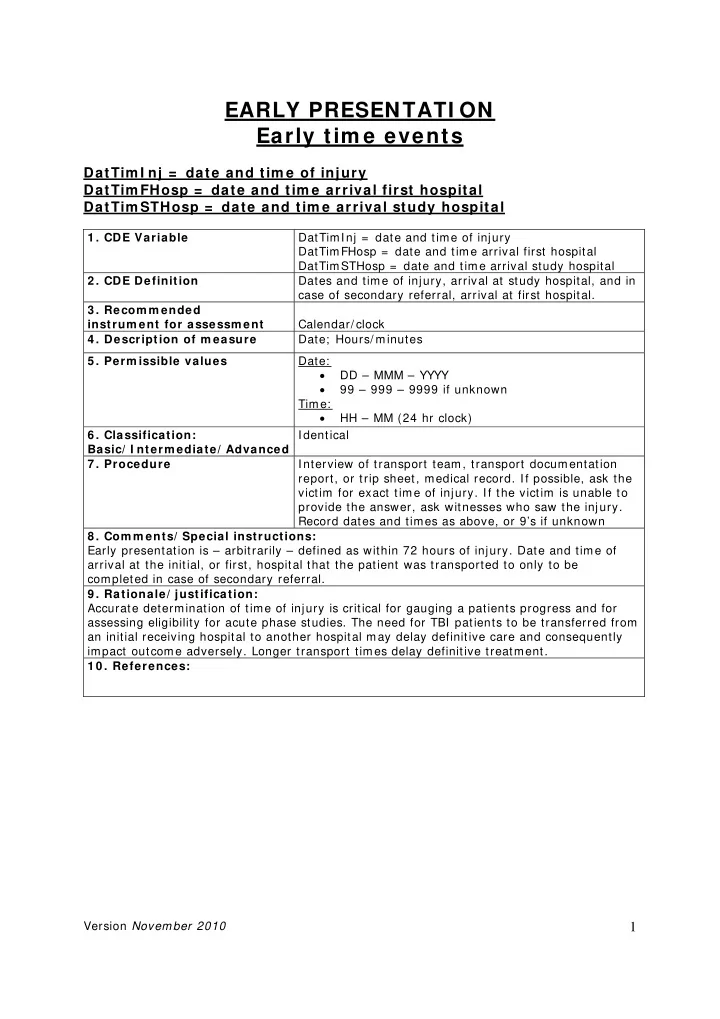
EARLY PRESENTATI ON Early tim e events
DatTim I nj = date and tim e of injury DatTim FHosp = date and tim e arrival first hospital DatTim STHosp = date and tim e arrival study hospital
1 . CDE Variable DatTimInj = date and time of injury DatTimFHosp = date and time arrival first hospital DatTimSTHosp = date and time arrival study hospital 2 . CDE Definition Dates and time of injury, arrival at study hospital, and in case of secondary referral, arrival at first hospital. 3 . Recom m ended instrum ent for assessm ent Calendar/ clock 4 . Description of m easure Date; Hours/ minutes 5 . Perm issible values Date: DD – MMM – YYYY 99 – 999 – 9999 if unknown Time: HH – MM (24 hr clock) 6 . Classification: Basic/ I nterm ediate/ Advanced Identical 7 . Procedure Interview of transport team, transport documentation report, or trip sheet, medical record. If possible, ask the victim for exact time of injury. If the victim is unable to provide the answer, ask witnesses who saw the injury. Record dates and times as above, or 9’s if unknown 8 . Com m ents/ Special instructions: Early presentation is – arbitrarily – defined as within 72 hours of injury. Date and time of arrival at the initial, or first, hospital that the patient was transported to only to be completed in case of secondary referral. 9 . Rationale/ justification: Accurate determination of time of injury is critical for gauging a patients progress and for assessing eligibility for acute phase studies. The need for TBI patients to be transferred from an initial receiving hospital to another hospital may delay definitive care and consequently impact outcome adversely. Longer transport times delay definitive treatment. 1 0. References:
SLIDE 2
Version November 2010
2
EARLY PRESENTATI ON
TBI Ref = Referral
1 . CDE Variable TBIRef = Referral 2 . CDE Definition “Primary” indicates that the patient was taken directly from the scene of accident to the study hospital. “Secondary” means that the patient was first taken to a non-study hospital, and then transferred to the study hospital. 3 . Recom m ended instrum ent for assessm ent N/ A 4 . Description of m easure Binary: primary versus secondary 5 . Perm issible values Primary Secondary 6 . Classification: Basic/ I nterm ediate/ Advanced Identical 7 . Procedure Firsthand description from first responders, emergency department physicians, or patient (if able to provide reliable information). Alternate source is medical record. 8 . Com m ents/ Special instructions: N/ A 9 . Rationale/ justification: The need for TBI patients to be transferred from an initial receiving hospital to another hospital may delay definitive care and induce a potential for selection bias. 1 0. References:
SLIDE 3 Version November 2010
3
EARLY PRESENTATI ON
TRANSMOD = Mode of transport
1 . CDE Variable TRANSMOD = Mode of Transport 2 . CDE Definition Mode of transportation from accident scene. 3 . Recom m ended instrum ent for assessm ent N/ A 4 . Description of m easure Categorical/ unique entry 5 . Perm issible values Helicopter Ground Ambulance with physician Ground ambulance no physician Private Vehicle Military Other 6 . Classification: Basic/ I nterm ediate/ Advanced Advanced 7 . Procedure Interview of transport team, transport documentation report, or trip sheet, medical record. Identify and record the type of service that responded to the scene and transported the patient from the accident site to the receiving hospital. 8 . Com m ents/ Special instructions: This variable refers only to the mode of transport from the accident scene, and not to the type of emergency care provided. Thus, if a physician is brought in for support by helicopter, but the patient transported by ambulance, the box for ambulance should be marked. If a physician accompanies the patient during ground ambulance transport, please mark the appropriate box. Otherwise, ground ambulance refers to certified medical ground transport and may include all other levels of medical personnel, except for physicians (basic, intermediate emergency medical technicians, physicians, nurses, paramedics or other levels
- f training). Other could include walk-in or other methods of delivery not provided.
9 . Rationale/ justification: Type of transport may impact the time to treatment and level of initial care provided which could impact patient outcome. 1 0. References: Berlot G, Fata CL, Bacer B, et al. Influence of prehospital treatment on the outcome of patients with severe blunt traumatic brain injury. Eur J Emerg Med. Jun 1 2009 Davis DP, Peay J, Serrano JA, et al. The impact of aeromedical response to patients with moderate to severe traumatic brain injury. Ann Emerg Med. Aug 2005; 46(2): 155-22.
SLIDE 4 Version November 2010
4
EARLY PRESENTATI ON
Em ergServ = Em ergency Services Em ergCare = Em ergency Care RespTim = Response Tim e ScenTim = Tim e at Accident Scene
1 . CDE Variable EmergServ = Emergency Services EmergCare = Emergency Care RespTim = Response Time ScenTim = Time at Accident Scene 2 . CDE Definition Emergency services: The branch of service involved at the accident scene. Emergency Care: The level of training of individuals providing medical care
Response Time: Time between injury and arrival emergency services. Time at Accident Scene: Time between arrival and departure of emergency services. 3 . Recom m ended instrum ent for assessm ent N/ A 4 . Description of m easure Categorical (multiple entries) Times: Hours/ Minutes 5 . Perm issible values Emergency service: None Police Firefighter Ambulance (basic; EMT-B) Ambulance with specialized personnel (EMT-P) Helicopter medical service Emergency Care: None Untrained person Military – non medic Paramedic Nurse Physician Medical rescue team
Response Time: HH-MM (24 hour clock) Time at Accident Scene: HH-MM (24 hour clock) 6 . Classification: Basic/ I nterm ediate/ Advanced Advanced procedure. 7 . Procedure Obtain information from transport team, trip sheet, transport documentation, history from patient (if possible), witnesses, or family. Identify and record the type of service and qualification of personnel providing initial medical care at the accident site.
SLIDE 5 Version November 2010
5
8 . Com m ents/ Special instructions: If information is not available from the sources listed above, contact transport service for
- information. Many services have two or more medical providers; mark the level of all the
providers that actually deliver medical care to the patient. Do not include drivers, pilots or
- ther personnel not directly involved in medical care delivery.
9 . Rationale/ justification: Level of training of the responders and transport team may impact the level of care provided and affect outcome. 1 0. References: Berlot G, Fata CL, Bacer B, et al. Influence of prehospital treatment on the outcome of patients with severe blunt traumatic brain injury. Eur J Emerg Med. Jun 1 2009 Davis DP, Peay J, Serrano JA, et al. The impact of aeromedical response to patients with moderate to severe traumatic brain injury. Ann Emerg Med. Aug 2005; 46(2): 155-22.