
SLIDE 1
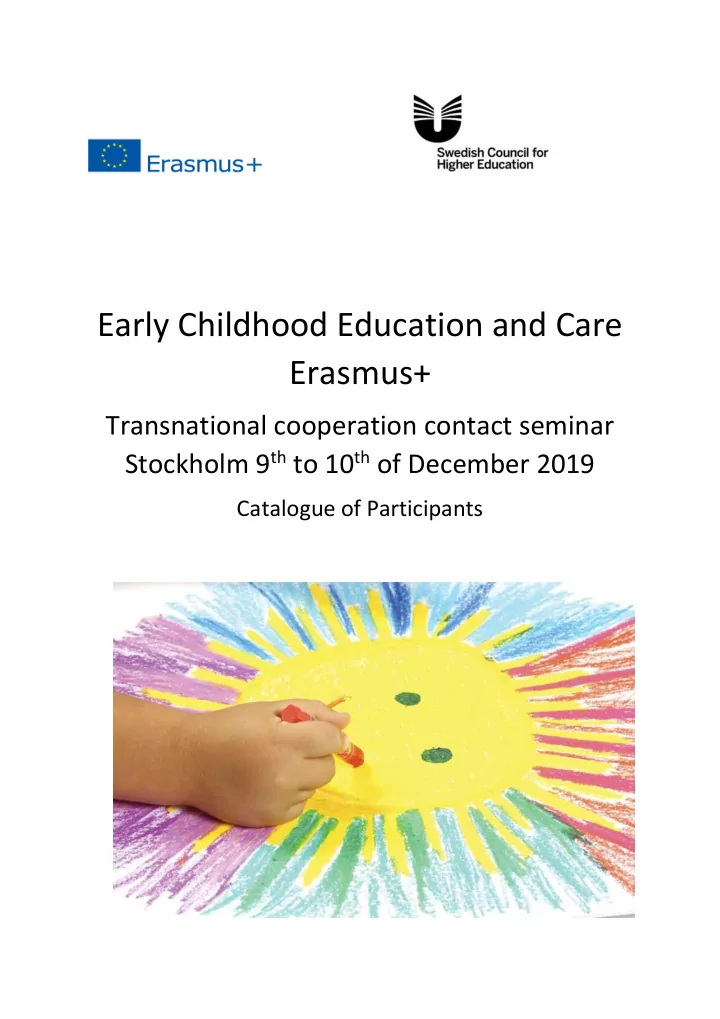
Early Childhood Education and Care Erasmus+ Transnational - - PDF document
Early Childhood Education and Care Erasmus+ Transnational cooperation contact seminar Stockholm 9 th to 10 th of December 2019 Catalogue of Participants Name: Nonna Nyman-Duenas Organization: stra Bro preschools, Upplands-Bro Municipality
2 Name: Nonna Nyman-Duenas Organization: Östra Bro preschools, Upplands-Bro Municipality Country: Sweden Please, present yourself
capacity/profession in the
I work as a principal in Östra Bro preschools in Upplands-Bro municipality. Please, describe the
size of organization? Age group of the children? Describe the pedagogical method being used. I have 3 preschools (21 departments, around 350 children and around 65 staff). The children are between 1 and 6 years old. We are using the Reggio Emilia pedagogic and methods. Please, describe what you are interested in developing in your organisation and why in an international Erasmus + context? I am interested in developing a preschool with a good quality for all children in my organisation, but also for all children in my community and whole Sweden. The quality aspects are the most interesting for me in the early childhood education.
3 Name: Vilma Liaudanske Organization: Marijampole preschool “Varpelis” Country: Lithuania Please, present yourself
capacity/profession in the
I am Vilma Liaudanske, a head of Marijampole preschool “Varpelis”. I am responsible for the management of provision of early education services. Please, describe the
size of organization? Age group of the children? Describe the pedagogical method being used. Marijampole preschool “Varpelis” is a small kindergarten. The establisher of the kindergarten is Marijampole municipality. We have 110 pupils. Children from 2 to 6 years old attend our kindergarten. 15 pedagogues work in the kindergarten. The main pedagogical method is game – learning through game. We apply and other pedagogical methods – especially methods related to active participation of pupils in the process of learning/ teaching. The main themes of education in the kindergarten “Varpelis” are healthy life style and ethno education. Please, describe what you are interested in developing in your organisation and why in an international Erasmus + context? The project idea is to promote skills of active citizenship from an early age of
environment in which I live." The aim of the project is to develop an active attitude of preschool children in learning to respect and protect the environment. Project objectives: 1) Educate preschoolers to sort waste and encourage others to do that. 2) Develop skills to take care about pupils’ close environment. 3) Develop a position of responsible consumerism. Problems of environment protection are very urgent nowadays, thus we are seeking to involve in the project together with other institutions from Lithuania and other countries.
4 Name: Janni Kruse Olsen Organization: Område 2 – dagtilbud, Vejen Kommune Country: Denmark Please, present yourself
capacity/profession in the
I am the leader of Område 2 - daycare. I’m educated pedagogue and have been a leader since 2015. I am passionate about conducting leadership that is collaborative in promoting daycare of high quality - and thus helping to ensure children's opportunities in life. Please, describe the
size of organization? Age group of the children? Describe the pedagogical method being used. I represent daycare for the ages of 0-6 years. There are 400 children. We are an
We are having a focus on playful learning, where the children have possibilities to be experimental in interaction with both children and pedagogues. Please, describe what you are interested in developing in your organisation and why in an international Erasmus + context? We have an interest in the early childhood education and care to explore what colleagues are in doing to create good and devoloping environments.
5 Name: Jonny Vollan Organization: Birralee International Kindergarten Trondheim Country: Norway Please, present yourself
capacity/profession in the
Leader at Birralee International Kindergarten in Trondheim, Norway. Please, describe the
size of organization? Age group of the children? Describe the pedagogical method being used. 52 children and 15 employees, Norwegian and English language. Children and staff have more than 25 different mother tongues. Children admitted from ages 3 to 5 years. The kindergarten follows the Norwegian framework plan (rammeplan for barnehage), with focus on inclusion among diverse cultures and development of language skills. Please, describe what you are interested in developing in your organisation and why in an international Erasmus + context? We are interested in continuing to build acceptance within Norwegian culture and to recognize signs of bullying and develop practices to prevent bullying. We want to foster an inclusive environment for all children, despite differences in backgrounds, languages, cultures, religion, etc. Therefore we are hopeful that this seminar will provide us with insight into how kindergartens in other countries address bullying, acceptance and inclusion, as well as make contacts with other kindergartens we could visit and/or host in the future.
6 Name: Anna Dimitriadou Nanou Organization: A’ Puplic Kindergarden School –Chlorakas Paphos (A’ Nipiagogio Chlorakas –Agiou Nicolaou) Country: Cyprus Please, present yourself
capacity/profession in the
I am director at Chlorakas Kindergarden School Please, describe the
size of organization? Age group of the children? Describe the pedagogical method being used. I represent a public kindergarden school. The school has 75 children from 3,5 - 6 years old. The school has 3 teachers and 2 assistants. We use the school curriculum of the Ministry of Education of Cyprus. We use child-centered approach and experiential learning. Please, describe what you are interested in developing in your organisation and why in an international Erasmus + context? We are interested in environmental issues such as protecting the environment and solving local environmental problems. One of this year aims is to involve the children in schoolyard learning using the outdoors as an instructional tool. We are planning the creation of a school garden with all the benefits of having children actively involved in this process at all stages, but also involving parents and the community. We are also interested in involving in projects in traditional art, crafts & techniques such as weaving, embroidery, knitting, crochet, mosaics etc. We believe that engaging children in traditional art activities and using tools and techniques helps them in their emotional, mental and personal development. It also acts as a protection against modern life and the uncontrollable use of
problems. We would like to involve in an international Erasmus+ to have the opportunity to exchange ideas, traditional techniques, methods and practices from other countries.
7 Name: Sabine Bartsch Organization: Robert-Wetzlar-Berufskolleg der Stadt Bonn Country: Germany Please, present yourself
capacity/profession in the
I am a teacher of English, French and German as a second language at a vocational college in Bonn, Germany. I am also in charge of our international projects (Erasmus+ and ProTandem, OFAJ, Konkreter Friedensdienst for our Namibia-Project). Our main fields are Health and Social Care (nursery nurses, educators, nursery school teachers, EYP’s, carers etc. either full time or part time) on different levels (university entrance level, university of applied sciences level). My third job is to be the department head in the hospitality section (hotel, restaurant, catering). We also train apprentices in the dual system at our
and beauticians. Please, describe the
size of organization? Age group of the children? Describe the pedagogical method being used. Our school “Robert-Wetzlar-Berufskolleg currently has 2300 students and 160
methods vary depending on the needs of our students, but we try to educate them to become fit for their life and that they can continue into a vocational training after their basic schooling. We use SOL (self-organised learning) in many classes, we work with portfolios, a lot of communicative classes in foreign language lessons which always have a reference to the professions the students want to do. Please, describe what you are interested in developing in your organisation and why in an international Erasmus + context? We already have a lot of international contacts in the UK, Ireland, Spain, France, Malta and Namibia. We would like to extend our contacts to the northern and Scandinavian countries (Sweden, Finland, Denmark) because some of our educators spent 4-5 months in individual work experiences in nursery schools
science to cooperate on the quality of education of pre-primary and primary
Erasmus+ KA1 limits us with regard to the activities (student mobilities). Therefore we would like to participate in a KA2 project.
8 Name: Claudia Luer Organization: Grundschule Neuenkirchen primary school Country: Germany
Please, present yourself briefly. What is your capacity/profession in the
My name is Claudia Luer. I’m since 17 years principal of the Grundschule Neuenkirchen. I’m also a classroom teacher of a 4th grade. I’ve studied sports and music. One of my favourite projects in school is to bring teachers and pupils of several European countries together to share ideas and work together at a common project issue. Please, describe the
the children? Describe the pedagogical method being used. The Grundschule Neuenkirchen is a primary whole day school in a small village near
special needs) and 6 assistant teachers. The pupils are between 6 and 10 years old. There are only a few children from immigrant families. At our school we integrate pupils with several kinds of special needs. They have disabilities in learning, mental development or social emotional development. In our village we have a children’s home for children who cannot live at their parents’ anymore. They come from families where they have been traumatized by violence or drug and alcohol abuse. Some of our pupils do not have the opportunity to go abroad. This project will help them to come into contact with children from different European countries and learn about foreign cultures, habits and environments. Children of the 3rd and 4th grade are learning English two hours weekly in a playful way. We have a project with the Kindergarten that helps children to get to know their school before it starts for them. The children of the Kindergarten have a partnership with the children of the first grade. Please, describe what you are interested in developing in your
international Erasmus + context? One of our main themes is “We are a school in Europe”. We were the coordinator of a Comenius school partnership from 2011-2013 “Aquamobility”. We took part in a second
Erasmus+ K2 partnership “Inclusion in motion” from 2016-2018. In these projects primary schools and schools for children with special needs took part. We worked together on the themes of the projects and had a lot of mobilities with
Now we are interested in sharing ideas and experiences of the teamwork of preschool and primary school and in finding partners for a new Erasmus+ K2 partnership. We have a project in our community called “Brückenjahr”. The aim is to prepare children of the “Kindergarten” one year before coming to school and to reduce fears. They visit the primary school once a week, have some lessons in German, Mathematics, Sports, Arts and Music and play in the schoolyard. They have partners in the 1st grade.
9 Name: MONICA MASSARI Organization: COMPREHENSIVE SCHOOL (PIANELLO V.T.-PIACENZA) Country: ITALY Please, present yourself
capacity/profession in the
I have been teaching Italian, Latin and Greek for 25 years and I’m now the headmaster of a school. It’s really a new job for me because I must cope with school problems from a different point of view and I must solve them looking for good strategies. Please, describe the
size of organization? Age group of the children? Describe the pedagogical method being used. The school is spread over 5 municipalities in 13 different buildings which host 700 students overall, from 3 to 14 years old. The pedagogical method tries to be student-centred and not teacher-centred and believes in the learning-by-doing strategy. We have different spaces in our schools aimed at different targets: corners where you can read or speak, big tables to project something together, areas with pc’s and tablets, interactive multimedia whiteboards in every classroom. Almost all the teachers lead the students to discover what they have to learn instead of giving them ready contents. Please, describe what you are interested in developing in your organisation and why in an international Erasmus + context? I’m really determined to develop the European dimension in my schools, through Erasmus + Action K1 and K2. I think that especially the small and isolated schools, such as some of mine, can really strengthen their quality with strategic partnerships with other European countries. During the seminar, I hope I’ll have the chance to network, learn and share ideas and practices from European colleagues and to set up a proposal for a partnership.
10 Name: Michaela Beijer Organization: Förskoleförvaltningen Malmö stad Country: Sweden Please, present yourself
capacity/profession in the
Hello My name is Michaela Beijer and I have been working as a preschool teacher since 2005 in the city of Malmö. In 2016 I got a new position, first preschool teacher. I have a special responsibility in the educational work in our preschool area Please, describe the
size of organization? Age group of the children? Describe the pedagogical method being used. In my preschool area there are four preschools of various sizes. And there are about 360 children in these preschools who are taught daily by about 70 preschool teachers and other educators. All of the children are between the age 1-6 years. Please, describe what you are interested in developing in your organisation and why in an international Erasmus + context? A little more than a year ago, we started a group in the preschool area together with a lecture in mathematics where we would look at how children play math- like subjects. We wanted to look and find the soft values with the free play in focus. Quite quickly we got into how children play distance assessment and during the last spring term we concluded three critical aspects, length, time and language use. Now we are interested in finding other preschools in Sweden, the Nordic countries and Europe to further develop our teaching in mathematics.
11 Name: Hilde Kriens Organization: Medbroen Drift AS Country: Norway Please, present yourself
capacity/profession in the
I am 44 years old, married and have 3 children. I am the head of our preschool. I am a preschool teacher with a master’s degree in leadership. I have been working in different preschools in Norway for 20 years, and at Medbroen for 8 years. Please, describe the
size of organization? Age group of the children? Describe the pedagogical method being used. Medbroen is a preschool located at a farm in the town of Stjørdal in Norway. We have 70 children in the age of 1-6 years old. We use the farm as a base for all
and pigs. We also have a large greenhouse and a small field where we grow vegetables and herbs that we use in our cooking. Please, describe what you are interested in developing in your organisation and why in an international Erasmus + context? The main goal of our project is to increase the competence of our staff within ICT, so that they more often use digital tools in their own work with pre- schoolers.
12 Name: Charlott Lundgren Organization: Växjö intresseförening för montessori (VIM) Country: Sweden Please, present yourself
capacity/profession in the
I am the headmaster for three montessori pre-schools in Växjö. I have been in this association as a montessori-pre-school-teacher for 31 years now and since 1997 I am also headmaster. Please, describe the
size of organization? Age group of the children? Describe the pedagogical method being used. The organization is build by engaged parents and is private, without any interests of profits. There are three pre-schools, with between 42-47 children, aged 1-5 years so all together there are 135 children in the organization. We use the montessori philosophy and methods together with the Swedish Curriculum-18 as the lead stars in both daily work and vision. It is very important for us to educate the children for peace and care of environment. The children
Please, describe what you are interested in developing in your organisation and why in an international Erasmus + context? My vision is to connect other pre-schools in Sweden, and abroad, which also work with peace as the utmost goal for the teachers to develop. How we educate both children and teachers to love both peace and learning in our pre-
peaceful and loving homes to live in. How we can influence politicians locally, to understand the children’s perspective and make wise decisions based on the Child conventions. Montessori talked so much about education for peace and to me, it is still central as a vision,so my hope for Erasmus+ is to make it central for all children
13 Name: Eva Torenfält-Karlsson Organization: Municipality of Linköping, Department of Education Country: Sweden Please, present yourself
capacity/profession in the
My name is Eva Torenfält-Karlsson, expert adviser at the Department of Education with the responsibility to develop issues in Schools in the City of Linköping. Coordinator for International Relations regarding preschools and Compulsery Schools for pupils 1-16 years old. I have a Master degree in Education and have been a headmaster for many years and after that I have been working at the Department of Education as an expert adviser with the key areas, Compulsery Schools, Education for children with special needs, Leadership programmes for principals and Mentoring coaching courses for First teachers in preschools and Schools. I have also experience from managing as well as participating in transnational partnerships. Please, describe the
size of organization? Age group of the children? Describe the pedagogical method being used. Preschool in Linkoping Linköping is one of the fastest growing municipalities in Sweden.
137 municipal preschools (6600 children)
Preschools should lay the foundation for lifelong learning and provide children with good pedagogical activities; where care, nurturing and learning come together to form a whole. Preschools are a necessity to uniting family life and work and promoting equality between men and women. Together with the home, preschools encourage the development of children into being responsible people and members of society. Activities in preschool should also encourage children to work and play together, train them to deal with conflicts and to accept responsibility. It should be stimulating, educational and safe for all the children who are in preschool. Creative work and play is very important for developing children´s learning ability. Preschool is offered to children between the ages of 1 and 5 when parents are working or studying. Children that need special support for their development can get childcare even if their parents do not study or work. Preschool is also offering 4 hours/day to children whose parents are unemployed or are on parental leave.
14 General preschool for children from 3-5 years of age without the need for supervision is provided in the form of preschool for four hours a day during school terms. The preschool is governed by a curriculum. The curriculum contains preschool values and assignments as well as goals and guidelines. The quality of the preschool shall be regularly and systematically documented, followed up, evaluated and developed. The results of documentation are used to develop the quality of the preschools. Integration of refuge children has become a central part in our preschools during the last two years. We strongly believe that this could lead to a more increased understanding of the needs to cooperate across the borders in Europe. Please, describe what you are interested in developing in your organisation and why in an international Erasmus + context?
ERASMUS+ KA2 - Strategic partnerships for the development of innovation Horizontal Priorities: Supporting educators, youth workers, educational leaders and support staff Specific priorities: Developing high quality early childhood education and care systems (in line with the ECEC Council Recommendation) In Sweden, during the last five-year period the share of preschool teachers dropped dramatically and today about 40% of the employees have a degree. Preschool teacher and
that the proportion of trained personnel is decreasing. In the revised curriculum of 2018, the preschool teacher has a specific responsibility in
responsive teaching is what the curriculum points out as a proper method, but there are still no guidelines for how it should be implemented in the preschools. This project can give staff the opportunity for skills development so that the curriculum goals can be achieved, i.e. to work with goal-directed processes in teaching with play pedagogy in focus. Objectives 1. To strengthen the skills of the teachers by developing and testing new methods related to the play responsive teaching
cooperation among peers across Europe Peer review´s tool Preparation of peer visit and tools for peer review
Expected results
review
15 Name: Jenny Vincent-Vivian Organization: Stockrosens förskola, Preschool Country: Sweden Please, present yourself
capacity/profession in the
I have been working as a preschool teacher for 14 years. Now I am working as first teacher with responsibility for the educational development work.
Please, describe the
size of organization? Age group of the children? Describe the pedagogical method being used. The size of the preschool Stockrosen is around 135 children in age between 1 to 6 and about 25 teachers shared in 8 groups. The group that is relevant to the project is around 20 children of the age 3-5. Stockrosen is in a multicultural area of Malmo where both children and teachers represent many different countries. The pedagogical method being used is inspired by Reggio Emilia based on the Swedish curriculum for preschools. The children can influence and are involved in the decision of what they do and how they learn. Please, describe what you are interested in developing in your organisation and why in an international Erasmus + context?
We are interested in getting a “collegiate learning” where experiences can be exchanged with other school using learning studies. We are also interested in learning how other preschools in others countries work with the synergy between playing and teaching.
16 Name: Monta Kulbe Organization: Private pre-school educational institution "Pasaku Valstība" Country: Latvia Please, present yourself
capacity/profession in the
I work as a kindergarten teacher more than 7 years, but in this institution 4 years. I teach kids from age of 5 – 7. In this organisation I work two full days as a teacher and two days as the Deputy School Head. I supervise the teachers and coordinate their work. I work with them equally and in a spirit of solidarity, I try to encourage teachers’ initiatives, try to inspire and motivate them positively.
Please, describe the
size of organization? Age group of the children? Describe the pedagogical method being used.
Type of organisation - kindergarten, Our establishment has 7 children's groups. Each group has 18 children. Together more than 126 children. At the age of 1.5 - 7 years. The office employs more than 30 employees: teachers, teacher assistants, psychologist, speech therapist and service staff. Our services:
Please, describe what you are interested in developing in your organisation and why in an international Erasmus + context?
We are a modern educational institution focused on the child's comprehensive development, therefore we offer wide – ranging interest education opportunities for children from the age of 1.5 years, but besides all of this, we want to teach our students how to be more independent in any situation and how to be responsible for the tasks
We don’t have any previous experiences in other seminars, so we are happy that we are going to have chance to be a part of this seminar and set up a proposal for a partnership, we are eager to learn about main topics and how to use our new experience in working with our children. I think that the new experience, what we will learn during this seminar will help not only children, but also educators themselves, we will have the chance to network, learn and share ideas and practices from European colleagues.
17 Name: Elisa Schleger Kobayashi Organization: Joyful Education Country: Sweden
Please, present yourself
capacity/profession in the
I did major in Psychology and I am a specialist in Gestalt Therapy with focus on child development. I have more thsn 10 years of practice as a psychologist and I am excited to use my knowledge in a preschool
Portuguese, English, Italian and Spanish.
Please, describe the
size of organization? Age group of the children? Describe the pedagogical method being used.
Joyful Eduction welcomes children ages 1-6 years of age. Currently we have 25 children in our preschool. We are 5 teachers working in the
Each classroom has access to a Swedish and an English speaking
activities in the subjects of language; science; technology; mathematics; arts & crafts and Physical development. Everyday we are
year: spring, summer, autumn and winter. We use an internet platform called Abbum that the teachers use to show the guardians photos/videos how we connect the weekly activities with the National Curriculum. This is also used at home to talk and converse with the children in their mother tongue about the weekly activities.
Please, describe what you are interested in developing in your organisation and why in an international Erasmus + context?
Our preschool would like to connect with other preschools/organisations/individuals that share the longing to further develop quality bilingual and multilingual learning environments in preschools/schools/organisations world wide. We came across Erasmus+ through UHR (Swedish Council for Higher Education). Looking forward to connect!
18 Name: Jenny Mossige-Norheim Organization: Joyful Education Country: Sweden
Please, present yourself briefly. What is your capacity/profession in the organization you work in?
Seeing people grow to their full potential motivates me a lot. Growing up in a bilingual home, but only learning one language, because of stigma of the other language, I was curious to explore more on the topic. As my children grew up in a bilingual home, I decided to start a multilingual preschool for them to deepen their language skills. Since 2010, together with a great team of teachers, I have pioneered a multilingual preschool for children ages 1-6 years old. I am the owner and principal of Joyful Education.
Please, describe the organization you represent: size of organization? Age group of the children? Describe the pedagogical method being used.
Joyful Eduction welcomes children ages 1-6 years of age. Currently we have 25 children in our preschool. We are 5 teachers working in the preschool. We follow the Swedish National Curriculum for Preschools. Each classroom has access to a Swedish and an English speaking teacher. We work in thematic ways as well as through individual activities in the subjects of language; science; technology; mathematics; arts & crafts and Physical development. Everyday we are outside in
spring, summer, autumn and winter. We use an internet platform called Abbum that the teachers use to show the guardians photos/videos how we connect the weekly activities with the National Curriculum. This is also used at home to talk and converse with the children in their mother tongue about the weekly activities.
Please, describe what you are interested in developing in your
international Erasmus + context?
Our preschool would like to connect with other preschools/organisations/individuals that share the longing to further develop quality bilingual and multilingual learning environments in preschools/schools/organisations world wide. We came across Erasmus+ through UHR (Swedish Council for Higher Education). Looking forward to connect!
19 Name: Athina Spathiadou Organization: Nicosia Public kindergarten Country: Cyprus Please, present yourself
capacity/profession in the
My name is Athina Spathiadou and I’m a preschool teacher (3-5 yrs old) from
to a public kindergarten in Nicosia. I’m 50 years old and have 20 years of experience in preschool ages. I have a Master in Educational psychology. I am married and I have a daughter who studies psychology in the university of Creta. Please, describe the
size of organization? Age group of the children? Describe the pedagogical method being used. I’m working in kindergarten which has 75 children (3-5 yrs old) shared in 3
Our kindergarten is multicultural and concerns children that don’t speak the Greek language and children that come from lower income families for this reason our kindergarten is cooperating with a program called “Drase” that co-funded by the European social fund. This program aims to improve these children’s financial stability and help them to belong in our country and our
Please, describe what you are interested in developing in your organisation and why in an international Erasmus + context? My school is multi national and subject of our interest are the following : knowing the cultures of all our children in the school through music, theater and storytelling. Environment ( garden, forests, water, earthquake) Immigrants(refugees-language barriers) Space Traditions and history of our country Traditional arts
20 Name: Dimitra Theodoridis Organization: Förskoleförvaltningen Malmö town Country: Sweden Please, present yourself
capacity/profession in the
Headmaster of a group of three preschools and five open preschools Please, describe the
size of organization? Age group of the children? Describe the pedagogical method being used. The three preschools I am responsible for include children between the ages 1 and 6. Our preschools focus on the language development of children, working mainly in various projects such as: outdoor pedagogical projects, projects in creating, playing and reading. The art studio and the library are also central in the pedagogical work with our children. The five open preschools run pedagogical activities to children together with their parents. They also offer opportunities for newly arrived families in Sweden to get social information regarding various vital matters such as care, school and language learning. Please, describe what you are interested in developing in your organisation and why in an international Erasmus + context? I am interested in enhancing the possibilities for the children to influence their situation and to participate in the pedagogical activities and learning. I am also interested in how we can use the children’s playing in their education and learning development.
21 Name: AUER ELISABETH Organization: BAfEP St. Pölten Country: Austria Please, present yourself
capacity/profession in the
I am a teacher for psychology an pedagogic, social communication My area of responsibility includes to coordinate all teachers for pedagogic. Please, describe the
size of organization? Age group of the children? Describe the pedagogical method being used. The educational establishment I represent is the establishment for elementary
We also have classes for adult students, called kolleg, which is attended by those who have already graduated. At our institution there are about 700 students, including those who study social pedagogic Please, describe what you are interested in developing in your organisation and why in an international Erasmus + context? For me, most important is to get an overview and insight how elementary pedagogic is taught in other countries. In which institutions? At what level? In which form? The context of Erasmus + is a perfect opportunity to learn about that. So I can help to strengthen the qualification in this field in Austria.
22 Name: Heidi Desmet Organization: GO! Onderwijs van de Vlaamse gemeenschap Country: Belgium Please, present yourself
capacity/profession in the
I am a policy coordinator. Information: https://pro.g-
Please, describe the
size of organization? Age group of the children? Describe the pedagogical method being used. GO! is organised by the public body called ‘GO! onderwijs van de Vlaamse Gemeenschap’, and represents the public education in Flanders organised by the Flemish Community. Despite being financed by the Flemish Government, it functions independently of the Flemish Ministry of Education. GO! embodies the practical outcome of every parent’s constitutional right to choose a school within reasonable proximity to his or her home. The Belgian constitution also guarantees free access to compulsory education. Consequently, primary and secondary schools are not allowed to charge an enrolment fee. GO! offers education at all levels, with the exception of higher education. GO! schools are spread all over Flanders and the Brussels-Capital Region. Many GO! schools have several locations, in different areas of a town or city. By special decree in 1989, State Education became Flemish Community Education for the Dutch speaking part of Belgium and French Community Education for the French speaking part of the country. From then on, Flemish Community Education was run by an independent council on behalf of the Flemish Government. Management was gradually decentralised, and in 2000 responsibilities were finally established at three levels: the local (the school), the regional (the ‘school group’), and the central level (GO! Council). At the local level, the school and its different locations are managed by one director, a school council, a parents’ council and an educational council. At the regional level, the ‘school group’ is managed by a general director, a board of governors and a board of principals. The group manages all GO!‘s educational institutions in a well-defined region. The GO! Council’s main mission is to guarantee freedom to choose a school of
also decides on the major strategies for GO!’s future. It is supported by
23 administrative and educational services, under the supervision of a managing director, located in the House of GO! (in Dutch: Huis van het GO!) in Brussels. Our educational services act as critical partners and offer support-on-the-job for teachers as well as guidance on a management level. They are also responsible for the development of curricula. In addition they try and stimulate all kinds of innovational projects in education. The in-service training department offers all kinds of training and courses to teachers, principals and other members of staff. Our organisation represents:
Mission GO! aims at reaching maximum learning benefit, entire personality development, active citizenship and individual well-being of every individual. We focus on what unites people. Children, youngsters and adults learn how to live together, beyond their differences. The school is turned into a significant learning and living environment for the creation of a more equitable society: a free democracy of active citizens in which all are given equal chances to develop themselves as much as possible. We intend to do this by:
geographically and accessible to all;
with all our stakeholders;
education;
and beneficial to our basic mission. Vision GO! has a clear vision of what the school of the future implies:
pupils and adult learners.
youngsters and adults learn how to live together on the basis of mutual respect and equivalence.
towards equal education opportunities. It focuses on citizenship and puts everyone’s well-being at the centre.
learning. In this modern learning environment, set within a fully accessible, multi- functional and sustainable building, the newest IT-applications are constantly being put at everyone’s disposal.
with the business world and the various cultural, social and economic actors.
learning process so that they can acquire as much benefit from learning as possible, thereby taking into account the skills, fields of interest and individual learning capacities of every individual. Values Go!’s goal is learning together how to live together based on respect, openness, equivalence, sincerity, involvement and commitment, values that form the essence of active citizenship
24 Please, describe what you are interested in developing in your organisation and why in an international Erasmus + context?
inspiring partners in the context of quality development in ECEC. We are currently focusing on quality from two quality frameworks offered from two different policy areas, namely the pedagogical framework (childcare) and the R- OK (Education Quality Reference Framework for Education) and have already developed vision materials to align these frameworks with each other. Nevertheless, there are still gaps that can strengthen a clear policy vision for our schools and childcare initiative partners. In a contact seminar we hope to meet inspiring partners in order to set up a concrete story about the vision and possible roll-out of it, without of course compromising the pedagogical project and the uniqueness of the context of each one.
for many years, but the time is ripe to broaden the horizon and to look for other school visions, learning strategies and methods that roll out and strengthen context-specific visions. On the other hand, from years of experience with collaborations across policy areas, we also have a lot of professional learning experience that we can share in the field of differentiated working with vertical groups, inclusion, parental participation, language-supporting initiatives and pedagogical coaching in child care with the bridge to education.
25 Name: Helle Eliasen Organization: Vejen Kommune Country: Denmark Please, present yourself
capacity/profession in the
I am consulting daycare in Vejen Kommune I’m educated pedagogue and master in leadership for educational schools. I have work with early childhood for many years. I am passionated about creating high quality environments for growing up - being, belonging and becoming. In order to make that happen focus on skills is important, in my point of view. Development of skills is also one of my tasks. Please, describe the
size of organization? Age group of the children? Describe the pedagogical method being used. I represent daycare in the age of 0- 6 years. There are about 1500 children. We focus on environment for learning during several methods chosen by the
by other things - cooperate childrens and parents points of views. Please, describe what you are interested in developing in your organisation and why in an international Erasmus + context? We have an interesting in the early childhood to explore what colleagues are in making for to create good and developing environments.
26 Name: Erika Poskeviciene Organization: Alytus kindergarten Saltinelis Country: Lithuania Please, present yourself
capacity/profession in the
I have worked as a primary school teacher more than 23 years. Since 2017 I’m the headteacher of Alytus' kindergarten Saltinelis. My responsibilities range from supplying and knowing all the processes to assuring the quality of education. Please, describe the
size of organization? Age group of the children? Describe the pedagogical method being used. Kindergarten Saltinelis has 8 groups, kids age from 1,5 to 6 (7) years. Total – 148 students this school year. Our staff consists of 16 teachers, 3 speech therapists and 18 service workers. The majority of groups are formed in a way that they are attended by children around the same age. Additionally, we have a single mixed-age group in which we apply the Montessori teaching method. Our teaching processes are based on kids learning a lot of valuable skills and self-support. Please, describe what you are interested in developing in your organisation and why in an international Erasmus + context? Improving the quality of education is an essential part of the strategic plan of the educational establishment in our kindergarten. As we have chosen the direction of the experiential education, taking part in the project would take us closer to our goals and priorities. We decided, that it is time for us to take part in Erasmus + to find international partners and learn from them, share our experiences and knowledge. We are improving the quality of education by making sure our teachers are always up to date on new and innovative teaching processes. Also, we are helping them to uplift their professional and general competences.
27 Name: Beata Wlodarczyk Organization: Förskoleförvaltningen Öster, Malmö Country: Sweden Please, present yourself
capacity/profession in the
I am a preschool teacher with 15 years of experience of teaching in preschool. For the last 3 years I have been working as a first teacher with responsibility for the educational development. Forme in my work, it's always the kids who are the focus, they give me meaning. Please, describe the
size of organization? Age group of the children? Describe the pedagogical method being used. The preschool administration in Öster consists of 46 preschools with approximately 3600 children. And I am pedagogical responsible for two preschools with four departments each, two departments with 1-3 years old and two departments with 3-5 years
In our organization we work with the curriculum Lpfö 18 where clear goal criteria exist. The preschools that I am responsible for are Reggio Emilia inspired with a focus on atelier and project work. Please, describe what you are interested in developing in your organisation and why in an international Erasmus + context? I would like to get new collaborative partners and create together development, and learn more about oithers countrys pedagogicals methods. I also whant to get inspired and inspire others where together we can learn lessons from each other's process.
28 Name: Ruska Tsonevska-Stoycheva Organization: St.St.Cyril and Methodius primary school, Plovdiv Country: Bulgaria Please, present yourself briefly. What is your capacity/profession in the organization you work in? My name is Ruska Stoycheva- a youth worker with a focus on students with learning difficulties, poor background and behaviour problems. I also work as an English teacher in a small private language centre with a focus on gamification and CLIL methodology while teaching the language. Highly interested in modern techniques of teaching and outdoor learning, non-formal learning and trying to find good practices for motivating our students with different methods, games and activities. Willing to find partners for future projects. I have already gained some experience in Erasmus. Please, describe what you are interested in developing in your organisation and why in an international Erasmus + context? For the state school we are interested to find partners and exchange good ideas about students‘ motivation and school management, I would be happy to find colleagues who work in similar environment and exchange experience. It will be great to do a project about developing programmes which will stop the aggression at school
something which will help our students become more responsible and taking care of the future world – preserving nature activities and team work. Meeting teachers and students at an international level will give us the knowledge and confidence and a chance to learn something different and set up a new programme at school. In my private organisation we are focusing now on developing programmes for outdoor learning. We have partners from Bulgaria who teach robotics
KA201 for outdoor learning with languages and
developing this idea at an international level. All our students are good at English and being part of such a programme will give them a chance to develop their language skills and communicate in real situations.
29 As described above I have two jobs. I work as a social worker at a state school and deal with students’ motivation, behaviour issues and try to turn the school into an attractive place for the students as well as I am in charge of doing international projects. The school has 120 students at the age of 7-13 and we work with lots of students from different ethnic groups and religions. We also have pupils from poor families and problematic background. My second job includes teaching English in a language centre owned by me where we do our best to turn the classroom into an innovative one. We use modern techniques and we believe non-formal learning is as important as formal one. We have about 80 children and a staff of 4 English teachers. We also have groups of adults who want to learn and speak good English. We organize musicals and performances in English, we use lots of educational games and online resources as well as ourdoor activities to teach English out of the frame. Please, describe what you are interested in developing in your organisation and why in an international Erasmus + context? For the state school we are interested to find partners and exchange good ideas about students‘ motivation and school management, I would be happy to find colleagues who work in similar environment and exchange experience. It will be great to do a project about developing programmes which will stop the aggression at school
something which will help our students become more responsible and taking care of the future world – preserving nature activities and team work. Meeting teachers and students at an international level will give us the knowledge and confidence and a chance to learn something different and set up a new programme at school. In my private organisation we are focusing now on developing programmes for outdoor learning. We have partners from Bulgaria who teach robotics
KA201 for outdoor learning with languages and
developing this idea at an international level. All our students are good at English and being part of such a programme will give them a chance to develop their language skills and communicate in real situations.
30 Name: Brenda De Wilde Organization: Agency for Educational Services (AGODI) - Flemish Ministry of Education & Training Country: Belgium Please, present yourself
capacity/profession in the
My name is Brenda De Wilde and I work for the Flemish Ministry of Education and Training, more specifically at the Agency for Educational Services (AGODI). I’m the coordinator compulsory education and home education (level primary education)
rings").
promoting kindergarten participation (see below). Please, describe the
represent: size of
the pedagogical method being used. Every school year, AGODI checks whether all compulsory school children in Flanders and Brussels meet compulsory education. AGODI compares the data in different files and writes to parents and local authorities that do not exist in these files. The agency also undertakes actions to inform and raise awareness among parents about compulsory education. In addition, the agency also focuses on qualitative pre-schooler participation of pre- school children. The Minister of Education appointed a kindergarten coordinator who works at the agency. The kindergarten coordinator invests in the development of networks at Flemish level to support cooperation at local level between schools, parents and
instruments. In implementation of the nursery action plan of the Minister of Education, AGODI was awarded the following assignments:
infant participation available to all relevant actors.
school participation, in particular parents from vulnerable groups.
Through each of these promotions, AGODI pays attention to:
schools and local partner organizations.
participation.
31
Please, describe what you are interested in developing in your
an international Erasmus + context? From 1 September 2020, the law of 23 March 2019 will take effect, modifying the law on compulsory education. With this legislative amendment, the compulsory school age is reduced from 6 to 5 years. AGODI would like to share its experiences with compulsory education (which is being reduced to 5 years) and pre-school participation (of non-compulsory school children) with other partners from the European member states. France in particular seems to be an interesting partner in this context. There, the compulsory education age was recently lowered from 6 to 3 years (reduction in effect from September 2019). From Flanders and Belgium, we are interested in the accompanying measures that were taken with their effects, as well as in the learning points that must be taken into account for the successful introduction of this age reduction.
32 Name: Giorgio Mezzanotti & Sharmaine Fridell Organization: Jensen Preschool Östermalm Country: Sweden Please, present yourself
capacity/profession in the
Giorgio Mezzanotti - Principal at JENSEN Pre-school Östermalm Sharmaine Fridell - preschool teacher Please, describe the
size of organization? Age group of the children? Describe the pedagogical method being used. JENSEN has 12 preschools in Sweden. Children are from 1 to 6 years old. All our preschools are interested in an exchange programme but just two of them will be represented at the conference: JENSEN preschool Norrmalm and Östermalm. JENSEN’s Concept “Training for reality” means that we prepare children for their next step in life. Formation, good social skills and self-confidence prepare children to face their future in a more conscious way. Jensen's health profile implies that children's health is seen from an overall perspective: nutrition, movement and recovery. It is fundamental to give children time to relax before and after some planned or spontaneous activities. We talk about everyday life’s situations and raise philosophical and open-ended questions to stimulate their imagination, reflection and thinking. This leads to a more social sustainable development that prepare them to their important role as global citizens. JENSEN’s pedagogy is based on the Swedish curricula which has been divided into 7 different focus areas: Language, Mathematics, Health, Empathy, Nature, Arts, Environment. Children relate to different areas depending on both interests and what their teachers believe they need to focus on in order to keep developing all their skills. Please, describe what you are interested in developing in your organisation and why in an international Erasmus + context? 1)We have worked with Sustainable Development for some years, we see the results when our children talk about what they have learnt but we would love to develop our approach and get brand new ideas. As a part of Sustainable Development, we would like to focus on the social and technological
want to develop better methods that can be used in our teaching. At the same time, we want the children to become more critical about the information they get from the Internet and the way technology has to be used in everyday life. 2) We have been working with Health and learning abilities for some years in
start to understand why they need movement, good nutrition and stress managing in their young age, it will be easier to keep their own methods once they become adults. With an international exchange, it would be interesting to see how other preschools work with this focus area in order to improve our methods and help them to develop their own ones.
33 Name: Sandra Jansson Organization: Brålanda P reschool Country: Sweden Please, present yourself
capacity/profession in the
My Name is Sandra Jansson and I work in a preschool in Brålanda, Sweden. Please, describe the
size of organization? Age group of the children? Describe the pedagogical method being used. It’s about 116 children / 6 Parts, 3 of them is 1-3 Year olds and the other 3 is 3-5. Please, describe what you are interested in developing in your organisation and why in an international Erasmus + context? I’m interested in working with other preschools and get inspired and inspire
34 Name: Ulrike Thurner Organization: BAfEP Hartberg Country: Austria Please, present yourself
capacity/profession in the
My name is Ulrike Thurner, I completed school in a college for nursery
practitioner and also as an extended day caregiver in elementary and secondary school. Now I´m a teacher in a college for nursery education, my task is to teach the students theoretic knowledge about early learning goals, how to provide activities and how to encourage, observe and progress the development of children between 0 and 6 years in all areas of learning. I also have to accompany, advise and support them in their practical work in kindergarten. Please, describe the
size of organization? Age group of the children? Describe the pedagogical method being used. Our students attend our school for 5 years, they start it at the age of 14 years and graduate at 19. They learn how to work as a nursery school teacher in theoretical and practical lessons. Next to our school there is a kindergarten with 4 groups, where our students can have practical training. But they can also do that in other nursery schools in our area. Please, describe what you are interested in developing in your organisation and why in an international Erasmus + context? Our students have to practice in different nursery schools in Austria, so they can see lots of pedagogical methods. We´d like to offer them the opportunity to see
Erasmus+ is a good chance to enable every student to get contact in Europe independently of financial possibilities. I hope to find partner institutions where our students can do a two - week internship in different European Nursery schools.
35 Name: Agnese Kantiševa Organization: Mālpils pre-primary school “Māllēpīte” Country: Latvia Please, present yourself
capacity/profession in the
During my time as a teacher (since 1996) and deputy director (since 2003) in Mālpils kindergarten, I have been working on the issues of early preschool education and care. It involves direct communication with children and their parents, facing problems and challenges related to this job, as well as supervision of preschool teachers, while taking care of their professional development. Please, describe the
size of organization? Age group of the children? Describe the pedagogical method being used. Preschool educational establishment “Māllēpīte” currently has 181 pupils, aged between 1,5 – 7. There are 9 groups, and 28 employees, 16 of whom are teachers. As of September 1, 2019, we began implementing a competency-based approach to the content of learning. In our pedagogical work we are using various interactive teaching methods: group work, exploratory learning, experiments, project method, discussions, role-playing games. Please, describe what you are interested in developing in your organisation and why in an international Erasmus + context? We are interested in topics such as ensuring a healthy lifestyle in early childhood and forming ecological attitudes in preschool children. It is a wonderful opportunity to acquire new international contacts, learn about the experience of preschool education establishments of other countries, as well as to gain knowledge in how to develop specific project ideas and prepare a project application.
36 Name: ROCA SIMONA Organization: THE EXTENDED PROGRAM KINDERGARTEN NO 13 IAȘI Country: ROMÂNIA Please, present yourself
capacity/profession in the
My name is Simona Roca and I am a preschool teacher at Extended Program Kindergarten
University of Iași and I have a Bachelor Degree in Pedagogy of Preschool and Primary School where I obtained in 2009 the initial teacher qualification. In 2011 I have obtained my definitive teaching degree as a preschool teacher and in 2014 I have obtained a Masters degree in another area of Science of Education - Diagnosis and Intervention for people with special needs. I learned to ebalorate and implement inclusive strategies in schools and how to develop therapeutic activities with children with special needs. I am working at Extended Program Kindergarten No. 13 since 2014 and I am a member of the Methodical Committee, of the Committee for further trainning of teachers, of the Curriculum Committee, the Committe for European Developement and Health Committee.
Please, describe the
size of organization? Age group of the children? Describe the pedagogical method being used.
The Extended Program Kindergarten No. 13 in Iasi is a public institution situated in the center of the neighborhood Tatarasi, on Vasile Lupu street, no.104 A. The institution was founded in 1970. In the 45 years of activity in our institution have formed many generations of children between 3 and 6 years old, under the guidance of well prepared
The world of our kindergarten, offers a complex and stimulating environment for the young children. They grow up, learn and get educated in it, while also receiving attention for harmonious care and education, as well as social, emotional and cognitive stimulation.Early education aims at the overall development of the child and the approach is holistic/comprehensive so as to respect his unique and socio-cultural heredity and facilitate the achievement of his potential. The approach of education from a global development perspective aims to cover all important aspects of the child's development, in line with his age and individual characteristics, learning activities being designed in the five areas: physical development of personal health and hygiene, socio-emotional development, learning capabilities and attitudes, development of language, communication and premises for learning and writing, cognitive development and knowledge of the world.
Please, describe what you are interested in developing in your organisation and why in an international Erasmus + context?
At the beginning of this school year, we elaborated the European Development Plan for the next 5 years (2020 - 2025) and we identified the needs of our institution in terms of European mobility and cooperation. Our main objective is to increase the number of international partnership developed by the kindergarten and by drawing up a new project Or first Erasmus+ project is what made us understand the importance of interaction with colleagues all over Europe and the ways we can improve the quality of education in our kindergarten according to the objectives for early childhood education in European Union. Giving the fact that we already had the opportunity to explore what Erasmus+ and international partnership means, and what impact this kind of projects may have in our institution, for our teachers, for the children, their parents and the community, we decided to continue to access financial support from the European Commission, in order to develop Extended Program Kindregarten No. 13 towards the goals established for early childhood education on european level.
37 Name: Rosa Fernandes Organization: Agrupamento de Escolas de Tondela Tomaz Ribeiro Country: Portugal Please, present yourself
capacity/profession in the
My name s Rosa Fernandes. I teach French and Portuguese. I’m the responsible for the European Club at my school and I’m coordinator of a KA1 project. I also integrate the library staff. Please, describe the
size of organization? Age group of the children? Describe the pedagogical method being used. My organization is a grouping of 15 schools , from preschool to secondary school: 9 preschools (children from 3-5 years) 2 primary schools (6-9 years) 2 middle schools (10-14 years) 1 secondary school (15-18 years) We have a total of 1330 students. Our pedagogical method is based in an inclusive and differential learning. Please, describe what you are interested in developing in your organisation and why in an international Erasmus + context? In 2017 our country, and especially our region, faced an unprecedented environmental tragedy due to fires. The children witnessed this event. The restoration of indigenous biodiverse forest is an urgency that will only be effectively met if all citizens, but especially young children, are involved. Only then will we have future citizens with a solid, informed and environmentally committed academic background. We intend to develop activities and projects which pursue the following objectives: . Use the sciences to know indigenous biodiversity; . Visit areas not destroyed by fires to compare with areas destroyed; . Participate in concrete recovery actions for destroyed ecosystems - sowing, planting,… of native plants; . Raise awareness of the problems of invasive species - acacia, eucalyptus, We would like to work on the following areas - the area of Personal and Social Training, the Expression and Communication Area and the World Knowledge Area, with environmental education and the study of the environment / native forest as the framing axis of intentionality to stimulate children's environmental sensitivity. Works of plastic expression with forest materials, publicity articles, awareness / information actions directed to the school and educational community could result from this project… We believe that contact / exchange with European countries and the sharing of nature and forest preservation actions in particular will be an added advantage.
38 Name: Anna Grimlund Organization: Pysslingen skolor och förskolor Country: Sweden Please, present yourself
capacity/profession in the
I work as principal at a pre-school and school year F-3 Please, describe the
size of organization? Age group of the children? Describe the pedagogical method being used. I represent Pysslingen schools which have 55 schools with integrated preschools in Sweden. Our organization also includes Pysslingen Preschools, which is Sweden's oldest free school company that started in 1986. Our main owner is AcadeMedia, which operates preschools in Sweden, Norway and Germany. On our unit you can assume that you are 1 year up to 9 years. Our way of working is based on our national curriculum. Please, describe what you are interested in developing in your organisation and why in an international Erasmus + context? I am partly interested in an exchange of experience on how to work with the transition from preschool to school. My second area of interest and dilemma is digitalisation in preschool.
39 Name: Birute Jovaisiene Organization: kindergarten “Puriena” Country: Lithuania Please, present yourself
capacity/profession in the
My name is Birute. I am a deputy director of education in the kindergarten. My goal is to motivate teachers to exchange experiences with colleagues, to improve their professional competences, to seek quality education. My curated area is the eTwinning projects. Please, describe the
size of organization? Age group of the children? Describe the pedagogical method being used. There are 19 groups in the institution. 4 of them for 2-3 year old children, 3 for pre-school aged children of 6-7 years old and 12 groups for 4-6 year old children. We seek comprehensive education. The school’s strengths – art education and physical activity. We are achieving excellent results – in the city and in the
There is a material base in the school: activities are carried out in classes, music and sports halls, the drama studio, art and experiment rooms. Considering the modern childs needs and information gathering methods, we purposefully develop experiential learning by learning through experiments and adventures. Please, describe what you are interested in developing in your organisation and why in an international Erasmus + context? We are interested in higher capability and professionalism on an international
Our most important goals are to get ready for the preparation/realization of international projects and to make connections with potential project partners. One of the ideas – prepare / be a part of the STEAM activities project.
40 Name: Susanna Picchi Organization: IC San Fior (Comprehensive School San Fior) Country: Italy Please, present yourself
capacity/profession in the
As headmaster of the Istituto Superiore Giorgi-Fermi in Treviso (Vocational and Technical Institute, 1450 students), from September 2012 to August 2019, I brought the culture of European projects, first with bilateral Comenius, then Erasmus +, key actions KA1 and KA2 and ”Move”, both linguistic and training abroad and welcomed foreign students with Intercultura and Rotary. In school year 2018-2019 I also had to lead the Comprehensive School IC2 ”Minerbi” in Mogliano Veneto (TV) composed of 8 schools: 3 nursery schools, 4 primary schools and a secondary school for a total of 1150 pupils. In this institute I carried out a twinning of classes with France and Spain and welcomed two foreign university students with Educhange. From September 2019 I have been headmaster of the Comprehensive School IC San Fior in San Fior (Treviso) with a music education sector composed of 8 schools: 1 nursery school, 5 primary schools and 2 secondary schools for a total of 900 students.
Please, describe the
size of organization? Age group of the children? Describe the pedagogical method being used.
The Comprehensive School IC San Fior in San Fior (Treviso) has 900 pupils from age 3 to age 14. There is 1 nursery school with 53 pupils from 3 to 5 years old, 5 primary schools with pupils aged from 6 to 10 and 2 secondary schools with pupils aged from 11 to 14. Our nursery school is formed of 2 sections, for a total of 53 children. There are 4 curricular teachers and 1 support teacher. Section A consists of 25 pupils of 3 and 4 years old. Section B is composed of 28 pupils of 3 and 5 years (2 of them have a certification of disability). In our nursery school the percentage of foreign pupils or not Italian speaking pupils is over 40%. The essential elements of our methodology are: VALORISATION OF THE GAME as a primary source of learning. EXPLORATION AND RESEARCH by proposing experiences that move from children's innate curiosity. RELATIONSHIP LIFE as an essential component of the process of growth and maturation of the self. THE EDUCATIONAL MEDIATION that is the use of all the strategies needed to promote learning. OBSERVATION, PLANNING AND EVALUATION
Please, describe what you are interested in developing in your organisation and why in an international Erasmus + context?
Our children from 3 to 6 are called, in particular way in this historical period, to grow in a world that is always more and more connected and are destined to overcome the sterile nationalisms to become the future European citizens and citizens of the World. In this “scenario” the CAA (Comunicazione Alternativa Aumentativa), in English AAC (Alternative Augmentative Communication), is considered as a universal idiom, a kind of “visual language” of immediate codification and understanding able to break down the language barriers. The school I represent intends to develop a partnership project linked to the use of CAA as a vehicle to implement the competences related to Citizenship and Constitution.
41 Name: Liselott Bernberg Organization: The office of education at the municipality of Upplands-Bro Country: Sweden Please, present yourself
capacity/profession in the
I work to find strategies how to develop digitalisation and language education in the preschools in our municipality and other areas. Please, describe the
size of organization? Age group of the children? Describe the pedagogical method being used. We have 17 preschools with 1500 attendant children from 1-5 years old. The Swedish national curriculum for preschools is guiding us what direction our education and care will take. We work after Vygotskijs sociocultural theory and inspired of Reggio Emilia philosophy, experiential learning in relationship-driven environments and that children have an “endless number” of ways of learning. Please, describe what you are interested in developing in your organisation and why in an international Erasmus + context? Right now we are in a KA1 project to educate our teachers in STEAM as a part of the “endless number” of ways of learning. Now we would like to get in touch with other preschools that works in these areas for KA2. Another area that we would like to see in progress is our multilingual work. To help children develop in all their languages. Almost a third of our children are multilingual, we have at least 82 different languages among our children.
42 Name: JANA VALLSALU Organization: Keila Kindergarten Vikerkaar Country: ESTONIA Please, present yourself
capacity/profession in the
My name is Jana and I am preschool teacher. I have been a teacher for almost 20 years and have always been an active teacher involved in institution development. Please, describe the
size of organization? Age group of the children? Describe the pedagogical method being used. Out pre-school is located 25 km from Estonian Republic capital Tallinn in Keila. We are located in a beautiful place. We have many historical and species-rich parks and there's a river flowing through the town. Our pre-school is called Keila Lasteaed Vikerkaar (Keila Rainbow pre-school) and it is the biggest of the town's pre-schools. Keila itself is a relatively small town with approximately 10 000
23 children in each class. We also have some classes with children with special
We have actively participated in different national projects. We belong among the health-promoting pre-schools. We deal with health related subjects throughout the year, popularizing movement and healthy lifestyles. Our pre- school is one of the few that has a nature corner with miscellaneous birds, fish and small animals. Please, describe what you are interested in developing in your organisation and why in an international Erasmus + context? At the seminar, we hope to find partners with similar ideas and with whom to build a high quality project. I want to contribute to the preparation and execution of the project.
43 Name: CONEA ANA ADRIANA Organization: SCHOOL CENTER FOR INCLUSION EDUCATION NO. 2 SIBIU Country: ROMANIA
Please, present yourself briefly. What is your capacity/profession in the
I graduate Lucian Blaga University, Faculty of Sciences, Sibiu, Educational Psychology, ROMANIA level in national classification: Bachelor’s degree, principal subjects/occupational skills covered: Educational psychology) - 1997 ; level in national classification: Master’ s degree, principal subjects/occupational skills covered: Educational Management - 2007. I am teacher for special need education since 1997 . I work as psychologist in School Center for Inclusion Education No. 2 Sibiu. I am able to: investigate cognitive and motivational aspects of learning processes in particular for children with deaf disorders, autistic disorders, children with perception problems and
to help teachers and parents who need support in their class activities/ home activities.
Please, describe the
the children? Describe the pedagogical method being used.
The School Center for Inclusive Education No. 2 Sibiu (where I am working since 2000) is a school for special need education, situated in Sibiu, a beautiful city in the middle of Romania. There are about 107 students ( kindergarten and school), with age from 3 to 14/15 years old. Children with special needs (under age 3, most of them with hearing disorders) who come in our school with their parents. A teacher for special need education will learn the parent to work as a team at home (parent – child); some of them will be our students in our kindergarten; Kindergarten: 3 groups:
School: preparatory class –VIII class:
autistic disorders). We have a national curriculum and we use a lots of visual support for our activities and methods for learning: verbal, sign and total communication .
Please, describe what you are interested in developing in your
international Erasmus + context? I am so interested : to find out new information about early childhood education and care ; to improve my experience about early childhood education and care ; to meet specialists from all over the Europe; to establish new connections between my country and others and encourage international dialogue / partnership for a new project. I think that Erasmus + is the only possibility for teacher to learn and improve their experience and establish new cooections with specialists from many countries.
44 Name: Sabina Krasnici Organization: Pildammstadens förskola, Malmö Country: Sweden Please, present yourself
capacity/profession in the
Hello My name is Sabina and I have working as a preschool teacher since 2014 I the city of Malmö. I have responsibility I preschool that has 30 children between 1-6 years. Please, describe the
size of organization? Age group of the children? Describe the pedagogical method being used. In my preschool area there are four preschools of varying sizes. And there are about 360 children in these preschools who are taught daily by about 70 preschool teachers and other educators. All of the children are between the age 1-6 years. Please, describe what you are interested in developing in your organisation and why in an international Erasmus + context? At the beginning of the autumn term we started a project with solution problematic I focus. This project is cold for action research. A basic idea in action research that the development work Is based on the questions that educations ask themselves and about their internship. My curiosity question is: How can I make kids aware of the nutritional content of the food? Vi are interested in exchanging experience with other preschools to get new ideas about researching in preschool to develop work.
45 Name: Gioia Zanin Organization: Istituto comprensivo “A. Gramsci” Campalto- Venezia – Scuola dell’infanzia “Girasole” Country: Italy
Please, present yourself briefly. What is your capacity/profession in the organization you work in? I graduated in “Scienze della formazione primaria” at University of Padua in 2010, with a thesis about exploring rhythms at preschool. After the graduation I worked in a private nursery for about 5 years, during this experience I was given the opportunity to learn about primary skills of motorial and linguistic development in 0-3y children. This private school offered me the chance to work in their preschool for 2 years: during that time I developed my communication skills with families and colleagues, I started to manage a large group of students alone (about 25 for each class) and I had my first experience with disability and medical services for special needs. I started to work in state preschool in 2017 and, since then, I have been working in the same organization. During these 3 years I have been increasing my collaboration with head teacher’s office through several commissions and responsibilities in and out of the organization. Please, describe the organization you represent: size of organization? Age group of the children? Describe the pedagogical method being used. The structure of my school is an “ISTITUTO COMPRENSIVO”, which includes 2 preschools, 2 primary schools and a secondary school, for about 670 students located in 4 different buildings next to the city of Mestre (Venezia). In my organization’s preschools welcome about 100 3-6y
and personal attitudes. Specifically my preschool welcomes about 45 from 3 to 6 year children, divided in 2 classes. In my school there are 5 curricular teachers, 3 “sostegno” teachers (a special teacher that support children with disability), 3 assistant and 2 janitors. We have a “CURRICOLO VERTICALE”: national competences’ goals and European key competences for lifelong learning are delineated in a commune document for all the teachers. During the school year there are several meeting time between students of each schools: younger children and older students meet, share their opinion and works about specific topics. In preschool all furnishings and toys are organized in a way that children are free to choose which
children’s capacities and encourage them to express their experiences and feelings. Educational activities are organized for group of children 3-6y who work together, but also for age groups with specific activities. Every day there are chance to talk between school and families because parents pick them up from school. In these moments families ask about children’s school life and problems to look for possible solutions with teachers. Please, describe what you are interested in developing in your
international Erasmus + context? My school is an inclusive one. Every student, every day in every class is supported on increasing it’s own faculties, and, furthermore, there are several projects organized by teachers and students to promote mutual acceptance, fundamental rights recognition and collaboration with local autorities. The mission of my organization is European lifelong learning skill’s developement and collaboration between preschools, primary and secondary schools. We work on vertical projects between schools to encourage students on increasing their skills. In my opinion taking part on Erasmus+ could help my organization on comparing different educational and pedagogical practices of several European countries and on elaborating sharable strategies for developing skills, starting from preschools.
46 Name: Anna-Karin Stefansson Organization: Vänersborgs municipality Country: Sweden Please, present yourself
capacity/profession in the
Principal of the preschool in Vänersborgs municipality. My preschools are in the countryside Please, describe the
size of organization? Age group of the children? Describe the pedagogical method being used. In my area of responsibility, there are 145 children at 2 preschools and 34 staff. The age of children is from 1-6 years. I have 12 principal colleagues The pedagogical method we are working on is, as an educator, to support the development of the children and to challenge the children based on age and
develop the children's different abilities Please, describe what you are interested in developing in your organisation and why in an international Erasmus + context? In the principal's role in the preschool, it is of interest to the business to develop the preschool's quality work both work organization and developmental
issues through international contacts.
47 Name: Henriett Szélinger Organization: Kindergarten - Szigetszentmiklósi Csicsergő Óvoda (Birdsong Kindergarten in Szigetszentmiklós) Country: Hungary Please, present yourself
capacity/profession in the
I have been a kindergarten teacher for 27 years. I'm also a drama teacher and a master teacher. My group has 30 kindergarten children. Teaching, integrating, catching up and differentiating children is part of my daily life. Art education is important to me in my work. I love to create and do creative things with kids. I have published a book where I present the works of famous painters to the
Hungarian and international paintings in the center. In Hungary I usually presentate about kindergarden and children's art education. Please, describe the
size of organization? Age group of the children? Describe the pedagogical method being used. There are 14 groups and over 400 children in my kindergarten. The kids are from 3 to 6 years old. We do action centerd things. We work on the holidays, international days, traditions and many interesting things in projects and theme weeks. Please, describe what you are interested in developing in your organisation and why in an international Erasmus + context? I want to improve the quality of my work and have the opportunity to work together effectively and to come up with new ideas. I would like to know how kindergartens and early childhood education work in
welcome to be incorporated into our work. Also, I would be interested in new ideas for children's art education and creative
education.
48 Name: Anette Grape- Holmberg Organization: JENSEN preschool Country: Sweden
Please, present yourself briefly. What is your capacity/profession in the organization you work in? Teacher and Team leader at JENSEN preschool Norrmalm Please, describe the organization you represent: size of organization? Age group of the children? Describe the pedagogical method being used. JENSEN has 12 preschools in Sweden. Children are from 1 to 6 years old. All our preschools are interested in an exchange programme but just two of them will be represented at the conference: JENSEN preschool Norrmalm and Östermalm.JENSEN’s Concept “Training for reality” means that we prepare children for their next step in life. Formation, good social skills and self-confidence prepare children to face their future in a more conscious way. Jensen's health profile implies that children's health is seen from an overall perspective: nutrition, movement and recovery. It is fundamental to give children time to relax before and after some planned or spontaneous
questions to stimulate their imagination, reflection and thinking. This leads to a more social sustainable development that prepare them to their important role as global citizens. JENSEN’s pedagogy is based on the Swedish curricula which has been divided into 7 different focus areas: Language, Mathematics, Health, Empathy, Nature, Arts, Environment. Children relate to different areas depending on both interests and what their teachers believe they need to focus on in order to keep developing all their skills.
Please, describe what you are interested in developing in your organisation and why in an international Erasmus + context?
1)We have worked with Sustainable Development for some years, we see the results when our children talk about what they have learnt but we would love to develop our approach and get brand new ideas. As a part of Sustainable Development, we would like to focus on the social and technological development. Technology is an important part of children’s life; therefore, we want to develop better methods that can be used in our teaching. At the same time, we want the children to become more critical about the information they get from the Internet and the way technology has to be used in everyday life. 2) We have been working with Health and learning abilities for some years in order to prepare the children to a more conscious approach to life. If children start to understand why they need movement, good nutrition and stress managing in their young age, it will be easier to keep their
see how other preschools work with this focus area in order to improve our methods and help them to develop their own ones.
49 Name: Anki ( Ann-Christin) Nilsson Organization: Smultronställets Förskola/Preschool Country: Sweden Please, present yourself
capacity/profession in the
I work as a preschool teacher, in a children's group with 21children between 3-6 year. During the years I have worked with children of different ages, and also formed myself in creation and language
different nationalities / languages. Please, describe the
size of organization? Age group of the children? Describe the pedagogical method being used. Smultronställets preschool is in the district of Sätra in Gävle. It is a large building, divided into two separate preschools, but with the same
departments where the younger children go (1-2) and two where the
that everyone follows. We are to some extent inspired by Reggio Emilia’s educational philosophy. Please, describe what you are interested in developing in your organisation and why in an international Erasmus + context? To develop our business and meet all children with a multicultural background, we need to increase our knowledge / find new methods
have had several new children who cannot speak or understand
project with, to find new methods to work on language development, preferably by using different forms of creation. We want to expand our international contacts.
50 Name: Hilde Stroobants Organization: University Colleges Leuven Limburg (UCLL) Country: Belgium Please, present yourself
capacity/profession in the
I teach educational sciences at the UCLL Early Childhood Education Teacher Education and am a practice based researcher in the Education for the future and ECE Research and Expertise Cell at the same organisation. I work with student teachers and practicing teachers, both in work placements and research projects. My passion is learning continually from what happens in Early Childhood abroad and it is this constant search for alternative and new ways to approach the learning and development of young children that has led me to projects such as Making learning visible in loose parts play; and Making Agency accessible and feasible for new teachers. Two ideas I would like to share with participants at the networking event. Please, describe the
size of organization? Age group of the children? Describe the pedagogical method being used. UCLL Teacher Education is situated in Flanders, Belgium. In the Early Childhood Education group we have 600 students who study to become a Bachelor in Early Childhood Education. They are on their way to become teachers for the age group of 2,5 to 6-years old. There is a close connection with the Primary Education Teacher Education Group where the target age is 6 to 12 years old. In the Early Childhood Education Group we aim to bring our student teachers in contact with a variety of different pedagogical methods: developmentally appropriate practice, experiential learning, loose parts play, outdoor learning, investing in relationships, agency, … are elements that are winning ground through the research projects that run alongside
Please, describe what you are interested in developing in your organisation and why in an international Erasmus + context? I come with two ideas: Seeing children as citizens with a place and a role in society requires that we provide room for agency in the way we work with them. Implementing agency (voice, choice, ownership and community) means that practitioners in early childhood need to take on a different role. A pedagogy of listening is winning territory in Early Childhood Education. But this is not an easy transition for many practitioners who have been used to a teacher directed
beginning teachers. Because this is an international movement in which international professional networks seem to play a key role, it makes sense to involve different European partners in working on advancing agency in early childhood contexts. We are now in the process of building the necessary expertise in a local project in which we are collecting and developing a first package of approaches and methods that support children's agency and we are working out the thinking steps that allow practitioners to turn teacher directed approaches into agency inspired activities.
51 We want to help collect, develop, design and test more approaches and methods that on the one hand provide sufficient safety and structure for teachers who are new to investing in and drawing on children's agency, and that on the other hand leave plenty of room for children to show authentic agency. A second idea concerns schema play and loose parts When looking through international exchanges of early childhood settings
settings all over the globe. Loose parts are materials that offer an enormous amount of room for children to bring in their own ideas, needs, urges, into their play, hence they allow young children to enter play at their own level. This offers beautiful opportunities for working in the zone of proximal development. However, we noticed that the possibilities these materials offer are often not picked up on by teachers. Making the child’s learning visible by coupling
teachers and parents see and give language to the learning that is taking place and to build further upon those insights to build further learning experiences. We believe that building a social media learning platform in which a professional community of practitioners can share learning stories and advice on questions concerning loose parts play and schemas is a good way to help practitioners in Europe build a practice that makes the most of the learning that is already taking place in children’s spontaneous play. We believe in the strength of an international context because it helps practitioners see that the system they may take for granted does not need to hold them back in finding ways to improve the learning possibilities for their children. Seeing alternative answers and practices makes for flexibility
The expertise we can offer is based on two and a half years of research and gradual implementation of loose parts play, schemas and learning stories.
52 Name: Liis Kommer Organization: Aruheina Kindergarten Country: Estonia Please, present yourself
capacity/profession in the
I’m the head teacher in Aruheina Kindergarten. I’m responsible and coordinating teacher and education. I advise teachers, guide them in their daily work and
I do different robotics trainings for our personnel to improve skills and by that teaching and education would be more interesting for children. I led our kindergarten activities in international event “Code Week” (https://codeweek.eu/events) and in Estonian programming event ”ProgeTiiger 2019” (https://aruheina.blogspot.com). Please, describe the
size of organization? Age group of the children? Describe the pedagogical method being used. Aruheina Kindergarten has 180 children and 9 groups. Children are aged 2-7. We have 2 nursery groups, 1 mixed aged group and 6 regular groups. The direction consists of the principal, head teacher, economy teacher and secretary. Every group has 1 teacher and 2 assistants. Also, we have 2 movement teachers, 2 music teachers, special education teacher and 2 speech therapists. One pedagogical method what we are using in Aruheina Kindergarten is project based learning which is based on the child, considers child’s interests and
events in order to make the upbringing and educating more effective. Please, describe what you are interested in developing in your organisation and why in an international Erasmus + context? Aruheina Kindergarten follows children-based education. We have created children’s council where we listen children’s ideas, after that we put those ideas into practice. Also, we enrich everyday education and teaching with robotics and IT-tools. We wish to find international cooperation partners who use project based learning or who are using robotics and IT-tools in daily educational work. Internationally, it gives us the opportunity to expand knowledge and get new ideas from the best practices to develop our kindergarten.
53 Name: Camilla Ekfeldt Organization: Östra Bro preschool, Upplands-Bro municipality Country: Sweden Please, present yourself
capacity/profession in the
My name is Camilla, im a preschool teacher and work as an educational developer at a preschool unit including three preschools. Im also studying to become a special needs teacher. Please, describe the
size of organization? Age group of the children? Describe the pedagogical method being used. Our preschool unit includes three different preschools, around 350 children and 66 teachers and educators. The children are 1-5 years old. All our preschools work project based and our preschool unit are Reggio Emilia inspired. Please, describe what you are interested in developing in your organisation and why in an international Erasmus + context? We want to develop our project based learning, our work regarding STEAM and also develop our methods regarding language development and multilingual. We want to combine all of these subjects into an international cooperation
54 Name: Anne-Charlotte Carlsson Organization: Condoren preshools, Nacka kommun/ Nacka Municipality Country: Sweden Please, present yourself
capacity/profession in the
Headmaster for the Condoren preschools since 2017 but almost 10 years’ experience as a preschool headmaster totally. Originally a preschool teacher and have an never ending interest of preschool development. Believes strongly in collaborative learning. Please, describe the
size of organization? Age group of the children? Describe the pedagogical method being used. A municipal preschool unit located nearby Stockholm. 3 preschools with total 220 children age between 1-6 years old and approximately 45 employees. 1 headmaster 1 art teacher/ateljerista
influenced Please, describe what you are interested in developing in your organisation and why in an international Erasmus + context? We are currently developing our work with sustainable development and would like to find international partners to widen our knowledge and view regarding this subject. We consider the international perspective to be crucial in the work with the SDGs and would like to learn new approaches and to share our own.
55 Name: Magdalena Gubernat Organization: Birkaskolan, Ekerö Country: SWEDEN Please, present yourself
capacity/profession in the
I am working as an English teacher at Birkaskolan Montessori school in Ekerö,
Since 2015 I am also a school coordinator for internationalization and Erasmus+
Please, describe the
size of organization? Age group of the children? Describe the pedagogical method being used. Birkaskolan is a small Montessori school that consists of pre-school, primary and secondary school. There are 360 students in total that attend Birkaskolan. Our school uses Montessori method of education that s based on obeservations and discovery of Maria Montessori. The aim of the approach as well as the method is learning for life. Child works in a respectful environment, freedom and responsibility. The method includes selfmotivation, selfdiscipline, selfdiscovery – a remarkable ability of children to develop their own potential, independence, systematic approach to solving problems, acquiring knowledge and skills and at the same time nurtures the joy
Please, describe what you are interested in developing in your organisation and why in an international Erasmus + context? The primary goals for our school to achieve are:
sustainable development
56 Name: Gunilla Borg Organization: Kindergarten 1-6 years old children Country: Sweden Please, present yourself
capacity/profession in the
Hi! My name is Gunilla Borg and I am the headmaster of a kindergarten that I situated in Hisingen in Gothenburg, Sweden. Please, describe the
size of organization? Age group of the children? Describe the pedagogical method being used. The Kindergarten can hold 218 children in total and the children are 1-6 years
members and 9 of those are kindergarten teachers. Our pedagogical method is inspired by the Reggio Emilia philosophy. That means we believe in the competent child, we work based on the form of project work. Right now we work with projekts based on the word relations in many different ways. We work a lot with the indoor and the outdoor environment and we believe in learning through esthetical means and through experimenting in different ways. We also have an “ateljerista” and two outdoor teachers. Our kindergarten is situated in a multi cultural area and our children (also staff) have/speak many different languages. Please, describe what you are interested in developing in your organisation and why in an international Erasmus + context? My motivation to attend this seminar is related with the following goals: · Share experiences and ideas for pedagogical activities, with focus on language and on “boardercrossing”. We are very interested in how others work with their school yards to create spaces that promote language learning activities combined with natural sciences. · Creating long-term partnerships with European partners. I’m looking forward to seeing you all!
57 Name: Desislava Krasimirova Ilieva Organization: 4 OU Prof. John Atanasov Country: Bulgaria Please, present yourself
capacity/profession in the
I am a speech and language therapist in a school with area of expertise mainly in diagnosis, prevention and therapy of communicational difficulties. My field is planning and leading speech and language therapy for all kinds of communicational and learning difficulties including students with special educational needs. The children I work with are of age above 5 (preparatory class) to 7th grade. In the school I’m in charge of the team managing and leading both national and international projects for 2019/2020 school year. At the moment I’m the coordinator of an Erasmus+ KA 101 project “Rising hand for the inclusion – one school for all” which aims the qualification improvement of the teacher in their work with children with SEN. Together with the school psychologist I lead a school developmental program named “Natural compass” created to increase the time orientation, socialization and team working skills of the children from 1st and 2nd grade. I am also taking part in school’s voluntary club “Golden heart” where teachers and students together organize a variety of charity activities.
Please, describe the
size of organization? Age group of the children? Describe the pedagogical method being used.
4 OU Prof. John Atanasov is a school in Sofia, the capital of Bulgaria. It has 800 pupils from 5 years
and they are taught full-time, from 8:00 am to 5 pm. Total number of teachers and pedagogical specialists is 82 and the non-pedagogical staff – 9 persons. In the school are taught 32 students with special needs with cerebral palsy, mental retardation, autism, hearing impairment and dyslexia. In the school typical classroom training is mainly used. Teachers teach lessons, students listen, then prepare their lessons and write homework. Information technology is used to illustrate lessons, but rarely for games and activities where students are active. Passed through many challenges our school is trying to level up to the contemporary standards of
using new interactive methods such as flipped classroom, CCCC (creativity, critical thinking, communication and collaboration ), some ICT tools and more. However, they still apply to some lessons and in some classes.
Please, describe what you are interested in developing in your organisation and why in an international Erasmus + context? I would like our school to have a true European appearance and to have its students well educated and socialized in order to become effective citizens of the community. Modern students also require modern teaching methods. I see that in recent years the European experience has been gradually changing the teachers in our school, encouraging them to use innovative methods, and it is their students who are more motivated and with better results. Also as a speech therapist, I work with children with developmental problems. They are special and require special working methods. I hope to create cooperation with other schools in Europe so that we can learn from them and this will increase my work and that of my colleagues with our special children and they will become worthy members of the Bulgarian and European society.
58 Name: Sabrina Grabenhofer Organization: VS Vorau (Primary School) Country: Austria Please, present yourself
capacity/profession in the
My name is Sabrina Grabenhofer. I am 25 years old and I live in a small town near Hartberg, Styria. I am a teacher in the primary school in Vorau and I teach the first grade. In my class there are 19 pupils and in there I teach every subject other then Religion. Please, describe the
size of organization? Age group of the children? Describe the pedagogical method being used. In my school there are 20 teacher who teach in 9 classes. All in all we have 176 pupils in the age between 6 and 10 years. In our school the pedagogical method is a mixture of different methods, for example Montessori or the In-depth specialisation in Robotic and Coding. Please, describe what you are interested in developing in your organisation and why in an international Erasmus + context? I am interested in improving the development of the kids. They have so much potential in learning or explaining and they only need the right support to increase there skills. I think the international Erasmus+ context helps to reach exactly this goal. In this way kids have so many chances to learn something new from other countries.
59 Name: Kirsten Kamstrup Organization: UCL University College Country: Denmark Please, present yourself
capacity/profession in the
I am an Educational Consultant at UCL, where I organize and facilitate continuing education and in-service training for pedagogues and teachers. My core responsibilities are to raise the general quality in childcare and contribute to a successful implementation of the enhanced pedagogical curriculum by strengthening the level of competence among pedagogical staff and management in childcare offers. The importance of the learning environment, and children’s opportunities for participation and experimental approaches, are central to the progress of both the education as a whole as well as the individual courses. The same is also true of the importance of play, as well as the participation of both children and adults. Please, describe the
size of organization? Age group of the children? Describe the pedagogical method being used. I work at UCL University College, Faculty of Professional Development and Continuing Education. Facts about UCL University College
enrolments) Because child development is beautifully complex, we take a holistic view and highlight the importance of children´s physical, social, cognitive, creative and emotional skills and how these complement and interact with one another. Our focused is to re-define play and re-imagine learning – leaning through play empowers children to become creative, engage and lifelong learners. Please, describe what you are interested in developing in your organisation and why in an international Erasmus + context? I want to explore how children and professionals can work together to develop experimental learning environments that support all children’s various expressions and opportunities for participation, in turn strengthening children’s courage to try something new - daring to fail, fumble, and challenge themselves. I want to develop learning through play and how playful experiences lead to deeper learning through the characteristics of playful experiences: joyful, actively Engaging, meaningful, iterative and social interactive.
60 Name: Camilla Bladlund Organization: Västra Bro preeschools (Upplands-Bro community) Country: Sweden Please, present yourself
capacity/profession in the
I work as an educational developer in a preschool unit including three different
university. Please, describe the
size of organization? Age group of the children? Describe the pedagogical method being used. Our organization consists of 3 preschools with about 300 children and about 60
We work on themes and projects with the children and the teachers. We work exploratory and listen to the children. We see the children as competent. In our municipality we have a joint project on sustainable learning. Children's relationship with their local environment - hopeful storytelling in sustainable learning Please, describe what you are interested in developing in your organisation and why in an international Erasmus + context? To get new insights and take part of other participants experiences from educational work and project based learning in preschool. In our municipality where all the edicational developers went to different STEAM courses focusing on developing our work regarding STEAM . We also strive to always develop our education and teaching methods/didactics in the preschools.
61 Name: Rosália Antunes Carvalho Sofia Organization: Agrupamento de Escolas de Nelas (Nelas School Cluster) Country: Portugal Please, present yourself
capacity/profession in the
I work as a primary school teacher in Nelas, a small town located in the interior north of Portugal. Please, describe the
size of organization? Age group of the children? Describe the pedagogical method being used. Nelas School Cluster brings together eleven schools and aims educational goals for about 1080 students from pre-school to secondary grades providing a quality educational service in the new framework of articulation from pre-school to secondary education. With a strong emphasis on intervention with students with special educational needs and gifted students, it seeks to find pedagogical answers adjusted to the characteristics, needs and interests of all students, thus enabling them to acquire skills (knowledge, abilities, attitudes) that allow them to face and respond to the dynamics of current and future society as autonomous, responsible, interventive, and tolerant citizens, capable of becoming lifelong learners. Science and technology, arts and communication, languages and social sciences are important areas for developing activities. Please, describe what you are interested in developing in your organisation and why in an international Erasmus + context? Set in a rural environment, about to change, my school needs methodologies that might improve the skills of all children particularly in terms of e.g. technological culture and environmental education, putting them at an equivalent level when of the transition between kindergarten and primary school, thus promoting a more inclusive school. Meeting other European realities that deal or have dealt with the same reality we have, will strength the students/teachers/parents support and offer new perspectives and management practices useful in a near future.
62 Name: Nesrin Mansurzarda Organization: Happyland Förskola, Butaland AB Country: Sweden Please, present yourself
capacity/profession in the
My name is Nesrin, principal of Happyand preschol with bilingual orientation. I am responsible to educational system of our preschool and operations of professional, qualified, and experienced teachers which are committee to a child-centred learning. Please, describe the
size of organization? Age group of the children? Describe the pedagogical method being used. We are one of the preschols which includes 3 branches in Huddinge ,about 100 children and 20 educators in our stuff. Our Kindergarten offers a unique learning experience for children aged 3 to 6 years and our qualified teachers provide an integrated curriculum,followed Reggio Emilio methods ,working with various projects based on the Swedish educational system. We will participate in the project and Our goal is to develop the linguistic abilities of children, both English and Swedish. To give children the opportunity to speak fluently in foreign languages because majority of children from non-Swedish origin. We expect new methods to integrate them into the Swedish environment and society. Please, describe what you are interested in developing in your organisation and why in an international Erasmus + context? Research skills in the development of young children and new strategies in the field of games and the early development of a second language.
63 Name: Päivi Aho Organization: Early Childhood Education and Care Country: Finland Please, present yourself
capacity/profession in the
My name is Päivi Aho. I have worked as a teacher of Early Childhood Education and Care (ECEC)
Now I have worked 5 years as The Head of Early Childhood and Care Centre (Master of Education, MEd) in Kerava.
Please, describe the
size of organization? Age group of the children? Describe the pedagogical method being used.
ECEC in Kerava:
employment status
all together 1854 children I have 2 daycare centres; together over 90 children and 22 educators. There are:
Our pedagogical method and activities in ECEC based on transversal competences which are:
Underlying values and conseption of learning New Pedagogies for Deep Learning (NPDL)
children and educators
that emerge from child-specific plans.
Please, describe what you are interested in developing in your organisation and why in an international Erasmus + context?
The vision of Kerava´s Education and Teaching International Program is internationality, which is reflected in all units of Kerava´s education and teaching in everyday activities. The values of internationalization include understanding and appreciating multiculturalism, equality of cultures and ecological awareness. The mission of Kerava international educational and teaching activities is to grow into global responsibility, where every child has the right to internationalization. The strategic goal of the Erasmus+ context is to encourage every daycare centre to acquire at least one international sibling school or daycare centre, to diversify and multi- channel international interaction and to provide international education services to serve the goals of education and teaching and to positively enchance the reputation of Kerava as an excellent internation partner.
64 Name: Jaana Lipiäinen Organization: City of Kerava/ Day care centers Kannisto & Niinipuu Country: Finland Please, present yourself
capacity/profession in the
My name is Jaana Lipiäinen. I Work in municipal Early Childhood Education and Care (ECEC) Services in Kerava, Finland. I`m the head of the day care centers called Kannisto and Niinipuu. I`ve been working in early childhood education for about 20 years now. I start as early childhood teacher and have since then worked in 5 day care centers in Helsinki area. Please, describe the
size of organization? Age group of the children? Describe the pedagogical method being used. In Kerava we have 19 municipal day-care centers and 19private day-care
count municipal and private day-care centers. In early childhood education children are between 1 and 6 years old. Each child under school age is entitled to ECEC. The primary objective of ECEC is to support a child`s growth, development, learning and overall well-being. ECEC is a system that consists of childcare, upbringing and education in which pedagogics is emphasised. ECEC is based on the guidelines of the National Curriculum of Early Childhood Education and Care, on which curricula are based. At day care and in family day care, a personal ECEC plan is prepared for each child. Kannisto and Niinipuu day-care centers – the ones I manage - have 7 groups that consist of a total of 120 children. One group is for children with special needs and one group is for children of parents who work in shifts and require care up to 10 pm. We have one group of pre-school students. Two groups for children under 3 years old. and 2 groups for children of the ages 2 to5 . In Kerava our pedagogical methods are NPDL - New Pedagogies for deep learning and Children’s own digital portfolio, Pedanet. Please, describe what you are interested in developing in your organisation and why in an international Erasmus + context? The vision of Kerava´s Education and Teaching International Program is internationality, which is reflected in all units of Kerava´s education and teaching in everyday activities. The values of internationalization include understanding and appreciating multiculturalism, equality of cultures and ecological awareness. The mission of Kerava international educational and teaching activities is to grow into global responsibility, where every child has the right to internationalization. The strategic goal of the Erasmus+ context is to encourage every daycare centre to acquire at least one international sibling school or daycare centre, to diversify and multi-channel international interaction and to provide international education services to serve the goals of education and teaching and to positively enchance the reputation of Kerava as an excellent internation partner.
65 Name: JUDIT Lakos Organization: Bárczi Gusztáv Óvoda, Budapest (kindergarten-age children with severe disabilities) Country: Hungary Please, present yourself
capacity/profession in the
I\'ve been a special education teacher for 18 years. I deal with the education and development of children with multiple injuries. Inclusive attitudes and social integration are particularly important to me. For this I lead AAT practitioners with a good dog and piglet. I am currently working in Bárczi, Budapest, where I develop kindergarten-age children with severe disabilities and as a tutor for 10 years I am involved in the education and mentoring of college students. Please, describe the
size of organization? Age group of the children? Describe the pedagogical method being used. There are 3 groups in kindergarten and I develop 9 crippled children. I have a child with autism, down syndrome, and multiple injuries. We develop in project method and individual differentiation. We use alternative pedagogical methods, animal assisted therapy, art therapy, and social circus. Experience pedagogy is the basis of my work and experience. Please, describe what you are interested in developing in your organisation and why in an international Erasmus + context? I want to improve the quality of my work and have the opportunity to work together effectively and to come up with new ideas. I would like to know how kindergartens and early childhood education work in
welcome to be incorporated into our work. Also, I would be interested in new ideas for children\'s education and creative
education.
66 Name: Iroda Karimova Organization: Karlsson preschool Country: Sweden Please, present yourself
capacity/profession in the
My name is Iroda, responsible teacher for English group in Karlsson preschool ( the branch of Butaland preeschols) Please, describe the
size of organization? Age group of the children? Describe the pedagogical method being used. We are one of the preeschols which includes 3 branches in Huddinge ,about 100 children and 20 educators in our stuff. Our Kindergarten offers a unique learning experience for children aged 3 to 6 years and our qualified teachers provide an integrated curriculum,followed Reggio Emilio methods ,working with various projects based on the Swedish educational system. We will participate in the project and Our goal is to develop the linguistic abilities of children, both English and Swedish. To give children the opportunity to speak fluently in foreign languages because majority of children from non-Swedish origin. We expect new methods to integrate them into the Swedish environment and society. Please, describe what you are interested in developing in your organisation and why in an international Erasmus + context? Research skills in the development of young children and new strategies in the field of games and the early development of a second language.
67 Name: Emelie Apelqvist Organization: Djupedals och Barrskogens förskolor Country: Sweden Please, present yourself
capacity/profession in the
My name is Emelie Apelqvist and I started my studies to become a preschool teacher in 2014 and began working in my new profession in January 2018. Ever since I’ve been filling my days as a preschool teacher with great adventures together with my colleagues and children at Djupedals- and Barrskogens preschools in Mölnlycke, municipal of Härryda.
Please, describe the
size of organization? Age group of the children? Describe the pedagogical method being used.
Since I finished my studies I’ve been working on Djupedals- and Barrskogens preschools which is a unit of two municipal preschools located in the Municipal of Härryda. Both preschools has the same headmaster and for the moment there are four sections on Djupedal and five sections on Barrskogen. The age of the children in our unit differs from
preschools are inspired by the Reggio Emilia Philosophy, meaning that our everyday work is project oriented. For to implement this approach we focus on exploring and discovering the surroundings together in a wider perspective than what perhaps would be the obvious, and in one way simplistic glance, at a curtain phenomenon. This approach also demands active pedagogues as well as active children which all are equals in the collaborative learning-processes. We believe that no one alone can have ”the right answer” in his/hers pocket, but together we can negotiate our unique and collective answer in our unique context.
Please, describe what you are interested in developing in your organisation and why in an international Erasmus + context?
There has been a lot of changes and development work in the Swedish preschool lately, both on micro- and macrolevel. On the macrolevel the curriculum of the Swedish preschool, which has been revised in 2018, states the rights from the Convention of the Rights of the Child even more clear. It also states that the implementation of these rights has to go in line with social-, economical and ecological sustainability work amongst with a positive belief in the future. On the microlevel we have got the chance to welcome the world’s fair Bordercrossing to our municipal. The exhibition states the importance of crossing borders when it comes to different subjects in schools, but most importantly when it comes to human rights and relationships between humans and countries since we nowadays can call us citizens of the world. As a result of the development work described above, our organisation is in hunger for to set som seeds that possibly could result in a great relationship making. A relationship making that can realize our work with social sustainability. We can se that we have started our journey towards our social sustainability goals, but we also feel that our unit alone can’t offer the wider perspective needed for to give our children a feeling of being citizens of the world. We find the international Erasmus+ context as a possible tool for to bring the world a little bit closer to our children so that they get to explore that we all have only one planet and that we are equally responsible for to take care of the worlds resources. Our hope is to start building a strong chain in which the children experience that their own rights and
68 Name: Katharina Ehrenfried Organization: Berlin Cosmopolitan School, Kindergarten & Preschool Country: Germany Please, present yourself
capacity/profession in the
Katharina is the Head of BCS Kindergarten & Preschool. Katharina holds an university degree in Cultural & Educational Science (University of Hildesheim) and Management of Social Institution (Berlin). She is also a trained Systemic Educational Life Coach. She lived and worked in the USA, France, Colombia and UK. Katharina worked in kindergartens, public schools, Montessori and Waldorf Schools with children with additional needs and capabilities, elderly people, adults as well as juveniles. She is passionate about professionalising the diversity sensitive approach in Early Years
This experience has led hear to develop new ideas in the field of diversity sensitive differentiation in partnership with parents and children.
Please, describe the
size of organization? Age group of the children? Describe the pedagogical method being used.
Berlin Cosmopolitan School (BCS) is a non-profit international school with a focus on the sciences, music and dance in the heart of Berlin. We offer Kindergarten and Preschool as well as Primary and Secondary School (German: Gymnasium). Our school, founded in 2004 with its two campuses, is located in Berlin-Mitte in a very quiet area between Alexanderplatz, Monbijou Park, Hackescher Markt & Prenzlauer Berg. Today about 700 students from over 45 countries are enrolled at BCS. At BCS we encourage students to become active and responsible world citizens. This includes strong academics and multilingualism as well as the development of social and intercultural skills. An individual education together with a good academic, emotional, and physical balance are top priorities at BCS. We prepare students for the future by providing them with a solid foundation of interdisciplinary knowledge and skills, as well as different methods of learning. Students at BCS become life long learners, who gain the knowledge and skills necessary to adjust and succeed in an ever-changing world. Our highly engaged and multiprofessional members of staff from all over the world strive to help children develop their self-confidence and independence in a safe and caring family-like environment.
Please, describe what you are interested in developing in your organisation and why in an international Erasmus + context?
Idea 1) We would like to develop a transdisciplinary method for the age group 1-6 to integrate the SDGs in an age appropriate way inquiry based into an existing curriculum. We feel this is a European/ global challenge for the generation z and alpha. Idea 2) We would like to research deeper into toxic stress caused by biases and how this can lead into violence in classrooms for learners age 1-6.
69 Name: Melinda Gyetvenová Organization: Základná škola Endre Adyho, Ady Endre Alapiskola Country: Slovakia Please, present yourself
capacity/profession in the
I’m a teacher at primary school called Ady Endre School in Slovakia My profession is coordinating activities and resources within a specific area of the curriculum, and supporting colleagues in the delivery of this specialist area,
planning, preparing and presenting lessons,
take place at weekends or in the evening Please, describe the
size of organization? Age group of the children? Describe the pedagogical method being used. The language of education is Hungarian but students study also Slovak and English languages. The study lasts nine years. Students can start their upper- secondary level education after finishing the 9th class. There are 700 students and age of children is from 6 to 14. The teacher’s primary role is to coach and facilitate student learning and overall comprehension of material, and to measure student learning through both formal and informal forms of assessment, like group projects, student portfolios, and class participation. Please, describe what you are interested in developing in your organisation and why in an international Erasmus + context? Our aim to create a safe environment that is motivating and stimulating children to develop a tolerant attitude, showing respect and understanding of others, to preserve our culture and tradition and to be environmentally friendly.