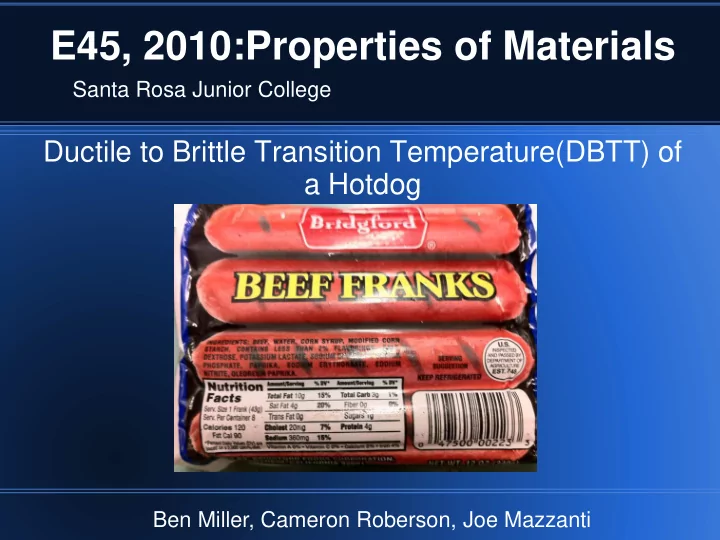
SLIDE 1
E45, 2010:Properties of Materials
Ductile to Brittle Transition Temperature(DBTT) of a Hotdog
Ben Miller, Cameron Roberson, Joe Mazzanti Santa Rosa Junior College
SLIDE 2 Our Inspiration
Our first idea was to find the tonal quality of
guitar strings
Guitar string samples failed without any data Our second idea was to test Younes's
hotdog claim, but it was only a joke.
Jokingly asked Younes about the Hotdog
experiment, and he thought it was a good idea, so here we are.
SLIDE 3 Theory
A hotdog (or any object) will vary in ductility
and brittleness with respect to temperature.
Younes said that at a certain temperature, a
hotdog should be strong enough so that you can, “hammer in a nail with it”.
Finding the DBTT of a hotdog will allow us
to predict where the hotdog is most able to hammer in a nail.
SLIDE 4 Theory
To measure the DBT of a Hotdog we used a
pendulum with a .5 kg weight attached.
With the length of the string, mass of the
weight, and velocity, we are able to find the kinetic energy needed to break the hotdog
SLIDE 5
Theory
SLIDE 6
Setup
Liquid Nitrogen Storage
SLIDE 7
Setup
Insulating container for hotdogs inside and out See us add the liquid nitrogen!
SLIDE 8
Original Setup
Motion Detector Laptop with Logger Pro Weight Connected to String
SLIDE 9
The revised setup
500 g. mass Motion detector Hot dog and holder String (50 cm) If you don’t understand this slide, come see for yourself.
SLIDE 10
Thermocoupler
Setup
SLIDE 11 Making the Temperature Profile
Temperature = 26.749Ln(m inutes) - 106.73
5 10 15 20 25 30 35 Tem perature( degrees C) Tim e( m inutes)
Tem perature Profile of Hotdog
Please note that the temperature values are adjusted by -5°C due to some error in the thermocoupler.
SLIDE 12
Logger Pro sample
See the trial that corresponds!
SLIDE 13 Sample Calculations
Find theoretical velocity of the pendulum at the instant before impact: Final velocity equation derived in earlier slide.
s m m m s m h h g
f
937 . 2 ) 51 . 95 (. 8 . 9 ( 2 V ) ( 2 V
2 l theoretica l theoretica
= − = − =
SLIDE 14
Sample calculations
Energy required to break a hot dog sample:
1.602J ) s m 1.489 s m 37 (.5kg)(2.9 2 1 ) V m(V 2 1
2 2 2 actual 2 l theoretica
= − = −
SLIDE 15
DBT theory explained
In all, we ended up with six decent data points. Not enough to form the high quality curve you can find in a textbook. The point of inflection (concave up to concave down) is the DBTT. We plot kinetic energy required to destroy the hot dog against the temperature that the hot dog was at when it was destroyed.
SLIDE 16 DBT Graph
0.5 1 1.5 2 2.5
- 100
- 90
- 80
- 70
- 60
- 50
- 40
- 30
- 20
- 10
Energy required to break ( J) Tem perature ( degrees C)
DBT of a Hotdog
The point of inflection exists at about -30° C It took us between 17 and 20 minutes to reach DBT
SLIDE 17
Younes on trial
Now that a reasonable temperature for DBT has been found, we must test a hot dog to see if Younes’s claim stands. Hot Dog after warming for less than 15 mins. Hot Dog after warming for 18 min.
SLIDE 18
Conclusion
Younes is right. It is possible to hammer in a nail with a hot dog. Our DBTT is in a range of about + or - 10°C. Some sources of error Other sources of error include the string we used, the timer we used, and the range of the motion detector, among other things.
SLIDE 19 Conclusion
How to eliminate errors: If we were to experiment again, we would definitely replace our string on the pendulum. We would use a rod attached to a ball bearing so our mass does not miss our sample or hit the frame of our support structure. We would also run multiple timers on our different groups of hot dogs in order to keep better track
- f their temperature/time ratio.
SLIDE 20
Special Thanks to:
The SRJC Chemistry Department: for their advice concerning liquid nitrogen The SRJC Physics Department: for lending our group all the equipment (excluding hot dogs and nitrogen) required to run our trials. And lastly…
SLIDE 21
Our lab mascot
That was Fantastic!!!