Dunmore Sand and Soil Modif ific ication 2 2 - Stage 5 10 10 - - PowerPoint PPT Presentation

dunmore sand and soil
SMART_READER_LITE
LIVE PREVIEW

Dunmore Sand and Soil Modif ific ication 2 2 - Stage 5 10 10 - - PowerPoint PPT Presentation

Dunmore Sand and Soil Modif ific ication 2 2 - Stage 5 10 10 Apr April il 20 2019 19 Com Communit ity Brie riefin ing Pre Presenta tati tion DSS Mod 2 Briefing - Introduction Agenda Welcome - Paul Jackson (Stakeholder
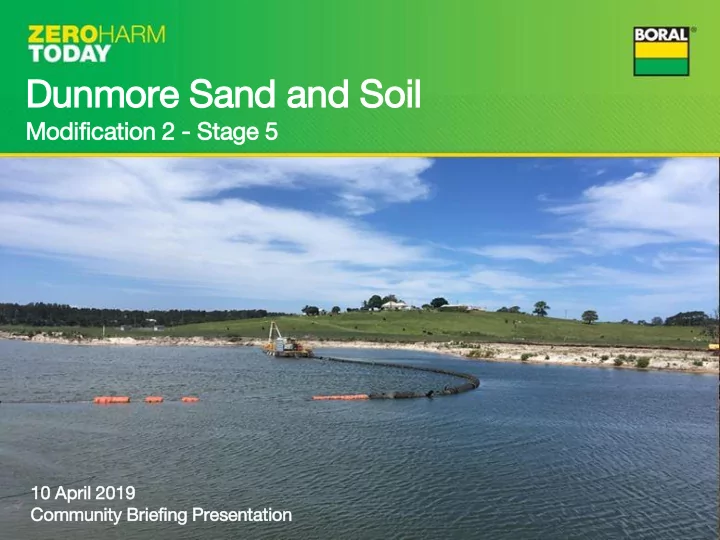

slide-1
SLIDE 1

Dunmore Sand and Soil

Modif ific ication 2 2 - Stage 5

10 10 Apr April il 20 2019 19 Com Communit ity Brie riefin ing Pre Presenta tati tion

slide-2
SLIDE 2

DSS Mod 2 Briefing - Introduction

Agenda

  • Welcome - Paul Jackson (Stakeholder Relations Manager) and Matthew

Banks (DSS Quarry Manager)

  • Overview of MOD 2 - Adnan Voloder (Planning and Development Manager)
  • Ecology - Adnan Voloder and Simon Tweed (Niche Consulting)
  • Water management - Ben Williams (Dunmore Environmental Co-ordinator)
  • Other issues nominated by visitors/questions - Residents
  • Conclusion
slide-3
SLIDE 3

DSS Mod 2 Briefing - Overview

slide-4
SLIDE 4

DSS Mod 2 Briefing - Overview

slide-5
SLIDE 5

DSS Mod 2 Briefing - Introduction

  • Modification to existing

approval to establish additional extraction areas (Stage 5)

  • Extraction is proposed in two

separate extraction areas, namely Stage 5A and 5B

  • Stage 5A (immediately south
  • f Riverside Drive)
  • Stage 5B (to the north of

Minnamurra River).

  • Sand resource to be extracted

is estimated at 234,000 t and approximately 1,123,000 t respectively

  • Mobile plant and equipment

will be operated across both extraction areas. Extraction methods will be identical to those in Stages 2 and 3. ~ 370m ~ 420m

slide-6
SLIDE 6

DSS Mod 2 Briefing - Stage 5A

  • Stage 5A
  • Establishment Process

Clearing and grubbing of groundcover vegetation. Topsoil stripped and stockpiled, for later re- use in rehabilitation. Earth mounds will be formed using a dozer to construct the flood protection bunding for the dredge pond.

  • Rehabilitation

Stage 5A backfilled with VENM, topsoil spread and groundcover vegetation planted to return the land to pasture.

  • Indicative timeframes

1-3 years

slide-7
SLIDE 7

DSS Mod 2 Briefing - Stage 5B

  • Establishment Process

Same as 5A

  • Rehabilitation

Stage 5B will be left as a freshwater pond, inline with existing practices implemented in Stage 2 - includes: ·Appropriate edging being implemented on the lake edge, to provide additional habitat for native fauna; ·Plant species planted along the lakes edges will be selected to maximise the bank stability; ·A fringing wetland community being created along the western and southern boundary, complemented by adjoining tree stands, improving habitat diversity; ·stabilise re-profiled areas as soon as possible, minimise potential erosion and degradation of areas

  • f exposed topsoil.
  • Indicative timeframes

~ 4-5 years

slide-8
SLIDE 8

DSS Mod 2 Briefing - Stage 5B - Rehabilitation

slide-9
SLIDE 9

DSS Mod 2 Briefing - Ecology

  • Role of Ecologist
  • Initial Engagement
  • Survey work completed
  • Findings of Surveys completed
slide-10
SLIDE 10

DSS Mod 2 Briefing - Ecology

  • NSW major projects assessed under BC Act using 3-stage approach of:

○ Avoid ○ Mitigate ○ Offset

  • Avoidance measures have focused on avoiding the majority of native vegetation and impacts on

adjacent areas mapped as Coastal Wetlands including proximity areas.

  • Mitigation measures will primarily involve clearing controls, a rehabilitation plan and protection of

adjacent areas.

  • Offsetting will be done in accordance with the NSW Biodiversity Assessment Methodology
slide-11
SLIDE 11

DSS Mod 2 Briefing - Ecology

  • Disturbance footprint is not

within the Coastal Wetlands Proximity Area (Buffer Area) and the Coastal Wetland itself.

  • Design was specifically

done to avoid impacts to coastal wetlands areas

slide-12
SLIDE 12

DSS Mod 2 Briefing - Ecology

slide-13
SLIDE 13

DSS Mod 2 Briefing - Ecology

slide-14
SLIDE 14

DSS Mod 2 Briefing - Ecology

slide-15
SLIDE 15

DSS Mod 2 Briefing - Ecology

slide-16
SLIDE 16

Current Operations Water Management: Stage 2

  • Stage 2 is the former dredge pond. It is

being backfilled for rehabilitation.

  • The pond is online to Rocklow Creek.

The pond was kept offline until the size of the pond was maximised.

  • There is a valved transfer pipe which can

turn discharge offsite on/off.

  • Water quality is measured monthly and

after 20mm of rainfall in 24 hours. Monitoring points are shown in red.

slide-17
SLIDE 17

Current Operations - Site Discharge

  • The re-aligned channel

was designed to keep the Stage 3 dredge pond

  • ffline.
  • The channel has been

designed to allow settling

  • f water in the case of

high rainfall.

  • Has been designed so it

does not inhibit natural flows and to mimic the flow of the former Western Tributary channel.

  • The water supply from

Stage 2 to this channel is valved so the site can turn discharge on/off.

slide-18
SLIDE 18

Current Operations - Site Discharge

slide-19
SLIDE 19

Current Operations - Site Discharge

slide-20
SLIDE 20

Current Operations - Site Discharge

slide-21
SLIDE 21

DSS Mod 2 Briefing - Current Ops Water Management

  • The Stage 3 pond is the current
  • perational dredge pond.
  • The circuit shown in yellow is kept
  • ffline to Rocklow Creek. No water

flows from this offline circuit expect in the case of an overflow.

  • The fines pond is protected by a 3.7m

bund which was designed to protect against a 1 in 100 year rainfall event.

  • Dredging and backfilling will cease if

there is less than 30cm freeboard within the dredge pond.

  • Water Quality is measured monthly.

Monitoring points are shown in red.

slide-22
SLIDE 22