Dual Credit Programs COLLEGE TRANSITIONS & DEVELOPMENTAL - - PowerPoint PPT Presentation

dual credit programs
SMART_READER_LITE
LIVE PREVIEW

Dual Credit Programs COLLEGE TRANSITIONS & DEVELOPMENTAL - - PowerPoint PPT Presentation

Elgin Community College Dual Credit Programs COLLEGE TRANSITIONS & DEVELOPMENTAL EDUCATION RODRIGO LOPEZ, MPA ASSISTANT DEAN OF SCHOOL PARTNERSHIPS ROLOPEZ@ELGIN.EDU EARLY COLLEGE CREDIT DUAL CREDIT Organized program with signed

slide-1
SLIDE 1

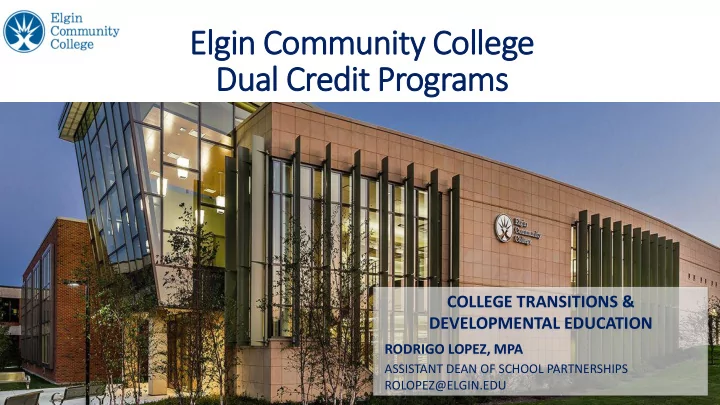
Elgin Community College Dual Credit Programs

COLLEGE TRANSITIONS & DEVELOPMENTAL EDUCATION

RODRIGO LOPEZ, MPA

ASSISTANT DEAN OF SCHOOL PARTNERSHIPS ROLOPEZ@ELGIN.EDU

slide-2
SLIDE 2

EARLY COLLEGE CREDIT

  • DUAL CREDIT
  • Organized program with signed agreements between the school districts and Elgin

Community College – students take college courses at ECC and earn both high school and college credit. Credit is earned while in high school.

  • ADVANCED PLACEMENT (AP)
  • High school students enroll in College Board’s Advance Placement courses and earn a

qualifying score on the AP exam. Official scores must be sent to the college. Credit is awarded after matriculation to college.

  • DUAL ENROLLMENT
  • Qualified, individual high school students take college courses on their own – for college

credit only (high school credit may or may not be awarded). Credit is earned while in high school.

slide-3
SLIDE 3

ADVANTAGES OF DUAL CREDIT

  • Upon successful completion, earn both college credit and high school credit
  • Students learn the rigors of college work early. They are able to adjust study

habits to college work before they have to deal with the total college experience

  • Saves students and parents money
  • Students can complete entry-level general education, elective, or career and

technical courses

  • Significantly lower costs than they would experience at four-year public or

private institution of higher education

slide-4
SLIDE 4

DUAL CREDIT: PART-TIME OPTIONS

CAREER TECHINICAL EDUCATION

Part-time Dual Credit program on ECC’s

  • campus. Students are enrolled in a Career-

Technical Education programs (i.e. Basic Nursing Assistant, Criminal Justice, etc.) and complete 2-3 courses each semester. Students earn a total of 15 credits and earn certifications (if applicable).

  • Career-Technical Pathways
  • Basic Vocational Specialist (BVS) Certificates
  • BVS in Basic Nurse Assistant Training Program
  • BVS in EMS
  • Industry Credentials
  • Certified Nursing Assistant (CNA)
  • EMT Basic Certification

GENERAL EDUCATION

Part-time Dual Credit program on ECC’s

  • campus. Students are enrolled in 1-2 general

education courses each semester. Students can earn a total of 12 transferable credits. Classes are taught on ECC’s campus during the week in the afternoon. Students can complete college-level courses in psychology, sociology, humanities, calculus, English, foreign language, etc.

  • General Education Core Curriculum
  • Major Electives
  • Transfer Degree Requirements
slide-5
SLIDE 5

BASIC NURSING ASSISTANT & CLINICAL LAB TECH PROGRAM

DUAL CREDIT: PART-TIME OPTIONS

9340 - Basic Nurse Assistant & Clinical Lab Technology Year 1 Basic Nurse Assistant Training Program NUR 105 (9341) 7 Credits Phlebotomy CLT 101 (9338) 3 Credits Clinical Lab Assistant Skills I CLT 105 (9339) 2 Credits Clinical Lab Assistant Skills II CLT 106 (9344) 3 Credits Certificate: BVS in Basic Nurse Assistant Training Program Industry Certification: Certified Nursing Assistant Summer Clinical Lab Technology Practicum I CLT 120 1.5 Credits Certificate: BVS in Phlebotomy Industry Certification: Phlebotomy ASCP Year 2 Principles of Biology BIO 110 (9336) 4 Credits Introduction to Psychology PSY 100 (9517) 3 Credits Human Anatomy & Physiology I BIO 245 (9346) 5 Credits

slide-6
SLIDE 6

GENERAL EDUCATION

DUAL CREDIT: PART-TIME OPTIONS

Course Title Course ID ECC Credits American Government # POS 150 3 Calculus with Analytic Geometry II

#, +

MTH 210 5 Calculus with Analytic Geometry III

#, +

MTH 230 5 English Composition 1

#, +

ENG 101 3 English Composition 2

#

ENG 102 3 Ethics # HUM 216 3 General Education Statistics # MTH 102 3 Introduction to Psychology

#, +

PSY 100 3 Introduction to Sociology

#, +

SOC 100 3 Introduction to Western Humanities

#

HUM 101 3 Japanese I (Blended Format)

=, +

JPN 101 3 Japanese II (Blended Format)

=, +

JPN 102 4 Principles of Biology

#, +

BIO 110 4 Principles of Microeconomics # ECN 201 3

(#) General Education Requirement – These courses fulfill a general education core requirement. As part of students’ baccalaureate education, a series of courses in varying disciplines are required prior/during the completion of specified (i.e. Major/Minor) courses that are selected for the program of study that is being completed. These courses have a high transferability rate and are typically completed within the first couple of years in college. (=) Elective – These courses help a student towards the successful completion of their required elective hours. Each program/institution sets a minimum of courses that students must complete separate from general education and major/minor specific courses. Often, these courses serve to fulfill a prerequisite in a math or science sequence. (+) Prerequisite – These courses are required in order to continue in the specified sequence (i.e. Biology, Chemistry, Mathematics, and/or Physics). Students must earn at least a “C”. The courses will also satisfy either a general education core requirement or be credited as electives.

slide-7
SLIDE 7

DUAL CREDIT: FULL-TIME OPTION

  • Students are enrolled in 4-5 general education courses each semester
  • Students can earn a total of 30+ transferable credits each year
  • Students are fully integrated into the college atmosphere
  • Students are provided with the guidance and academic advising
  • Courses are aligned to an Associate in Arts, Associate in Science, or CTE degrees
  • All high school graduation requirements will be completed*
  • Students will be able to continue their participation in high school activities and clubs*
  • Students will be welcomed to joined clubs & organizations at ECC

*High school district might have additional policies/requirements

SENIOR PATHWAY - GENERAL EDUCATION

slide-8
SLIDE 8

DUAL CREDIT: FULL-TIME OPTION

  • Students are enrolled in both Fire Science and Safety and General Education courses
  • Students will complete the Associate of Applied Science in Fire Science and Safety degree
  • Students are fully integrated into the college atmosphere
  • Students are provided with the guidance and academic advising
  • All high school graduation requirements will be completed*
  • Weekly Progress Meetings at high schools
  • Students will be able to continue their participation in high school activities and clubs*
  • Students will be welcomed to joined clubs & organizations at ECC

*High school district might have additional policies/requirements JUNIOR PATHWAY – FIRE SCIENCE AND SAFETY

slide-9
SLIDE 9

DUAL CREDIT: FULL-TIME OPTION

Things to Consider

  • Students involved in extra-curricular high school activities, will need to ensure they can commit to

an 8 a.m.-3:15 p.m. school day

  • ECC’s academic calendar is different from high school calendar.
  • The grades will result in a permanent college transcript
  • Students must follow all college policies and procedures (i.e. Code of Conduct)
  • Students are required to work closely with their high school counselor and ECC staff
  • Students will complete a rigorous college curriculum
  • Academic Plans will be unique to student’s intended major and institution
  • 1 Year Program – Courses are preselected by ECC and HS Districts
slide-10
SLIDE 10
slide-11
SLIDE 11
slide-12
SLIDE 12

“HOW DO I ENROLL?”

ADMISSIONS PROCESS

  • Meet and discuss the dual credit program/s with your guidance counselor
  • Complete online application
  • Submit high school transcripts
  • Meet all minimum competencies and prerequisites (English, reading, and math)
  • Dual Credit Office will provide the high school with a roster of eligible students.
  • High schools will meet with students and confirm admission
slide-13
SLIDE 13

TIMELINE AND DEADLINES

slide-14
SLIDE 14

Next Steps from ECC

Admission Decision

  • Elgin Community College will send a “Acknowledgement Letter” to indicate the application has been processed
  • Upon confirming testing and other requirements, guidance counselor will communicate the admission decision

directly to students Dual Credit Welcome Night and Student Orientation

  • After students have been accepted to their program, they will receive an official invitation to attend a

mandatory Welcome Night event and Student Orientation. Parents highly encouraged to attend “Welcome Night. ECC Student Portal & Email

  • This will be the primary channel of communication. Schedules will be available through the student portal prior

to the start of the semester. Set-up instructions will provided at orientation. Bookstore & Support Services

  • Information about textbooks and campus support services will be available during the Welcome Night and

Student Orientation

slide-15
SLIDE 15

Frequently Asked Questions

  • Who do I meet with at the high school?
  • Does the high school have additional requirements?
  • What if the student is enrolled in an Advanced Placement course?
  • What costs will the student be responsible for paying?
  • Who can we talk to if we have follow up questions?
  • How will admission, testing, and scheduling decisions be communicated?
  • What will the semester schedule be like?
  • Will students be allowed to participate in athletics/activities at the high school?
  • When is the deadline to change course selections?
  • Midterm and Final grades – How will the school be notified?
  • How do I find out which programs are offered through my high school?