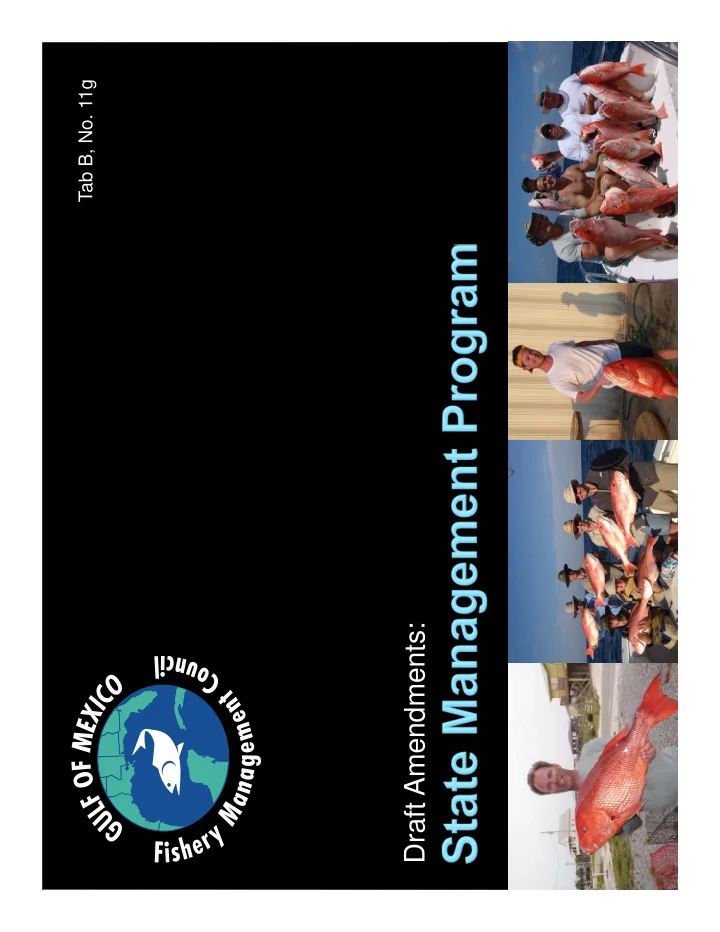
SLIDE 1
Draft Amendments:
Tab B, No. 11g
SLIDE 2
- Current preferred alternatives
- How state management would work
Potential Alternatives
adjacent to each state in the EEZ
permits Issues
participating
vessels
water enforcement
SLIDE 3
Inconsistent with each other Program Amendment Action 1: Components Alt 4 (Aug 2017) Each state decides to manage private only or both components. Action 2: Allocation Alt 6 (June 2018) EFP allocations Individual States LA MS AL FL TX Action 1: Delegation or CEPs Alt 2, Options 2a-2d (Apr 2018) Alt 2, Options 2a-2d (Apr 2018) Alt 2, Options 2a-2d (Apr 2018) None Alt 2, Options 2a-2e + 2g (June 2018) Action 2: Quota Adjustment Alt 2, Option 2a (Aug 2017) Alt 2, Option 2a (Jan 2018) None None None
SLIDE 4
Action 1 – Components of the Recreational Sector to include in State Management Programs Preferred Alternative 4: For a state with an approved state management program, the state will choose whether to manage its private angling component only, or to manage both its private angling and federal for-hire components. Action 2 – Apportioning the Recreational ACL (Quota) Preferred Alternative 6: Establish an allocation of the recreational sector ACL that may be used for state management programs by apportioning the private angling ACL among the states based on the allocations set in the exempted fishing permits approved for the states to manage the recreational harvest of red snapper in 2018 and 2019.
SLIDE 5
- All 5 states have state management
amendments approved and programs in place.
- States establish fishing seasons when red
snapper may be landed from state and federal waters.
- Enforcement carried out dockside.
- EEZ essentially stays open.
SLIDE 6
participating.
vessels.
requiring on-the-water enforcement. May require partitioning the EEZ.
SLIDE 7
- Establishing allocation by
state
- Permits are transferable
- Gulf-wide permit, but all
states may not participate Alternatives:
- Partition the EEZ
- Endorsement to for-hire
permits to determine state for landings
SLIDE 8 Alternative: Establish a red snapper endorsement for vessels with a charter/headboat permit for Gulf reef
- fish. To land red snapper in a state managing the
federal for-hire component in the Gulf, a federally permitted vessel must have an endorsement for that state, and must follow the regulations specific to the state program for which the endorsement is issued. A Gulf-wide endorsement will be required for vessels with a charter/headboat permit for Gulf reef fish to land red snapper in a state not managing the for-hire component under an approved state management program.
SLIDE 9
If the permit is transferred and the new permit holder will be fishing in a different jurisdiction: Option a: an endorsement for a different state management program or the Gulf-wide season will not be issued to the transferred permit until the following fishing year. Option b: a new endorsement may be issued upon request for a different state management program.
SLIDE 10 State management, as it has been previously considered by the Council, included measures that would rely primarily on dockside enforcement, such as bag limits (Options 2a and 2b) and size limits (Options 2c and 2d). When in federal waters, enforcement would be
- f the most generous state regulation (e.g., highest bag limit) of a state
with an open season. Option 2a: bag limit Option 2b: for-hire vessel captain/crew may not retain a bag limit Option 2c: minimum size limit within range of 14 to 18 inches TL Option 2d: maximum size limit Option 2e: requirements for live release devices (e.g., descending devices) Option 2f: requirements for harvest gear Option 2g: use of area or depth-specific regulations.
SLIDE 11
Option 2e: requirements for live release devices (e.g., descending devices) Option 2f: requirements for harvest gear State regulations could be written for dockside enforcement (“must carry aboard”), and not require delegation Option 2g: use of area or depth- specific regulations. Without further information about the scope and purpose of the area or depth-specific regulations, Option 2g cannot be included in a state’s delegation.