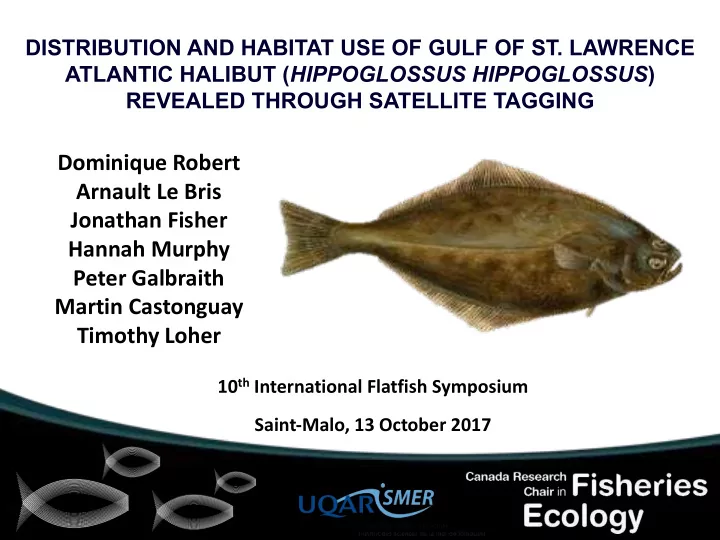
SLIDE 1 DISTRIBUTION AND HABITAT USE OF GULF OF ST. LAWRENCE ATLANTIC HALIBUT (HIPPOGLOSSUS HIPPOGLOSSUS) REVEALED THROUGH SATELLITE TAGGING
Dominique Robert Arnault Le Bris Jonathan Fisher Hannah Murphy Peter Galbraith Martin Castonguay Timothy Loher
10th International Flatfish Symposium Saint-Malo, 13 October 2017
SLIDE 2 Canadian Atlantic halibut stocks
Gulf halibut
– Exploited by 5 provinces – 30% of total landings – Stock considered healthy (DFO surveys, commercial catch)
- Value of landings in 2015: $51 Million
SLIDE 3 DFO In prep.
Gulf halibut – good news
2017-18 = 1296 t
Year Landings (t)
SLIDE 4 Data needs for the Gulf stock
– Spawning and nursery areas – seasonal migrations – habitat distributions
assessment model
– SSB, mortality, exploitation rate, reference points
- Uncertainty on stock structure
– genetic studies – tagging studies
SLIDE 5 Objectives of the study
- Determine distribution and seasonal migrations
- Assess depth associations over an annual cycle
- Test the hypothesis that tagged individuals complete their annual cycle in
the Gulf
- Identify winter spawning grounds for the stock
The main objective is to gain knowledge of key ecological traits of GSL halibut to inform and improve a new longline survey carried
- ut in partnership with industry
Record T, D, light for programmed durations Upon release, float and transmit data directly via satellites No need to recover PSATs to receive some data
SLIDE 6
Tagging Methods
SLIDE 7 Deployment locations
2013-14 (108-139 cm) 2014-15 (86-98 cm) 2015-16 (141-174 cm)
SLIDE 8
Depth and temperature: PSAT 131932
SLIDE 9
Putative spawning rise patterns
Murphy et al. 2017. Marine and Coastal Fisheries n = 11 n = 11
SLIDE 10 Geolocation model
Le Bris et al. (2017) ICES J Mar Sci
- A hidden Markov model was used to compute the posterior probability
distribution of daily locations between tagging and pop-off.
- Consists of a process model (2D random walk) and an observation model
(observational likelihood) considering depth and bottom temperature at a 2 km2 resolution within NAFO 4RST.
SLIDE 11
Geolocation results – All fish
Archived datasets 2013-14
SLIDE 12
Geolocation results – All fish
Archived datasets 2014-15
SLIDE 13
Geolocation results – All fish
Archived datasets 2015-16
SLIDE 14
Geolocation of spawning activity
recovered tags (2014-2016)
SLIDE 15
Preliminary conclusions
Ø So far, fish tagged in the GSL completed their seasonal migrations and spawned within the GSL Ø These results support the current management regime under which GSL stock is managed separately from southern stock Ø Geolocation model allowed the identification of migration corridors and putative spawning areas Ø Need for comprehensive satellite tagging in the whole management unit including the Northwest Gulf of St. Lawrence
SLIDE 16 Next steps:
Strategic Grant 2017-20
Ø Extend sat tagging to the northwestern and southern sectors of the GSL Ø Validate and possibly extend the geolocation model Ø Assess connectivity among the different sectors of the GSL through otolith chemistry Ø Identification of spawning and nursery areas through modelling of egg and larval drift
SLIDE 17
Deployment locations Sep-Oct 2017
SLIDE 18
Merci pour votre attention!