
SLIDE 1
Domain Name System (DNS)
Ayitey Bulley abulley@ghana.com
Session-3: Configuration of Authoritative Nameservers
Recap
- DNS is a distributed database
- Resolver asks Cache for information
- Cache traverses the DNS delegation tree to
find Authoritative name server which has the information requested
- Bad configuration of authoritative server can
result in broken domains
DNS Replication
- For every domain, we need more than one
authoritative nameserver with the same information (RFC 2182)
- Data is entered in one server (Master) and
replicated to the others (Slaves)
- Outside world cannot tell the difference
between master and slave
– NS records are returned in random order for equal load sharing
- Was called “primary” and “secondary”
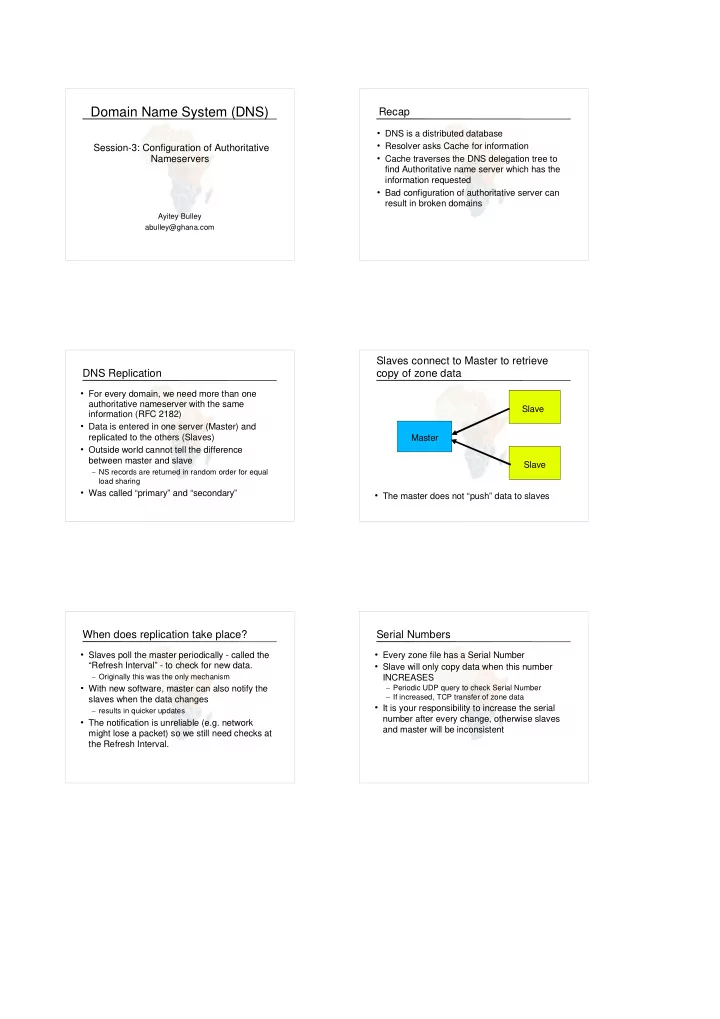
Slaves connect to Master to retrieve copy of zone data
- The master does not “push” data to slaves
Slave Slave Master
When does replication take place?
- Slaves poll the master periodically - called the
“Refresh Interval” - to check for new data.
– Originally this was the only mechanism
- With new software, master can also notify the
slaves when the data changes
– results in quicker updates
- The notification is unreliable (e.g. network
might lose a packet) so we still need checks at the Refresh Interval.
Serial Numbers
- Every zone file has a Serial Number
- Slave will only copy data when this number
INCREASES
– Periodic UDP query to check Serial Number – If increased, TCP transfer of zone data
- It is your responsibility to increase the serial