1 DNS: The Politics DNS: The Politics DNS: The Big Issues DNS: - - PDF document

1
SMART_READER_LITE
LIVE PREVIEW

1 DNS: The Politics DNS: The Politics DNS: The Big Issues DNS: - - PDF document

Today Today 1. Domain Name Service (DNS) illustrates: issues and structure for large-scale naming systems naming contexts The Domain Name Service, Etc. The Domain Name Service, Etc. use of hierarchy for scalability decentralized


slide-1
SLIDE 1

1

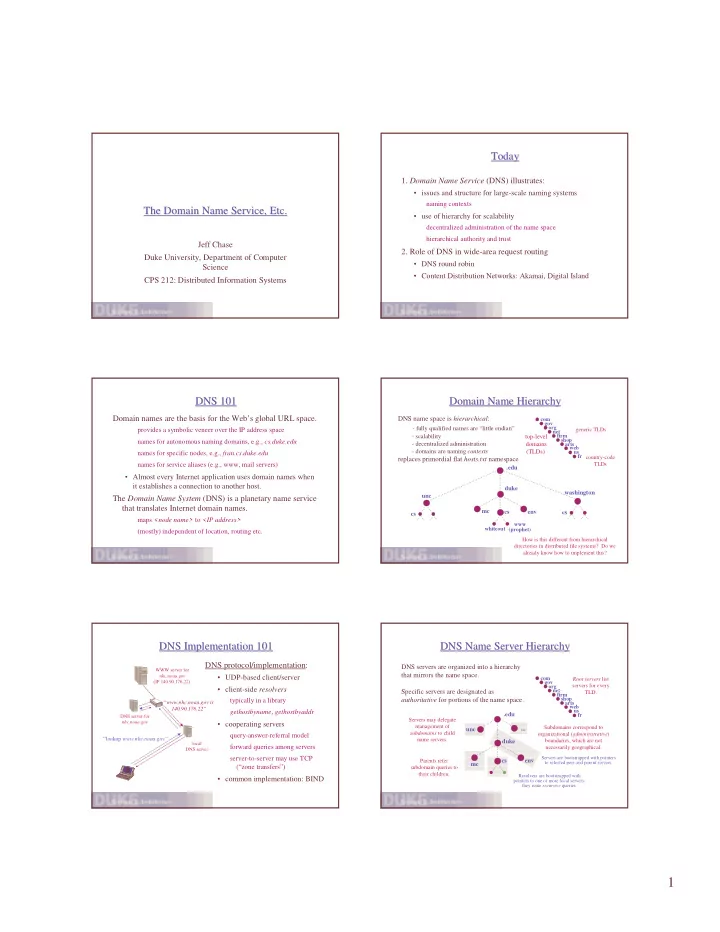
The Domain Name Service, Etc. The Domain Name Service, Etc.

Jeff Chase Duke University, Department of Computer Science CPS 212: Distributed Information Systems

Today Today

  • 1. Domain Name Service (DNS) illustrates:
  • issues and structure for large-scale naming systems

naming contexts

  • use of hierarchy for scalability

decentralized administration of the name space hierarchical authority and trust

  • 2. Role of DNS in wide-area request routing
  • DNS round robin
  • Content Distribution Networks: Akamai, Digital Island

DNS 101 DNS 101

Domain names are the basis for the Web’s global URL space.

provides a symbolic veneer over the IP address space names for autonomous naming domains, e.g., cs.duke.edu names for specific nodes, e.g., fran.cs.duke.edu names for service aliases (e.g., www, mail servers)

  • Almost every Internet application uses domain names when

it establishes a connection to another host.

The Domain Name System (DNS) is a planetary name service that translates Internet domain names.

maps <node name> to <IP address> (mostly) independent of location, routing etc.

Domain Name Hierarchy Domain Name Hierarchy

.edu unc cs duke cs env mc

www (prophet) whiteout

cs washington

com gov

  • rg

net firm shop arts web us

top-level domains (TLDs)

fr generic TLDs country-code TLDs

DNS name space is hierarchical:

  • fully qualified names are “little endian”
  • scalability
  • decentralized administration
  • domains are naming contexts

replaces primordial flat hosts.txt namespace

How is this different from hierarchical directories in distributed file systems? Do we already know how to implement this? “lookup www.nhc.noaa.gov”

DNS server for nhc.noaa.gov local DNS server

“www.nhc.noaa.gov is 140.90.176.22”

DNS Implementation 101 DNS Implementation 101

WWW server for nhc.noaa.gov (IP 140.90.176.22)

DNS protocol/implementation:

  • UDP-based client/server
  • client-side resolvers

typically in a library gethostbyname, gethostbyaddr

  • cooperating servers

query-answer-referral model forward queries among servers server-to-server may use TCP (“zone transfers”)

  • common implementation: BIND

DNS Name Server Hierarchy DNS Name Server Hierarchy

.edu unc duke cs env mc ...

com gov

  • rg

net firm shop arts web us fr Root servers list servers for every TLD.

DNS servers are organized into a hierarchy that mirrors the name space. Specific servers are designated as authoritative for portions of the name space.

Subdomains correspond to

  • rganizational (admininstrative)

boundaries, which are not necessarily geographical. Servers may delegate management of subdomains to child name servers. Parents refer subdomain queries to their children.

Servers are bootstrapped with pointers to selected peer and parent servers. Resolvers are bootstrapped with pointers to one or more local servers; they issue recursive queries.

slide-2
SLIDE 2

2

DNS: The Politics DNS: The Politics

He who controls DNS controls the Internet.

  • TLD registry run by Network Solutions, Inc. until 9/98.

US government (NSF) granted monopoly, regulated but not answerable to any US or international authority.

  • Registration is transitioning to a more open management

structure involving an alphabet soup of organizations.

For companies, domain name == brand.

  • Squatters register/resell valuable domain name “real estate”.
  • Who has the right to register/use, e.g., coca-cola.com?

DNS: The Big Issues DNS: The Big Issues

  • 1. Naming contexts

I want to use short, unqualified names like whiteout instead of whiteout.cs.duke.edu when I’m in the cs.duke.edu domain.

  • 2. What about trust? How can we know if a server is

authoritative, or just an impostor?

What happens if a server lies or behaves erratically? What denial-of-service attacks are possible? What about privacy?

  • 3. What if an “upstream” server fails?
  • 4. Is the hierarchical structure sufficient for scalability?

more names vs. higher request rates

DNS Caching DNS Caching

Caching of query responses allows subsequent queries to bypass the roots of the server hierarchy.

Each response is stamped with a time-to-live (TTL) to limit damage from stale cache entries.

.edu duke cs TLD root

prophet.cs.duke.edu Local server caches .edu, duke.edu, cs.duke.edu, and prophet.cs.duke.edu. response query What about negative caching: is it worthwhile to cache negative responses?

DNS Replication DNS Replication

Every DNS domain has or should have at least

  • ne secondary name server replica.
  • configure peers to offload queries from primary
  • serve as authoritative backup

Secondary replicas keep themselves up to date by periodically fetching/refreshing the entire naming database via zone transfer (TCP).

The primary database is timestamped with a “serial number” to short-circuit if no updates have occurred since last zone transfer. How to load-balance the secondaries? What if primary is overloaded with too many secondaries requesting zone transfers?

.edu duke cs mc

query zone transfer primary secondary query (backup) domain admin updates primary

Reverse Translation Reverse Translation

152 ...2 3 140 ... ...

5 (prophet) 152.3.140.5

... 4...

The Server Selection Problem The Server Selection Problem

Which network site? Which server?

“Contact the weather service.” server array A server farm B

slide-3
SLIDE 3

3

DNS Round Robin DNS Round Robin

“lookup www.nhc.noaa.gov” a

DNS server for nhc.noaa.gov

b c d

local DNS server

“www.nhc.noaa.gov is IP address a” (or {b,c,d})

Brisco (Rutgers), RFC 1794 What about DNS caching? How to handle server failures? How effective is the load-balancing?

Cisco DistributedDirector uses a more sophisticated DNS load balancing approach, based on its Director Response Protocol (DRP), and also incorporates HTTP redirection.

Generalized Cache/CDN Generalized Cache/CDN (External View)

(External View) {request, reply} Origin Servers Clients {push, request, reply}

Content Distribution Networks

Web Caches

Generalized Cache/CDN Generalized Cache/CDN (Internal View)

(Internal View) Leaf Caches

(e.g., ISP proxies)

Interior Caches

root caches reverse proxies CDN caches

Request Routing Function ƒ

bound client populations

ƒ

DNS DNS-

  • based Request Routing

based Request Routing

How to apply the request routing function ƒ?

  • Some intermediary intercepts the request, and directs it to a

selected site.

Smart proxies or switches? E.g., look at URL or server IP address.

  • Or, interpose on the binding procedure, before the client sends

the request itself.

Smart clients, Active Names, RPC binding, or DNS lookup

Third-party CDNs are based on DNS servers that select the cache/replica site on DNS lookup for the request.

Akamai, Digital Island, Web hosting providers (e.g., Exodus), etc. Like DNS-RR....but smarter...

Using DNS for Third Using DNS for Third-

  • party CDNs

party CDNs

Intelligent DNS-based request routing has some tricky parts:

  • Third-party CDNs contract with content providers (e.g., Web

sites such as cnn.com) to serve a subset of their content.

Resource-rich content, e.g., images, audio, video.

  • To use DNS request routing, the CDN must assume DNS

duties for the URLs that reference the content it serves.

  • The content provider does not want to designate the CDN as

the authoritative DNS server for its domain (e.g., cnn.com).

Solution: make up new DNS domains for the client provider’s content served by the CDN.

Domain Granularity and “Akamaizing” Domain Granularity and “Akamaizing”

  • CDN (e.g., Akamai) creates new domain names for each

client content provider.

e.g., a128.g.akamai.net

  • The CDN’s DNS servers are authoritative for the new

domains.

  • The client content provider modifies its content so that

embedded URLs reference the new domains.

“Akamaize” content, e.g.: http://www.cnn.com/image-of-the-day.gif becomes http://a128.g.akamai.net/image-of-the-day.gif.

  • Using multiple domain names for each client allows the

CDN to further subdivide the content into groups.

DNS sees only the requested domain name, but it can route requests for different domains independently.

slide-4
SLIDE 4

4

The Akamai et. al. DNS The Akamai et. al. DNS Hook Hook

get http://www.nhc.noaa.gov a

DNS server for nhc.noaa.gov

b c

local DNS server

www.nhc.noaa.gov “Akamaizes” its content. “Akamaized” response object has inline URLs for secondary content at a128.g.akamai.net and other Akamai-managed DNS names. akamai.net DNS servers lookup a128.g.akamai.net

Akamai servers store/cache secondary content for “Akamaized” services.

Wide Wide-

  • Area Request Routing

Area Request Routing

What information does a DNS-based request routing function ƒ have available to it?

  • client’s or proxy’s DNS resolver’s IP address

Gives the best guess at where the client is...can we do better?

  • domain name embedded in URL

content domain

  • NOT the rest of the URL
  • other information about server load or network state

The CDN decides where to cache/replicate each content domain, and which cache/replica to serve each request.

Directory Services (e.g., LDAP) Directory Services (e.g., LDAP)

A directory service is a souped-up a name service.

  • read-mostly access to named entries with unique, global

distinguished names

  • clients see a uniform view of a hierarchical name space

authority to serve the name space is partitioned across a collection

  • f servers

partitioning reflects geographical or organizational boundaries context-based lookups with referrals

  • simple updates: add/delete/update single entry
  • large-scale caching/replication with soft consistency

Attributes and Searching Attributes and Searching

Directory services are augmented with support for attributes.

e.g., LDAP: Lightweight Directory Access Protocol (X.500)

  • An entry is a named collection of attributes.
  • An attribute is a typed collection of values, whose format is

defined by its type.

e.g., printer, name=buzzard, location=LSRC 312, resolution=600dpi Attributes are more useful if their types are standardized.

Attributes can be used as the basis for searches that find an

  • bject with specified properties.
  • can specify filters, scope of search, etc.
  • goal: attribute-based definition of services