Domain analysis l Goal: build an object-oriented model of the real- - - PowerPoint PPT Presentation

domain analysis
SMART_READER_LITE
LIVE PREVIEW

Domain analysis l Goal: build an object-oriented model of the real- - - PowerPoint PPT Presentation

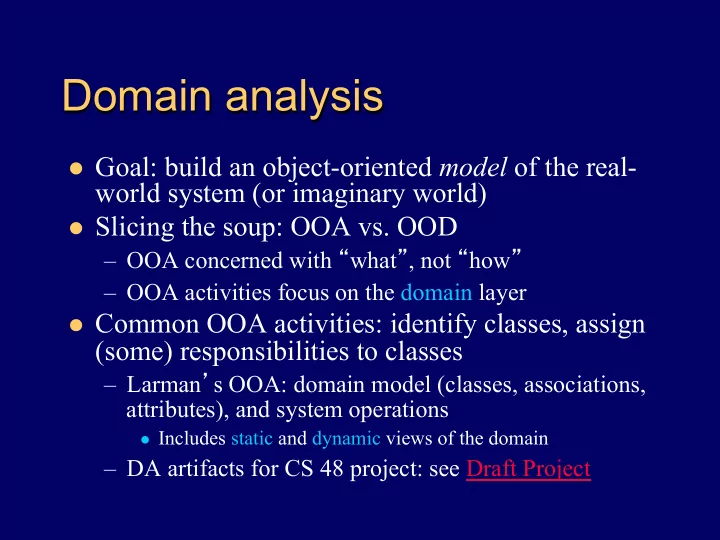
Domain analysis l Goal: build an object-oriented model of the real- world system (or imaginary world) l Slicing the soup: OOA vs. OOD OOA concerned with what , not how OOA activities focus on the domain layer l Common OOA


slide-1
SLIDE 1

Domain analysis

l Goal: build an object-oriented model of the real-

world system (or imaginary world)

l Slicing the soup: OOA vs. OOD

– OOA concerned with “what”, not “how” – OOA activities focus on the domain layer

l Common OOA activities: identify classes, assign

(some) responsibilities to classes

– Larman’s OOA: domain model (classes, associations, attributes), and system operations

l Includes static and dynamic views of the domain

– DA artifacts for CS 48 project: see Draft Project

slide-2
SLIDE 2

Domain analysis activities

l Static view – model the domain

– Identify domain concepts – Identify associations between the concepts

l Now ready to start drawing domain model – a visual

representation of these concepts and associations

– Identify attributes of the concepts

l Dynamic view – model the system behavior

– Make system sequence diagrams – Write system operation contracts

slide-3
SLIDE 3

Identifying concepts

l Class = major abstraction (i.e.,not just an attribute) l How to find candidate classes?

– Think/brainstorm about the domain

l Ask Who? What? When? Where? l But save the How? questions for OOD

– Identify the nouns & noun phrases in problem statement, use case descriptions, other …

l Consider all as candidates to start; refine later

– i.e., a candidate class turns out to be just an attribute

l But common error to decide too early

slide-4
SLIDE 4

Suggest: start CRC cards now

l 1 card for each candidate class, showing:

– Class name – do now – Responsibilities – knowledge now, operations in OOD – Collaborators – some now, more in OOD

l CRC cards are useful for both OOA and OOD:

– OOA – help sort out classes; use to lay out diagrams – OOD – role-playing to find operations; more diagrams

Class (name) Responsibilities

Collaborators

slide-5
SLIDE 5

Split cards into 3 piles

  • 1. Critical classes – must include
  • 2. Totally irrelevant classes – must reject

– Set aside, but record as irrelevant in glossary

  • 3. Classes you are still undecided about – ask

yourself questions like the following:

– Is it same as another class? Is it an instance? – Is it actually outside the system? (like a person) – Does it have unique knowledge/responsibilities? – Is it needed by other classes?

l Keep updating the piles as more is learned!

slide-6
SLIDE 6

Choosing concept names

l Note: if you can’t think of a simple, clear name,

maybe you have a bad abstraction!

l A good test: Can a person with domain knowledge

(not CS knowledge) describe the abstraction based on its

name alone?

l Best to use existing names “in the territory”

– Larman’s cartographer analogy – Also: “exclude irrelevant features”

l And “do not add things that are not there.”

l But no sense to labor over good candidate names

– e.g., “register” vs. “POST” – choice is arbitrary

slide-7
SLIDE 7

Specification types

l Larman tip: types that specify attributes for other

types are often handy (“Description Classes”)

– e.g., a ProductDescription – includes UPC, price, and any other specs common to an Item

l Two main purposes:

– Eliminate redundant storage – no need to store common specs with each item – Prevents loss of info when objects depleted – i.e., when the last item is sold

l In general, look for unifying concepts

slide-8
SLIDE 8

Partial POS domain model

l a.k.a. static

class diagram

l Concepts are

boxes

l Associations

are lines connecting boxes

l Other UML

details to follow

Register Item Store Sale CashPayment Sales LineItem Cashier Customer Product Catalog Product Description Stocks

*

Houses 1..* Used-by

*

Contains 1..* Describes

*

Captured-on Contained-in 1..* Records-sale-of 0..1 Paid-by Is-for Logs- completed

*

3 Works-on 1 1 1 1 1..* 1 1 1 1 1 1 1 0..1 1 1 Ledger Records- accounts- for 1 1

slide-9
SLIDE 9

Associations

l Def: relationships between concepts l Common associations:

– Dependency – a class “uses” another – Generalization – a class is derived from another – Aggregation – one class is a collection of others – But can be any kind of relationship

l Good association names are important too

– And helpful to identify the direction of association

l Also helpful to use proper UML

slide-10
SLIDE 10

UML: dependency relationship

l When a class “uses” or otherwise depends on

another class to fulfill a responsibility

– Dashed line with arrow in UML

slide-11
SLIDE 11

UML: showing generalization

l a.k.a.,

inheritance –

  • ne class is

derived from another

– In UML, triangle at end of line “points” at parent class

slide-12
SLIDE 12

UML: aggregation & multiplicity

l “Whole” is identified by the diamond shape

at that end of the line

many

slide-13
SLIDE 13

Naming associations

l Recommended for any relation between concepts

– Absolutely necessary if UML lacks notation (like dependency, aggregation, or generalization)

l Use verb or verb phrase: e.g., “records”, “paid by”

slide-14
SLIDE 14

Identifying associations

l Don’t overdo it

– Useful associations only – otherwise clutter – Must be domain-meaningful at this stage

l Highest priority categories are “need-to-know”

associations – knowledge of the relationship must be preserved for awhile

– A is physically or logically part of B – A is physically or logically contained in B – A is recorded in B

slide-15
SLIDE 15

Generalization

l A domain model term, concerning general-

specific relationships

– e.g., Bird – general – a.k.a. supertype Penguin – specific – a.k.a. subtype A Penguin is a Bird.

l Aids abstract thinking l Facilitates handling

– Express more economically in conceptual model – Lends itself to implementation using inheritance

slide-16
SLIDE 16

When to use generalization

l Define a subtype of a concept when instances of

the subtype differ from other instances, as in:

– They have additional attributes, and/or associations – They are handled differently, in important ways – They represent things with varying behaviors

l Define a supertype to generalize concepts when:

– All subtypes are true variations of a single concept, – Subtypes share the same attributes and associations, – And subtypes all conform to both:

l 100% rule – all supertype attributes and associations apply l “is a” rule

slide-17
SLIDE 17

Abstract Classes

l Def.: If every instance of a class C must

also be an instance of a subclass, then C is called an abstract conceptual class.

Payment

CashPayment CreditPayment CheckPayment

slide-18
SLIDE 18

vs Concrete Classes

l If a Payment instance exists which is not a

member of a subclass, then Payment is not abstract – it is concrete.

Payment

CashPayment CreditPayment CheckPayment

slide-19
SLIDE 19

UML: Abstract Classes

l UML notation: italicized class name Payment Cash Payment Check Payment Credit Payment

slide-20
SLIDE 20

Class attributes

l a.k.a., “properties” of classes

– Describe an object’s state at a point in time – Attributes are “pure data values” – not complex things (which are concepts, not attributes)

l Purpose of attribution:

– Insure that all information needed by the system’s

  • bjects is remembered somewhere

l Encapsulation principles help guide attribution

– Info is most useful if stored where it’s needed most – Identity info of an object is best stored with that object

slide-21
SLIDE 21

More attribution principles

l What to store depends on the application

– e.g. Employee – Name? Address? Wage? Title?

l Key question: What does this application need?

– i.e., need pertinent abstractions of concepts

l Representation depends on application too

– i.e., how to represent in the conceptual model

l e.g., Title just a String? – okay – else if complex meaning,

maybe it is a concept of its own, or an association

l Should be simple – “data types”

– e.g., 5, “white” – an instance has no unique identity

slide-22
SLIDE 22

Attribute or Class?

l Classes: objects with unique identities

– e.g., 2 instances of Person

l Attributes: primitive types

– e.g., number, string, time…

l What to do with non-primitive data types?

– composed of separate sections (address) – quantities with units (payment amount) – has more attributes (promotional price: start/end) – has operations associated (SSN: validate)

slide-23
SLIDE 23

UML: Attribute or Class?

l Non-primitive data types may be shown as

attributes or classes!

ProductSpecification ItemID

1 1

ProductSpecification id: ItemID

  • r
slide-24
SLIDE 24

Attribution in practice

l Two complementary approaches:

  • 1. Choose a class – list its properties
  • 2. Choose a property – ask what it describes

– Do it both ways for a complete set of attributes

l Probably will discover new concepts

– Okay – augment the conceptual model – Note: sometimes an association should store attributes

l Means the association is a concept of its own l e.g., Gymnast, Team – and Membership to associate them

slide-25
SLIDE 25

Attribution Pitfall

l Relate conceptual classes with an

association, not an attribute!

Cashier name currentRegister Cashier Register

1 1

name number

uses

slide-26
SLIDE 26

Glossary notes

l Record all attributes in the glossary

– Sometimes called the “data dictionary”

l Also record all concepts, associations,

  • perations, use cases, …

– And any terms that require clarification

l Purpose: reduce risk of miscommunication

– With clients, and other team members – And for yourself a few weeks down the road – And in CS 48 – so we can understand your artifacts

l But don’t overdo it – always minimize busywork

slide-27
SLIDE 27

System behavior

l Focus is on dynamic view: states and sequences l State of the system is like a snapshot – a point-

in-time record of memory contents

– What objects currently exist? – What associations are currently formed? – What are the current values of object attributes?

l System sequences involve changes in state

– Objects are created and destroyed – Associations are formed and broken – Values of attributes are modified

slide-28
SLIDE 28

System sequence diagrams

Partial SSD for Larman’s BuyItems use case

Actor triggers each event Each event has a signature Note :System is an instance – and a “black box”

slide-29
SLIDE 29

Naming events

l Use “level of intent” (still OOA, not OOD)

– i.e., not committed to a particular design

l e.g., makePayment instead of submitCash – leaves flexibility

for other payment types (in later cycle)

l Start with a verb – signifies something to happen l Be sure to cover each event in each use case

– i.e., playGame() is not an event! – it is at least a whole use case; probably many events – Best place to look: use cases’ typical courses of events

l Tip: if a simple name doesn’t work – maybe trying

to name a complex process, not an event

slide-30
SLIDE 30

System operations

l Focus in analysis stage is on effect of operations

– i.e., what happens to system’s state? – not how

l System operation contracts – describe the

system’s response to events

– Operation – same as event name; include parameters – Cross References – at least the use case(s) involved – Pre-conditions – assumptions about system state before the operation begins – Post-conditions – end changes the operation makes to system state: instances, attributes, associations

slide-31
SLIDE 31

Contract Example

Operation: makePayment(amount: Money) Cross References: UseCases: ProcessSale Preconditions: A sale is underway. Postconditions:

– a payment instance p was created – p.amountTendered became amount – p was associated with current Sale – current Sale was associated with Store

slide-32
SLIDE 32

Contract Guidelines

l Identify system operations from SSDs l For complex operations (may have subtle

results, unclear in use case): write contract

l For postconditions, use categories:

– instance creation/deletion – attribute modification – associations formed & broken

l As usual: Don’t overdo it!

slide-33
SLIDE 33

Next

System Design