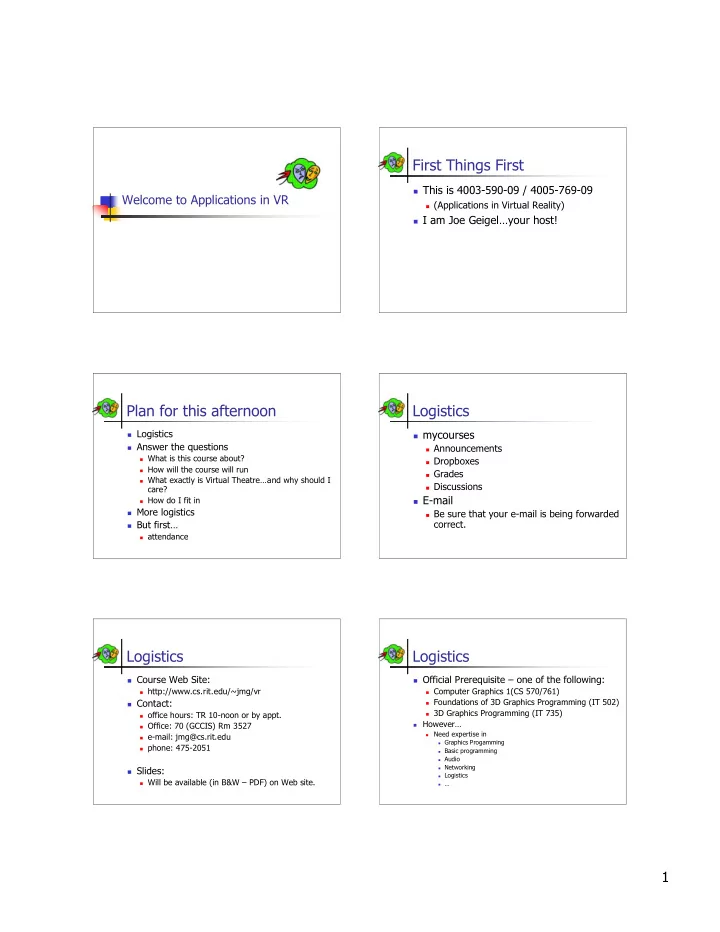
First Things First This is 4003-590-09 / 4005-769-09 Welcome to - - PDF document

first things first
SMART_READER_LITE
LIVE PREVIEW

First Things First This is 4003-590-09 / 4005-769-09 Welcome to - - PDF document

First Things First This is 4003-590-09 / 4005-769-09 Welcome to Applications in VR (Applications in Virtual Reality) I am Joe Geigelyour host! Plan for this afternoon Logistics Logistics mycourses Answer the questions


slide-1
SLIDE 1

1

Welcome to Applications in VR

First Things First

 This is 4003-590-09 / 4005-769-09

 (Applications in Virtual Reality)

 I am Joe Geigel…your host!

Plan for this afternoon

 Logistics  Answer the questions

 What is this course about?  How will the course will run  What exactly is Virtual Theatre…and why should I

care?

 How do I fit in

 More logistics  But first…

 attendance

Logistics

 mycourses

 Announcements  Dropboxes  Grades  Discussions

 E-mail

 Be sure that your e-mail is being forwarded

correct.

Logistics

 Course Web Site:

 http://www.cs.rit.edu/~jmg/vr

 Contact:

 office hours: TR 10-noon or by appt.  Office: 70 (GCCIS) Rm 3527  e-mail: jmg@cs.rit.edu  phone: 475-2051

 Slides:

 Will be available (in B&W – PDF) on Web site.

Logistics

 Official Prerequisite – one of the following:

 Computer Graphics 1(CS 570/761)  Foundations of 3D Graphics Programming (IT 502)  3D Graphics Programming (IT 735)  However…

 Need expertise in  Graphics Progamming  Basic programming  Audio  Networking  Logistics  …

slide-2
SLIDE 2

2

More Logistics

 Computing Environment

 ICL6

 Windows Machines  TORQUE gaming engine  Need SAMBA account

 Breakout Room 2

 MoCap development  Need access

Textbooks

3D Game Programming All in One, 2nd Edition By Kenneth Finney The Game Programmer's Guide to Torque By Edward F. Maurina III

Other references

 TORQUE developer pages

 http://www.garagegames.com/developer/t

  • rque/tge

Goals of the course

 Introduce students to virtual reality

hardware, software, and toolkits

 Apply to a given domain  Apply to a large scale problem.  Teamwork, teamwork, teamwork!

Virtual Theatre VR and Theatre

 Virtual Theatre

 A distributed computer system whereby

performers, stage crew, and audience can be in physically separate places yet share in the same live theatrical performance.

slide-3
SLIDE 3

3

Logistics

 This is a project based course  Teams will be assembled

 Each team will build a VT software component  Components will be connected via a common networking

infrastructure.

 Team Web site!  Grad students as team leaders!

 Collective goal:

 To build the framework for a virtual theatre system  Test the framework out on short virtual performance.  Have the system fully documented for next time.

Logistics

 Collaboration

 Within teams  Between teams  With artists in School of Design

 Questions so far?

How will the course be run?

Schedule will be aggressive

Weeks 1

Intro material

Team formation

Week 2

Define team implementation plan

Weeks 3 – 9

Group work

Lectures: status meetings / updates / working sessions

3 checkpoints

Week 9 - 10

Integration

Finals Week

Demonstration

How will the course be run

 Checkpoints

 Periodic Status checks

 Weeks 3,5,7,9  At least 1 intermediate deliverable  Demo

 Checkpoint deliverables vary by team

 Will be discussed at start of CP cycle.

How will the course be run

 Status meetings

 Announcements / new developments  News from the artistic side

 Updates  Mini-deliverables

 TBD

 Guaranteed team working time.

Important dates

 Checkpoint 1: Implementation Plans

 March 27th

 Checkpoint 2

 Demo: April 10th

 Checkpoint 3

 Demo: April 24th

 Checkpoint 4

 Demo: May 8

 Final demo

 Finals week

slide-4
SLIDE 4

4

Assessment – Team Grade

 Team grade

 Meeting checkpoint  Deliverable + demos  Working with final demo

 Individual Grades

 Peer review

 Evaluation of teams from those not in teams

 Teammate Evaluation

 Evaluation of students from teammates

 Leader Evaluation

 Evaluation of grad leaders from teammates

Grad Students

 In addition, Grad Students will be

assessed:

 Leadership Role -- Leader evals  Documentation -- Team documentation is

responsibility of leader.

 Other deliverables -- as agreed upon with

instructor.

Assessment

25% 20% Peer Evals (Individual) 20% Leadership / Docs (GRAD) 40% 35% Final Demo (Team) 35% 25% Checkpoints (Team) Undergrad Graduate

Plan for today

 Answer the questions

 What is this course about?  How will the course will run  What exactly is Virtual Theatre…why should I

care?

 How do I fit in

 Any questions?

This year’s domain

Virtual Theatre

 Art and Technology Collaboration

 Visuals  Lighting / Staging  Technology

slide-5
SLIDE 5

5

Virtual Theatre

 Our experiments in theatrical storytelling

 Live…action takes place in a distributed virtual space  Performers / crew control from a physical space  Active Audience Participation

Integration of distributed virtual reality / gaming technologies into the theatrical storytelling process.

Spring 2004 - present

Motivation

 Machinima

a new form of filmmaking that uses computer games technology to shoot films in the virtual reality of a game engine.

Anna (2003) -- Fountainhead Entertainment

Motivation

 Machinimation (Fountainhead Entertainment)

http://www.fountainheadent.com

Cinema vs. Theatre

 Cinema

 Recorded  Editted  Passive Audience  POV of filmmaker

 Theatre

 Live  Real time  Active Audience  POV of audience

Why Start From Scratch?

 Gaming Engines

 Provide object oriented graphical abstraction  Performs real time rendering  Provides networking infrastructure

 Requirements for theatrical use

 Adapt to use theatrical metaphor / language  Physical control of virtual characters and staging  Theatrical components designed by artisans.

Gaming Engines

 API

 Set of programming libraries used to create 3D games  Implies use of low level language (C, C++, Java)

 Scripting Systems

 Extending of existing games (Mods)  Game specific language  Constrained by capabilities of game / script  Examples  Quake II  Unreal Tournament  Second Life

slide-6
SLIDE 6

6

System Architecture

Graphics Hardware Graphics API Gam ing Eng ine

VIRTUAL THEATRE LAYER participant

Networking API Network Hardware To network To display Sound API Sound Hardware To speaker

Network Layout

Virtual stage

The Virtual Theatre Layer

 Components of a

theatrical production

 Action  Staging  Audience  Sound / Music  Objects to be defined

  • n virtual stage

 Actors  Stage Manager  Audience Member  Orchestra

Local device control

Shared Virtual stage

Local device control component Local control object Shared control object

Actor Objects

 Controls characters on stage  Actors have associated avatar(s) on

virtual stage.

 Specific control of avatar behavior

defined by subclasses of Actor

Actor Objects

 Example 1

 Emiline (Getting By -- Spring 2005)

Device Control Emiline object

moCap signals

setJoints()

slide-7
SLIDE 7

7

Actor Objects

 Example 2

 Flock of bees (What’s the Buzz? Spring 2004)

Device Control Flock object setEmotion() setLeadBee()

FOB signals Dataglove gesture

Staging

 Set and Lighting Design

 Created by artistic team  Imported into Virtual Stage  Controllable Components  Triggering of Cues  Continuous Events

Staging

 What’s the Buzz?

Staging

 Getting By

Stage Manager Object

 Controls dynamic staging, lighting, and

sound effects

 Triggering of predefined cues.  Stage manager object manages cues

and allows for manual (or automatic) triggering of these cues.

 Object in virtual space

Stage Manager

Device Control Stage Mgr object

control signals

control()

Lights Props Sound

slide-8
SLIDE 8

8

Audience

 Each audience member is also an object

in the virtual space

 May (or may not) have a physical avatar  Human audience member connected via

audience device control

 Interactivity

 Control of what the audience sees

Playing Games with the audience

 Interactivity (What’s the Buzz?)

Playing Games with the audience

 Perspective (What’s the Buzz?)

Playing Games with the audience

 Special Effects

Playing Games with the audience

 Critters (Spring 2006)

 Rose colored glasses  Audience decides to see visions or not.

Questions?

 Let’s take a break…  After break: Critters!

slide-9
SLIDE 9

9

Announcement

 Graduating seniors:

 Looking for a co-op in game development?  Grip Media (Rochester) looking for a full-time applicants (after

graduation)

 Skills:  Hands-on development in Flash including ActionScript/Lingo  Strong background in OOP, HTML, PHP  Ruby on Rails (would be a nice plus)  Strong background in relational databases. MySQL.  E-mal me for job info if interested.

Spring Job Fair

 Fair:

 Wednesday, March 28, 11a.m. – 4 p.m. in

the Gordon Field House.

 Inteviews

 Thursday, March 29

 More info to come…

This year’s production CRITTERS

 Story  Audience Participation

Critters

 Preliminary list of critters

 Critter in refrigerator  Critter cat on chair  Synchronized swimming critters in soup pot  ‘hand’ critter in flower pot  Bird critters with head lights outside LR window  Critter in living in TV?  Dancing broom critter

Critters (Spring 2006/7) Critters

 Models from Design Team (CIAS)

 Modeled using Maya  Models

 Skeletons  Skins

 Predefined animations

slide-10
SLIDE 10

10

Teams for this year

 Each team will focus on one class of

participants in the performance

 Actors (using moCap)  Actors (using “puppets”)  Stage Manager  Orchestra  Audience  Networking(?)

Actors / moCap

 Probably the largest team  moCap systems

 ShapeWrap II (measurand - full body)  5DT Data Glove (hand)  Flock of birds (1 node - 6DOF)

 Display device

 Stereo head mounted display.

 Ray Tordoff’s moCap API.

 C++ layer over ShapeWrap II and dataglove

drivers

Actors / moCap

 Tasks:

 Hardware

 Adapt ray’s API with latest measurand software  Connect moCap to Torque using Ray’s API.  Get torque to effective output to HMD

 Models

 Successfully import actor skinned models into

Torque

 Advise art team on doing this.

Actors / puppets

 Puppets:

 Skinned/rigged models  Set of predefined animations.

 Tasks:

 Import of models  Import of animations  GUI to allow performer to trigger when

model should perform a given animation.

Stage Manager

 Responsible for:

 Stage elements / Set  Lights  Triggered sound effects

 Some view of stage (can be another audience

member)

 Tasks:

 Import set / stage  Cueing system  Allow for control of lights  Allow for control of sound  GUI for control panel.

Orchestra

 Streamed audio / MIDI to all.  Assume MIDI  Live or prerecorded.  Some view of the stage (can be another

audience member).

 Tasks

 MIDI instrument to Torque  Sound subsystem of torque  Interface with staging and audience

slide-11
SLIDE 11

11

Audience

 Audience

 Predefined seat in theatre

 Avitar in virtual space.

 Allow control of

 View, lookat, zoom

 Feedback

 Boo / Clap to trigger audio clips

 Interactive control

 Rose colored glasses

 GUI for interaction (may just be keyboard/mouse

controlled).

Team Networking

 Responsible for networking

infrastructure

 Torque is client / server

 Must configure, manage, maintain  Create tools as needed

Teams

 Choosing teams

 First Quiz!

 Student questionairre on mycourses  Please fill out ASAP (by March 16th)  Will try my best to accommodate

 Grad Leaders

 6 teams / 3 grad students  Double up? We’ll see.

 Questions?

Torque

 One last matter of logistical business…

 Torque licenses

 Need password to enter Wiki and other

documentation.

 Will be sent via e-mail

 We will be looking at Torque next class

For Next time…

 Talk to sysadmins about SAMBA account  Fill out student questionaire / team request

  • n mycourses.

 To prepare for next class:

 Chapters 4,5,6 of Torque book on e-reserve. Get

from mycourses and read for next time.