DNA/PROTEIN SEQUENCE AND FUNCTION MAKING COMPLEX DATA AVAILABLE FOR - - PowerPoint PPT Presentation

dna protein sequence and function
SMART_READER_LITE
LIVE PREVIEW

DNA/PROTEIN SEQUENCE AND FUNCTION MAKING COMPLEX DATA AVAILABLE FOR - - PowerPoint PPT Presentation

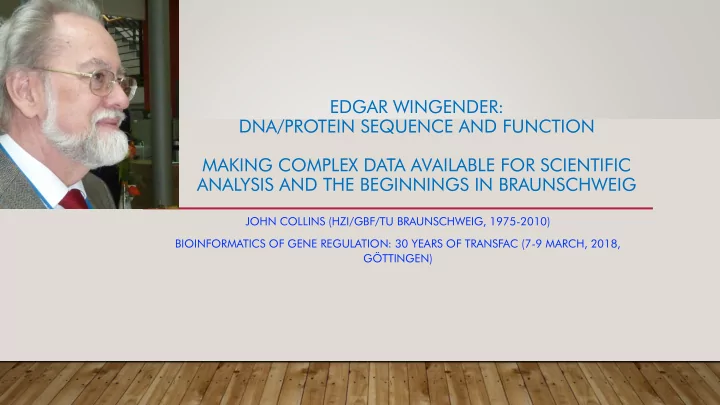
EDGAR WINGENDER: DNA/PROTEIN SEQUENCE AND FUNCTION MAKING COMPLEX DATA AVAILABLE FOR SCIENTIFIC ANALYSIS AND THE BEGINNINGS IN BRAUNSCHWEIG JOHN COLLINS (HZI/GBF/TU BRAUNSCHWEIG, 1975-2010) BIOINFORMATICS OF GENE REGULATION: 30 YEARS OF


slide-1
SLIDE 1

EDGAR WINGENDER: DNA/PROTEIN SEQUENCE AND FUNCTION MAKING COMPLEX DATA AVAILABLE FOR SCIENTIFIC ANALYSIS AND THE BEGINNINGS IN BRAUNSCHWEIG

JOHN COLLINS (HZI/GBF/TU BRAUNSCHWEIG, 1975-2010) BIOINFORMATICS OF GENE REGULATION: 30 YEARS OF TRANSFAC (7-9 MARCH, 2018, GÖTTINGEN)

slide-2
SLIDE 2

Edg dgar‘s tim ime at the GBF: 01.1977 77 – 12.1977 Dip iplo lomarb marbei eit with Professor Karl l Wagner ner 05.12.1977 77 started Doktorar ktorarbei beit, promoted 09.12.1980 80 ( Karl Wagner ner, , Jürgen en Bode de) till 30.04.1981 81 as as Post stdoc doc.

Wingender, E. Modulation of the nucleosome structure by histone acetylation Eur. J. Biochem. 110, 143-152 (1980) Wingender, E., Maass, K. and Bode, J. Influence of cysteine- specific labels upon the stability of nucleosomes Int. J. Biol.

  • Macromol. 3, 114-120 (1981) Bode, J., Henco, K. and

Wingender, E. and Arellano, A. Synthesis and properties of the new thiol-specific reagent difluorescein disulfide: its application on histone- histone and histone-DNA interactions Anal. Biochem. 127, 351-360 (1982) Wingender, E. Fluorescamine and fluorescein: a new energy- transfer pair and its application to the binding of histone H5 to nucleosomes Anal. Biochem. 121, 146-150 (1982)

slide-3
SLIDE 3

1981 1981-198 986 Univers rsity ity of

  • f Marbur

urg as as Research arch Assistan istant (Lec ectu ture rer) ) wi with th Prof

  • fesso

essor r Klaus us H. Seifart art 1981 1981 ti till 1986

Wingender, E. and Seifart, K. H. Transcription in eukaryotes - the role of transcription complexes and their components Angew. Chem. Int. Ed. Engl. 26, 218-227 (1987) Jahn, D., Wingender, E. and Seifart, K. H. Transcription complexes for various class III genes differ in parameters of formation and stability towards salt J. Mol. Biol. 193, 303- 313 (1987) Wingender, E., Jahn, D. and Seifart, K. H. Association of RNA polymerase III with transcription factors in the absence of DNA J. Biol. Chem. 261, 1409-1413 (1986) Wingender, E., Dilloo, D. and Seifart, K. H. Zinc ions are differentially required for the transcription of ribosomal 5S RNA and tRNA in a HeLa-cell extract Nucleic Acids Res. 12, 8971-8985 (1984) Wingender, E., Shi, X. P., Houpert, A. and Seifart, K. H. Isolation of a transcription complex for ribosomal 5S RNA EMBO J. 3, 1761-1768 (1984) Shi, X. P., Wingender, E., Bỏttrich, J. and Seifart, K. H. Faithful transcription of ribosomal 5-S RNA in vitro depends on the presence of several factors Eur. J. Biochem. 131, 189- 194 (1983)

slide-4
SLIDE 4

Returned ned to to the GBF F 01.02.198 .02.1986 6 – 15.11.2002 .11.2002 as as Rese sear arch ch Ass ssis istant tant (Postdoc

  • stdoc)
  • founded

ded Transfac sfac 1987 87, spin spin-off

  • ff from GBF

F ->-> > foundin ding of

  • f

Bio ioba base se

slide-5
SLIDE 5

1986 1986 – 1990 1990 Wingender, E. Compi mpilatio tion of

  • f

trans anscript ription

  • n regul

ulat ating ing proteins teins Nucleic Acids Res. 16, 1879-1902 (1988)

slide-6
SLIDE 6
slide-7
SLIDE 7

1986 1986 – 1990 1990 Sömjen, D., Binderman, I., Schlüter, K.-D., Wingender, E., Mayer, H. and Kaye, A. M. Stimulation ation by by defined ed parathyr athyroi

  • id hormone
  • ne fragments

nts of

  • f cell

proli lifera ration ion in in skeletal al derive ved cell cultures ures Biochem. J. 272, 781-785 (1990) Rupp, E., Mayer, H. and Wingender, E. The promote

  • ter of
  • f the human

n parathyr athyroid

  • id hormone
  • ne gene contains

ains a a functional ional cyclic ic AMP-resp response

  • nse element

Nucleic Acids Res. 18, 5677-5683 (1990) Wingender, E. Transcri nscript ption ion regulati lating ng proteins ins and their recognit gnition

  • n

sequence nces CRC Crit. Rev. in Eukaryotic Gene Expression 1, 11-48 (1990) Wingender, E., Bercz, G., Schlüter, K.-D. and Mayer, H. Structur ure-Func unction ion Relationship

  • nship in Parathyr

athyroi

  • id Hormone

ne Advances in Protein Design - International Workshop 1988 (H. Blöcker, J. Collins, R. D. Schmidt, eds.), GBF Monographs, Verlag Chemie, Weinheim 12, 167-176 (1989) Schlüter, K.-D., Hellstern, H., Wingender, E. and Mayer, H. The centra ral part of

  • f

parathyr athyroid

  • id hormone
  • ne stimulates

lates thymidi idine ne incor

  • rporat
  • ration

ion of

  • f chondro

ndrocy cytes J.

  • Biol. Chem. 264, 11087-11092 (1989)

Wingender, E., Bercz, G., Blöcker, H., Frank, R. and Mayer, H. Expressi ssion

  • n of
  • f

human an parathy hyroid id horm rmone

  • ne in Esche

heric richia hia coli J. Biol. Chem. 264, 4367- 4373 (1989) Seifart, K. H.,
slide-8
SLIDE 8

Leopol

  • ld

d Flohé, , GBF , Direc ecto tor 1991 1991-1994 Rudi i Balling, GBF/HZI HZI Direc ecto tor 2001 2001-2009

slide-9
SLIDE 9
slide-10
SLIDE 10
slide-11
SLIDE 11

What was possible? What looked impossible? What was the state of the art when I first came to the GBF in 1975? 1965 Holley had solved the structure of a tRNA 1971 Sanger had started obtaining sequences for bacteriophage RNA extended by Walter Fiers 1972-76 for MS2 bacteriophage 1973 Gilbert & Maxam: the nucleotide sequence of the lac operator

slide-12
SLIDE 12

Late ate 1975 Jan Jan Eng Engber berg (Panum anum Medi Medical cal Sc Scho hool, l, Cope penh nhage gen) and nd myse myself lf wr writi iting on

  • n our
  • ur work

work and and ideas ideas on

  • n the rol
  • le of
  • f symm

symmetry etry in in DNA DNA reg regul ulati ation

  • n

in in Tetrahymena etrahymena pyriformis rmis

slide-13
SLIDE 13

Karrer r & Gold(1976 976)J )J. mole lec. . Biol. , 104 104, , 421 421

slide-14
SLIDE 14

Karrer r & Gold(1 (1976 976)J )J. mole lec. . Biol. , 104, 421

slide-15
SLIDE 15

It therefore seemed imperative to us to have a tool to analyse DNA sequences for various possible structures including initially symmetric regions (palindromic sequences) even though we could analyze ALL the sequences that were available in 1975/76 by hand in a short time. Generally useable sequencing technology didn‘t come into being until the end of 1977: Maxam & Gilbert and the Sanger method which required either isolated end-labelled (P32) DNA fragments or single- stranded DNA (e.g. from an M13-cloned fragement) and a synthetic DNA primer

slide-16
SLIDE 16

First computer algorithms searching for inverse symmetry (palindromic sequences) Dave Lincoln & John Collins, 1975 binary binary A= 3 011 G= 6 110 T= 4 100 C= 1 001 A+T = 7 0111 C+G = 7 0111 A+A= 6 0010 C+T= 5 0101 T+T= 8 1000 G+T= 10 1010 G+G= 12 1100 A+G= 9 1001 C+C= 2 0010 C+A = 4 0100 *************************************************************** Choose length of scan for symmetry e.g. 6 bp: DNA sequence ………………………G G A A T T C T A A……….. a b c d e f -> [(a+f)-7] if SUM= 0 -> [(b+e)-7, if SUM =0 -> [(c+d)-7] -> if SUM =0 -> write out sequence and position (first steps to GENMON and computing

  • n small computers compared to mainframe).

Later modified for partial homology (consensus) and partial symmetry comparisons.

slide-17
SLIDE 17
slide-18
SLIDE 18

Collins J. and Hohn B. (1978) Cosmids: a type of plasmid gene-cloning vector that is packageable in vitro in bacteriophage Lambda heads. Proc. Natl. Acad. Sci. USA 75, 4242-4246 Gross G., Mayr U., Bruns W., Grosveld F ., Dahl H. H. M. and Collins J. (1981) The structure of a thirty-six kilobase region of the human chromosome including the fibroblast interferon gene IFN-ß. Nucl. Acids Res. 9, 2495-2507 Hauser H., Gross G., Bruns W., Hochkeppel H.-K., Mayr U. and Collins J. (1982) Inducibility of human ß-interferon gene in mouse L-cell clones. Nature (Lond.) 297, 650- 655

slide-19
SLIDE 19
slide-20
SLIDE 20

Edgar, thanks to you, and all those who worked with you, to facilitate interpretation of the wealth of data that accumulated on gene regulation, structure and function. Wishing you a happy and healthy retirement!