
cosmogenic-36Cl, exposure-dating, paleoearthquakes, fault-scarps, Hebgen-Lake
Geological Society of America, 51st Annual Meeting, Rocky Mountain Section April 8-10, 1999, Pocatello, Idaho.
TIMING OF LATE QUATERNARY EARTHQUAKES ON THE HEBGEN LAKE FAULT BY COSMOGENIC CHLORINE-36 DATING OF BEDROCK FAULT SCARP ZREDA, Marek, Department of Hydrology and Water Resources, University of Ari- zona, Tucson, AZ 85721, marek@hwr.arizona.edu; NOLLER, Jay S., Depart- ment of Geology, Vanderbilt University, Nashville, TN 37235. Fault scarps along the Hebgen Lake fault, Montana, recorded multiple large pale-
- earthquakes, including the most recent earthquake in 1959. We used cosmogenic
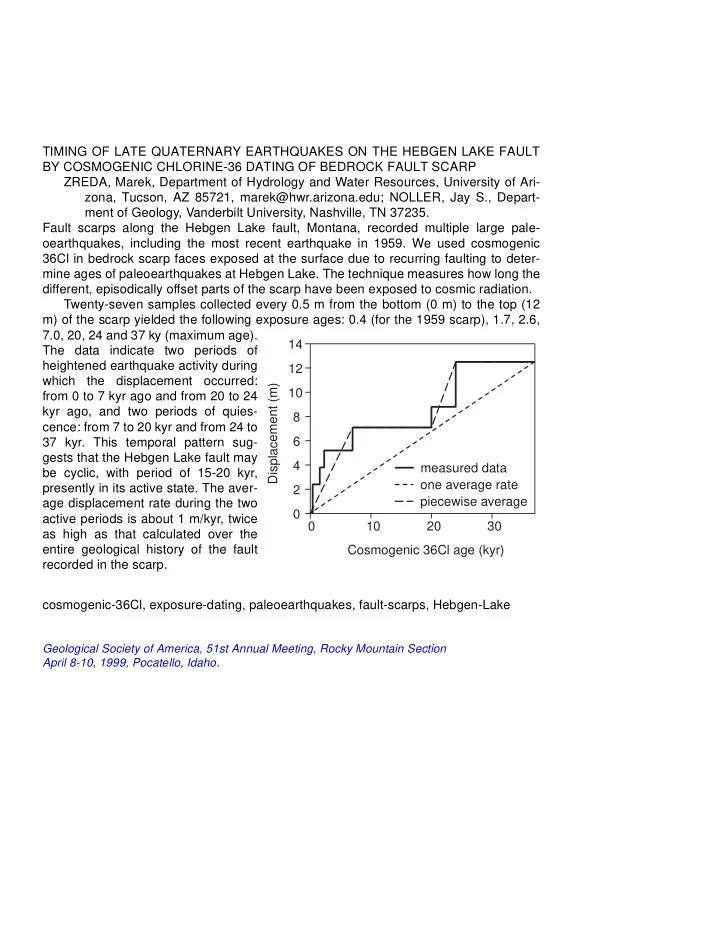
36Cl in bedrock scarp faces exposed at the surface due to recurring faulting to deter- mine ages of paleoearthquakes at Hebgen Lake. The technique measures how long the different, episodically offset parts of the scarp have been exposed to cosmic radiation. Twenty-seven samples collected every 0.5 m from the bottom (0 m) to the top (12 m) of the scarp yielded the following exposure ages: 0.4 (for the 1959 scarp), 1.7, 2.6, 7.0, 20, 24 and 37 ky (maximum age). The data indicate two periods of heightened earthquake activity during which the displacement occurred: from 0 to 7 kyr ago and from 20 to 24 kyr ago, and two periods of quies- cence: from 7 to 20 kyr and from 24 to 37 kyr. This temporal pattern sug- gests that the Hebgen Lake fault may be cyclic, with period of 15-20 kyr, presently in its active state. The aver- age displacement rate during the two active periods is about 1 m/kyr, twice as high as that calculated over the entire geological history of the fault recorded in the scarp. Cosmogenic 36Cl age (kyr) 10 20 30 Displacement (m) 2 4 6 8 10 12 14 measured data
- ne average rate
piecewise average