Disk Drive Schematic Disk Drive Schematic Typically 512 bytes - - PowerPoint PPT Presentation

disk drive schematic disk drive schematic
SMART_READER_LITE
LIVE PREVIEW

Disk Drive Schematic Disk Drive Schematic Typically 512 bytes - - PowerPoint PPT Presentation

Disk Drive Schematic Disk Drive Schematic Typically 512 bytes Typically 512 bytes reads by sensing a magnetic field spare sectors added for fault tolerance spare sectors added for fault tolerance writes by creating one floats on air cushion


slide-1
SLIDE 1

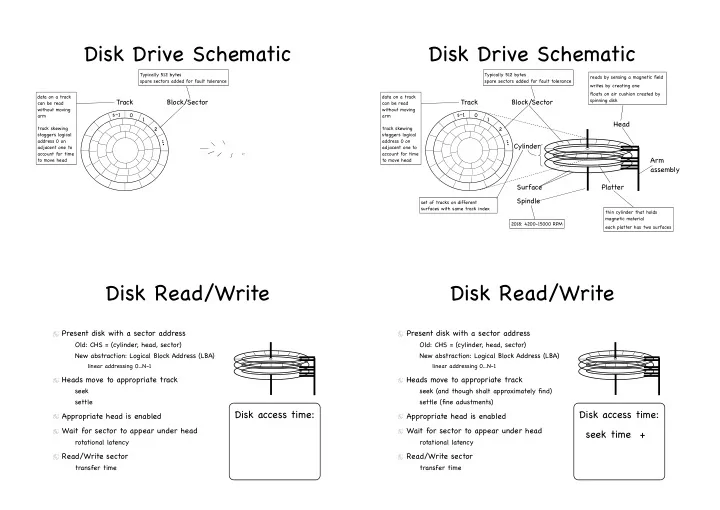
Disk Drive Schematic

17

Block/Sector

Typically 512 bytes spare sectors added for fault tolerance

1 2 s–1

... Track

data on a track can be read without moving arm track skewing staggers logical address 0 on adjacent one to account for time to move head

Disk Drive Schematic

18

Block/Sector Platter Surface Head Spindle

thin cylinder that holds magnetic material each platter has two surfaces reads by sensing a magnetic field writes by creating one floats on air cushion created by spinning disk

Arm assembly

Typically 512 bytes spare sectors added for fault tolerance set of tracks on different surfaces with same track index

Cylinder

2018: 4200-15000 RPM

1 2 s–1

... Track

data on a track can be read without moving arm track skewing staggers logical address 0 on adjacent one to account for time to move head

Disk Read/Write

Present disk with a sector address

Old: CHS = (cylinder, head, sector) New abstraction: Logical Block Address (LBA)

linear addressing 0...N-1

Heads move to appropriate track

seek settle

Appropriate head is enabled Wait for sector to appear under head

rotational latency

Read/Write sector

transfer time

Disk access time:

Disk Read/Write

Present disk with a sector address

Old: CHS = (cylinder, head, sector) New abstraction: Logical Block Address (LBA)

linear addressing 0...N-1

Heads move to appropriate track

seek (and though shalt approximately find) settle (fine adustments)

Appropriate head is enabled Wait for sector to appear under head

rotational latency

Read/Write sector

transfer time

Disk access time: seek time +

slide-2
SLIDE 2

Disk Read/Write

Present disk with a sector address

Old: CHS = (cylinder, head, sector) New abstraction: Logical Block Address (LBA)

linear addressing 0...N-1

Heads move to appropriate track

seek (and though shalt approximately find) settle (fine adustments)

Appropriate head is enabled Wait for sector to appear under head

rotational latency

Read/Write sector

transfer time

Disk access time: seek time + rotation time +

Disk Read/Write

Present disk with a sector address

Old: CHS = (cylinder, head, sector) New abstraction: Logical Block Address (LBA)

linear addressing 0...N-1

Heads move to appropriate track

seek (and though shalt approximately find) settle (fine adustments)

Appropriate head is enabled Wait for sector to appear under head

rotational latency

Read/Write sector

transfer time

Disk access time: seek time + rotation time + transfer time

A closer look: seek time

Minimum: time to go from one track to the next 0.3-1.5 ms Maximum: time to go from innermost to outermost track more than 10ms; up to over 20ms Average: average across seeks between each possible pair

  • f tracks

approximately time to seek 1/3 of the way across disk

How did we get that?

To compute average seek time, add distance between every possible pair of tracks and divide by total number of pairs

assuming tracks, pairs, and sum of distances is N

<latexit sha1_base64="btCibZ9opsf0j+ZI38usz6nu0k=">AB6HicjVDLSgNBEOyNrxhfUY9eBoPgKexKgh48BLx4kgTMA5IlzE56kzGzs8vMrBCWfIEXD4p49ZO8+TdOHgcVBQsaiqpuruCRHBtXPfDya2srq1v5DcLW9s7u3vF/YOWjlPFsMliEatOQDUKLrFpuBHYSRTSKBDYDsZXM79j0rzWN6aSYJ+RIeSh5xRY6XGTb9Y8sruHORvUoIl6v3ie28QszRCaZigWnc9NzF+RpXhTOC0Es1JpSN6RC7lkoaofaz+aFTcmKVAQljZUsaMle/TmQ0noSBbYzomakf3oz8Tevm5rws+4TFKDki0WhakgJiazr8mAK2RGTCyhTHF7K2EjqigzNpvC/0JonZW9SrnaqJRql8s48nAEx3AKHpxDa6hDk1gPAT/Ds3DmPzovzumjNOcuZQ/gG5+0Tq8CM1w=</latexit>

N 2

<latexit sha1_base64="csebhpKIF2oMNZv+GYfyudTMrxA=">AB6nicjVC7SgNBFL0bXzG+Vi0FGQyCVdgNihaCARsrSdA8IFnD7GQ2GTI7u8zMCmFJaWljoYitH2HrL9j5DfoRThILFQUPXDicy/3OvHnCntOK9WZmp6ZnYuO59bWFxaXrFX12oqSiShVRLxSDZ8rChnglY105w2Yklx6HNa9/vHI79+SaVikTjXg5h6Ie4KFjCtZHOTi+KbTvFpwx0N8kf/T8drX5VHkvt+2XViciSUiFJhwr1XSdWHsplpoRToe5VqJojEkfd2nTUIFDqrx0HWIto3SQUEkTQmNxurXiRSHSg1C3SGWPfUT28k/uY1Ex0ceCkTcaKpIJNFQcKRjtDobtRhkhLNB4ZgIpnJikgPS0y0+U7uf0+oFQvubmGv4uZLhzBFjZgC3bAhX0owQmUoQoEunANt3BncevGurceJq0Z63NmHb7BevwA4cGR+w=</latexit>

N

X

x=0 N

X

y=0

|x − y|

<latexit sha1_base64="Y3gbNKTCPsS19HEdDSWaTWxKkz4=">ACnicjVDLSsNAFJ34rPUVdSnIaBHcWBJRdKFYcONKWrAPaGOYTCft0MkzEykIe1S3Pgrblz4wJXgF7jzG/QjTBsXKgoeuHDuOfcyc48TMCqVYbxqI6Nj4xOTmans9Mzs3Ly+sFiRfigwKWOf+aLmIEkY5aSsqGKkFgiCPIeRqtM5GvjVcyIk9fmpigJieajFqUsxUolk6sNGXp23D0w+mcnMG2itOnB7mYEe7aeM/PGEPBvkjt8ertYuS+9F239pdH0cegRrjBDUtZNI1BWjISimJF+thFKEiDcQS1STyhHpFWPDylD9cTpQldXyTFRyqXzdi5EkZeU4y6SHVlj+9gfibVw+Vu2fFlAehIhynD7khg8qHg1xgkwqCFYsSgrCgyV8hbiOBsErSy/4vhMpW3tzO75SMXGEfpMiAZbAGNoAJdkEBHIMiKAMLsE1uAV32pV2oz1oj+noiPa5swS+QXv+AOEnkI=</latexit>

Z N

x=0

Z N

y=0

|x − y|dy dx

<latexit sha1_base64="xmFVr+v9H+Wt68el6QDwD4nf7Q=">ACE3icjVDLSgMxFM34rPVdSlIsAgiWqai6EKx4MaVtGAf0I4lk8m0oZnMkGSkw9ilezf+igufODWjTu/QT/CtONCRcEDCecy83OXbAqFSm+WoMDY+Mjo2nJtKTU9Mzs5m5+Yr0Q4FJGfvMFzUbScIoJ2VFSO1QBDk2YxU7c5h36+eESGpz09UFBDLQy1OXYqR0lIzs9agXDXj7r7ZOz2GSRElxTnsbkT6diLYWIdOt5nJ5nPmAPBvkj14eLtYuim9F5uZl4bj49AjXGpKznzUBZMRKYkZ6UYoSYBwB7VIXVOPCKtePCnHlzRigNdX+jDFRyoXydi5EkZebu9JBqy59eX/zNq4fK3bViyoNQEY6TRW7IoPJhPyDoUEGwYpEmCAuq3wpxGwmElY4x/b8QKpu5/FZu2RmC3sgQosgmWwCvJgBxTAESiCMsDgElyDO3BvXBm3xqPxlLQOGZ8zC+AbjOcPolWhKQ=</latexit>

which we compute as

slide-3
SLIDE 3

How did we get that?

To compute average seek time, add distance between every possible pair of tracks and divide by total number of pairs

assuming tracks, pairs, and sum of distances is The inner integral expands to N

<latexit sha1_base64="btCibZ9opsf0j+ZI38usz6nu0k=">AB6HicjVDLSgNBEOyNrxhfUY9eBoPgKexKgh48BLx4kgTMA5IlzE56kzGzs8vMrBCWfIEXD4p49ZO8+TdOHgcVBQsaiqpuruCRHBtXPfDya2srq1v5DcLW9s7u3vF/YOWjlPFsMliEatOQDUKLrFpuBHYSRTSKBDYDsZXM79j0rzWN6aSYJ+RIeSh5xRY6XGTb9Y8sruHORvUoIl6v3ie28QszRCaZigWnc9NzF+RpXhTOC0Es1JpSN6RC7lkoaofaz+aFTcmKVAQljZUsaMle/TmQ0noSBbYzomakf3oz8Tevm5rws+4TFKDki0WhakgJiazr8mAK2RGTCyhTHF7K2EjqigzNpvC/0JonZW9SrnaqJRql8s48nAEx3AKHpxDa6hDk1gPAT/Ds3DmPzovzumjNOcuZQ/gG5+0Tq8CM1w=</latexit>

N 2

<latexit sha1_base64="csebhpKIF2oMNZv+GYfyudTMrxA=">AB6nicjVC7SgNBFL0bXzG+Vi0FGQyCVdgNihaCARsrSdA8IFnD7GQ2GTI7u8zMCmFJaWljoYitH2HrL9j5DfoRThILFQUPXDicy/3OvHnCntOK9WZmp6ZnYuO59bWFxaXrFX12oqSiShVRLxSDZ8rChnglY105w2Yklx6HNa9/vHI79+SaVikTjXg5h6Ie4KFjCtZHOTi+KbTvFpwx0N8kf/T8drX5VHkvt+2XViciSUiFJhwr1XSdWHsplpoRToe5VqJojEkfd2nTUIFDqrx0HWIto3SQUEkTQmNxurXiRSHSg1C3SGWPfUT28k/uY1Ex0ceCkTcaKpIJNFQcKRjtDobtRhkhLNB4ZgIpnJikgPS0y0+U7uf0+oFQvubmGv4uZLhzBFjZgC3bAhX0owQmUoQoEunANt3BncevGurceJq0Z63NmHb7BevwA4cGR+w=</latexit>

N

X

x=0 N

X

y=0

|x − y|

<latexit sha1_base64="Y3gbNKTCPsS19HEdDSWaTWxKkz4=">ACnicjVDLSsNAFJ34rPUVdSnIaBHcWBJRdKFYcONKWrAPaGOYTCft0MkzEykIe1S3Pgrblz4wJXgF7jzG/QjTBsXKgoeuHDuOfcyc48TMCqVYbxqI6Nj4xOTmans9Mzs3Ly+sFiRfigwKWOf+aLmIEkY5aSsqGKkFgiCPIeRqtM5GvjVcyIk9fmpigJieajFqUsxUolk6sNGXp23D0w+mcnMG2itOnB7mYEe7aeM/PGEPBvkjt8ertYuS+9F239pdH0cegRrjBDUtZNI1BWjISimJF+thFKEiDcQS1STyhHpFWPDylD9cTpQldXyTFRyqXzdi5EkZeU4y6SHVlj+9gfibVw+Vu2fFlAehIhynD7khg8qHg1xgkwqCFYsSgrCgyV8hbiOBsErSy/4vhMpW3tzO75SMXGEfpMiAZbAGNoAJdkEBHIMiKAMLsE1uAV32pV2oz1oj+noiPa5swS+QXv+AOEnkI=</latexit>

Z N

x=0

Z N

y=0

|x − y|dy dx

<latexit sha1_base64="xmFVr+v9H+Wt68el6QDwD4nf7Q=">ACE3icjVDLSgMxFM34rPVdSlIsAgiWqai6EKx4MaVtGAf0I4lk8m0oZnMkGSkw9ilezf+igufODWjTu/QT/CtONCRcEDCecy83OXbAqFSm+WoMDY+Mjo2nJtKTU9Mzs5m5+Yr0Q4FJGfvMFzUbScIoJ2VFSO1QBDk2YxU7c5h36+eESGpz09UFBDLQy1OXYqR0lIzs9agXDXj7r7ZOz2GSRElxTnsbkT6diLYWIdOt5nJ5nPmAPBvkj14eLtYuim9F5uZl4bj49AjXGpKznzUBZMRKYkZ6UYoSYBwB7VIXVOPCKtePCnHlzRigNdX+jDFRyoXydi5EkZebu9JBqy59eX/zNq4fK3bViyoNQEY6TRW7IoPJhPyDoUEGwYpEmCAuq3wpxGwmElY4x/b8QKpu5/FZu2RmC3sgQosgmWwCvJgBxTAESiCMsDgElyDO3BvXBm3xqPxlLQOGZ8zC+AbjOcPolWhKQ=</latexit>

which we compute as Z x

y=0

(x − y)dy + Z N

y=x

(y − x)dy

<latexit sha1_base64="J41ZGtJ9FPYMA9ZiUBuMWU0TkPI=">ACFnicjZDLSgMxGIUz9VbrbdSlIMEiVKRlRhRdKBbcuJIW7AV6I5PJtKGZzJBkpMPQpU/gxkfRjaAibsWdz6AP4bRVUFHwQODwnf8nybF8RqUyjBctMTY+MTmVnE7NzM7NL+iLS2XpBQKTEvaYJ6oWkoRTkqKkaqviDItRipWN2jQV45I0JSj5+q0CcNF7U5dShGKkYtPVunXLWi8MDoN3sw08uG9AO4Sb85L1+8wRmwmxvwFt62swZQ8G/Tfrw9vV89ar4Vmjpz3Xbw4FLuMIMSVkzDV81IiQUxYz0U/VAEh/hLmqTWmw5colsRMNv9eF6TGzoeCI+XMEh/boRIVfK0LXiSRepjvyZDeBvWS1Qzl4jotwPFOF4dJETMKg8OgI2lQrFgYG4QFjd8KcQcJhFXcZOp/JZS3cuZ2bqdopP7YKQkWAFrIANMsAvy4BgUQAlgcAGuwR241y61G+1BexyNJrSPnWXwTdrTO1KMogY=</latexit>

which evaluates to x2/2 + (N 2/2 − xn + x2/2)

<latexit sha1_base64="XklQGdCQ3PocoXW7ZkYGgdfqT0g=">ACBXicjVDLSgMxFM3UV62vUZeKBItQEetMUXQhWHDjSlqwD6hjyaSZNjSTGZKMtJRuBPFX3LhQRNyJv+DOb9CPMJ26UFHwIWTc+7l5h43ZFQqy3o1EiOjY+MTycnU1PTM7Jw5v1CWQSQwKeGABaLqIkY5aSkqGKkGgqCfJeRits+HPiVcyIkDfiJ6obE8VGTU49ipLRUN5c7Z7mtHNyAmeOYbMIO169YXa+baTtrxYB/k/TB89vlymPxvVA3X04bAY58whVmSMqabYXK6SGhKGaknzqNJAkRbqMmqWnKkU+k04uv6M1rTSgFwhdXMFY/TrRQ76UXd/VnT5SLfnTG4i/ebVIeXtOj/IwUoTj4SIvYlAFcBAJbFBsGJdTRAWVP8V4hYSCsdXOp/IZRzWXs7u1O0vl9MEQSLIFVkAE2AV5cAQKoAQwuADX4BbcGVfGjXFvPAxbE8bnzCL4BuPpA+tVmNI=</latexit>

How did we get that?

To compute average seek time, add distance between every possible pair of tracks and divide by total number of pairs

assuming tracks, pairs, and sum of distances is The inner integral expands to The outer integral becomes N

<latexit sha1_base64="btCibZ9opsf0j+ZI38usz6nu0k=">AB6HicjVDLSgNBEOyNrxhfUY9eBoPgKexKgh48BLx4kgTMA5IlzE56kzGzs8vMrBCWfIEXD4p49ZO8+TdOHgcVBQsaiqpuruCRHBtXPfDya2srq1v5DcLW9s7u3vF/YOWjlPFsMliEatOQDUKLrFpuBHYSRTSKBDYDsZXM79j0rzWN6aSYJ+RIeSh5xRY6XGTb9Y8sruHORvUoIl6v3ie28QszRCaZigWnc9NzF+RpXhTOC0Es1JpSN6RC7lkoaofaz+aFTcmKVAQljZUsaMle/TmQ0noSBbYzomakf3oz8Tevm5rws+4TFKDki0WhakgJiazr8mAK2RGTCyhTHF7K2EjqigzNpvC/0JonZW9SrnaqJRql8s48nAEx3AKHpxDa6hDk1gPAT/Ds3DmPzovzumjNOcuZQ/gG5+0Tq8CM1w=</latexit>

N 2

<latexit sha1_base64="csebhpKIF2oMNZv+GYfyudTMrxA=">AB6nicjVC7SgNBFL0bXzG+Vi0FGQyCVdgNihaCARsrSdA8IFnD7GQ2GTI7u8zMCmFJaWljoYitH2HrL9j5DfoRThILFQUPXDicy/3OvHnCntOK9WZmp6ZnYuO59bWFxaXrFX12oqSiShVRLxSDZ8rChnglY105w2Yklx6HNa9/vHI79+SaVikTjXg5h6Ie4KFjCtZHOTi+KbTvFpwx0N8kf/T8drX5VHkvt+2XViciSUiFJhwr1XSdWHsplpoRToe5VqJojEkfd2nTUIFDqrx0HWIto3SQUEkTQmNxurXiRSHSg1C3SGWPfUT28k/uY1Ex0ceCkTcaKpIJNFQcKRjtDobtRhkhLNB4ZgIpnJikgPS0y0+U7uf0+oFQvubmGv4uZLhzBFjZgC3bAhX0owQmUoQoEunANt3BncevGurceJq0Z63NmHb7BevwA4cGR+w=</latexit>

N

X

x=0 N

X

y=0

|x − y|

<latexit sha1_base64="Y3gbNKTCPsS19HEdDSWaTWxKkz4=">ACnicjVDLSsNAFJ34rPUVdSnIaBHcWBJRdKFYcONKWrAPaGOYTCft0MkzEykIe1S3Pgrblz4wJXgF7jzG/QjTBsXKgoeuHDuOfcyc48TMCqVYbxqI6Nj4xOTmans9Mzs3Ly+sFiRfigwKWOf+aLmIEkY5aSsqGKkFgiCPIeRqtM5GvjVcyIk9fmpigJieajFqUsxUolk6sNGXp23D0w+mcnMG2itOnB7mYEe7aeM/PGEPBvkjt8ertYuS+9F239pdH0cegRrjBDUtZNI1BWjISimJF+thFKEiDcQS1STyhHpFWPDylD9cTpQldXyTFRyqXzdi5EkZeU4y6SHVlj+9gfibVw+Vu2fFlAehIhynD7khg8qHg1xgkwqCFYsSgrCgyV8hbiOBsErSy/4vhMpW3tzO75SMXGEfpMiAZbAGNoAJdkEBHIMiKAMLsE1uAV32pV2oz1oj+noiPa5swS+QXv+AOEnkI=</latexit>

Z N

x=0

Z N

y=0

|x − y|dy dx

<latexit sha1_base64="xmFVr+v9H+Wt68el6QDwD4nf7Q=">ACE3icjVDLSgMxFM34rPVdSlIsAgiWqai6EKx4MaVtGAf0I4lk8m0oZnMkGSkw9ilezf+igufODWjTu/QT/CtONCRcEDCecy83OXbAqFSm+WoMDY+Mjo2nJtKTU9Mzs5m5+Yr0Q4FJGfvMFzUbScIoJ2VFSO1QBDk2YxU7c5h36+eESGpz09UFBDLQy1OXYqR0lIzs9agXDXj7r7ZOz2GSRElxTnsbkT6diLYWIdOt5nJ5nPmAPBvkj14eLtYuim9F5uZl4bj49AjXGpKznzUBZMRKYkZ6UYoSYBwB7VIXVOPCKtePCnHlzRigNdX+jDFRyoXydi5EkZebu9JBqy59eX/zNq4fK3bViyoNQEY6TRW7IoPJhPyDoUEGwYpEmCAuq3wpxGwmElY4x/b8QKpu5/FZu2RmC3sgQosgmWwCvJgBxTAESiCMsDgElyDO3BvXBm3xqPxlLQOGZ8zC+AbjOcPolWhKQ=</latexit>

which we compute as Z x

y=0

(x − y)dy + Z N

y=x

(y − x)dy

<latexit sha1_base64="J41ZGtJ9FPYMA9ZiUBuMWU0TkPI=">ACFnicjZDLSgMxGIUz9VbrbdSlIMEiVKRlRhRdKBbcuJIW7AV6I5PJtKGZzJBkpMPQpU/gxkfRjaAibsWdz6AP4bRVUFHwQODwnf8nybF8RqUyjBctMTY+MTmVnE7NzM7NL+iLS2XpBQKTEvaYJ6oWkoRTkqKkaqviDItRipWN2jQV45I0JSj5+q0CcNF7U5dShGKkYtPVunXLWi8MDoN3sw08uG9AO4Sb85L1+8wRmwmxvwFt62swZQ8G/Tfrw9vV89ar4Vmjpz3Xbw4FLuMIMSVkzDV81IiQUxYz0U/VAEh/hLmqTWmw5colsRMNv9eF6TGzoeCI+XMEh/boRIVfK0LXiSRepjvyZDeBvWS1Qzl4jotwPFOF4dJETMKg8OgI2lQrFgYG4QFjd8KcQcJhFXcZOp/JZS3cuZ2bqdopP7YKQkWAFrIANMsAvy4BgUQAlgcAGuwR241y61G+1BexyNJrSPnWXwTdrTO1KMogY=</latexit>

which evaluates to x2/2 + (N 2/2 − xn + x2/2)

<latexit sha1_base64="XklQGdCQ3PocoXW7ZkYGgdfqT0g=">ACBXicjVDLSgMxFM3UV62vUZeKBItQEetMUXQhWHDjSlqwD6hjyaSZNjSTGZKMtJRuBPFX3LhQRNyJv+DOb9CPMJ26UFHwIWTc+7l5h43ZFQqy3o1EiOjY+MTycnU1PTM7Jw5v1CWQSQwKeGABaLqIkY5aSkqGKkGgqCfJeRits+HPiVcyIkDfiJ6obE8VGTU49ipLRUN5c7Z7mtHNyAmeOYbMIO169YXa+baTtrxYB/k/TB89vlymPxvVA3X04bAY58whVmSMqabYXK6SGhKGaknzqNJAkRbqMmqWnKkU+k04uv6M1rTSgFwhdXMFY/TrRQ76UXd/VnT5SLfnTG4i/ebVIeXtOj/IwUoTj4SIvYlAFcBAJbFBsGJdTRAWVP8V4hYSCsdXOp/IZRzWXs7u1O0vl9MEQSLIFVkAE2AV5cAQKoAQwuADX4BbcGVfGjXFvPAxbE8bnzCL4BuPpA+tVmNI=</latexit>

Z N

x=0

(x2 + N 2/2 − xn) = N 3/3

<latexit sha1_base64="WUK5KRmEDYM6FgiK4POKBnQ1hQA=">ACEHicjVBNS0JBFJ1nX2ZfVsghiQyIn1qUYskoU0rUcgP8It546iD8+Y9ZuaF8nDZsk1/pY2LIty2bNdvqB/RqC0qCjpw4cw593LnHstlVCrTfDUCM7Nz8wvBxdDS8srqWnh9oygdT2BSwA5zRNlCkjDKSUFRxUjZFQTZFiMlq3sx9kvXREjq8CvVd0nNRm1OWxQjpaVGeK9KuWr4vbQ5qGdhtFdPwgOYrSfjSXgIe3wfpvUrFU81wpFEzJwA/k0i56O3m+1h/j3XCL9Umw72bMIVZkjKSsJ0Vc1HQlHMyCBU9SRxEe6iNqloypFNZM2fHDSAu1pwpYjdHEFJ+rXCR/ZUvZtS3faSHXkT28s/uZVPNU6rfmUu54iHE8XtTwGlQPH6cAmFQr1tcEYUH1XyHuIGw0hmG/hdCMRlLHMWO82YkcwamCItsAOiIAFOQAZcghwoAxuwT14AI/GnTE0nozRtDVgfM5sgm8wnj8Adu6deA=</latexit>

which we divide by the number of pairs to obtain N/3

<latexit sha1_base64="py29803+pTSoS9JXtxsFsN1PA9U=">AB6nicdVDLSgNBEOz1GeMr6lEPg0HIad3ViDl4CHjxJBHNA5IlzE5mkyGzD2ZmhbDkEyTgQRGvfomf4M0P8e5sVsSIFjQUVd10d7kRZ1JZ1rsxN7+wuLScW8mvrq1vbBa2thsyjAWhdRLyULRcLClnAa0rpjhtRYJi3+W06Q7PU795S4VkYXCjRhF1fNwPmMcIVlq6vjw87haKlmxUiDbtDJimeVZpVjdm3RKH6+TWrfw1umFJPZpoAjHUrZtK1JOgoVihNxvhNLGmEyxH3a1jTAPpVOMj1jA60kNeKHQFCk3VnxMJ9qUc+a7u9LEayN9eKv7ltWPlVZyEBVGsaECyRV7MkQpR+jfqMUGJ4iNMBFM34rIAtMlE4nr0P4/v1/0jgy7bJ5cqXTOIMOdiFfSiBDadQhQuoQR0I9OEOHuDR4Ma98WQ8Z61zxtfMDszAePkEkomRCA=</latexit>

A closer look: seek time

Minimum: time to go from one track to the next 0.3-1.5 ms Maximum: time to go from innermost to outermost track more than 10ms; up to over 20ms Average: average across seeks between each possible pair

  • f tracks

approximately time to seek 1/3 of the way across disk Head switch time: time to move from track on one surface to the same track on a different surface range similar to minimum seek time i

A closer look: rotation time

Today most disk rotate at 4200 to 15,000 RPM

≈15ms to 4ms per rotation good estimate for rotational latency is half that amount

Head starts reading as soon as it settles on a track

track buffering to avoid “shoulda coulda” if any of the sectors flying under the head turn out to be needed

slide-4
SLIDE 4

A closer look: transfer time

Surface transfer time

Time to transfer one or more sequential sectors to/ from surface after head reads/writes first sector Much smaller that seek time or rotational latency

512 bytes at 100MB/s ≈ 5µs (0.005 ms)

Lower for outer tracks than inner ones

same RPM, but more sectors/track: higher bandwidth!

Host transfer time

time to transfer data between host memory and disk buffer

60MB/s (USB 2.0) to 2.5GB/s (Fibre Channel 20GFC)

Buffer Memory

Small cache (8 to 16 MB) that holds data

read from disk about to be written to disk

On write

write back (return from write as soon as data is cached) write through (return once it is on disk)

Computing I/O time

The rate of I/0 is computed as TI/O = Tseek + Trotation + Ttransfer

<latexit sha1_base64="x5Dh4vI28Fqy1qt029Na3b/ivZE=">ACD3icdVDLSgMxFM3UV62vqks3wSIQp2xom7EghtdWaG1gi0lk96xoZkHyR2hlPmG4sZfcSMigqKf4G8I7k1bXdTHgcDJOeSnOtGUmi07TcrNTY+MTmVns7MzM7NL2QXl850GCsOFR7KUJ27TIMUAVRQoITzSAHzXQlVt3Y96tXoLQIgzJ2Iqj7DIQnuAMjdTI2uVG93jzJKH71DAN0E7oRp+qEAeRrysqFmgPVNLI5py8PQD9n+QO3nu19Y/HXqmRfak1Qx7ECXTOsLx46w3mUKBZeQZGqxhojxNruE7qBPQteM1KReqMwJkA7UkRzte74rkn6DFv6p9cX/IuYvT26l0RDFCwIcPebGkGNL+cmhTKOAoO4YwroT5IeUtphHs8KMqW7nCzvbTsGmv8l39bOtvLOd3zt1csUiGSJNVsgqWScO2SVFckRKpEI4uSF35Ik8W9fWrXVvPQyjKetrZpmMwHr9BHnOoDw=</latexit>

RI/O = SizeT ransfer

TI/0

<latexit sha1_base64="1VZg6IVGzR8AsamTjFQWR2+VybA=">ACHicdVDLSgMxAMz6rPV9eglWIR6WXdt0V7Eghc9WbUv6JYlm2b0OyDJCvUZX/AS3/Fi4gXhZ78BX9D8G7a6qE+BgLDzIRkxgkZFdIw3rSZ2bn5hcXUnp5ZXVtPbOxWRNBxDGp4oAFvOEgQRj1SVSyUgj5AR5DiN1p3c68us3hAsa+BXZD0nLQx2fuhQjqSQ7s3dlx+f7Fwk8hpbLEY6v6S2x4wpHvnAJT5K4MgoYSWJnsqZujAH/J9mT94GV+xgOynbm1WoHOPKILzFDQjRNI5StGHFJMSNJ2oECRHuoQ6Jx0USuKukNnQDro4v4VidyiFPiL7nqKSHZFf89EbiX14zkm6xFVM/jCTx8eQhN2JQBnC0CmxTrBkfUQ5lT9EOIuUntItV1aVTf0/GHBzBvwN/muXjvQzYJevDSzpRKYIAW2wQ7IARMcgRI4A2VQBRgMwAN4Bi/anXavPWpPk+iM9nVnC0xBG34CT3GeEg=</latexit>

Example: Toshiba MK3254GSY (2008)

Size Platters/Heads 2/ 4 Capacity 320GB Performance Spindle speed 7200 RPM

  • Avg. seek time R/W

10.5/12.0 ms

  • Max. seek time R/W

19 ms Track-to-track 1 ms Surface transfer time 54-128 MB/s Host transfer time 375 MB/s Buffer memory 16MB Power Typical 16.35 W Idle 11.68 W

slide-5
SLIDE 5

500 Random Reads

Workload

500 read requests, randomly chosen sector served in FIFO order

How long to service them?

500 times (seek + rotation + transfer) seek time: 10.5 ms (avg) rotation time:

7200 RPM = 120 RPS rotation time 8.3 ms

  • n average, half of that: 4.15 ms

transfer time

at least 54 MB/s 512 bytes transferred in (.5/54,000) seconds = 9.26µs

Total time:

500 x (10.5 + 4.15 + 0.009) ≈ 7 .33 sec

Size Platters/Heads 2/ 4 Capacity 320GB Performance Spindle speed 7200 RPM

  • Avg. seek time R/W

10.5/12.0 ms

  • Max. seek time R/W

19 ms Track-to-track 1 ms Surface transfer time 54-128 MB/s Host transfer time 375 MB/s Buffer memory 16MB Power Typical 16.35 W Idle 11.68 W RI/O = 500×.5×10−3MB

7.33 s

= 0.034 MB/s

<latexit sha1_base64="rBSc0w4/YJXZm9bNcozX6NBqwfQ=">ACKnicbVDNSiQxGEyru+qo6gn8fLhIHhY27Td6lyEQS+KyKo4KtizQzqT1mD6hyQtDE2/kRfwpMHL6JeFHyQTc/oYWQLApWq7yOpClLBlcb42RoaHvnxc3RsvDIxOfVrujoze6qSTFLWpIlI5HlAFBM8Zk3NtWDnqWQkCgQ7C653Sv/shknFk/hEd1PWishlzENOiTZSu7p/3M73Vv8UsAV+KAnN1zEGX/OIKbDXvxg4+G+4hZwsF3km7brgv8bVLmEbex65nKwvara1Rq267gEODbuE2x7g0qtAWLh5Wj+4bBdvfc7Cc0iFmsqiFIXDk51KydScypYUfEzxVJCr8kly3tRC1gyUgfCRJoTa+ipA3MkUqobBWYyIvpKfdK8X/eRabDeivncZpFtP+Q2EmQCdQ9gYdLhnVomsIoZKbHwK9IqYxbdqt9K7G57jlom/k6/op2u249n1I6fW8FAfY2gBLaJl5KBN1EC76BA1EUV36Am9oXfr1nq0nq3X/uiQ9bkzhwZgfwDeMij9A=</latexit>

500 Sequential Reads

Workload

500 read requests for sequential sectors on the same track served in FIFO order

How long to service them?

seek + rotation + 500 times transfer seek time: 10.5 ms (avg) rotation time:

4.15 ms, as before

transfer time

  • uter track: 500 x (.5/128000) ≈ 2ms

inner track: 500 x (.5/54000) seconds ≈ 4.6ms

Total time is between:

  • uter track: (2 + 4.15 + 10.5) ms ≈ 16.65 ms

inner track: (4.6 + 4.15 + 10.5) ms ≈ 19.25 ms

Size Platters/Heads 2/ 4 Capacity 320GB Performance Spindle speed 7200 RPM

  • Avg. seek time R/W

10.5/12.0 ms

  • Max. seek time R/W

19 ms Track-to-track 1 ms Surface transfer time 54-128 MB/s Host transfer time 375 MB/s Buffer memory 16MB Power Typical 16.35 W Idle 11.68 W

RI/O = 500×.5×10−3MB

16.65 ms

= 15.02 MB/s

<latexit sha1_base64="hGMqLfLtLPYPnDGgC8Zq+YxAq4=">ACLHicbVBLSwMxGMz6tr6qghcvwSKI6DaxD+tBKHrRQ/GBVcHWk2zGsw+SLJCWfYvedGzXv0BXkS8KPg7zLZ6qDgQmMx8H8mMEwquNEKv1sDg0PDI6Nh4ZmJyanomOzt3qoJIUlangQjkuUMUE9xndc21YOehZMRzBDtzbnZT/+yWScUD/0R3Qtb0yJXPXU6JNlIrWztuxfv5gwRuw4YrCY1LCMG5h5T0C79MojRZbxeSGBtJ4lx2S4bZw16Kl3DJRtmFtJ69a2RyKygFxDbqEWQX+5VcdeHp8fb5YeuwlX1utAMaeczXVBClLjAKdTMmUnMqWJpRIqFhN6QKxZ3wyZw2Uht6AbSHF/Drto3RzylOp5jJj2ir9VfLxX/8y4i7VaMfDSDOf9h5yIwF1ANPmYJtLRrXoGEKo5OaHkF4T05k2/Wa60QvlIi6kif+S3+inGzYu2pUjnKugh7GwCJYAisAg01QBXvgENQBfgFXyAT+vOerHerPfe6ID1szMP+mB9fQM1H6Wm</latexit>

RI/O = 500×.5×10−3MB

19.25 ms

= 12.99 MB/s

<latexit sha1_base64="/Fm3Cy51kzCQhfRBGy1zHz/mRU=">ACLHicbVBLSwMxGMz6tr6qghcvwSKI6DZpq7YHoehFD8UHVgVbSzbNajD7IMkKZdm/5EXPevUHeBHxouDvMNvqoeJAYDLzfSQzTi40gi9WgODQ8Mjo2PjmYnJqemZ7OzcqQoiSVmdBiKQ5w5RTHCf1TXgp2HkhHPEezMudlN/bNbJhUP/BPdCVnTI1c+dzkl2kitbO24Fe/nDxK4DRuJDTeQAg2NPeYgvbGL4MYXcbrxQTWdpIYV+yCcdagp9I1XLArFXOr7eRVK5tDdhmlgNhGPYLsUr+Sqy48Pd4+P1QOW9nRjugkcd8TQVR6gKjUDdjIjWngiWZRqRYSOgNuWJxN2wCl43Uhm4gzfE17Kp9c8RTquM5ZtIj+lr9VLxP+8i0m65GXM/jDTzae8hNxJQBzBtDra5ZFSLjiGESm5+COk1MZ1p02+mG724WcLFNPFf8hv9tGDjkl0+wrnqKuhDCyCJbACMNgCVbAHDkEdUHAPXsEH+LTurBfrzXrvjQ5YPzvzoA/W1zdHIaWy</latexit>

Other I/O

Disk Head Scheduling

OS maximizes disk I/O throughput by minimizing head movement through disk head scheduling

and this time we have a good sense of the length of the task!

(surface, track, sector)

CPU

Disk

In a multiprogramming/time sharing environment, a queue of disk I/Os can form

FCFS

Assume a queue of request exists to read/write tracks

83 72 14 147 16 150

and the head is on track 65

150 125 100 75 50 25 65

FCFS scheduling results in disk head moving 550 tracks

15

and makes no use of what we know about the length of the tasks!

slide-6
SLIDE 6

SSTF: Shortest Seek Time First

Greedy scheduling

Rearrange queue from: to:

83 72 14 147 16 150 83 72 14 147 16 150

150 125 100 75 50 25

Head moves 221 tracks

65 15

BUT mismatch with array-

  • f-blocks interface

starvation

SCAN Scheduling “Elevator”

Move the head in one direction until all requests have been serviced, and then reverse

Rearrange queue from: to:

83 72 14 147 16 150 83 72 14 147 16 150

Head moves 187 tracks.

150 125 100 75 50 25 65 15

sweeps disk back and forth

C-SCAN scheduling

Circular SCAN

sweeps disk in one direction (from outer to inner track), then resets to outer track and repeats e

150 125 100 75 50 25 65 15

More uniform wait time than SCAN

moves head to serve requests that are likely to have waited longer

Outsourcing Scheduling Decisions

Selecting which track to serve next should include rotation time (not just seek time!)

SPTF: Shortest Positioning Time First

Hard for the OS to estimate rotation time accurately

Hierarchical decision process

OS sends disk controller a batch of “reasonable” requests disk controller makes final scheduling decisions

slide-7
SLIDE 7

Error detection and correction

A layered approach

At the hardware level, checksums and device-level checks

remedy through error correcting codes

At the system level, redundancy, as in RAID End-to-end checks at the file system level

Storage device failures and mitigation - I

Sector/page failure (i.e., Partial failure)

Data lost, rest of device operates correctly

Permanent (e.g. due to scratches) or transient (e.g., due to “high fly writes” producing weak magnetic fields, or write/read disturb errors) Non recoverable read errors: in 2011, one bad sector/page per 1014 to 1018 bits read

Mitigations

data encoded with additional redundancy (error correcting codes + error notification) for non recoverable read errors, remapping (device includes spare sectors/pages)

Pitfalls

non-recoverable error rates are negligible - 10% when reading a 2TB disk with a bad sector/1014 bits non-recoverable error rates are constant - they depend on load, age, workload failures are independent - errors often correlated in time or space error rates are uniform - different causes can contribute differently to nonrecoverable read errors

Example: unrecoverable read errors

Your 500GB laptop disk just crashed BUT you have just made a full backup on a 500GB disk non recoverable read error rate: 1 sector/1014 bits read What is the probability of reading successfully the entire disk during restore?

Expected number of failures while reading the data: 500 GB x GB 8 x 109 bits x 1 error 1014 bits = 0.04 Alternatively… Assume each bit has a 10-14 chance of being wrong and that failures are independent Probability to read all bits successfully: (1 - 10-14)(500 x 8 x 10 )

9

= 0.9608

Storage device failures and mitigations - II

Device failures

Device stops to be able to serve reads and writes to all sectors/pages (e.g. due to capacitor failure, damaged disk head, wear-out) Annual failure rate

fraction of disks expected to fail/year

2011: 0.5% to 0.9%

Mean Time To Failure (MTTF)

inverse of annual failure rate

2011: 106 hours (0.9%) to 1.7 x 10⁶ hours (0.5%)

Pitfalls

MTTF measures a device’ s useful life (MTTF applies to device’ s intended service life) advertised failure rates are trustworthy failures are independent failure rates are constant devices behave identically ignore warning signs (SMART technology)

Time Failure Rate Advertised Rate Wear

  • ut

Infant Mortality Self Monitornig, Analysis, ReportTing

slide-8
SLIDE 8

Example: disk failures in a large system

File server with 100 disks MTTF for each disk: 1.5 x 10⁶ hours What is the expected time before one disk fails?

Assuming independent failures and constant failure rates: MTTF for some disk = MTTF for single disk / 100 = 1.5 x 10⁴ hours Probability that some disk will fail in a year: (365 x 24) hours x 1

1.5 x 10⁴

hours errors = 58.5% Pitfalls: actual failure rate may be higher than advertised failure rate may not be constant

RAID

Redundant Array of Inexpensive* Disks

* In industry, “inexpensive” has been replaced by “independent” :-)

E Pluribus Unum

Implement the abstraction of a faster, bigger and more reliable disk using a collection of slower, smaller, and more likely to fail disks

different configurations offer different tradeoffs

Key feature: transparency

to the OS looks like a single, large, highly performant and highly reliable single disk

a linear array of blocks mapping needed to get to actual disk cost: one logical I/O may translate into multiple physical I/Os

In the box:

microcontroller, DRAM (to buffer blocks) [sometimes non- volatile memory, parity logic]

Failure Model

RAIDs can detect and recover from certain kinds

  • f failures

Adopt the strong, somewhat unrealistic Fail-Stop failure model

component works correctly until it crashes, permanently

disk is either working: all sectors can be read and written

  • r has failed: it is permamently lost

failure of the component is immediately detected

RAID controller can immediately observe when a disk has failed

slide-9
SLIDE 9

How to Evaluate a RAID

Capacity

what fraction of the sum of the storage of its constituent disks does the RAID make available?

Reliability

How many disk fault can a specific RAID configuration tolerate?

Performance

Workload dependent

RAID-0: Striping

1 2 3 4 5 6 7 8 9 10 11 12 13 14 15 Stripe Stripe Stripe Stripe

Spread blocks across disks using round robin

+ Excellent parallelism — high positioning time

RAID-0: Striping

2 4 6 1 3 5 7 8 10 12 14 9 11 13 15 Stripe Stripe

Spread blocks across disks using round robin

+ lower positioning time — lower parallelism

RAID-0: Evaluation

Capacity

Excellent: N disks of B blocks: RAID-0 exports NxB blocks

Reliability

Poor: Any disk failure causes data loss

Performance

Workload dependent, of course We’ll consider two

Sequential: single disk transfers S MB/s Random: single disk transfer R MB/s S >> R (50 times higher in your textbook example!)

slide-10
SLIDE 10

RAID-0: Performance

Single-block read/write thoughput

about the same as accessing a single disk

Latency

Read: T ms (latency of one I/O op to disk) Write: T ms

Steady-state read/write throughput

Sequential: N x S MB/s Random: N x R MB/s

RAID-1: Mirroring

1 1 2 2 3 3 4 4 5 5 6 6 7 7

Each block is replicated twice Read from any Write to both

RAID-1: Evaluation

Capacity

Poor: N disks of B blocks yield (N x B)/2 blocks

Reliability

Good: Can tolerate the failure of any one disk

and if you can pick who fails, can tolerate up to N/2 disk failures [NOT ROBUST!]

Performance

Fine for reads: can choose any disk Poor for writes: every logical write requires writing to both disks

suffers worst seek+rotational delay of the two writes

RAID-1: Performance

Steady-state throughput

Sequential Writes: N/2 x S MB/s

Each logical W involves two physical W

Sequential Reads: N/2 x S MB/s

Suppose we want to read 0, 1, 2, 3, 4, 5, 6, 7

1 1 2 2 3 3 4 4 5 5 6 6 7 7

slide-11
SLIDE 11

RAID-1: Performance

Steady-state throughput

Sequential Writes: N/2 x S MB/s

Each logical W involves two physical Ws

Sequential Reads: N/2 x S MB/s Random Writes: N/2 x R MB/s

Each logical W involves two physical Ws

Random Reads: N x R MB/s

Reads can be distributed across all disks

Latency for Reads and Writes: T ms

1 1 2 2 3 3 4 4 5 5 6 6 7 7

Suppose we want to read 0, 1, 2, 3, 4, 5, 6, 7 Each disk only delivers half of his bandwidth

RAID-4: Block Striped, with Parity

Data disks Parity disk

1 2 3 P0 4 5 6 7 P1 8 9 10 11 P2 12 13 14 15 P3

Stripe Stripe Stripe Stripe

1 1 1 1 1 1 1 1 1 1 1 1 1 1 1 1 1 1 1 1 1 1

RAID-4: Block Striped, with Parity

Data disks Parity disk

1 2 3 P0 4 5 6 7 P1 8 9 10 11 P2 12 13 14 15 P3

Stripe Stripe Stripe Stripe

1 1 1 1 1 1 1 1 1 1 1 1 1 1 1 1 1 1 1 1 1 1

Disk controller can identify faulty disk single parity disk can detect and correct errors

RAID-4: Evaluation

Capacity

Pretty good: N disks of B blocks yield (N-1) x B blocks

Reliability

Pretty Good: Can tolerate the failure of any one disk

Performance

Fine for sequential read/write accesses and random reads Random writes are a problem!

slide-12
SLIDE 12

RAID-4: Performance

Steady-state throughput

Sequential Writes: (N-1) x S MB/s Sequential Reads: (N-1) x S MB/s Random Read: (N-1) x S MB/s Random Writes: R/2 MB/s (Yikes!)

need to read block from disk and parity block Compute Pnew = (Bold XOR Bnew) XOR Pold Write back Bnew and Pnew Bottleneck accessing P disk eliminates any parallelism for random writes

Latency

Reads: T ms Writes: 2T m

RAID-5: Rotating Parity

Parity and Data distributed across all disks

1 2 3 P0 5 6 7 P1 4 10 11 P2 8 9 15 P3 12 13 14 P4 16 17 18 19

RAID-5: Evaluation

Capacity

As in Raid-4

Reliability

As in Raid-4

Performance

Sequential read/write accesses as in RAID-4 Random Reads are slightly better

N x R MB/s (instead of (N-1) x R MB/s

Random Writes are much better than in RAID-4

(N/ 4) x R MBs (each logical read causes 4 I/O ops)