
1
How can student interactivity be enhanced through the use of a blended learning approach?
– A Blended Learning Model using
Outline
1) Online Survey [Questionnaire] 2) About the Project 3) Experiencing Moodle [Participants online] 4) Moodle Admin Tools 5) Research findings 6) What does the future hold? 7) Discussion & Questions 8) Action Plan – Where to start? 9) Online Survey [Evaluation] Handout: notes & links to all sites/resources
What is Blended Learning?
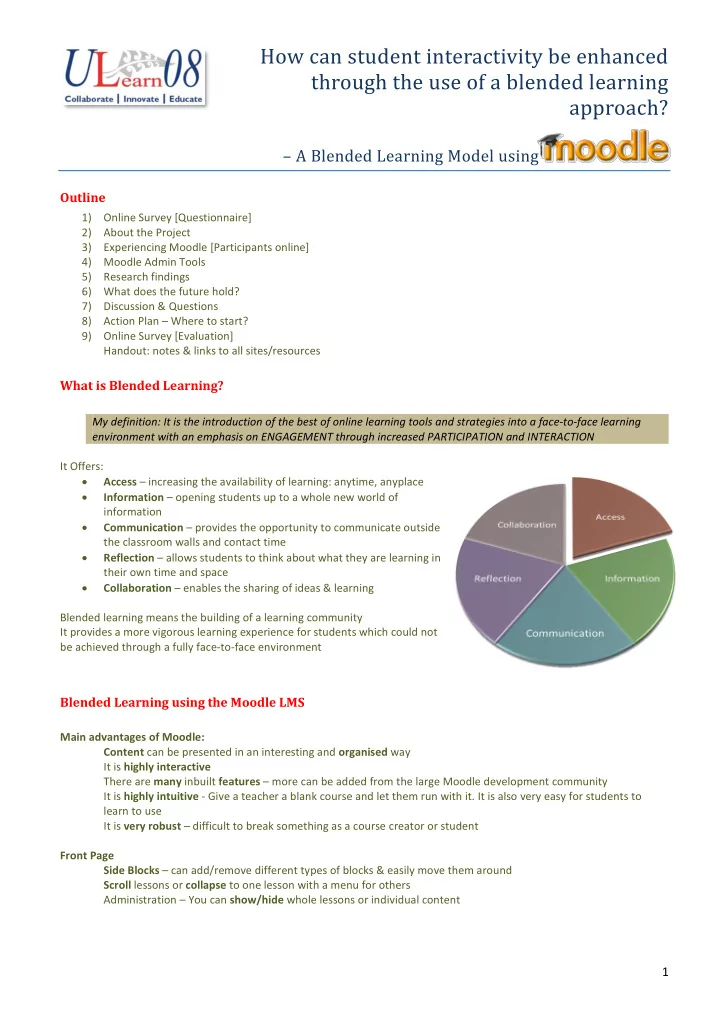
My definition: It is the introduction of the best of online learning tools and strategies into a face-to-face learning environment with an emphasis on ENGAGEMENT through increased PARTICIPATION and INTERACTION It Offers:
- Access – increasing the availability of learning: anytime, anyplace
- Information – opening students up to a whole new world of
information
- Communication – provides the opportunity to communicate outside
the classroom walls and contact time
- Reflection – allows students to think about what they are learning in
their own time and space
- Collaboration – enables the sharing of ideas & learning
Blended learning means the building of a learning community It provides a more vigorous learning experience for students which could not be achieved through a fully face-to-face environment
Blended Learning using the Moodle LMS
Main advantages of Moodle: Content can be presented in an interesting and organised way It is highly interactive There are many inbuilt features – more can be added from the large Moodle development community It is highly intuitive - Give a teacher a blank course and let them run with it. It is also very easy for students to learn to use It is very robust – difficult to break something as a course creator or student Front Page Side Blocks – can add/remove different types of blocks & easily move them around Scroll lessons or collapse to one lesson with a menu for others Administration – You can show/hide whole lessons or individual content