Disclosures Adolescents & Decision of Organ Donation I have - - PowerPoint PPT Presentation

disclosures
SMART_READER_LITE
LIVE PREVIEW

Disclosures Adolescents & Decision of Organ Donation I have - - PowerPoint PPT Presentation

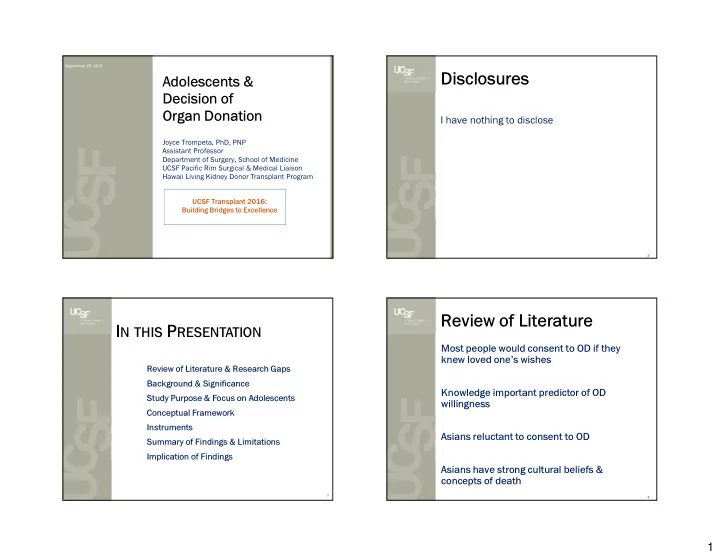
September 29, 2016 Disclosures Adolescents & Decision of Organ Donation I have nothing to disclose Joyce Trompeta, PhD, PNP Assistant Professor Department of Surgery, School of Medicine UCSF Pacific Rim Surgical & Medical Liaison


slide-1
SLIDE 1

1

UCSF Transplant 2016: Building Bridges to Excellence

September 29, 2016

Adolescents & Decision of Organ Donation

Joyce Trompeta, PhD, PNP Assistant Professor Department of Surgery, School of Medicine UCSF Pacific Rim Surgical & Medical Liaison Hawaii Living Kidney Donor Transplant Program

Disclosures

I have nothing to disclose

2 3

IN THIS PRESENTATION

Review of Literature & Research Gaps Background & Significance Study Purpose & Focus on Adolescents Conceptual Framework Instruments Summary of Findings & Limitations Implication of Findings

Review of Literature

Most people would consent to OD if they knew loved one’s wishes Knowledge important predictor of OD willingness Asians reluctant to consent to OD Asians have strong cultural beliefs & concepts of death

4

slide-2
SLIDE 2

2

Research Gaps

Lack of research with AAs & OD Attitudes/knowledge of AAs remain largely unexamined, especially in adolescents Little research devoted to importance of family discussion & OD Lack of reliable, valid, culturally sensitive instruments

5 6

Backgroundon Organ Donation & Transplantation

Over 120,000 people on organ transplant waiting list In Hawaii, incidence of kidney disease is 33% higher than the U.S. national average In 2014, only 3% of U.S. organs donated from Asian Americans compared to 69%

  • rgans from Caucasians

UNOS (2016); NKF (2014)

Significance

Asian Americans:

Most diverse & fastest growing ethnic group 50% ↑incidence ESRD than Caucasians Demand for kx tx likely to ↑ as young Asian population ages

7 8

Revised Uniform Anatomical Gift Act

In 2008, Hawaii enacted the Revised Uniform Anatomical Gift Act, under which first- person authorization to become an organ donor is legally binding

slide-3
SLIDE 3

3

9

Why Adolescents?

Development of critical/abstract thinking skills Lifelong behaviors are being formed Adopt meaningful moral standards, values & belief systems Organ Donation Card Influence to promote organ donation

10

Study Purpose & Importance

Examined Attitudes, Beliefs & Knowledge about Organ Donation & Transplantation among Asian American Adolescents Stimulate family conversation at home Prepare to decide whether to sign

  • rgan donor card upon applying for

driver’s license

11

Attitude towards organ donation Knowledge of

  • rgan donation

Willingness/Intent to Donate Family Discussion Acculturation Level of Adolescent

Conceptual Framework

Acculturation

Becomes way in which individuals incorporate values & behaviors with the dominant society they live May help explain or predict attitudes/knowledge

12

slide-4
SLIDE 4

4

Suinn-Lew Asian Self-Identity Acculturation Scale (SL-ASIA)

13

Sample Questions

“What language do you prefer to speak?” “What generation are you?” “What is your food preference at home?” “Rate yourself on how much you believe in American (Western) values”

Suinn et al. (1992). The Suinn-Lew Asian Self-Identity Acculturation Scale: Concurrent and factorial

  • validation. Educational and Psychological Measurement, 52,1041-1046

Organ Donation & Transplantation Knowledge Survey (ODTK)

14

Sample Questions

“My religious beliefs do not support organ donation” “I could need an organ transplant at some time in my life” “Racial discrimination prevents minority people from receiving organ transplants they need” “A patient can receive an organ transplant from a living donor”

Trompeta JA et al. (2010). Development of the organ donation & transplantation knowledge survey for Asian American adolescents. Transplantation Proceedings, 42, 1427-1431.

ADOLESCENTS N=121

16 years old 52.1% (N=63) 17 years old 47.9% (N=58) Juniors 55.4% (N=67) Seniors 44.6% (N=54) Females 71.9% (N=87) Males 28% (N=34) Born in U.S. 98% (N=117) Born in Hawaii 88% (N=103) Mixed Ethnicity 78.5% (N=95) >= 2 Asian Ethnicities 42.1% (N=51) Religious Affiliation 62.3% (N=73) Unreported/No Religious Affiliation 37.7% (N=48)

16

Mean

  • Std. Deviation

Opposing organ donation 2.01 .35 Approving organ donation 2.84 .31 General organ donation knowledge 3.10 .38 Willingness to donate

  • rgan

3.20 .74

Findings

Attitudes / Knowledge / Willingness to Donate

slide-5
SLIDE 5

5

Findings

17

Strongly Agree Agree Disagree Strongly Disagree

Has discussed own wishes about OD with family

60 40 20

Frequency Has discussed own wishes about OD with family

Findings Suggest

Positive Attitudes & Knowledge associated with Willingness to Donate & Family Discussion High acculturation level affects willingness to donate; however, no association with Family Discussion

18

Limitations

High ethnic mix Self-selected Highly acculturated Gender SES

19 20

Willingness to donate associated with: positive knowledge related to general aspects about organ donation high level of acculturation low level of negative attitudes Asian American adolescents with positive attitudes were likely to engage in family discussion about organ donation

Trompeta JA et al. (2012). Asian American adolescents and their willingness to donate and engage in family discussion about organ donation. Progress in Transplantation, 22:1,33-40.

SUMMARY OF FINDINGS

slide-6
SLIDE 6

6

21

To reinforce & maintain high levels of knowledge & positive attitudes ~ organ donation education is most likely needed in high schools

Trompeta JA et al. (2012). Asian American adolescents and their willingness to donate and engage in family discussion about organ donation. Progress in Transplantation, 22:1,33-40.

IMPLICATION OF FINDINGS

Thank you!