Disclosures Dr. Collard has ongoing contractual relationships with - - PowerPoint PPT Presentation

disclosures
SMART_READER_LITE
LIVE PREVIEW

Disclosures Dr. Collard has ongoing contractual relationships with - - PowerPoint PPT Presentation

11/5/2016 Disclosures Dr. Collard has ongoing contractual relationships with the following organizations: Grants: NIH/NHLBI, NIH/NCATS Contracts: Alkermes, aTyr, Bayer, Boehringer Ingelheim, Bristol-Myers Non-pharmacological Treatment


slide-1
SLIDE 1

11/5/2016 1

Non-pharmacological Treatment of ILD

Harold R Collard, MD Director, Interstitial Lung Disease Program Associate Professor of Medicine University of California San Francisco Sally McLaughlin, RN, MSN Interstitial Lung Disease Program Nurse Educator University of California San Francisco

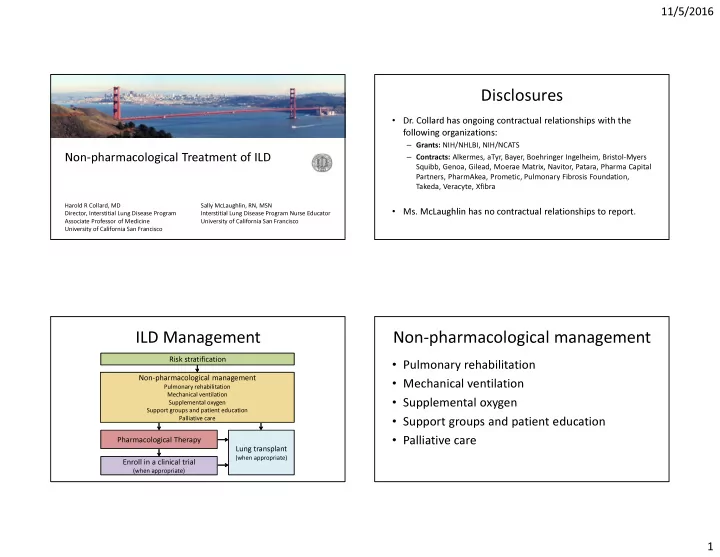
Disclosures

  • Dr. Collard has ongoing contractual relationships with the

following organizations:

– Grants: NIH/NHLBI, NIH/NCATS – Contracts: Alkermes, aTyr, Bayer, Boehringer Ingelheim, Bristol-Myers Squibb, Genoa, Gilead, Moerae Matrix, Navitor, Patara, Pharma Capital Partners, PharmAkea, Prometic, Pulmonary Fibrosis Foundation, Takeda, Veracyte, Xfibra

  • Ms. McLaughlin has no contractual relationships to report.

ILD Management

Enroll in a clinical trial

(when appropriate)

Risk stratification Non-pharmacological management

Pulmonary rehabilitation Mechanical ventilation Supplemental oxygen Support groups and patient education Palliative care

Pharmacological Therapy Lung transplant

(when appropriate)

Non-pharmacological management

  • Pulmonary rehabilitation
  • Mechanical ventilation
  • Supplemental oxygen
  • Support groups and patient education
  • Palliative care
slide-2
SLIDE 2

11/5/2016 2

Pulmonary rehabilitation Pulmonary rehabilitation

  • “a comprehensive intervention based on a

thorough patient assessment followed by patient-tailored therapies that include, but are not limited to, exercise training, education, and behavior change….”

Spruit AJRCCM 2013;188:e13

Do you refer ILD patients to PR?

  • A. Yes, and almost all of my patients go.
  • B. Yes, but many of my patients cannot go

due to insurance issues

  • C. Yes, but many of my patients cannot go

due to location/tansportation issues

  • D. No, I do not find PR helpful in ILD

Y e s , a n d a l m

  • s

t a l l

  • f

. . . Y e s , b u t m a n y

  • f

m y . . . Y e s , b u t m a n y

  • f

m y . . . N

  • ,

I d

  • n
  • t

f i n d P R h . . .

31% 6% 46% 17%

IPF: Pulmonary rehabilitation

  • “The majority of patients with IPF should be

treated with pulmonary rehabilitation...”

– WEAK YES recommendation – LOW QUALITY evidence

Raghu AJRCCM 2011;183:788

slide-3
SLIDE 3

11/5/2016 3

Change in 6MW distance after PR

Holland Cochrane Syst Review 2014

Change in dyspnea after PR

Holland Cochrane Syst Review 2014

Change in QOL after PR

Holland Cochrane Syst Review 2014

Duration of PR benefit?

Ryerson Resp Med 2014;108:203

slide-4
SLIDE 4

11/5/2016 4

Duration of PR benefit?

Ryerson Resp Med 2014;108:203

Challenges to PR implementation

  • Insufficient reimbursement for PR programs
  • Lack of payer coverage for patients
  • Lack of knowledge/awareness
  • Limited training opportunities for staff

Rochester AJRCCM 2015;192:1373

Mechanical ventilation How often do you use MV in ILD?

  • A. Frequently (75% or greater)
  • B. Often (25-75%)
  • C. Rarely (less than 25%)

F r e q u e n t l y ( 7 5 %

  • r

g r . . . O f t e n ( 2 5

  • 7

5 % ) R a r e l y ( l e s s t h a n 2 5 % )

9% 63% 28%

slide-5
SLIDE 5

11/5/2016 5

How often do you use MV in IPF?

  • A. Frequently (75% or greater)
  • B. Often (25-75%)
  • C. Rarely (less than 25%)

F r e q u e n t l y ( 7 5 %

  • r

g r . . . O f t e n ( 2 5

  • 7

5 % ) R a r e l y ( l e s s t h a n 2 5 % )

2% 77% 21%

IPF: Mechanical ventilation

  • “The majority of patients with respiratory

failure due to IPF should not receive mechanical ventilation...”

– WEAK NO recommendation – LOW QUALITY evidence

Raghu AJRCCM 2011;183:788

MV in idiopathic pulmonary fibrosis

  • Study using Nationwide Inpatient Sample (US)
  • Patients from 2006-2012 with IPF by ICD9

17,700 patients with IPF 1703 received mechanical ventilation 778 received non- invasive ventilation Rush Resp Med 2016;111:72

MV in idiopathic pulmonary fibrosis

  • Study using Nationwide Inpatient Sample (US)
  • Patients from 2006-2012 with IPF by ICD9

17,700 patients with IPF 1703 received mechanical ventilation 778 received non- invasive ventilation Rush Resp Med 2016;111:72

slide-6
SLIDE 6

11/5/2016 6

MV in idiopathic pulmonary fibrosis

Rush Resp Med 2016;111:72

60 55 50 45 40

Mortality (%)

50 40 30 20

Mortality (%)

2006 2008 2010 2012 2006 2008 2010 2012

Intubation Non-invasive

MV in idiopathic pulmonary fibrosis

Rush Resp Med 2016;111:72

60 55 50 45 40

Mortality (%)

50 40 30 20

Mortality (%)

2006 2008 2010 2012 2006 2008 2010 2012

Intubation Non-invasive Limitations:

  • 1. Heterogeneous population by diagnosis
  • patients without IPF
  • patients intubated for non-respiratory reason
  • 2. Heterogeneous population by disease severity
  • no measure (except for oxygen use) available
  • sicker patients may not have been offered

mechanical ventilation

Supplemental oxygen Support groups and patient education Palliative care ATS: Supplemental oxygen

  • “We recommend that patients with IPF and

clinically significant resting hypoxemia should be treated with long-term oxygen therapy...”

– STRONG YES recommendation – VERY LOW QUALITY evidence

Raghu AJRCCM 2011;183:788

slide-7
SLIDE 7

11/5/2016 7

Supplementary oxygen is:

  • A. Easy for most of my patients to get

covered

  • B. Easy for some patients, difficult for
  • thers
  • C. Difficult for most patients to get

covered

E a s y f

  • r

m

  • s

t

  • f

m y p . . . E a s y f

  • r

s

  • m

e p a t i e n t s . . . D i f f i c u l t f

  • r

m

  • s

t p a t i . . .

65% 8% 27%

Supplemental Oxygen

Goal Keep saturation ≥ 90% at rest, with activity, during sleep, at altitude (planes) AND stay active 2011 – Center for Medicare and Medicaid Services (CMS) Competitive Bidding Program = poor reimbursement to oxygen suppliers = restricted choice of, and access to, equipment = people in lower socioeconomic levels, rural areas, people who need higher flows unable to get the equipment they need ATS efforts

26

SECTION HEADING

In general, my patients:

  • A. Feel well-educated about their disease

and have adequate support available

  • B. Are confused and scared about their

disease and lack support

  • C. Are somewhere in between

F e e l w e l l

  • e

d u c a t e d a . . . A r e c

  • n

f u s e d a n d s c a r . . A r e s

  • m

e w h e r e i n b . . .

4% 57% 39%

  • Learn about disease and treatment
  • Feel supported by others who understand
  • Develop self-sufficiency
  • Learn to navigate healthcare system more effectively
  • Learn to be a more knowledgeable/engaged patient
  • Make better decisions about their health care
  • Maintain a sense of normalcy
  • Improve coping skills
  • Share stories with those who understand
  • Help others
  • Fell less anxious
  • Change health behaviors
  • Fell less isolated and more hopeful

Support groups help patients & family

slide-8
SLIDE 8

11/5/2016 8

Education

www.pulmonaryfibrosis.org www.scleroderma.org www.lamfoundation.org www.stopsarcoidosis.org

Palliative Care and Hospice

  • Distressing symptoms of dyspnea, cough, fatigue
  • Decreased activity levels and difficulty carrying out ADLs
  • Fear of suffocation
  • Depression, fear, anxiety,

social isolation, dependence

  • Caregiver well-being
  • Financial burdens
  • Spiritual/existential distress
  • Bereavement

Summary

  • Non-pharmacological care is am important

component of comprehensive ILD care!

  • Availability of key treatments (e.g. pulmonary

rehabilitation, supplemental oxygen) can be a big problem for patients!

  • In general, patients should be connected with

support and advocacy groups!

Non-pharmacological Treatment of ILD

Harold R Collard, MD Director, Interstitial Lung Disease Program Associate Professor of Medicine University of California San Francisco Sally McLaughlin, RN, MSN Interstitial Lung Disease Program Nurse Educator University of California San Francisco