Disclosures Evidence Based Medicine: None Concomitant or - - PowerPoint PPT Presentation

disclosures
SMART_READER_LITE
LIVE PREVIEW

Disclosures Evidence Based Medicine: None Concomitant or - - PowerPoint PPT Presentation

4/18/2015 Disclosures Evidence Based Medicine: None Concomitant or Sequential Phlebectomy for Varicosities with Venous Ablation? 2015 UCSF Vascular Symposium Warren Gasper, MD Assistant Professor of Surgery UCSF Division of Vascular


slide-1
SLIDE 1

4/18/2015 1

Evidence Based Medicine: Concomitant or Sequential Phlebectomy for Varicosities with Venous Ablation?

2015 UCSF Vascular Symposium

Warren Gasper, MD Assistant Professor of Surgery UCSF Division of Vascular Surgery

Disclosures

  • None

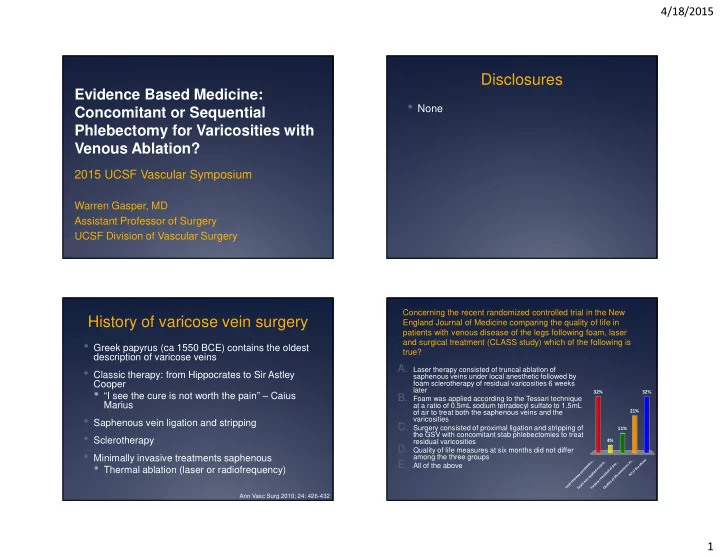
History of varicose vein surgery

  • Greek papyrus (ca 1550 BCE) contains the oldest

description of varicose veins

  • Classic therapy: from Hippocrates to Sir Astley

Cooper

  • “I see the cure is not worth the pain” – Caius

Marius

  • Saphenous vein ligation and stripping
  • Sclerotherapy
  • Minimally invasive treatments saphenous
  • Thermal ablation (laser or radiofrequency)

Ann Vasc Surg 2010; 24: 426-432

Concerning the recent randomized controlled trial in the New England Journal of Medicine comparing the quality of life in patients with venous disease of the legs following foam, laser and surgical treatment (CLASS study) which of the following is true?

  • A. Laser therapy consisted of truncal ablation of

saphenous veins under local anesthetic followed by foam sclerotherapy of residual varicosities 6 weeks later

  • B. Foam was applied according to the Tessari technique

at a ratio of 0.5mL sodium tetradecyl sulfate to 1.5mL

  • f air to treat both the saphenous veins and the

varicosities

  • C. Surgery consisted of proximal ligation and stripping of

the GSV with concomitant stab phlebectomies to treat residual varicosities

  • D. Quality of life measures at six months did not differ

among the three groups

  • E. All of the above

L a s e r t h e r a p y c

  • n

s i s t e d

  • .

. . F

  • a

m w a s a p p l i e d a c c

  • r

d . . . S u r g e r y c

  • n

s i s t e d

  • f

p r

  • .

. . Q u a l i t y

  • f

l i f e m e a s u r e s a t . . . A l l

  • f

t h e a b

  • v

e

32% 4% 32% 21% 11%

slide-2
SLIDE 2

4/18/2015 2

What about the superficial varicosities?

  • In the era of general anesthesia for saphenous

ligation and stripping, concomitant stab phlebectomy was typical

  • The new paradigm of minimally invasive

therapies have brought the procedure to the clinic, hence an interest in a procedure that could be tolerated in an office setting

Phlebectomy technologies

  • Stab phlebectomy / microphlebectomy
  • Light assisted phlebectomy
  • Light assisted power phlebectomy
  • Mechanical phlebectomy
  • Foam sclerotherapy

All can be done with local anesthesia

  • 507 limbs with truncal reflux and >3mm

symptomatic varicose veins

  • 355 (70%) had concomitant phlebectomy
  • 126 (25%) had sequential phlebectomy
  • 86 limbs with truncal reflux and symptomatic

varicose veins

  • EVLA first with photographic assessment at 1mo
  • 36 (42%) had sequential phlebectomy
slide-3
SLIDE 3

4/18/2015 3

Vasc Endovasc Surg 44(7) 545-549

  • 50 patients randomized to saphenous laser ablation

and concomitant vs sequential phlebectomy

  • 16/24 (67%) treated with EVLA alone had subsequent

phlebectomy (vs 1/25 in concomitant group)

Br J Surg 2009; 96: 369–375; BJS 2014; 101: 1093–1097 Br J Surg 2009; 96: 369–375; BJS 2014; 101: 1093–1097

  • 101 patients randomized to saphenous RFA with

concomitant vs sequential phlebectomy

  • 18/50 (36%) treated with RFA alone had subsequent

phlebectomy (vs 1/51 in concomitant group)

Ann Surg 2015;261:654–661

slide-4
SLIDE 4

4/18/2015 4 Predicting need for concomitant phlebectomy

38% of limbs (115/302) had complete varicose vein resolution Of patients with C2 disease and residual varicosities, 85.7% (132/155) requested a secondary procedure Of patients with C3-6 disease and residual varicosities, 39.4% (13/33) requested a secondary procedure

Conclusions

  • Varicose vein treatment has gone from a “fool

me once…” surgery to an office based,

  • utpatient procedure
  • Phlebectomies can be safely performed in a

concomitant or sequential fashion

  • Consider concomitant phlebectomy for

extensive, large (>6mm) varicosities and especially in C2 disease