Probability and Statistics for Computer Science The weak law of - - PowerPoint PPT Presentation

probability and statistics
SMART_READER_LITE
LIVE PREVIEW

Probability and Statistics for Computer Science The weak law of - - PowerPoint PPT Presentation

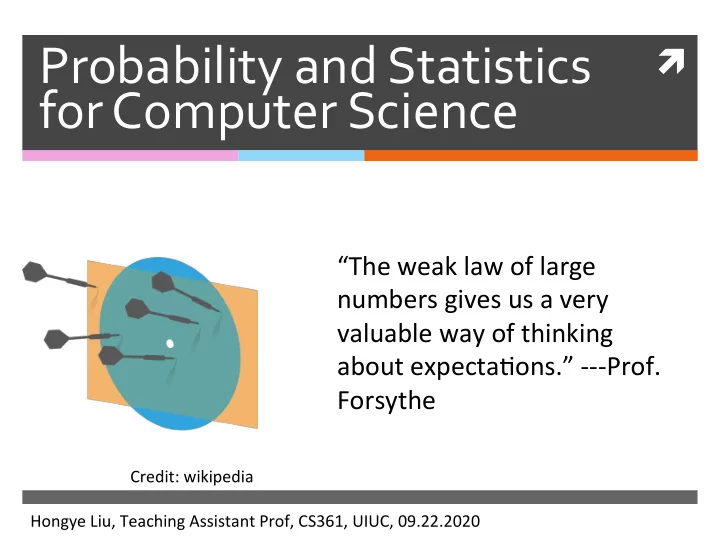
Probability and Statistics for Computer Science The weak law of large numbers gives us a very valuable way of thinking about expecta:ons. ---Prof. Forsythe Credit: wikipedia Hongye Liu, Teaching Assistant Prof, CS361, UIUC,


slide-1
SLIDE 1

ì

Probability and Statistics for Computer Science

“The weak law of large numbers gives us a very valuable way of thinking about expecta:ons.” ---Prof. Forsythe

Hongye Liu, Teaching Assistant Prof, CS361, UIUC, 09.22.2020 Credit: wikipedia

slide-2
SLIDE 2

Midtemexau.li#

  • n0c€

Please

schedule

CBTFexamzpract.is

are

linked

a

problem

2 Solutions

slide-3
SLIDE 3

One

practice

exam

will

be

given

in

a

week

through

Grades cope

co

mimic

CBTF

exam

protocol

.
slide-4
SLIDE 4

How many

possible colors

?

Hex

Kolar

codes

uses

Hexadecimal

( 16

per position )

format

to

define

colors

.

With

9

Here

.
  • digits ,

how

many

colors

can

be represented ?

16×16 x

  • .
.

eb

( 69,4×9
slide-5
SLIDE 5

Last time

Random

variable

c R
  • V . )

*

Expected

value

Definition

Xcw)

properties

f CX)

*

  • *

Variance

&

covariance

fix . 's)

#

slide-6
SLIDE 6

Objectives

Random

variable

, R

* Review

  • f

expectations

*

Markov 's

Inequality

chebyshev

's

inequality

* The

weak

law of

Lyga numbers

slide-7
SLIDE 7

Expected value

The expected value (or expecta,on)

  • f a random variable X is

The expected value is a weighted sum

  • f all the values X can take

E[X] =

  • x

xP(x)

Pc

¥"

slide-8
SLIDE 8

Linearity of Expectation

E- ( a Xtb ] = a Etat b

Ef Xt Y ]

=

EATt EET) E [ ? Xi )

= ? Efxi]

slide-9
SLIDE 9

Expected value of a function of X

Eff CX)) = I fix)

. Pix)

7C

slide-10
SLIDE 10

Probability distribution

Given the random variable X, what is

E[2|X| +1]?

X

1 1/2

p(x)

P(X = x)

  • 1
  • A. 0
  • B. 1
  • C. 2
  • D. 3
  • E. 5

E- ( 21×41] =2Eh× =3

  • z

Hmp ' "

El 1×11=7 "t - EY, *÷

=/

a

slide-11
SLIDE 11

Expected time of cat

A cat moves with random constant

speed V, either 5mile/hr or 20mile/hr with equal probability, what’s the expected 5me for it to travel 50 miles?

T =

= f 'V)

D-

  • a

Earl

EITI Z type

vs t

= ÷

. Paris + ¥ . p cuz,

=

x'T t

xtz-6.rs

slide-12
SLIDE 12

Jensen 's

inequality

for

convex

tune

.
  • g. CX)

Elgin) > glean)

#

Can 't

assume

ELgcxst-glEHD.iq

slide-13
SLIDE 13

A neater expression for variance

var[X] = E[X2] − E[X]2

var[X] = E[(X − E[X])2]

Variance of Random Variable X is

defined as:

It’s the same as:

vagueXI

=?

thevarEx]

A

slide-14
SLIDE 14

Probability distribution and cumulative distribution

Given the random variable X, what is

var[2|X| +1]?

X

1 1/2

p(x)

P(X = x)

  • 1
  • A. 0
  • B. 1
  • C. 2
  • D. 3
  • E. -1

= Ivar ( I xp]

I

slide-15
SLIDE 15

Probability distribution

Given the random variable X, what is

var[2|X| +1]? Let Y = 2|X|+1

X

3 1

P(Y = y)

p(y)

i

. I txt ) =

Eflxl

']

  • EH xD
slide-16
SLIDE 16

Probability distribution

Given the random variable X, what is

var[2|X| +1]? Let Y = 2|X|+1

X

3 1

P(Y = y)

p(y)

slide-17
SLIDE 17

Probability distribution

Give the random variable S in the 4-

sided die, whose range is {2,3,4,5,6,7,8}, probability distribu:on of S.

S

2 3 4 5 6 7 8

p(s)

1/16 What is var[S] ?

  • ECS't - Ecs

)

=ZEgED

slide-18
SLIDE 18

These

areequivalent

(1)

Cov CX

, 41=0 ;

Corr CX

,-0=0

( I )

ECXYI

= ECXIECY ]

( II)

var[ Xt's]

  • uarfxfiuascy]

they

all

mean

X , Y

are

uncorrelated

.

Cove x.

'D=

ECXTI - E- CHEH ]

var Ext'll = usixltuarteltrcoucx, y,

slide-19
SLIDE 19

Properties of independence in terms

  • f expectations
  • E[XY ] = E[X]E[Y ]

it

X.

'fore inept .

Proof :

LHS =

2- -2

xypcx

  • y )

x y

ifX.Tareiwdpt.pl

  • x. g) =p ex) pay,

for

ace * . y

LH s

= I xpcac, Egg pigs

=

ECXIEIT]

= RHS

slide-20
SLIDE 20

If

X , T

are

independent then

Cove X. 41=0 ,

  • Corr CX, -9=0

ECXY)

= EAT ECT]

{ uarfxtyj-uarcxltuas.IT]

¥±÷i÷÷÷

:

slide-21
SLIDE 21

Q: What is this expectation?

We toss two iden5cal coins A & B

independently for three 5mes and 4 5mes respec5vely, for each head we earn $1, we define X is the earning from A and Y is the earning from B. What is E(XY)?

  • A. $2 B. $3 C. $4

work

  • n it off line

K

D

ECx7= ?

ECT ) =?

slide-22
SLIDE 22

Uncorrelated vs Independent

If two random variables are

uncorrelated, does this mean they are independent? Inves5gate the case X takes -1, 0, 1 with equal probability and Y=X2.

Work

  • n

it

  • ffline

E- Cx's

  • _ Efx) ECT)

but

pck.gl#Pcxspcy )

slide-23
SLIDE 23

How do you

make

it with

a

die?

as it

throwing

a

biased

wig

with

probability

  • _ 0.75

coming

up

head ?

4 - sided

die

0.25 1,213€

4

  • l T

p

  • logo
slide-24
SLIDE 24

What

does it

mean that 2

RVs

have

the

scene

distr . ?

" Pl X -
  • 24

/

,,PlY=y)

identical

t

  • ÷
.

Hit.

tail

Yew>=/ ?

4-die-off

,

X ( w)={

°

,

head

4- die comes 4-die

xp

  • dd
2- Cw)=/ ° shows I orz

I

  • z
  • r 4
slide-25
SLIDE 25

Three experiments of

2

Students

Report

the

sum of

random

number each

4-

finds after

rolling

a fa

die

.

each

roll

  • nce

,

then

add

them

sit

u

at

them

""s

+" U 't'm Etten .

@

  • ne

rolls

  • nce,

then times its

gamer variance

2

.
slide-26
SLIDE 26

Ist

l

M

  • und

I

14

.

Sunny

. N car
  • die

distinct

  • numbers

N

M

=

N

I t

i -
  • i

MX N = M N

X

X

  • I ④Nr-N
  • p
  • µµ_C
slide-27
SLIDE 27

Towards the weak law of large numbers

The weak law says that if we repeat a random

experiment many :mes, the average of the

  • bserva:ons will “converge” to the expected value

For example, if you repeat the profit example, the

average earning will “converge” to E[X]=20p-10

The weak law jus:fies using simula:ons (instead of

calcula:on) to es:mate the expected values of random variables

  • # 5 -fo

E → I x.pox,

slide-28
SLIDE 28

Markov’s inequality

For any random variable X that only takes

x ≥ 0 and constant a > 0

For example, if a = 10 E[X]

P(X ≥ a) ≤ E[X] a

P(X ≥ 10E[X]) ≤ E[X] 10E[X] = 0.1

  • -
slide-29
SLIDE 29

Proof of Markov’s inequality

X only take

a > o

Eun =

I

.

Expose,

× so

set a

X > a

3 I

>TP

"' 3 E.age

. P")

=

a,a

pT×⇒

= a. pix>a, Pity

a

slide-30
SLIDE 30

Chebyshev’s inequality

For any random variable X and constant a >0 If we let a = kσ where σ = std[X] In words, the probability that X is greater than

k standard devia:on away from the mean is small P(|X − E[X]| ≥ kσ) ≤ 1 k2

P(|X − E[X]| ≥ a) ≤ var[X] a2

slide-31
SLIDE 31

Proof of Chebyshev’s inequality

Given Markov inequality, a>0, x ≥ 0 We can rewrite it as

ω > 0

P(X ≥ a) ≤ E[X] a

P(|U| ≥ w) ≤ E[|U|] w

it's

the

same

as

:

'f- IVI

y 7

O

U = (X- ECHR

( VI =

( x- Efx) 5

slide-32
SLIDE 32

Proof of Chebyshev’s inequality

If U = (X − E[X])2

P(|U| ≥ w) ≤ E[|U|] w = E[U] w

  • BBpBEE"

RHs=#

pixewxwgsuarwxiii

:

w=a

' pclx-EHIZajsva.az#

slide-33
SLIDE 33

Now we are closer to the law of large numbers

slide-34
SLIDE 34

Sample mean and IID samples

We define the sample mean to be the

average of N random variables X1, …, XN.

If X1, …, XN are independent and have

iden,cal probability func:on then the numbers randomly generated from them are called IID samples

The sample mean is a random variable

P(x)

X

  • #EEi÷i÷

.

slide-35
SLIDE 35

Sample mean and IID samples

Assume we have a set of IID samples from N

random variables X1, …, XN that have probability func:on

We use to denote the sample mean of

these IID samples

P(x)

X = N

i=1 Xi

N

X

D.

'

¥

,

slide-36
SLIDE 36

Expected value of sample mean of IID random variables

By linearity of expected value

E[X] = E[ N

i=1 Xi

N ] = 1 N

N

  • i=1

E[Xi]

E- CTX.

  • I
= -2 Efxi]

i

p*'

Ely ,7⇐

Eagle

. .

CX:D

II

EAT

E- (51=4

  • N
  • EAT

= Efx)

slide-37
SLIDE 37

Expected value of sample mean of IID random variables

By linearity of expected value Given each Xi has iden:cal

P(x)

E[X] = E[ N

i=1 Xi

N ] = 1 N

N

  • i=1

E[Xi]

E[X] = 1 N

N

  • i=1

E[X] = E[X]

ECXt-ECX.IE?IelxnI

slide-38
SLIDE 38

Variance of sample mean of IID random variables

By the scaling property of variance

var[X] = var[ 1 N

N
  • i=1

Xi] = 1 N 2var[

N
  • i=1

Xi]

{Hi

, Xj ))

mutual t

.

pix,

var C Xitxu) = var

+varley
  • X. I

,xi

work

, I = var Kil
  • =urrfxµ]

= var EX]

varix) = * t]=¥

. N - var Cx]
slide-39
SLIDE 39

Variance of sample mean of IID random variables

By the scaling property of variance And by independence of these IID random

variables

var[X] = var[ 1 N

N
  • i=1

Xi] = 1 N 2var[

N
  • i=1

Xi]

var[X] = 1 N 2

N

  • i=1

var[Xi]

varCI I = ¥

.

var Cx) = ¥

. N
  • varix]
= an Cx)
slide-40
SLIDE 40

Expected value and variance of sample mean of IID random variables

The expected value of sample mean is the

same as the expected value of the distribu:on

The variance of sample mean is the

distribu:on’s variance divided by the sample size N

var[X] = var[X] N

E[X] = E[X]

slide-41
SLIDE 41

Weak law of large numbers

Given a random variable X with finite variance,

probability distribu:on func:on and the sample mean of size N.

For any posi:ve number That is: the value of the mean of IID samples is very

close with high probability to the expected value of the popula:on when sample size is very large

P(x)

X

lim

N→∞P(|X − E[X]| ≥ ) = 0

> 0

slide-42
SLIDE 42

Proof of Weak law of large numbers

Apply Chebyshev’s inequality

P(|X − E[X]| ≥ ) ≤ var[X] 2

E- LET = Efx)

var( II = # varix]

slide-43
SLIDE 43

Proof of Weak law of large numbers

Apply Chebyshev’s inequality Subs:tute and

E[X] = E[X]

var[X] = var[X] N

P(|X − E[X]| ≥ ) ≤ var[X] N2

P(|X − E[X]| ≥ ) ≤ var[X] 2

  • µ→N
slide-44
SLIDE 44

Proof of Weak law of large numbers

Apply Chebyshev’s inequality Subs:tute and

E[X] = E[X]

var[X] = var[X] N

P(|X − E[X]| ≥ ) ≤ var[X] N2

P(|X − E[X]| ≥ ) ≤ var[X] 2

N → ∞

i i d

X

.
slide-45
SLIDE 45

A- v

m -

  • 3

I }

'

÷

*

( St

2nd

6

µ Ntl

Nfr

  • ' N
  • Mz
"

RV .

3

3

¥3

I

z

n

I

' ,

;

I

¥3

'
slide-46
SLIDE 46

Proof of Weak law of large numbers

Apply Chebyshev’s inequality Subs:tute and

E[X] = E[X]

var[X] = var[X] N

P(|X − E[X]| ≥ ) ≤ var[X] N2

P(|X − E[X]| ≥ ) ≤ var[X] 2

lim

N→∞P(|X − E[X]| ≥ ) = 0

N → ∞

slide-47
SLIDE 47

Applications of the Weak law of large numbers

slide-48
SLIDE 48

Applications of the Weak law of large numbers

The law of large numbers jus,fies using

simula,ons (instead of calcula:on) to es:mate the expected values of random variables

The law of large numbers also jus,fies using

histogram of large random samples to approximate the probability distribu:on func:on , see proof on

  • Pg. 353 of the textbook by DeGroot, et al.

lim

N→∞P(|X − E[X]| ≥ ) = 0

P(x)

slide-49
SLIDE 49

Histogram of large random IID samples approximates the probability distribution

The law of large numbers jus:fies using

histograms to approximate the probability distribu:on. Given N IID random variables X1, …, XN

According to the law of large numbers As we know for indicator func:on

E[Yi] = P(c1 ≤ Xi < c2)= P(c1 ≤ X < c2) Y = N

i=1 Yi

N

N → ∞

E[Yi]

slide-50
SLIDE 50

Simulation of the sum of two-dice

hpp://www.randomservices.org/

random/apps/DiceExperiment.html

slide-51
SLIDE 51

Probability using the property of Independence: Airline overbooking

An airline has a flight with s seats. They

always sell t (t>s) :ckets for this flight. If :cket holders show up independently with probability p, what is the probability that the flight is overbooked ?

P( overbooked)

=

t

  • u=s+1

C(t, u)pu(1 − p)t−u

slide-52
SLIDE 52

Simulation of airline overbooking

An airline has a flight with 7 seats. They

always sell 12 :ckets for this flight. If :cket holders show up independently with probability p, es:mate the following values

Expected value of the number of :cket

holders who show up

Probability that the flight being overbooked Expected value of the number of :cket

holders who can’t fly due to the flight is

  • verbooked.
slide-53
SLIDE 53

Conditional expectation

Expected value of X condi:oned on event A: Expected value of the number of :cketholders

not flying

E[X|A] =

  • x∈D(X)

xP(X = x|A)

t
  • u=s+1

(u − s) t

u
  • pu(1 − p)t−u

t

v=s+1

t

v
  • pv(1 − p)t−v

E[NF|overbooked] =

slide-54
SLIDE 54

Simulate the arrival

Expected value of the number of :cket

holders who show up

nt=100000, t= 12, s=7, p=0.1, 0.2, … 1.0

. . .

… Num of trials (nt) Num of :ckets (t)

We generate a matrix of random numbers from uniform distribu:on in [0,1], Any number < p is considered an arrival

slide-55
SLIDE 55

Simulate the arrival

Expected value of the number of :cket

holders who show up

nt=100000, t= 12, s=7, p=0.1, 0.2, … 1.0

  • 0.2
0.4 0.6 0.8 1.0 2 4 6 8 10 12 Expected value of the number of ticket holders who show up Probability of arrival (p) Expected value
slide-56
SLIDE 56

Simulate the expected probability of

  • verbooking

Expected probability of the flight being

  • verbooked

Expected probability is equal to the expected

value of indicator func,on. Whenever we have Num of arrival > Num of seats, we mark it with an indicator func:on. Then es:mate with the sample mean of indicator func:ons.

t= 12, s=7, p=0.1, 0.2, … 1.0

slide-57
SLIDE 57

Simulate the expected probability of

  • verbooking

Expected

probability of the flight being

  • verbooked

nt=100000, t= 12, s=7, p=0.1, 0.2, … 1.0

  • 0.2
0.4 0.6 0.8 1.0 0.0 0.2 0.4 0.6 0.8 1.0 Expected probability of flight being overbooked Probability of arrival (p) Expected value
slide-58
SLIDE 58

Simulate the expected value of the number of grounded ticket holders given overbooked

Expected value of

the number of :cket holders who can’t fly due to the flight being overbooked

Nt=200000, t= 12, s=7, p=0.1, 0.2, … 1.0

  • 0.2
0.4 0.6 0.8 1.0 1 2 3 4 5 Expected value of the number of ticket holder not flying given overbooked Probability of arrival (p) Expected value
slide-59
SLIDE 59

Assignments

Finish Chapter 4 of the textbook Next :me: Con:nuous random

variable, classic known probability distribu:ons

slide-60
SLIDE 60

Additional References

Charles M. Grinstead and J. Laurie Snell

"Introduc:on to Probability”

Morris H. Degroot and Mark J. Schervish

"Probability and Sta:s:cs”

slide-61
SLIDE 61

See you next time

See You!