Disclosures US Patent and Applications Pending: U.S. Pat. App. - - PowerPoint PPT Presentation

disclosures
SMART_READER_LITE
LIVE PREVIEW

Disclosures US Patent and Applications Pending: U.S. Pat. App. - - PowerPoint PPT Presentation

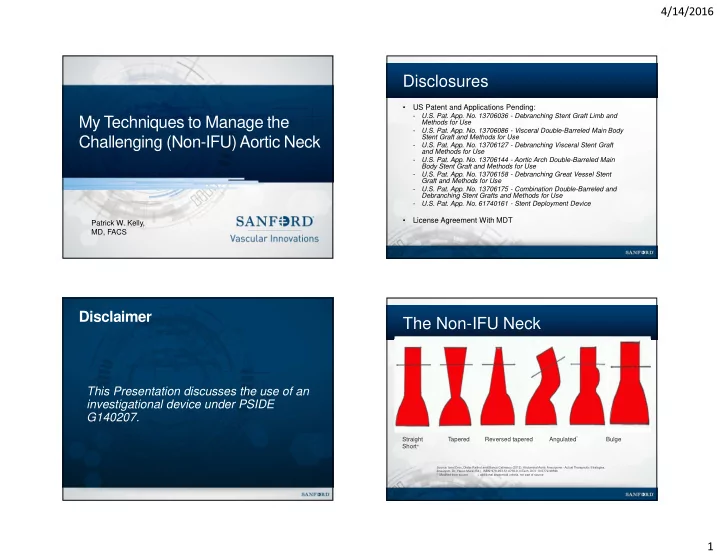
4/14/2016 Disclosures US Patent and Applications Pending: U.S. Pat. App. No. 13706036 - Debranching Stent Graft Limb and - My Techniques to Manage the Methods for Use U.S. Pat. App. No. 13706086 - Visceral Double-Barreled Main Body -


slide-1
SLIDE 1

4/14/2016 1

My Techniques to Manage the Challenging (Non-IFU) Aortic Neck

Patrick W. Kelly, MD, FACS

Disclosures

  • US Patent and Applications Pending:
  • U.S. Pat. App. No. 13706036 - Debranching Stent Graft Limb and

Methods for Use

  • U.S. Pat. App. No. 13706086 - Visceral Double-Barreled Main Body

Stent Graft and Methods for Use

  • U.S. Pat. App. No. 13706127 - Debranching Visceral Stent Graft

and Methods for Use

  • U.S. Pat. App. No. 13706144 - Aortic Arch Double-Barreled Main

Body Stent Graft and Methods for Use

  • U.S. Pat. App. No. 13706158 - Debranching Great Vessel Stent

Graft and Methods for Use

  • U.S. Pat. App. No. 13706175 - Combination Double-Barreled and

Debranching Stent Grafts and Methods for Use

  • U.S. Pat. App. No. 61740161 - Stent Deployment Device
  • License Agreement With MDT

This Presentation discusses the use of an investigational device under PSIDE G140207.

Disclaimer

Source: Ionel Droc, Dieter Raithel and Blanca Calinescu (2012). Abdominal Aortic Aneurysms - Actual Therapeutic Strategies, Aneurysm, Dr. Yasuo Murai (Ed.), ISBN: 978-953-51-0730-9, InTech, DOI: 10.5772/48596 * Modified from source + additional anatomical criteria, not part of source

The Non-IFU Neck

Straight Tapered Reversed tapered Angulated* Bulge Short+

slide-2
SLIDE 2

4/14/2016 2

Non IFU Aortic Neck

  • > 60 degrees
  • > 32mm
  • < 10mm though this varies with manufacture
  • +/- Thrombus/ Calcifications

What Are The Failure Mode of the IFU Deviations

  • > 60 degrees

– Type 1 EndoLeak – Migration

What Are The Failure Mode of the IFU Deviations

  • Dilated Neck >32mm

– Type I EndoLeak – Migration

  • Catastrophic collapse into the Aneurysm Sake

– Advancement of the Aneurysm Proximally

What Are The Failure Mode of the IFU Deviations

  • Short Neck <10mm

– Type I EndoLeak – Migration

  • Catastrophic collapse into the Aneurysm Sake

– Advancement of the Aneurysm Proximally

slide-3
SLIDE 3

4/14/2016 3

What Are The Failure Mode of the IFU Deviations

  • Thrombus/ Calcification

– Type 1 EndoLeak – Migration – Embolization – Aortic Leak With Proximal Ballooning

In Isolation

  • One Deviation From IFU

– Doable

  • With the caveat >34mm dia and Neck <5mm
  • Will Need to Consider Adjuncts
  • Two Or More Deviations From IFU

– Look to More Aortic coverage/ Fixation

  • Endo Anchors
  • Parallel Grafting
  • Investigational Device

Successful EVAR

  • Fixation
  • Seal
  • Flow

My Approach

slide-4
SLIDE 4

4/14/2016 4

First Step In My Algorithm

  • Look at the PATIENT

– Performance status

  • Solid
  • Compromise
  • Extreme Risk

Open Surgery It Still Works Surgical Repair

  • Primary Abdominal Aortic Repair
  • Hybrid Repair

– Before EVAR

  • Renal Bypass to Gain Affective Neck Length

– After Failed EVAR

  • Renal Bypass to Gain Affective Neck Length
  • Napkin Ring (Create A New Neck)

Napkin Ring Endo Treatments

  • Increase Affective Neck Length

– Anchors – Parallel (Longitudinal Grafts) – Investigational Device

slide-5
SLIDE 5

4/14/2016 5

Cross Bar 3 mm 1.0 mm 3.5 mm

Endo Anchors

Parallel Graft Our IDE device

IDE Device

slide-6
SLIDE 6

4/14/2016 6

Unitary Stent Graft System

Fixation 40-50 mm Long Main Body 6-8 mm Visceral Limbs 13-14 mm InfraRenal Extension

Unitary

6-8mm Visceral Limbs 13-14mm InfraRenal Extension

Proximal Deployment

Place the Unitary Graft above the “branch vessels.”

This allows for continued perfusion throughout the procedure.

Type IV TAAA

Proximal Deployment

Of Unitary Graft

slide-7
SLIDE 7

4/14/2016 7

Endo-Bypass

Each of the branch vessels are stented individually from a position more proximally.

These bridging stents are slightly longer, but the favorable flow characteristics and conformability to anatomic variations mirror many of the lessons we’ve learned from open bypass.

Type IV TAAA

Endo-Bypass

Type IV TAAA

Endo-Bypass

Type IV TAAA

Endo-Bypass

slide-8
SLIDE 8

4/14/2016 8

Type IV TAAA

Endo-Bypass

Delayed Distal Seal

Once flow has been secured to each of the involved branches, then the open limb of the unitary graft can be extended distally excluding the diseased segment of vessel.

Type IV TAAA

Delayed Distal Seal

Type IV TAAA

Delayed Distal Seal

slide-9
SLIDE 9

4/14/2016 9

Type IV TAAA

Thank You