Disclosures The Thin Red Line Between I have nothing to disclose - - PowerPoint PPT Presentation

disclosures
SMART_READER_LITE
LIVE PREVIEW

Disclosures The Thin Red Line Between I have nothing to disclose - - PowerPoint PPT Presentation

Current Issues 2015 - Tihan 5/21/2015 Disclosures The Thin Red Line Between I have nothing to disclose Neuropathology and Head & Neck Pathology Tarik Tihan, MD, PhD UCSF, Department of Pathology Neuropathology Division


slide-1
SLIDE 1

Current Issues 2015 - Tihan 5/21/2015 1

Disclosures

I have nothing to disclose

The Thin Red Line Between Neuropathology and Head & Neck Pathology

Tarik Tihan, MD, PhD UCSF, Department of Pathology Neuropathology Division

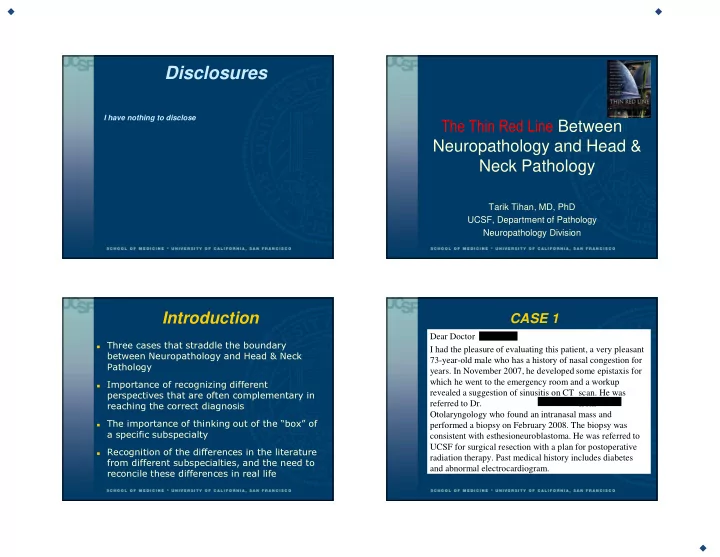
Introduction

Three cases that straddle the boundary

between Neuropathology and Head & Neck Pathology

Importance of recognizing different

perspectives that are often complementary in reaching the correct diagnosis

The importance of thinking out of the “box” of

a specific subspecialty

Recognition of the differences in the literature

from different subspecialties, and the need to reconcile these differences in real life

CASE 1

Dear Doctor I had the pleasure of evaluating this patient, a very pleasant 73-year-old male who has a history of nasal congestion for

  • years. In November 2007, he developed some epistaxis for

which he went to the emergency room and a workup revealed a suggestion of sinusitis on CT scan. He was referred to Dr. from Otolaryngology who found an intranasal mass and performed a biopsy on February 2008. The biopsy was consistent with esthesioneuroblastoma. He was referred to UCSF for surgical resection with a plan for postoperative radiation therapy. Past medical history includes diabetes and abnormal electrocardiogram.

slide-2
SLIDE 2

Current Issues 2015 - Tihan 5/21/2015 2

AXIAL T1-gad AXIAL T1-gad

Smear Frozen

slide-3
SLIDE 3

Current Issues 2015 - Tihan 5/21/2015 3

Frozen

slide-4
SLIDE 4

Current Issues 2015 - Tihan 5/21/2015 4

Synaptophysin Chromogranin

BUT WAIT!!! ISN’T THERE ANYTHING UNUSUAL HERE?

MIB-1

slide-5
SLIDE 5

Current Issues 2015 - Tihan 5/21/2015 5

Cytokeratin ACTH Answer Case 1= Pituitary Adenoma

  • Clinical: Typical visual field defect and

endocrinological symptoms are helpful if present. Often a long-standing clinical history

  • Radiological: Involvement of the sella turcica and

sphenoid prior to nasal or ethmoid involvement

  • Histological: Ample, sometimes clear cytoplasm,

rare mitoses. Otherwise similar to carcinoid tumors

  • Immunohistochemistry: CHR, SYN, Pituitary

Transcription Factors or Hormones

FEATURE Pituitary Adenoma Olfactory Neuroblastoma Low Grade Olfactory Neuroblastoma High Grade Sinonasal Undifferentiated Carcinoma

Lobular pattern

Common Common Focal or Rare Rare

Uniform nuclei

Typical Typical Focal or Absent Absent

Mitotic Figures

Rare Rare Frequent Frequent

Necrosis

Absent Absent Rare Frequent

Rosettes

Absent Present Rare/Absent Absent

slide-6
SLIDE 6

Current Issues 2015 - Tihan 5/21/2015 6

FEATURE

Pituitary Adenoma Olfactory Neuroblastoma Low Grade Olfactory Neuroblastoma High Grade Sinonasal Undifferentiated Carcinoma

Cytokeratins

Mostly Positive Negative Negative Positive

S100 protein

Negative Positive Positive/focal Negative/Rare

NSE

Positive Positive Positive Positive (50%)

PIT1/SF- 1/TPIT Or Pit Hormones

Positive

Negative Negative Negative

Synaptophysin

Positive Positive Positive/Focal Negative

Chromogranin

Often positive Often positive Occasionally positive Rare positive cells

Follow-up 7 years later

Dear Doctor I am delighted to report that the MRI showed no evidence whatsoever of a recurrent pituitary tumor. This is excellent news! I would recommend that you repeat the MRI again in two years. You could work with at to make the arrangements for the follow-up MRI and the appointment.

CASE 2

  • A 21 year old man presented with dysphagia and a

change in his voice. He has also lost 15 lb over the last few months. An MRI revealed a cervical mass. He underwent a biopsy of the lesion, followed by a radical resection. The tumor appeared to have encased the vertebral artery and involved the neural foramen and partially compressed the cervical spinal cord.

slide-7
SLIDE 7

Current Issues 2015 - Tihan 5/21/2015 7

SAGITTAL T2 AXIAL T1-gad

slide-8
SLIDE 8

Current Issues 2015 - Tihan 5/21/2015 8

slide-9
SLIDE 9

Current Issues 2015 - Tihan 5/21/2015 9

AE1-AE3 CAM5.2 EMA

Brachyury

slide-10
SLIDE 10

Current Issues 2015 - Tihan 5/21/2015 10

Brachyury

Answer Case 2 = Chordoma

  • Most common location sacrum, followed by skull

base/clivus

  • Midline with contrast enhancement
  • Epithelial differentiation, typically EMA positive, and

also cytokeratin positive

  • S100 protein often strongly positive along with

Vimentin

  • Brachyury is the marker of choice for the diagnosis
  • f Chordomas

FEATURES CHORDOMA CHONDROSARCOMA

Localization Midline Clivus Lateralized, Temporal bone Physalliphorous cells YES NO Cytokeratin Positive Negative S100 protein Positive Positive EMA Positive Negative Brachyury Positive Negative IDH1 or IDH2 mutations Absent Present

slide-11
SLIDE 11

Current Issues 2015 - Tihan 5/21/2015 11

CASE 3

A 43-year-old man presented with significant

weight loss, postural instability and difficulty in

  • walking. He also suffered from occasional

nausea and vomiting. A recent audiogram demonstrated left severe mixed hearing loss. An MRI revealed a mass that distorted the fourth ventricle with significant hydrocephalus.

slide-12
SLIDE 12

Current Issues 2015 - Tihan 5/21/2015 12

Trichrome Type IV Collagen EMA

slide-13
SLIDE 13

Current Issues 2015 - Tihan 5/21/2015 13

CD34 BCL-2

BUT WAIT!!! ISN’T THERE ANYTHING UNUSUAL HERE?

STAT6

slide-14
SLIDE 14

Current Issues 2015 - Tihan 5/21/2015 14

Answer Case 2 = Solitary Fibrous Tumor

Unification

FEATURE

Solitary Fibrous Tumor Hemangiopericytoma

Collagen-rich

YES NO

HPC-like vasculature

YES YES

Reticulin Stain

Focal positive & vascular pattern Strongly positive

CD34 staining

Diffuse Strong Focal or Negative

BCL-2 staining

Diffuse Strong Diffuse Strong

STAT-6 staining

Diffuse Strong (nuclear) Diffuse Strong (nuclear)

Biphasic architecture

Common Uncommon

Local Recurrence

Rare Common (~60%)

Extracranial metastasis

Exceptional Common (~30%)

NAB2/STAT6 fusion

YES (ex4-ex6 fusion)* YES (ex6-ex16 fusion)*

slide-15
SLIDE 15

Current Issues 2015 - Tihan 5/21/2015 15

THANK YOU