Disclosures Drug-induced Liver Disease: I have nothing to disclose. - - PowerPoint PPT Presentation

disclosures
SMART_READER_LITE
LIVE PREVIEW

Disclosures Drug-induced Liver Disease: I have nothing to disclose. - - PowerPoint PPT Presentation

5/26/2018 Disclosures Drug-induced Liver Disease: I have nothing to disclose. Problem Patterns Raga Ramachandran, MD PhD UCSF Pathology May 26, 2018 raga.ramachandran@ucsf.edu Acute liver failure Evaluating a liver biopsy for drug etiology


slide-1
SLIDE 1

5/26/2018 1

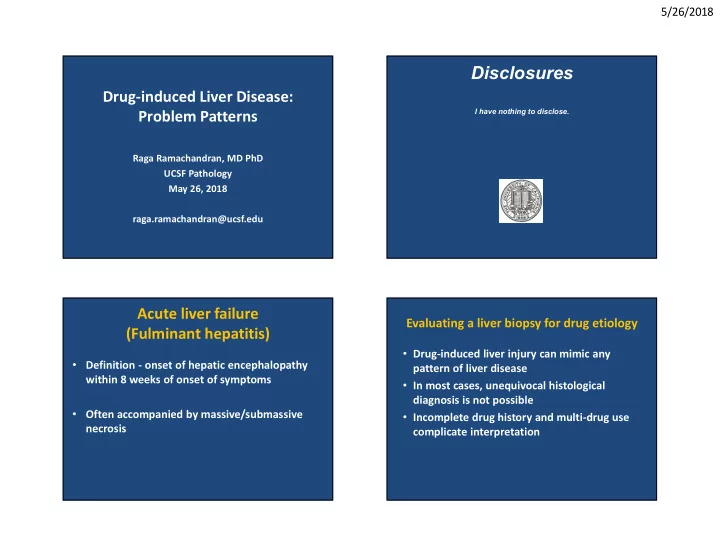
Drug-induced Liver Disease: Problem Patterns

Raga Ramachandran, MD PhD UCSF Pathology May 26, 2018 raga.ramachandran@ucsf.edu

Disclosures

I have nothing to disclose.

Acute liver failure (Fulminant hepatitis)

  • Definition - onset of hepatic encephalopathy

within 8 weeks of onset of symptoms

  • Often accompanied by massive/submassive

necrosis

Evaluating a liver biopsy for drug etiology

  • Drug-induced liver injury can mimic any

pattern of liver disease

  • In most cases, unequivocal histological

diagnosis is not possible

  • Incomplete drug history and multi-drug use

complicate interpretation

slide-2
SLIDE 2

5/26/2018 2

Drug-induced acute liver failure has 3 patterns

  • Extensive microvesicular steatosis (rare)
  • Necrosis with little or no inflammation
  • Necrosis with marked inflammation (most common)
  • Extensive microvesicular steatosis (rare)

– Ex: Tetracycline, zidovudine (nucleoside analogs), valproate, L-asparaginase, amineptine

*Diagnostic pitfall – identifying macrovesicular (large and small droplet) and microvesicular steatosis

Pattern 1

Large and small droplet fat True microvesicular steatosis

slide-3
SLIDE 3

5/26/2018 3

27-year-old man on entecavir (Baraclude)

Extensive microvesicular steatosis

  • Mechanism – mitochondrial injury, may be

accompanied by lactic acidosis

  • Morphology – little inflammation, variable

cholestasis and necrosis

  • DDx – alcoholic foamy degeneration, Reye

syndrome, acute fatty liver of pregnancy, Jamaican vomiting sickness (ackee fruit), urea cycle enzymatic deficiencies

  • Necrosis with little or no inflammation
  • Necrosis with marked inflammation (most common)

Patterns 2 and 3

Intrinsic vs. idiosyncratic hepatotoxicity

  • Intrinsic toxins (relatively few drugs)

– Necrosis with little or no inflammation – Damage in a predictable, dose-dependent manner by drug or its metabolite

  • Idiosyncratic hepatotoxins (most drugs)

– Necrosis with marked inflammation – Metabolic (predisposed individuals) – Immunological (hypersensitivity)

slide-4
SLIDE 4

5/26/2018 4

  • Necrosis with little or no inflammation

– Ex: Acetaminophen, cocaine, MDMA (Ecstasy), CCl4, mushroom alkaloids

Pattern 2

Acute acetaminophen toxicity

  • Acute coagulative, perivenular (zone 3) to panacinar

necrosis

  • Minimal to no inflammation; no fibrosis

Pattern 3

  • Necrosis with marked inflammation (most common)

– Ex: Antimicrobials, MAO inhibitors, anticonvulsants, herbal and supplemental agents, potentially any drug that causes acute hepatitis

Acute hepatitis

  • The most common drug-related injury

pattern seen on biopsy Rest of differential

  • Acute viral hepatitis
  • Initial presentation of autoimmune hepatitis
  • Wilson disease
  • Up to 15% of cases progressing to fulminant

hepatic failure are of unknown etiology

slide-5
SLIDE 5

5/26/2018 5

Ketoconazole toxicity

Submassive to massive necrosis

  • Early stage — necrosis
  • Subacute to late stage — regeneration with

nodule formation

*Diagnostic pitfall: distinguishing necrosis from fibrosis in persistent drug injury

Severe active (subacute) hepatitis with diffuse small nodules mimicking cirrhosis

Distinguishing fibrosis from necrosis

Trichrome stain

  • Established fibrosis is uniformly dark blue
  • Elastic fiber bundles appear pale
  • Necrosis shows two-toned staining

– Dense, darker, and thicker bundles of scar – Light, loose, and thinner bundles of residual framework and debris

slide-6
SLIDE 6

5/26/2018 6

Trichrome, Cirrhosis Trichrome, Cirrhosis Severe acute hepatitis, trichrome: subacute stage Severe acute hepatitis, trichrome: subacute stage

slide-7
SLIDE 7

5/26/2018 7

Trichrome, Late-stage submassive necrosis Trichrome, Two-toned staining

Fibrosis vs Necrosis

Reticulin stain

  • Highlights cell plate framework

– Regenerative plates – Collapsing plates – No distinct staining pattern for established scar

Severe acute hepatitis, reticulin: early stage

slide-8
SLIDE 8

5/26/2018 8

Severe acute hepatitis: subacute stage Severe acute hepatitis, reticulin: subacute stage Reticulin, Cirrhosis

Fibrosis vs Necrosis

Elastic stains – Orcein

  • Highlights elastic fibers in later stages of

fibrosis, as well as smaller elastic fibers in early stages of fibrosis

slide-9
SLIDE 9

5/26/2018 9

Orcein in cirrhosis with elastic bundles Subacute hepatitis with prominent ductular reaction Orcein, Subacute Hepatitis

The only elastic fibers present are in residual portal zones or central veins

Histochemical stains

Necrosis Fibrosis H&E Dropout

  • Trichrome

Two-tone blue Thin fibers All dark blue Thicker bundles

Reticulin Dropout/ Collapse

  • Orcein

(elastic fibers) Negative Positive

slide-10
SLIDE 10

5/26/2018 10

Phenytoin-induced hepatitis Lamotrigine-induced hepatitis Isoniazid-induced hepatitis

Drugs that can mimic autoimmune hepatitis

Methyldopa ANA (16%), ASMA (35%) Minocycline ANA, anti-DNA Nitrofurantoin ANA (80%), ASMA (72%) Oxyphenisatin ANA (67%), ASMA (67%) Statins ANA (80-90%) ASMA (25%)

slide-11
SLIDE 11

5/26/2018 11

Methyldopa hepatitis Possible drug injury – herbals

Trichrome stain – herbal history

Herbals & supplements

  • An often overlooked source of liver injury
  • Not regulated by the FDA
  • >20,000 products marketed as powders, essential oils, teas
  • $5 billion spent annually purchasing herbals
  • Nearly 20% of Americans have used herbals
  • Herbal supplements may be contaminated by heavy metals

(arsenic, lead, mercury, cadmium)

slide-12
SLIDE 12

5/26/2018 12

Summary

  • Drug injury can mimic any pattern of primary liver

disease

– Careful clinical history is essential (including herbals) – Literature search can be useful

  • Acute liver failure (morphologic correlate of

fulminant hepatitis) has 3 patterns:

– Extensive microvesicular steatosis – Necrosis with little inflammation – Or necrosis with marked inflammation