Disclosures I have nothing to disclose. Spindle cell sarcomas of - - PowerPoint PPT Presentation

disclosures
SMART_READER_LITE
LIVE PREVIEW

Disclosures I have nothing to disclose. Spindle cell sarcomas of - - PowerPoint PPT Presentation

Disclosures I have nothing to disclose. Spindle cell sarcomas of soft tissue: Beyond herringbones and fibrosarcoma Andrew Horvai, MD, PhD Clinical Professor, Pathology Introduction Introduction Bick EM. Ann Surg 1935; 101(2):759-65. 1


slide-1
SLIDE 1

1

Spindle cell sarcomas of soft tissue:

Beyond herringbones and fibrosarcoma

Andrew Horvai, MD, PhD Clinical Professor, Pathology

Disclosures

I have nothing to disclose.

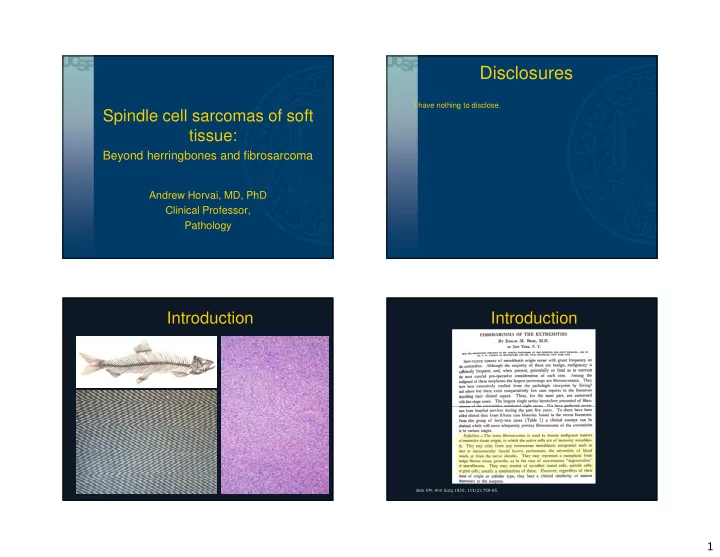
Introduction Introduction

Bick EM. Ann Surg 1935; 101(2):759-65.

slide-2
SLIDE 2

2

Introduction

  • Fibrosarcoma: Malignant tumor, composed of

fibroblasts with variable collagen and, in classical cases, a herringbone architecture (WHO, 2002)

  • Fibrosarcoma: Malignant tumor, composed of

fibroblasts with variable collagen and, in classical cases, a herringbone architecture. It is a diagnosis of exclusion (WHO, 2013)

  • Problem: What is the definition of a fibroblast?

Fisher, C., et al. (2002). Adult Fibrosarcoma. WHO Pathology and Genetics Tumours of Soft Tissue and Bone: 100-101. Folpe, A. L. (2013). Adult fibrosarcoma. WHO Classification of Tumours of Soft Tissue and Bone: 91-92.

Introduction

0% 10% 20% 30% 40% 50% 60% 70% 1936 1974 1989 2010

Fibrosarcoma as % of soft tissue sarcomas

Meyerding H et al. Surg Gynecol Obstet 1936; 62: 1010-1019. Pritchard DJ et al. Cancer 1974; 33(3):888-97. Scott SM et al. Cancer 1989; 65(4):925-31. Bahrami A, Folpe AL. Am J Surg Pathol 2010;34(10):1504-13

Questions

  • 1. How have tumors formerly known as fibrosarcoma

been reclassified?

  • 2. Are there any true fibrosarcomas?

Monophasic synovial

sarcoma

Malignant peripheral

nerve sheath tumor

Adult fibrosarcoma Undifferentiated

spindle cell sarcoma

Spindle cell

rhabdomyosarcoma

Infantile fibrosarcoma Myxofibrosarcoma Sclerosing epithelioid

fibrosarcoma

Low-grade

fibromyxoid sarcoma

Dermatofibrosarcoma protuberans (DFSP) Fibrosarcomatous DFSP

Looks like fibrosarcoma Called fibrosarcoma
slide-3
SLIDE 3

3

Monophasic synovial sarcoma

  • Clinical

Young adults 80% extremity, but can arise anywhere 5 year survival 36-76%, chemotherapy + surgery

  • Pathology

Highly uniform spindle cells, short fascicles, occasionally

herringbone

Hyperchromatic nuclei Branching vessels, calcification

  • IHC

Keratin, EMA – at most focal, patchy S100 in ~30% CD34 negative

  • Genetics

t(X;18), SS18-SSX fusion

Monophasic synovial sarcoma Monophasic synovial sarcoma Monophasic synovial sarcoma

slide-4
SLIDE 4

4

Monophasic synovial sarcoma EMA Keratin SS18 break apart FISH

Malignant peripheral nerve sheath tumor (MPNST)

  • Clinical

Middle aged adults, post-radiation 50% in NF1 patients, 50% sporadic Prognosis related to grade

  • Pathology

Tight fascicular pattern is only one of many Tapering, hyperchromatic nuclei More mitotic activity (>5/10) and pleomorphism than SS Herniation into vessels, pre-existing benign NF

  • IHC

~50% S100 or SOX10, usually very focally Keratin, desmin, EMA, CD34 usually negative H3K27 Me3 loss

  • Genetics

No reproducible changes

Prieto-Granada CN et al. Am J Surg Pathol 2015 (epub).

Malignant peripheral nerve sheath tumor

slide-5
SLIDE 5

5

Malignant peripheral nerve sheath tumor Malignant peripheral nerve sheath tumor Malignant peripheral nerve sheath tumor: herniation into vessels Malignant peripheral nerve sheath tumor S100 SOX10

slide-6
SLIDE 6

6

Fibrosarcomatous DFSP

  • Clinical

Trunk, proximal extremity mid-age, > 5cm Synchronous or metachronous DFSP Controversial if prognosis worse than DFSP after complete

excision

  • Pathology

Usually precursor DFSP can be found at periphery

Normal epidermis, uniform storiform, “Swiss cheese”

Transition to fascicular, herringbone, hypercellular area High mitotic activity (>7 / 10 hpf), necrosis

  • IHC

CD34 positive but weaker than DFSP

  • Genetics

t(17;22)(q21;q13) COL1A1:PDGFβ fusion

DFSP Fibrosarcoma Dermatofibrosarcoma protuberans Fibrosarcomatous DFSP

slide-7
SLIDE 7

7

Fibrosarcomatous DFSP Fibrosarcomatous DFSP DFSP + Fibrosarcoma CD34

Adult fibrosarcoma “undifferentiated spindle cell sarcoma”

  • Clinical

Trunk, proximal extremity mid-age Deep soft tissue Poor prognosis (<55% 5 year survival)

  • Pathology

Monomorphic spindle cells Fascicles, herringbone and/or storiform Rarely fibromatosis like areas Collagen can be wispy or keloidal

  • IHC

Negative except focal SMA

  • Genetics

Variable

slide-8
SLIDE 8

8

Adult Fibrosarcoma Adult Fibrosarcoma Keratin SMA CD34 Caldesmon S100 CD10 … and more Adult Fibrosarcoma Adult Fibrosarcoma

slide-9
SLIDE 9

9

Adult Fibrosarcoma Adult Fibrosarcoma

Infantile fibrosarcoma

  • Clinical

Very rare, distal extremity but wide distribution Congenital (1/3rd) to 1 year Relatively good prognosis, does not correlate with grade

  • Pathology

Highly cellular, monomorphic ovoid to spindled Herringbone to sheets HPC-like vessels

  • IHC

Negative, weak focal SMA

  • Genetics

t(12;15) ETV6:NTRK3 Same as congenital pulmonary fibrosarcoma, congenital

mesoblastic nephroma

Also in secretory breast cancer and AML

Infantile Fibrosarcoma

slide-10
SLIDE 10

10

Infantile Fibrosarcoma Infantile Fibrosarcoma Infantile Fibrosarcoma

Ancillary tests summary

Synovial sarcoma MPNST FS in DFSP Infantile FS Adult FS Keratin Rare cells

  • S100

Weak, patchy Weak, patchy

  • CD34
  • Rare cells

Weak

  • Other

SS18 FISH SOX10 PDGF FISH ETV6 FISH

slide-11
SLIDE 11

11

Take-home messages

  • 1. Adult fibrosarcoma is a diagnosis of exclusion
  • 2. Some diagnoses that retain the diagnosis of

“fibrosarcoma” are not uniformly herringbone

  • 3. Most herringbone spindle cell neoplasms in adults

can be classified as synovial sarcoma, MPNST or fibrosarcomatous DFSP

  • 4. Immunohistochemistry and, in some cases,

genetics are needed in most cases to classify these tumors