Saying I do to the QSAR/PBPK marriage Goal: reliably and efficiently - - PowerPoint PPT Presentation

saying i do to the qsar pbpk marriage
SMART_READER_LITE
LIVE PREVIEW

Saying I do to the QSAR/PBPK marriage Goal: reliably and efficiently - - PowerPoint PPT Presentation

Saying I do to the QSAR/PBPK marriage Goal: reliably and efficiently u<lize PBPK modeling to reduce animal/human tes<ng Permeability, solubility vs. pH, pKa(s), logD vs. pH, Fup, blood:plasma ra<o, <ssue Kps, CLint,


slide-1
SLIDE 1

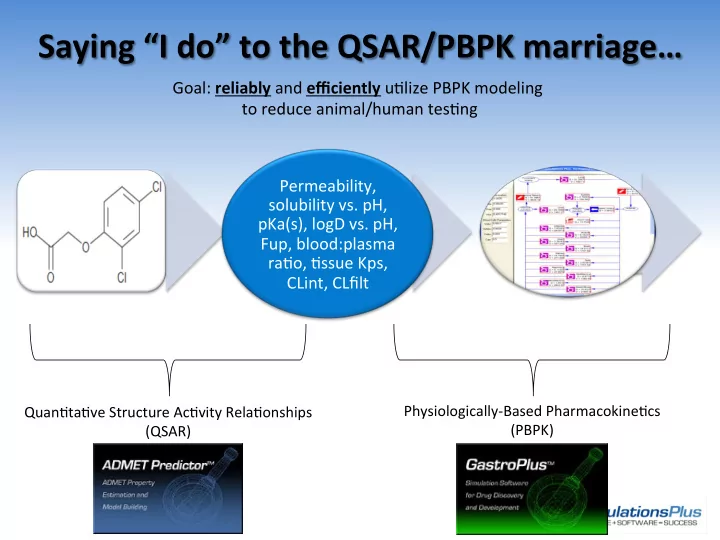
Saying “I do” to the QSAR/PBPK marriage…

Permeability, solubility vs. pH, pKa(s), logD vs. pH, Fup, blood:plasma ra<o, <ssue Kps, CLint, CLfilt

Quan<ta<ve Structure Ac<vity Rela<onships (QSAR) Physiologically-Based Pharmacokine<cs (PBPK)

Goal: reliably and efficiently u<lize PBPK modeling to reduce animal/human tes<ng

slide-2
SLIDE 2

Why is GastroPlus unique?

AbsorpEon & DissoluEon:

  • #1-ranked commercial QSAR models

integrated

  • #1-ranked commercial model for

absorp<on rate calcula<ons

  • Several dissolu<on models – including the

popular Z-factor approach

  • Mechanis<c nuclea<on/growth

precipita<on model

  • Paracellular permeability
  • Animal physiology models – dog, rat,

mouse, cyno & rhesus monkeys, minipig, rabbit

  • It’s not just gut!

PBPK Modeling:

  • #1-ranked Kp calcula<on method
  • Adjustments of plasma lipid binding
  • Animal physiology models – same as above
  • Unlimited metabolite tracking
  • Transporter-based IVIVE – automated scaling
  • f <ssue PStc
  • Customiza<on of model without equa<on

wri<ng

slide-3
SLIDE 3

That’s not all!

ANYTHING you can do with other tools can be done with GastroPlus:

  • Popula<on PBPK models (since 2005)
  • PBPK/PD modeling (since 2005)
  • DDI predic<ons (since 2008)
  • Mechanis<c IVIVCs (since 2001)
  • Nonlinear metabolism or transport kine<cs in any <ssue (since 2005)
  • … and more!
slide-4
SLIDE 4

How do our model results compare?

Comparison of first-in-human (FIH) PBPK predic<on accuracy in a 2-year study of 21 compounds (Cole et al., ISSX 2008) Independent comparison of logP predictors (Tetko & Poda, 2007) Independent comparison of aqueous solubility predictors (Dearden JC. Exper. Opin. Drug Discovery 2006 1:31) Independent comparison of pKa predictors (Fraczkiewicz, Lobell, et al., PCMDDD 2013)

slide-5
SLIDE 5

Recent validaEon: The QSAR/PBPK marriage

Daga et al. (2015) Gordon Research Conf. Building QSAR models for clearance using 15-30 in vivo rat CL measurements: >75% of compounds predicted within 2-fold Lawless et al. (2015) ISSX Annual MeeEng Using QSAR & PBPK to predict human F%: 70% of compounds predicted within 2-fold

slide-6
SLIDE 6

Do I have the <me & exper<se to write code and manage updates? No equa<on wri<ng AND customiza<on op<ons available How do I define all of the parameters required for a PBPK model? in

  • #1 rated QSAR models integrated for complete

silico solu<ons What about other species or different popula<ons? – Complete database of animal and human (American & Asian pediatrics and adults) physiology models included What if my chemical is exposed through several dosing routes? Mechanis<c models for oral, pulmonary, dermal, and ocular delivery How am I going to predict both local and systemic concentra<ons? Track all variables and easily capture output in Excel Where do I start with all of the chemicals I have? Batch mode, automated sensi<vity analysis and

  • p<miza<on available

How possible is it to predict metabolite exposure? Unlimited metabolite tracking op<ons I am guessing the commercial tools must be expensive? Flexible licensing op<ons and expert consul<ng support Will my commercial provider be around for the long haul? Publicly traded for >18 years & coun<ng

How does GastroPlus address your challenges?

slide-7
SLIDE 7

Regulatory scienEsts trained on GastroPlus PBPK modeling

slide-8
SLIDE 8
  • In 2013, scien<sts from 17 companies in North America

and Europe formed the GastroPlus User Group

  • To date, >930 members on the LinkedIn group page –

membership is free!

Mission Statement

Discuss best prac<ces, Q&A and FAQs Present and advance M&S science via social media, webinars and face-to-face mee<ngs Establish pre-compe<<ve areas of research and collabora<on across industry and academia Understand and influence regulatory expecta<ons for M&S submissions