Disclosures I have nothing to disclose. ___________________________ - - PowerPoint PPT Presentation

disclosures
SMART_READER_LITE
LIVE PREVIEW

Disclosures I have nothing to disclose. ___________________________ - - PowerPoint PPT Presentation

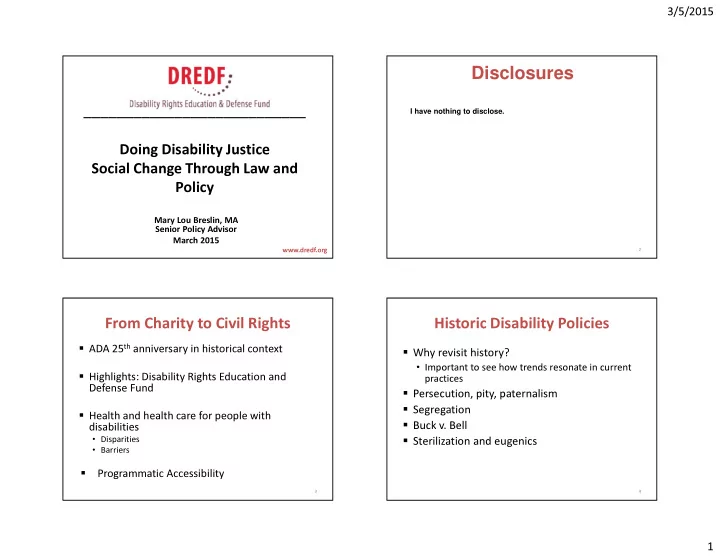
3/5/2015 Disclosures I have nothing to disclose. ___________________________ Doing Disability Justice Social Change Through Law and Policy Mary Lou Breslin, MA Senior Policy Advisor March 2015 www.dredf.org 2 From Charity to Civil Rights


slide-1
SLIDE 1

3/5/2015 1

___________________________

Doing Disability Justice Social Change Through Law and Policy

Mary Lou Breslin, MA Senior Policy Advisor March 2015

www.dredf.org

Disclosures

I have nothing to disclose.

2

From Charity to Civil Rights

ADA 25th anniversary in historical context Highlights: Disability Rights Education and Defense Fund Health and health care for people with disabilities

  • Disparities
  • Barriers
  • Programmatic Accessibility

3

Historic Disability Policies

Why revisit history?

  • Important to see how trends resonate in current

practices

Persecution, pity, paternalism Segregation Buck v. Bell Sterilization and eugenics

4

slide-2
SLIDE 2

3/5/2015 2

Buck v. Bell

US Supreme Court Justice Oliver Wendell Holmes writes that forced sterilization of people with disabilities was not a violation of her constitutional rights in the landmark 1927 case Buck v. Bell – – “It is better for all the world, instead of waiting to execute degenerate offspring for crime, or to let them starve for their imbecility, society can prevent those who are manifestly unfit from continuing their kind. Three generations of imbeciles is enough.”

5

Carrie Buck

6

Sterilization and Eugenics

By 1930

  • Thirty states had passed legislation authorizing

forced sterilization of people disabilities

By the 1970s

  • 63,000 Americans were reported to have been

sterilized without their consent

Eugenics waned in the US by the 1940s but was adopted in Nazi Germany

7

Good Intentions/Segregation

Good intentions can obscure discriminatory policies The paradox: how can blatant and harmful discrimination exist in an atmosphere of charity and concern By mid-20th century people with disabilities lived under a system of virtual apartheid

8

slide-3
SLIDE 3

3/5/2015 3

Pity

Images of pity predominated modern culture

9

New Advocacy

Rise of disability-led organizations

  • Independent living (1972)
  • People First Movement(1974)
  • National Council on Independent Living (1982)
  • World Institute on Disability (1983)
  • Mental Patient’s Liberation Front/Support Coalition

International (1978 – 1988)

10

Nothing About Us Without Us

The Disability Rights and Independent Living Movement

11

Civil Rights

Disability Rights Education and Defense Fund (1979)

  • First national, cross-disability law and policy center
  • Legal advocacy, training, education, and public

policy and legislative development

  • Spearheaded disability rights legislation in the

1980’s

  • Major contributor to passage of ADA
  • Advancing education rights, transit access,

healthcare, technology access today

12

slide-4
SLIDE 4

3/5/2015 4

DREDF Fundamentals

Cross disability Social change through law and policy (integration, full inclusion, equal treatment and opportunity)

  • Inspired by other civil rights legal groups

Goal: shift from medical emphasis on diagnosis/treatment to impact of physical and social barriers, discrimination, prejudice

13

Disability Law Resource Center: Berkeley 1978

14

Setting the Stage for the ADA

US Supreme Court cases set stage for ADA Civil rights community poised to support National networks in place Strong Congressional relationships Executive agency relationships

15 16

slide-5
SLIDE 5

3/5/2015 5

ADA Signing Ceremony

The Americans with Disabilities Act of 1990 – signing ceremony, White House, July 26

17

Post ADA

US Supreme Court redefines disability

  • Trilogy of cases

DREDF - Nationwide training National precedent for full inclusion in schools

  • Holland v. Sacramento City School District
  • Emma C. v. Delaine Eastin

18

Rachel Holland

19

DREDF Healthcare Initiative

Health and healthcare reform

  • Research, policy advocacy, education
  • Affordable Care Act implementation
  • Healthcare Stories
  • Diabetes care in schools
  • HHS Section 504 complaints—alternative formats

20

slide-6
SLIDE 6

3/5/2015 6

Health Disparities

Women with disabilities have higher death rates from breast cancer Three out of five people with serious mental illness die 25 years earlier than other individuals, from preventable, co-occurring chronic disease People with disabilities die from lung cancer at higher rates due to treatment disparities

21

Why Disparities?

  • Barriers to Care

– Architectural – Equipment – Communication

  • Provider Awareness
  • ADA implementation

22

DREDF Healthcare STORIES

  • First person accounts
  • Stories capture elements that elude

research

  • Themes

–Tables and scales –Provider awareness –Professional education

23

slide-7
SLIDE 7

3/5/2015 7

Physical Barriers to Primary Care

Data from on-site reviews of over 2300 Medicaid Managed Care primary care provider facilities in 18 of California’s 58 Counties

  • 8.4% of provider sites had a height-adjustable

exam table

  • 3.6% had an accessible weight scale

25

Barriers to Specialty Care

Review of 256 specialty practices:

  • 56 (22%) reported that they could not accommodate the

patient

  • 9 (4%) reported that the building was inaccessible
  • 47 (18%) reported the inability to transfer a patient from a

wheelchair to an examination table

  • Only 22 (9%) reported the use of height-adjustable tables
  • r a lift for transfer
  • Gynecology was the subspecialty with the highest rate of

inaccessible practices (44%)

26 27

Disability Competency

Outcomes from one survey commissioned by Special Olympics report:

  • Of 2500 respondents:
  • 52 percent of medical school deans
  • 53 percent of dental school deans
  • 56 percent of students responded that graduates were “not

competent” to treat people with intellectual disabilities

Less that 20 percent of medical schools teach disability literacy courses

28

slide-8
SLIDE 8

3/5/2015 8

ADA Impact on Healthcare

Limited effect on accessibility of services Litigation

  • US Department of Justice
  • Barrier Free Health Care Initiative
  • Large hospital litigation
  • Private
  • Kaiser Permanente – system wide reforms in No. Cal.
  • UCSF Med. Center – physical access in existing hospital,

accessible equip.

  • Sutter Health – system wide reforms
  • Washington Hospital Center -- access to hospital facilities and

equipment for patients with mobility impairments and other disabilities

  • Mass. General and Brigham and Women’s Hsp. – system wide

reforms/access

29

What Is Needed?

Data Collection

  • Identify disability status in healthcare reporting tools
  • Fund Affordable Care Act (ACA) disability mandated

research re: where care is received; accessibility, effectiveness of that care

Robust provider training Provider incentives via managed care health plans Heightened attention by accreditation bodies: Joint Commission, etc. Leadership/innovative collaborations (e.g., Master, Kripke, Holder, Kirschner) Policies and procedures

30

Programmatic Access

Programmatic access means that the policies and procedures that are part of the delivery of healthcare do not hinder the ability of people with disabilities to receive the same quality of care as other persons Where usual healthcare practice may impose barriers, modifications in policy or procedure may be necessary to assure access

31

Policies and Procedures for Programmatic Access

Methods of effectively communicating with patients Appointment scheduling procedures Patient treatment by the medical staff Awareness of and methods for selecting and purchasing accessible equipment Staff training and knowledge Standards for referral for tests or other treatment System-wide coordination and flexibility to enable access Disability cultural awareness

32

slide-9
SLIDE 9

3/5/2015 9

Exam Tables

33

Weight Scales

34

Other Medical Equipment

35

Sign Language Interpreters

36

slide-10
SLIDE 10

3/5/2015 10

CART (Communication Access Real Time Translation)

37

Video Relay Service for ASL Users

38

Digital and Audio Formats

  • Print materials in alternative formats

39

Resources

US Department of Justice – Barrier Free Health Care Initiative http://www.ada.gov/usao-agreements.htm US Department of Justice – ADA Information and Technical Assistance http://www.ada.gov Access to Medical Care for Individuals with Disabilities http://www.ada.gov/medcare_mobility_ta/medcare_ta.pdf Harris Family Center for Disability and Health Policy http://hfcdhp.org American Association on Health and Disability (AAHD) www.aahd.us Disability Rights Education and Defense Fund (DREDF) www.dredf.org

40

slide-11
SLIDE 11

3/5/2015 11

Appendix

Policies or Procedures for Programmatic Access Rationale or Methods for Achieving Programmatic Access

41

Policies for Communication and Access to Information

Policy or Procedure Rationale or Method

Provisions for intake forms to be completed by persons with visual impairments with the same confidentiality afforded other patients Use of large print forms, electronic or

  • nline web-based forms, or in-person staff

assistance in a private location Provision for the presence of Sign Language interpreters to enable full communication with deaf patients who use Sign Language Professionalism and confidentiality require that the healthcare provider take responsibility for the communication Provisions for making auditory information (e.g., automated phone menus or messages) available via alternative means Written communication or web-based methods are possible substitutes Provisions for communicating with deaf patients by telephone. Use of the telephone relay service (TRS), a TDD, or use of electronic means such as texting or email

42

Policies for Scheduling and Waiting

Policy or Procedure Rationale or Method

Policies that allow scheduling additional time for the duration of appointments for patients with disabilities who may require it. Patients may require more time than the standard because of complexities associated with the interaction of a non- disability-related medical condition with the existing impairment or disability. More time may be needed to conduct the examination or for communication through an interpreter or because of other communication issues. Policies to enable patients who may not be able to tolerate waiting in a reception area to be seen immediately upon arrival. Patients with cognitive, intellectual or some psychiatric disabilities may be unable to wait in a crowded reception area without becoming agitated or anxious.

43

Policies for Scheduling and Waiting

Policy or Procedure Rationale or Method

Policies to allow flexibility in appointment times for patients who use paratransit Patients may arrive late at appointments because of delays or other problems with paratransit scheduling and reliability Policies to enable compliance with the federal law that guarantees access to medical offices for people with disabilities who use service animals Patients with service animals expect the animal to accompany them into the waiting and examination rooms, and this is a protected right under the Americans with Disabilities Act. A policy enables medical

  • ffices to be prepared to respond

appropriately to the needs of all patients

44

slide-12
SLIDE 12

3/5/2015 12

Procedures for Conducting the Examination

Policy or Procedure Rationale or Method

Training of nurses and medical staff to safely assist or lift patients from wheelchairs to examination tables or other equipment, and return them safely after the exam. Training to appropriately help a patient who may need assistance with dressing both before and at the conclusion

  • f the exam

Training will reduce the likelihood of injury to the patient or to the medical personnel providing assistance, and ensure that a comprehensive examination can be conducted Ability to identify the need for equipment to assure an exam or procedure can be conducted; knowledge about purchasing accessible equipment, repairing or replacing it Special equipment (e.g., for lifting, weighing, or examining a patient) may make thorough exams possible and better for both patient and provider

45

Procedures for Conducting the Examination

Policy or Procedure Rationale or Method

Training of doctors, nurses, and other medical staff in the operation of accessible equipment Medical office staff must know how to

  • perate the accessible equipment, such as

adjustable height exam tables and mammography machines and weight scales, so they can be regularly and easily utilized Training of doctors, nurses, and other office staff for disability cultural competence – – knowledge regarding how to treat a patient with a disability with dignity and respect, and knowledge of how disability may affect the provision of medical treatment for primary and other care Stereotypes regarding whether people with disabilities experience pain or are capable of making medical decisions have resulted in deficient treatment. Providers may fail to speak directly to the patient, may not provide for privacy, or may make incorrect assumptions. Plan for emergency evacuation of patients includes evacuation procedures for people with disabilities. Evacuation plans should cover procedures for people who may need assistance in exiting the facility under extraordinary conditions

46

Procedures for Follow-up or Referral

Policy or Procedure Rationale or Method

Current potential patients, including people with disabilities, should only be referred to another provider for established medical reasons are specialized expertise. Referral results in a delay of treatment and subjects patients two additional time and expense and also reduces patient choice of provider Knowledge and/or attention to the accessibility of laboratories, testing facilities, specialists, or other healthcare delivery venues to which patients are referred Patients may be unable to comply with medical recommendations if referred to a location for testing, special treatment or a specialist that is not accessible or is not prepared to provide the recommended service

47

Healthcare System-Wide Issues

Ability to provide healthcare through flexibility or creativity to overcome barriers resulting from system-wide policies or practices Where services may need to be delivered in an atypical venue (e.g., teeth cleaning under general anesthesia), system-wide policies and/or coordination is required to ensure access

48