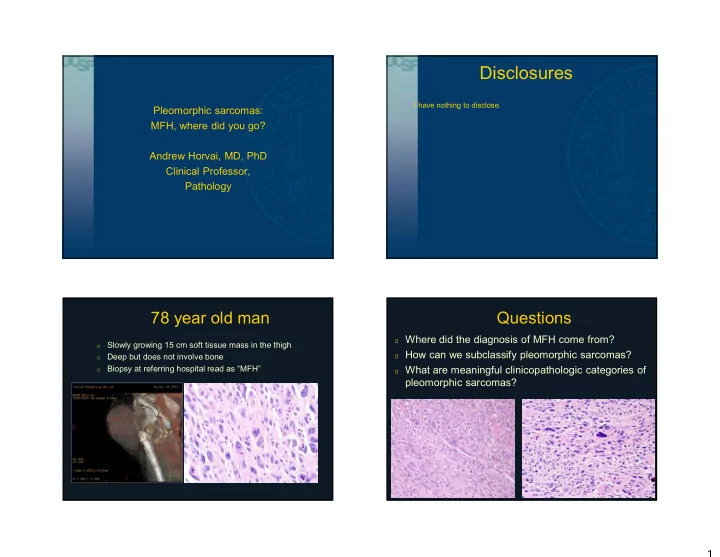
SLIDE 2 2
Where did MFH come from?
1960s: Stout et al. multiple reports of “fibrous xanthoma” and “histiocytoma”
Cultured cells from MFH (Ozello, Stout and Murray)
Initially ameboid movement, phagocytosis histiocytes Later, bipolar spindled cells fibroblasts “Facultative fibroblasts”: histiocytes capable of fibroblast
differentiation
Kauffman SL, Stout AP. Cancer 1961 14:469-82. Ozzello et al Cancer 1963 16:331-44.
Where did MFH come from?
1972: Kempson and Kyriakos
Kempson RL, Kyriakos M. Cancer 1972 961-76.
MFH Histotype?
Theories
Facultative fibroblasts (facultative histiocytes?) Mixture of fibroblasts and histiocytes Stem cell with dual differentiation into fibroblasts and histiocytes
Problems
No histotype supported by ancillary diagnostic and in-vitro methods Some well-differentiated tumors (liposarcoma, leiomyosarcoma, etc.)
contain areas indistinguishable from pleomorphic, storiform or giant- cell MFH
No unifying genetic changes (usually profound genomic instability)
“Histiocytes”