Disclosures I have nothing to disclose. The ABCs of non-neoplastic - - PowerPoint PPT Presentation

disclosures
SMART_READER_LITE
LIVE PREVIEW

Disclosures I have nothing to disclose. The ABCs of non-neoplastic - - PowerPoint PPT Presentation

Disclosures I have nothing to disclose. The ABCs of non-neoplastic joint disease: Arthritis, Bacteria and Crystals Andrew Horvai, MD, PhD Clinical Professor, Pathology Normal infant joint Introduction: Joints Solid = nonsynovial =


slide-1
SLIDE 1

1

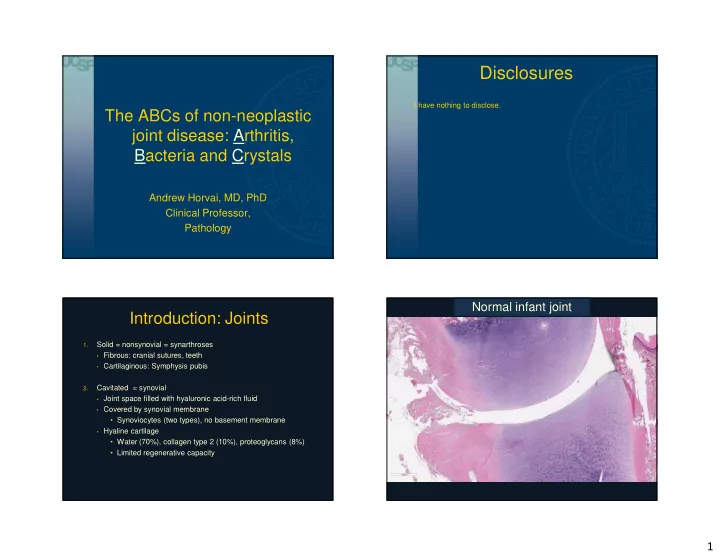
The ABCs of non-neoplastic joint disease: Arthritis, Bacteria and Crystals

Andrew Horvai, MD, PhD Clinical Professor, Pathology

Disclosures

I have nothing to disclose.

Introduction: Joints

1.

Solid = nonsynovial = synarthroses

  • Fibrous: cranial sutures, teeth
  • Cartilaginous: Symphysis pubis

2.

Cavitated = synovial

  • Joint space filled with hyaluronic acid-rich fluid
  • Covered by synovial membrane
  • Synoviocytes (two types), no basement membrane
  • Hyaline cartilage
  • Water (70%), collagen type 2 (10%), proteoglycans (8%)
  • Limited regenerative capacity

Normal infant joint

slide-2
SLIDE 2

2 Normal adult joint Normal synovium

Non-neoplastic joint disease

  • Noninfectious arthritis
  • Osteoarthritis (OA)
  • Rheumatoid arthritis (RA)
  • Others
  • Seronegative spondyloarthropathies
  • Juvenile idiopathic arthritis (JIA)
  • Crystal induced arthritis
  • Gout
  • Pseudogout
  • Infectious arthritis
  • Septic (bacterial) arthritis
  • Infected arthroplasty
  • Lyme arthritis

Osteoarthritis

  • Definition: A degeneration of articular cartilage resulting in

structural and functional failure of synovial joints

  • Clinical:
  • Most common disease of joints
  • Incidence
  • Primary (oligoarticular): 40% of people over 70
  • Secondary (polyarticular): Rare, underlying disease, younger
  • Knee, hip, DIP and PIP joints
  • Pathogenesis
  • Chondrocyte injury, genetic predisposition, biomechanical
  • Cartilage degradation > repair
  • Loss of cartilage and chondrocytes
  • Despite suffix –itis inflammation is minimal
slide-3
SLIDE 3

3

Osteoarthritis

Osteoarthritis: duplicated tidemark

slide-4
SLIDE 4

4

Osteoarthritis: subchondral cyst Osteoarthritis: Schmorl’s node

Rheumatoid arthritis

  • Definition: Chronic inflammatory, autoimmune disorder principally

attacking joints producing a nonsuppurative, proliferative and inflammatory arthritis

  • Clinical
  • Prevalance 1-5%
  • Female: Male 3:1
  • MCP and PIP, wrist, elbow
  • Extraarticular: lung, kidney, soft tissue (rheumatoid nodule)
  • Pathogenesis
  • Genetics (HLA) + Environmental (infection, smoking)
  • TH1 TH17 and B cell responses to self antigens (citrullinated

peptides)

  • Lymphocytes, antibodies and immune complex enter joint
  • Pannus, destruction of bone and cartilage,

Rheumatoid arthritis

slide-5
SLIDE 5

5 Rheumatoid arthritis Rheumatoid arthritis Rheumatoid arthritis Rheumatoid arthritis

slide-6
SLIDE 6

6

Rheumatoid nodule Rheumatoid nodule

Horvai A, Robbins Textbook of Pathology, Elsevier, 2015

Arthritis summary

Other non-infectious arthritis

  • Seronegative spondyloarthropathies
  • Sacroiliac joints
  • Pathology best seen in ligamentous attachments (entheses)
  • RhFactor-, association with HLA-B27
  • Subtypes: Ankylosing spondylitis, reactive arthritis, enteritis

associated arthritis, psoriatic arthritis

  • Juvenile idiopathic arthritis
  • Heterogeneous group of joint disorders, present before age 16 and

persist for at least 6 weeks

  • Oligoarthritis, large joints
  • ANA+ RhFactor-
slide-7
SLIDE 7

7

Ankylosing spondylitis

Enthesopathy of Ankylosing spondylitis

Juvenile idiopathic arthritis

Crystal induced arthritis

slide-8
SLIDE 8

8

Gout (Calcium urate) arthritis

  • Definition: Transient attacks of acute arthritis initiated by urate

crystals within and around joints.

  • Clinical:
  • Incidence ~ 50 / 100,000
  • M>F, renal failure, obesity predispose
  • Monoarticular acute arthritis, MTP joint most common
  • Asymptomatic intercritical period
  • Chronic tophaceous gout
  • Pathogenesis
  • Hyperuricemia (6.8 mg/dL) necessary but not sufficient
  • Most commonly due to reduced excretion of urate
  • Age, genetics, EtOH, obesity, thiazide diuretic
  • Urate crystals trigger inflammation, leukocyte recruitment

Gout

Acute Gout arthritis (joint aspirate)

Gout (alcohol process)

slide-9
SLIDE 9

9

Gout (alcohol process) Gout Gout (polarized optics) Pseudogout (calcium pyrophosphate dihydrate, CPPD)

  • Definition: Deposition of CPPD crystals in and around joints

causing acute, chronic or subacute arthritis.

  • Clinical:
  • May be asymptomatic; CPPD crystals may be secondary

degenerative phenomenon in joints and soft tissue

  • M=F, >50 years old
  • Knees, elbows most commonly affected
  • Relapsing course, ~50% chronic joint damage similar to OA
  • Pathogenesis
  • Not known
  • Proteoglycans in articular cartilage normally inhibit mineralization,

their loss may promote CPPD deposits

slide-10
SLIDE 10

10

Pseudogout Pseudogout

CPPD CPPD

slide-11
SLIDE 11

11

CPPD (polarized optics)

Infectious arthritis Septic (bacterial) arthritis

  • Definition: Pyogenic or granulomatous infection of synovium and articular

surfaces

  • Clinical:
  • Fever, swollen, erythematous, painful joint
  • Synovial fluid grey-green, 20K-200K WBC/µL, >75% PMN
  • Compared to osteomyelitis, joint infection is a more urgent problem

because cartilage has limited appear to regenerate

  • Pathogenesis
  • Inoculation of joint by infectious organisms
  • Usually bacterial
  • Hematogenous
  • Periosteal
  • Direct

Septic arthritis

  • S. aureus
  • S. pyogenes

S. Pneumoniae Gram negative Other

slide-12
SLIDE 12

12

Septic arthritis Septic (bacterial) arthritis

  • Definition: Pyogenic or granulomatous infection of synovium and

articular surfaces

  • Orthopedic hardware (joint prostheses) at high risk
  • Lyme arthritis
  • Infection with Borrelia burgdorferi
  • 10% develop arthritis in late stage, large joints (since most

cured)

  • Borrelia in joints (~25% by Warthin Starry, ~50% by PCR)

Infectious arthritis Infectious arthritis

slide-13
SLIDE 13

13

Infectious arthritis Infectious arthritis Granulomatous infectious arthritis

Infected arthroplasty

slide-14
SLIDE 14

14

Infected arthroplasty

Early Late

Time <3 months > 24 months Organisms

  • S. Aureus
  • E. Coli

Coag – Staph

  • P. Acnes

Route Direct Hematogenous Clinical Fever ↑ WBC Pain Loosening Instability Pain

  • The “delayed” form (3-24 months) with overlapping features

between Early and Late.

Hardware loosening

  • Aseptic loosening (85%)
  • Wear induced particle

debris

  • Stress shielding

(atrophy)

  • Hardware failure
  • Septic loosening

(15%)

  • Infection

Immediate replacement Removal Antibiotic cement spacer 6 wks IV antibiotics

Septic loosening

Gold standard: Positive culture from multiple

sites

Intraoperative: Neutrophils in synovium or

granulation tissue or capsule

Criterion Sensitivity Specificity Feldman 5 neutrophils/hpf in > 5 hpf* 25% 98% Athanasou 10 neutrophils/10 hpf 70% 64% *hpf: 400X (0.5 mm2) high power field.

Bori G et al. J Bone Joint Surg 2007 89:1232

Septic loosening

slide-15
SLIDE 15

15

Septic loosening

PMNs in capsule: YES

PMNs in fibrin: NO

PMNs in vessels: NO

slide-16
SLIDE 16

16

Other common arthroplasty findings

  • Wear debris reaction
  • Xanthoma cells
  • Capsule (synovial metaplasia)
  • Foreign materials

Barium: radio-opaque contrast Methyl methacrylate: cement Polyethylene: articular surface (large prosthesis) Silastin: silicone rubber (small prosthesis) Rosenberg, A. E., et al. (2011). Semin Diagn Pathol 28(1): 65-72.

Wear debris reaction Wear debris reaction Xanthoma cells

slide-17
SLIDE 17

17 Barium and Me-Methacrylate

Polyethylene Polyethylene

Lyme disease

Horvai A, Robbins Basic Pathology, Elsevier, 2017.

slide-18
SLIDE 18

18

Lyme arthritis (images courtesy Dr. M. Klein, HSS)

Take-home messages

  • 1. Osteoarthritis, the most common joint disease, usually

lacks inflammation

  • 2. Lymphoid follicles with germinal centers is consistent with

rheumatoid arthritis but is seen in other autoimmune arthritides

  • 3. Neutrophils in fibrin and vascular lumina do not count for

septic loosening of a prosthesis

  • 4. CPPD crystals can occur as a secondary phenomenon in

degenerative joints for various reasons and are not diagnostic of pseudogout