Disclosures LEADS TO LESS POSTOPERATIVE FATTY INFILTRATION THAN - - PowerPoint PPT Presentation

disclosures
SMART_READER_LITE
LIVE PREVIEW

Disclosures LEADS TO LESS POSTOPERATIVE FATTY INFILTRATION THAN - - PowerPoint PPT Presentation

ARTHROSCOPIC ROTATOR CUFF REPAIR Disclosures LEADS TO LESS POSTOPERATIVE FATTY INFILTRATION THAN OPEN REPAIR John Costouros, MD: Consultant: Zimmer, Arthrex, Tornier, Depuy-Mitek, Shoulder Options, Inc. Royalties: Arthrex, Tornier,


slide-1
SLIDE 1

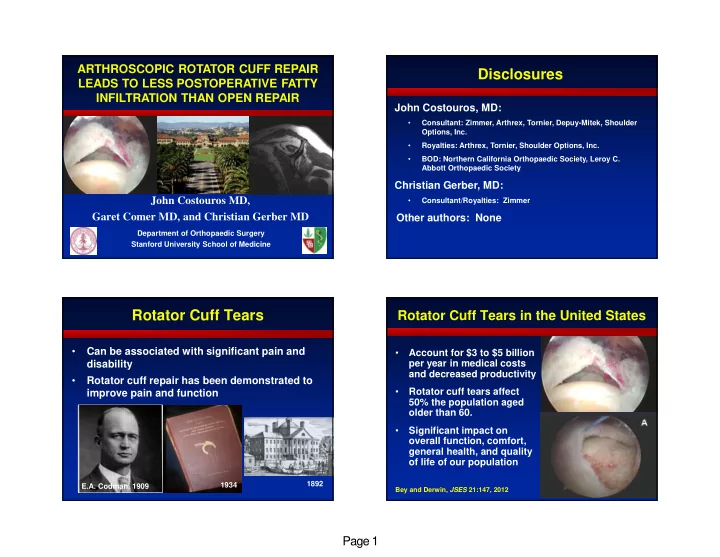
Page 1 ARTHROSCOPIC ROTATOR CUFF REPAIR LEADS TO LESS POSTOPERATIVE FATTY INFILTRATION THAN OPEN REPAIR

John Costouros MD, Garet Comer MD, and Christian Gerber MD

Department of Orthopaedic Surgery Stanford University School of Medicine

Disclosures

John Costouros, MD:

  • Consultant: Zimmer, Arthrex, Tornier, Depuy-Mitek, Shoulder

Options, Inc.

  • Royalties: Arthrex, Tornier, Shoulder Options, Inc.
  • BOD: Northern California Orthopaedic Society, Leroy C.

Abbott Orthopaedic Society

Christian Gerber, MD:

  • Consultant/Royalties: Zimmer

Other authors: None

Rotator Cuff Tears

  • Can be associated with significant pain and

disability

  • Rotator cuff repair has been demonstrated to

improve pain and function

E.A. Codman, 1909 1934 1892

Rotator Cuff Tears in the United States

  • Account for $3 to $5 billion

per year in medical costs and decreased productivity

  • Rotator cuff tears affect

50% the population aged

  • lder than 60.
  • Significant impact on
  • verall function, comfort,

general health, and quality

  • f life of our population

Bey and Derwin, JSES 21:147, 2012

slide-2
SLIDE 2

Page 2

Evolution of Rotator Cuff Repair Advances in Technique

  • Improved suturing

techniques – Suture pattern – Knot types – Marginal convergence – Double row fixation

  • Improved anchor design
  • Improved anchor

placement site

  • Biologics?

Open vs. Arthroscopic RCR

  • Comparable success

rates: – Pain – Function – Patient satisfaction

  • Integrity of the repair:

– Elevation – Strength

Baker and Liu, AmJSM 23: 99-104, 1995. Severud et al., Arthroscopy 19:234-38, 2003. Sauerbrey et al., Arthroscopy 21:1415-20, 2005. Warner et al., Arthroscopy 21:328-32, 2005.

The Weak Link: Muscle and Tendon Quality

  • Correlation

between fatty infiltration of the RTC and: – Functional and clinical outcome – Risk of structural failure following RCR

Flurin et al., Rev Chir Orthop 91:31-42, 2005. Fuchs et al., JBJS Am 88:309-16, 2006.

slide-3
SLIDE 3

Page 3

Fatty Infiltration and RCT

  • Irreversible

consequence of tendon tearing

  • Fiber shortening &

increase in pennation angle

  • Suprascapular nerve

compression

Meyer et al., JOR 22:1004-1007, 2004.

Objective

  • To compare fatty infiltration and
  • utcomes in patients with isolated, full-

thickness tears of the supraspinatus: – Open RCR – Arthroscopic RCR

  • Structurally intact repairs only

– Postop MRI at minimum 1yr postop

Methods

  • Retrospective review
  • 37 consecutive patients with isolated,

surgically treated, full-thickness SST without retear on postop MRI

  • Postoperative Assessment:

–Clinical (Constant score, SSV) –Radiographic (Fatty Infiltration)

Goutallier et al., CORR 304:78-93, 1994 Fuchs et al., JSES 8:599-605, 1999.

slide-4
SLIDE 4

Page 4

Study Cohort

Group 2 (Arthro):

  • N=18 (12 ♂

♂ ♂ ♂, 6 ♀ ♀ ♀ ♀)

  • Mean age 54 (34-65)
  • F/u 18 mos (12-42)

Group 1 (Open):

  • N=19 (14 ♂

♂ ♂ ♂, 5 ♀ ♀ ♀ ♀)

  • Mean age 57 (40-75)
  • F/u 24 mos (12-48)

Clinical Results

20 40 60 80 100 120 140 160 CS CS% SSV FE ABD

Percent/Degrees

Clinical Results

2 4 6 8 10 12 14 Pain Strength

Radiographic Results

0.2 0.4 0.6 0.8 1 1.2 1.4

FI SSP FI ISP Fi SSC

Mean Fatty Infiltration

slide-5
SLIDE 5

Page 5

Conclusions

  • Isolated full-thickness supraspinatus

tears can be treated equally well with either open or arthroscopic surgery.

  • Open repair is associated with an

increased risk of progression of FI of the supraspinatus.

  • Repair of the supraspinatus is

associated with progression of FI in the infraspinatus using either method.

THANK YOU