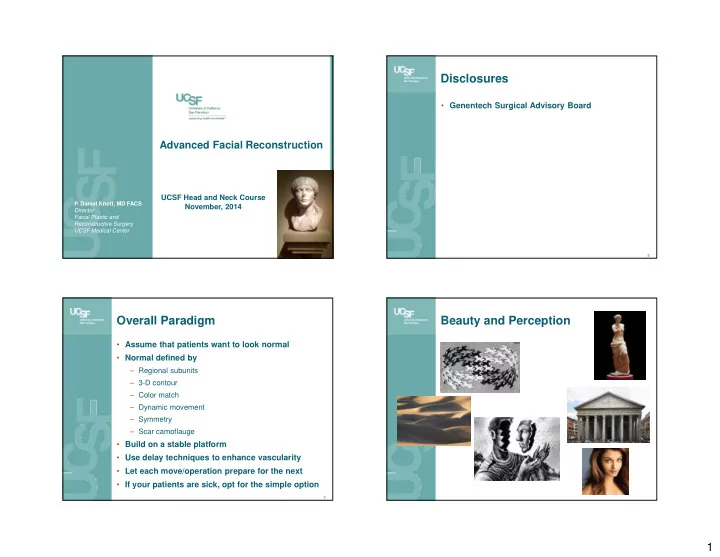
Disclosures Genentech Surgical Advisory Board Advanced Facial - - PowerPoint PPT Presentation

disclosures
SMART_READER_LITE
LIVE PREVIEW

Disclosures Genentech Surgical Advisory Board Advanced Facial - - PowerPoint PPT Presentation

Disclosures Genentech Surgical Advisory Board Advanced Facial Reconstruction UCSF Head and Neck Course P. Daniel Knott, MD FACS November, 2014 Director Facial Plastic and Reconstructive Surgery UCSF Medical Center 2 Overall Paradigm


slide-1
SLIDE 1

1

Advanced Facial Reconstruction

  • P. Daniel Knott, MD FACS

Director Facial Plastic and Reconstructive Surgery UCSF Medical Center

UCSF Head and Neck Course November, 2014

Disclosures

  • Genentech Surgical Advisory Board

2

Overall Paradigm

  • Assume that patients want to look normal
  • Normal defined by

– Regional subunits – 3-D contour – Color match – Dynamic movement – Symmetry – Scar camoflauge

  • Build on a stable platform
  • Use delay techniques to enhance vascularity
  • Let each move/operation prepare for the next
  • If your patients are sick, opt for the simple option

3

Beauty and Perception

slide-2
SLIDE 2

2 Facial Subunits

5

Menick, FW; Nasal Reconstruction, PRS 125: 138e, 2010

Subunit Principle

6

Why the subunit principle?

7

Subunit Principle

8

slide-3
SLIDE 3

3 Subunit Skin Graft

9

Paramedian Forehead Flap

10

  • Fig. 4. The vertical paramedian forehead flap is centered over the supratrochlear

vessels and is richly perfused by a random, axial, and frontalis muscle blood supply. (From Menick F. Nasal Reconstruction: Art and Practice. New York: Elsevier, 2008.) Menick, FW; Nasal Reconstruction, PRS 125: 138e, 2010

Forehead flap

11

Internal Lining Defects

12

Menick, FW; Nasal Reconstruction, PRS 125: 138e, 2010

slide-4
SLIDE 4

4 Nasolabial Flaps

13

Nasolabial Flaps

14

Internal lining

15

3 Stage Forehead Flap

16

slide-5
SLIDE 5

5 3 Stage Forehead Flap

17

3 Stage Forehead Flap

18

Recurrent Melanoma

19

Total Rhinectomy

20

slide-6
SLIDE 6

6 Vascularized Nasal Lining

21

Vascularized Nasal Lining

22

Vascularized Nasal Lining

23

Vascularized Nasal Lining

24

slide-7
SLIDE 7

7 Vascularized Nasal Lining

25

What makes for a good facial reconstructive outcome?

  • 1. Good skin color match
  • 2. Contour restoration
  • 3. Creative scar placement
  • 4. Support of local structures (nose, lips, orbit.

. . )

  • 5. Avoidance of contracture
  • 6. Subunit principle
  • 7. Restore movement

26

Skin Color Match

27

Skin Flaps with Similar Sun Exposure

slide-8
SLIDE 8

8 Skin Color better with skin grafts

29

Vascularized Fascia Lata

30

Fascia Lata for Scalp Reconstruction

31 32

slide-9
SLIDE 9

9 Vascularized Fascia Lata

33

Contour Restoration

34

Adipofascial Contour Restoration Creative Scar Placement

36

slide-10
SLIDE 10

10

Prese ntatio Prese ntatio

Creative Scar Placement

39

Support of Local Structures

40

slide-11
SLIDE 11

11

slide-12
SLIDE 12

12 Support of Local Structures

45

Avoidance of Contracture

46

Subunit Principle

47

Temporalis Myoplasty

  • Significant temporal

edema for 2 weeks

  • Muscle may be

“shocked” for several weeks

  • Some degree of posterior

temporal hollowing

  • Voluntary smile may be

achieved

  • Movement usually

approaches 6 mm of upper lip excursion

48

slide-13
SLIDE 13

13 Temporalis Myoplasty

49

Conclusion

  • Assume that your patients want to look normal
  • Accurate color and contour restoration critical

to an acceptable outcome

  • 3 stage fold over forehead flaps for internal

lining

  • Fascia lata microvascular flaps for total nasal

reconstruction and appropriate scalp/forehead reconstructions

  • Use bone and large skin paddles to avoid

contracture

  • Take advantage of subunit principle when

possible

50 51

Thank you for your attention