Disclosures TO EVALUATE THE OUTCOMES OF OPERATIVELY TREATED FEMORAL - - PowerPoint PPT Presentation

disclosures
SMART_READER_LITE
LIVE PREVIEW

Disclosures TO EVALUATE THE OUTCOMES OF OPERATIVELY TREATED FEMORAL - - PowerPoint PPT Presentation

5/8/2014 A PROSPECTIVE OBSERVATIONAL STUDY Disclosures TO EVALUATE THE OUTCOMES OF OPERATIVELY TREATED FEMORAL SHAFT No conflicts of interest FRACTURES IN SUB-SAHARAN AFRICA: Research funded by the OTA and OREF PRELIMINARY RESULTS


slide-1
SLIDE 1

5/8/2014 1

A PROSPECTIVE OBSERVATIONAL STUDY TO EVALUATE THE OUTCOMES OF OPERATIVELY TREATED FEMORAL SHAFT FRACTURES IN SUB-SAHARAN AFRICA: PRELIMINARY RESULTS

David Shearer, MD, MPH1, Edmund Eliezer, MD2, Billy Haonga, MD2, Saam Morshed, MD, PhD1 (1)University of California, San Francisco, CA, USA (2) Muhimbili Orthopaedic Institute, Dar es Salaam, Tanzania

Disclosures

  • No conflicts of interest
  • Research funded by the OTA and OREF

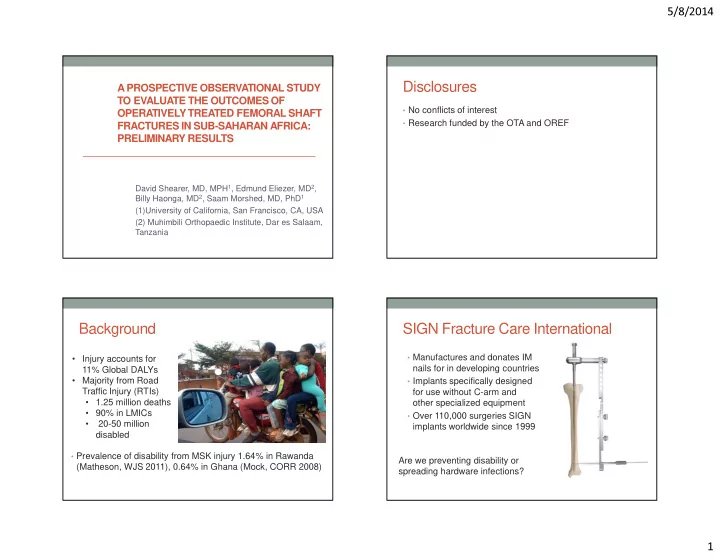
Background

  • Prevalence of disability from MSK injury 1.64% in Rawanda

(Matheson, WJS 2011), 0.64% in Ghana (Mock, CORR 2008)

  • Injury accounts for

11% Global DALYs

  • Majority from Road

Traffic Injury (RTIs)

  • 1.25 million deaths
  • 90% in LMICs
  • 20-50 million

disabled

SIGN Fracture Care International

  • Manufactures and donates IM

nails for in developing countries

  • Implants specifically designed

for use without C-arm and

  • ther specialized equipment
  • Over 110,000 surgeries SIGN

implants worldwide since 1999 Are we preventing disability or spreading hardware infections?

slide-2
SLIDE 2

5/8/2014 2

Study Partnership

  • Investigators met at SIGN Flap Course/IGOT Research

Course

  • Muhimbili Orthopaedic Institute
  • Tertiary referral hospital in Dar es Salaam, Tanzania
  • Femur fractures rarely treated non-operatively
  • SIGN site
  • 20% cases ORIF with plate (surgeon preference)

Study Design

  • Prospective observational study
  • Skeletally mature patients with femoral shaft fractures (OTA

32) presenting to Muhimbili Orthopaedic Institute

  • Primary comparison
  • Locked intramedullary nailing
  • ORIF with DC plate
  • Outcome:
  • 10 Reoperation
  • 20 Clinical union, radiographic union, return to work, EQ-5D
  • Hypothesis: There is a difference in the rate of

reoperation for adult femoral shaft fractures comparing intramedullary nailing with open reduction internal fixation with a plate

Eligibility Criteria

  • Registry Book Screening: All patients with diagnosis of femoral

fracture

  • Radiographic Screening
  • Proximal femur fracture: Any fracture extension proximal to the

lesser trochanter

  • Distal femur fracture: Fracture involving the distal femur (as defined

by the “rule of squares”)

  • Skeletal immaturity: Open physes present
  • Pathologic fracture
  • Prior surgery
  • Delayed presentation (>6 weeks)
  • Clinical Screening
  • Evidence of pre-existing infection at the time of surgery
  • Pathologic fracture
  • Severe TBI (GCS < 12 on admission)
  • Severe burns (>10% TBSA)
  • Unable to adhere to follow up schedule

Bottom line: All adult midshaft femur fractures managed with operative treatment

Follow up Protocol

  • Preop x-rays
  • Radiographic

screening

  • Follow up data

sheet completed

  • Plain x-rays
  • EQ-5D
  • Clinical

screening

  • Informed

consent

  • Intake data

collection

  • Postop data

collection

  • Postop x-rays
  • Routine

clinical evaluation

  • Follow up data

sheet completed

  • Plain x-rays
  • EQ-5D
  • Follow up data

sheet completed

  • Plain x-rays
  • EQ-5D
  • Follow up data

sheet completed

  • Plain x-rays
  • EQ-5D

Present to MOI Surgery 2-week Follow up 6-week Follow up 3 month Follow up 6 month Follow up 1-year Follow up

slide-3
SLIDE 3

5/8/2014 3

The Research Team

  • Investigators
  • MOI
  • Four Surgeons (2 specialists, 2

residents)

  • UCSF
  • Two surgeons (1 attending, 1

resident)

  • Research Coordinators
  • Two part-time coordinators
  • Both medical records

department

  • Communication
  • Site visits q6months
  • Bi-weekly Skype meetings

REDCap: Research Electronic Data Capture

Using Technology

Research Laptop + Modem: $280 USD Mobile Phone for image upload: $200 USD

From July 2012 to July 2013

slide-4
SLIDE 4

5/8/2014 4

Age (years), mean (SD) 31.8 (11.2) Gender Male, no. (%) 262 (85.9) Female, no. (%) 43 (14.1) Baseline EQ-5D Index, mean (range) 0.996 (0.52-1) Baseline EQ-5D VAS, mean (range) 99.2 (70-100) Time from Injury to Presentation (days), median (5-95th percentile) 2 (1-4) Time from Injury to Surgery (days), median (5-95th percentile) 7 (1-40) Any comorbidity, no. (%) 10 (3) Mechanism Motorvehicle Crash, no. (%) 157 (49.5) Motorcycle Crash, no. (%) 113 (35.7) Pedestrian vs. Auto, no. (%) 6 (1.9) Fall, no. (%) 21 (14.1) Crush, no. (%) 4 (2.7) Gunshot, no. (%) 0 (0) Temporary Stabilization, no. (%) None 18 (5.5) Skin traction 303 (93.2) External fixation 1 (0.3) Skeletal Traction 3 (0.9) Type of Treatment, no. (%) SIGN Nail 306 (94.2) Non-SIGN Nail 12 (3.7) Plate 5 (1.5) External fixation 2 (0.6) Periop Antibiotics, no. (%) Yes 318 (98.5) No 5 (1.6) IM Nail Approach, no. (%) Antegrade 170 (54.1) Retrograde 144 (45.9) Reaming, no. (%) Yes 314 (99.7) No 1 (0.3) Reduction, no. (%) Open 322 (100) Closed 0 (0) Open Fracture, no. (%) Yes 7 (2.2) No 312 (97.8)

Follow up

  • Goal 80% at 1 year
  • Eliminating barriers for the patient
  • Dedicated Research Clinic
  • Reduce costs consultation fees, x-rays
  • Appointment Reminders
  • Weekly phone calls and SMS
  • Recruiting patients lost to follow up
  • Minimum 6 months
  • 228/331 (68.0%)
  • Study scheduled to be completed August

2014

Reoperation

  • IM nailing:
  • 21/319 = 6.6%
  • Plates
  • 2/5 = 40%

P = 0.042

slide-5
SLIDE 5

5/8/2014 5

Mode of failure

Plate IM Nail Nonunion 2 (40) 10 (3.13) Deep Infection 0 (0) 6 (1.88) Implant failure 0 (0) 1 (0.31) Malalignment 0 (0) 1 (0.31) Missed Interlocks 0 (0) 1 (0.31) Nail Migration 0 (0) 1 (0.31) Painful hardware 0 (0) 1 (0.31) Total 2(40) 21 (6.6)

Predictors of reoperation

  • Age > 60
  • 4/22 (15.4%) vs 18/305 (5.9%)
  • P = 0.08
  • Delayed presentation (> 24hrs)
  • 9/80 (11.3%) vs 10/202 (4.9%)
  • p=0.06
  • Early surgery after presentation (<1 week)
  • 15/149 (10.1%) vs 5/161 (3.0%)
  • P=0.01
  • Nail diameter 8mm
  • 5/29 (17.2%) vs 14/284 (4.9%)
  • P = 0.022
  • Motorvehicle vs Motorcycle Crash
  • 11/157 (7.0%) vs 1/113 (0.9%)
  • P = 0.01

Did not matter: Gender BMI Smoking status Alcohol use Comorbidities Antegrade/Retrograde Nailing Number interlocking screws

Summary

  • Open nailing lower reoperation rate compared to

plate fixation in low-resource environment

  • Reoperation rates higher than closed nailing
  • Improved pre-hospital care may improve outcomes
  • Academic partnership a viable model for

collaborative research in low-resource environments

  • Much more to do!
  • Complete follow up
  • Radiographic review
  • Secondary outcomes
  • Economic analysis

Thank you!

  • Co-investigators from Tanzania
  • Edmund Eliezer
  • Billy Haonga
  • Study coordinators
  • Joshua Nghayoma
  • Justin Kessy