Disclosures RECOGNITION AND MANAGEMENT Research : NIH, Great Lakes - - PowerPoint PPT Presentation

disclosures
SMART_READER_LITE
LIVE PREVIEW

Disclosures RECOGNITION AND MANAGEMENT Research : NIH, Great Lakes - - PowerPoint PPT Presentation

2/15/2019 FUNCTIONAL MOVEMENT DISORDERS: Disclosures RECOGNITION AND MANAGEMENT Research : NIH, Great Lakes Neurotechnologies, and the Michael J Fox Foundation Consultant/scientific advisory board : Abbvie, Neuroderm, Impax, Acadia,


slide-1
SLIDE 1

2/15/2019

FUNCTIONAL MOVEMENT DISORDERS: RECOGNITION AND MANAGEMENT

Alberto J. Espay, MD, MSc

Professor of Neurology Director and Endowed Chair James J. and Joan A. Gardner Family Center for Parkinson’s Disease and Movement Disorders University of Cincinnati Academic Health Center

52nd Annual Recent Advances in Neurology February 4-16, 2019 IUCSF, San Francisco

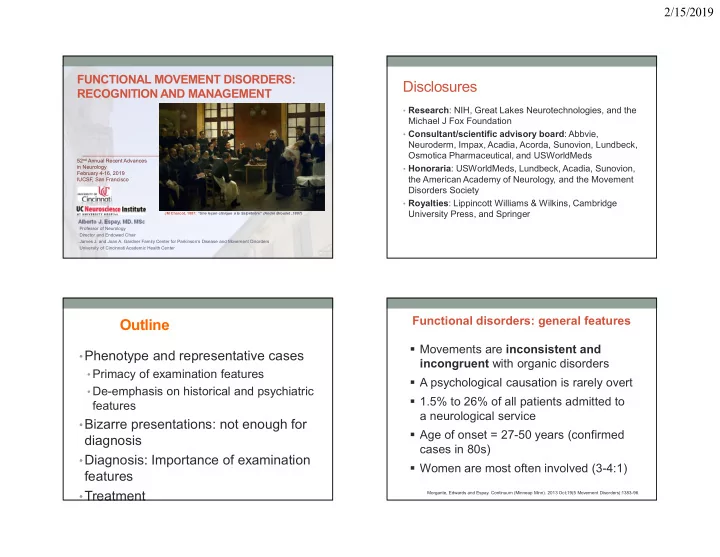
JM Charcot, 1887: “Une leçon clinique à la Salpêtrière“ (André Brouilet ,1887)

Disclosures

  • Research: NIH, Great Lakes Neurotechnologies, and the

Michael J Fox Foundation

  • Consultant/scientific advisory board: Abbvie,

Neuroderm, Impax, Acadia, Acorda, Sunovion, Lundbeck, Osmotica Pharmaceutical, and USWorldMeds

  • Honoraria: USWorldMeds, Lundbeck, Acadia, Sunovion,

the American Academy of Neurology, and the Movement Disorders Society

  • Royalties: Lippincott Williams & Wilkins, Cambridge

University Press, and Springer

Outline

  • Phenotype and representative cases
  • Primacy of examination features
  • De-emphasis on historical and psychiatric

features

  • Bizarre presentations: not enough for

diagnosis

  • Diagnosis: Importance of examination

features

  • Treatment

Functional disorders: general features

  • Movements are inconsistent and

incongruent with organic disorders

  • A psychological causation is rarely overt
  • 1.5% to 26% of all patients admitted to

a neurological service

  • Age of onset = 27-50 years (confirmed

cases in 80s)

  • Women are most often involved (3-4:1)

Morgante, Edwards and Espay. Continuum (Minneap Minn). 2013 Oct;19(5 Movement Disorders):1383-96.

slide-2
SLIDE 2

2/15/2019

N= 1245 FMD patients (8 specialized centers) Tremor 37.5%* Dystonia 29.3 Myoclonus 11.7 Gait Disorders 5.7%** Parkinsonism 4.8% Tic 2.3% Others 5.1%

What’s the relative frequency of FMD?

Lang, 2006

* Upper (84%) > lower limbs (24%) > generalized (20%) ** If associated to other PMD = 42.3%

Historical clues suggesting functional movement disorders

Modified from Gupta & Lang, Curr Op Neur, 2009

Supportive but neither sufficient nor necessary

Abrupt onset Maximum deficits at onset (not always) Spontaneous remissions Spread to multiple non-anatomically adjacent sites Paroxysmal symptoms (generally nonkinesigenic) Multiple somatizations/undiagnosed conditions Previous history of minor injury

Signs supporting functional movement disorders

Hoover sign

Hip extension weak

Tubular vision defect

Hip extension normal with contralateral hip flexion against resistance

Drift without pronation of the weak arm

Espay et al, JAMA Neurol 2018

Other signs: False (give-away) weakness Non-anatomical sensory loss

Organic drift with pronation Functional drift without pronation

Required for clinically definite PMD INCONSISTENCY

  • Variability of phenomenology and/or severity over time

(frequency, amplitude, direction/distribution of movement)

  • Disproportionate disability to the extent of objective motor deficits
  • Suppression or clear change in phenomenology with complex tasks
  • Magnification of the disability when attention is focused on the affected

body part

INCONGRUENCE

Movement is incongruous with the presentation, progression, and disability associated with known organic movement disorders

SUGGESTIBILITY

Amelioration or worsening with application of non physiologic interventions (somatic trigger points, tuning fork, electrotherapy) or placebo.

slide-3
SLIDE 3

2/15/2019

Required for clinically definite psychogenic movement disorders INCONGRUENCE

Movement is incongruous with the presentation, progression, and disability associated with known organic movement disorders

Demands extensive experience on

  • rganic disorders*

* Implying, among other things, that a psychiatrist cannot be relied upon to make or confirm the diagnosis

Optional for clinically definite psychogenic movement disorders (if present: diagnostic) SUGGESTIBILITY

Demands adequate rapport with the patient and non-judgmental sharing

  • f the outcome of suggestibility*

Amelioration or worsening with application of non physiologic interventions (somatic trigger points, tuning fork, electrotherapy) or placebo.

* A rule that applies to the approach to all psychogenic movement disorders –and would ensure initial steps in treatment

DOCUMENTED Remittance with suggestion, physiotherapy, psychotherapy, placebo, ‘while unobserved’. CLINICALLY ESTABLISHED Inconsistent over time/incongruent with clinical conditions. other manifestations: other ‘false’ signs, multiple somatizations, obvious psychiatric disturbance PROBABLE Inconsistent/incongruent - no other features POSSIBLE

  • bvious emotional disturbance

Fahn-Williams Criteria for PMD

(Adv Neur, 1988)

  • “Possible” or “probable” PMD criteria overlap with many organic

movement disorders with emotional disturbances

“Bizarre” alone does not suffice “Stressors” alone do not suffice Pitfalls for probable/possible categories of certainty

The diagnosis is ”clinically definite” if these neurological features are all present*

slide-4
SLIDE 4

2/15/2019

Change of the original tremor frequency to match the frequency of a repetitive task performed in another limb (e.g. tapping) or side-to-side tongue movements.

Functional tremor SUPPRESSIBILITY and/or ENTRAINMENT

  • 1. Entrainment or full

suppressibility

  • 2. Distractibility
  • 3. Tonic coactivation

at tremor onset

  • 4. Pause of tremor

during contralateral ballistic movements

  • 5. Variability in

frequency, axis, and/or distribution Clinically definite if all present Functional tremor: variability, suppressibility, and entrainability

  • 1. Entrainment or full

suppressibility

  • 2. Distractibility
  • 3. Tonic coactivation

at tremor onset

  • 4. Pause of tremor

during contralateral ballistic movements

  • 5. Variability in

frequency, axis, and/or distribution Clinically definite if all present

Variability of the tremor frequency both at the native rate and after task performance, which matches the frequency of a repetitive task performed in another limb (entrainability)

Key features shown

  • 1. Rapid onset*
  • 2. Fixed dystonia at

rest

  • 3. Variable resistance

to manipulation and/or distractibility

(or absence when unobserved)

Clinical definite if all present Functional dystonia (Fixed dystonia)

Most common pattern of functional foot dystonia: fixed foot inversion and plantar flexion

Typical foot pattern

* Only phenotype for which a historical feature must be present Fasano et al, MDJ 2012

Functional facial dystonia

The most common pattern: tonic, sustained, lateral, and/or downward protrusion of one side of the lower lip with ipsilateral jaw deviation (84.3%). Ipsi- or contralateral blepharospasm and excessive platysma contraction

  • ccurred in isolation or combined with

the fixed jaw dystonia (60.7%).

slide-5
SLIDE 5

2/15/2019

  • 1. Rapid onset
  • 2. Fixed dystonia at

rest

  • 3. Variable resistance

to manipulation and/or distractibility

(or absence when unobserved)

Clinical definite if all present

Tonic contraction of the mouth with jaw deviation fixed posturing of hand fixed posturing of foot

Espay et al, JAMA Neurol 2018

Functional dystonia

  • Axial jerks are worse when supine
  • Usually trunk flexion, some with

flexion of hips and knees

Courtesy: Dr. Francesca Morgante

Propriospinal myoclonus

  • 1. Variability in

duration and/or distribution of jerks or their latency

  • 2. Entrainment or full

suppressibility

  • 3. Distractibility

Clinical definite if all present Recommended: Surface EMG to assess variability and EMG-EEG averaging for Bereitschaftspotential

Functional parkinsonism with dystonia: the common signs

Signs Deliberate slowness Variable resistance to passive manipulation Preservation of the pincer function “Huffing and puffing” with tasks and upon standing

Functional Parkinsonism

  • Parkinsonian features are

inconsistent and incongruent with

  • rganic forms of parkinsonism
  • A psychological causation is rarely
  • vert
  • Excessive, deliberate slowness

discordant with casual manual tasks

  • Pseudo-rigidity: resistance varies

with varying force of passive manipulation

  • Associated fixed dystonia common
  • Women are relatively less affected (2:1

ratio) compared with other functional disorders (3-4:1)

Jankovic J. J Neurol Neurosurg Psychiatry. 2011 Dec;82(12):1300-3. Hallett M. J Neurol Sci. 2011 Nov 15;310(1-2):163-5

  • 1. Marked slowness on

examined manual tasks discordant with casual manual tasks (e.g., buttoning, tying shoe laces)

  • 2. Variable resistance

against passive movements without cogwheel rigidity Clinically definite if all present

slide-6
SLIDE 6

2/15/2019

Most common functional gait: knee-buckling pattern

Caveat – Bizarre gait does not equal functional gait

Chorea acanthocytosis

(Rodrigues et al, Mov Disord. 2008 Oct 30;23(14):2090-3)

Bizarre gait ≠ functional gait

Status cataplecticus (“limp man syndrome”)

(Simon et al, Mov Disord. 2004 Jul;19(7):838-40)

Electrophysiologic demonstration of tremor entrainment in a patient with psychogenic tremor

Morgante, Edwards, Espay, Continuum Neur 2013

slide-7
SLIDE 7

2/15/2019

Psychogenic muscle jerks – cortical premovement potentials (Bereitschaftspotential)

µV 0.0

  • 5.0
  • 10.0
  • 15.0
  • 20.0
  • 25.0

5.0 10.0 ms

  • 3000.0
  • 2500.0
  • 2000.0
  • 1500.0
  • 1000.0
  • 500.0

0.0 500.0 µV 0.0

  • 5.0
  • 10.0

5.0 10.0

R Biceps EMG C3

Slow rising wave in EEG 1-3 seconds before onset of the EMG burst indicate voluntary activity

Adapted from slide courtesy of Dr. Robert Chen

Delivery of diagnosis: first step in treatment

Espay et al, 2009

Acceptance of the diagnosis by the patient is the most important variable (60%) in predicting a favorable prognosis Diagnosis remains exclusionary or undisclosed in almost 50% of cases

4 steps to enhance outcomes

DELIVERING THE DIAGNOSIS: FIRST STEP IN THERAPY

Step 1

  • State to the patient what he/she has
  • Rather than what he does not have (e.g., “medically

unexplained disorder”)

  • VERY HELPFUL: “Let me explain how I made this

diagnosis” (discuss tremor suppressibility, entrainment, etc.)

  • Patients must not walk away from the clinic under the

impression that “my doctor doesn’t really know” or “I was not told what I have”

slide-8
SLIDE 8

2/15/2019

Showing patients how the diagnosis was made

“Our experience is that patients do not lose their “psychogenic” signs

  • nce they are shown them. More importantly, we have found that

sharing these signs with patients is a powerful way of persuading them that we, as their clinical neurologists, know what is wrong with them and that their problem cannot be due to anything else.”

Step 2

  • State that the movements and the

disability are real

  • “This is not made up” and “the abnormal movements are truly

involuntary and creating severe and progressive disability”

Severity of disability reported by the FMD group was equal to that seen in a progressive neurodegenerative condition

Anderson, Mov Disord 2007

Step 3

  • State that the disorder does not

mean he/she is “crazy”

  • This is potentially the greatest obstacle to move on with

therapy: “My doctor thinks I am crazy” or “it’s all in my head” (“I am making it up”)

Step 4

  • Reveal the three “secrets to success”
  • 1. Embrace/Never doubt the diagnosis 100%
  • 2. Understand that the potential for reversibility is

high, but…

  • 3. The reversibility depends on fully embracing the

therapy and recognizing that anyone around is there to assist but not to cure. Cure comes exclusively from within

slide-9
SLIDE 9

2/15/2019

Diagnosis delivery: Summary

  • Step 1: State the diagnosis and how it was made with

clinical certainty

  • Step 2: Validate the disability: movements are real
  • Step 3: Discuss new models of disease (“not crazy”)
  • Step 4: Success in therapy depends on patient:
  • “You must understand and accept the diagnosis 100%”
  • “You but not your therapist has the key to the cure”
  • Items of Discussion:
  • “Conflicts of interest” for treatment program (e.g., seeking disability,

litigation proceedings, patient-centered family dynamics)

  • Medication simplification program
  • Antidepressants appear to reduce PMD severity in patients with a comorbid

mood or anxiety disorder (Voon & Lang, J Clin Psychiatry, 2005)

  • Psychodynamic Psychotherapy (Hinson et al, Park & Rel Dis, 2006)
  • Cognitive Psychotherapy and Physiotherapy (Moene FC et al. Psychother

Psychosom ,2002)

  • Other interventions reported in literature:

 TENS (Ferrara et al, J Neuropsy Clin Neurosci , 2011)  Physical activity: three sessions/week of structured low-moderate intensity walking to be conduced as a group at a country track or individually (Dallocchio et al, MDJ 2010)  Botulinum Toxin (Kassavetis et al, MDS congress 2011)  Acupuncture (van Nuenen, MDJ, 2007)  Repetitive TMS: “Psychogenic aphonia: spectacular recovery after motor cortex transcranial magnetic stimulation”, Chastan et al, JNNP 2009

Discussing available treatments depends on local availability and patient-specific needs

Cognitive behavioral therapy

Complementary Strategy: Tremor retrainment (biofeedback)

Espay et al, Park Rel Disord, 2014

slide-10
SLIDE 10

2/15/2019

Tremor retrainment

Espay et al, Park Rel Disord, 2014

  • Tremor improved from 22.2 ฀

13.39 to 4.3 ฀ 5.51 (p = 0.0019) at the end of retrainment.

  • Benefits were maintained for up

to 6 months in 6 patients

  • Relapses: 4 patients between 2

weeks and 6 months.

  • Three subjects achieved tremor

freedom.

Key messages

  • Diagnosis should be based on positive clinical

signs by a neurologist with expertise in movement disorders

  • Definitive diagnosis requires:
  • Knowledge of organic disorders to prove

incongruence

  • Demonstration of variability to maneuvers to prove

inconsistency

  • Psychological stressors are not helpful
  • Rarely present
  • If present, rarely acknowledged

Proper delivery of diagnosis is crucial

  • Increasing disability and poor prognosis if diagnosis is

delayed (or is unassertive)

  • No need for further laboratory or imaging

investigations to avoid ambiguity in debriefing

  • Except for confirmatory neurophysiologic testing in selected

cases of tremor and myoclonus

  • Except in cases of “probable” or “possible”, whose use is highly

discouraged

  • Cognitive behavioral therapy, biofeedback, other

multidisciplinary approach only helpful when patients have understood and accepted the diagnosis

Collaborators

Acknowledgment: Funding sources for FMD studies

Francesca Morgante (University of Messina, Italy) Davide Martino (Queen Square, UK) Mark Edwards (Queen Square, UK) Kailash Bhatia (Queen Square, UK) Jon Stone (U Edinburgh, Scotland, UK) Alfonso Fasano (University of Toronto, Canada) Anthony Lang (University of Toronto, Canada) Curt LaFrance (Brown University, USA) Jerzy Szaflarski (University of Alabama, USA) Mark Hallett (NIH, USA) Kathrin LaFaver (University of Louisville, USA)

Study Group on FMD

NIH CTSA KL2 Research Scholars Career Development Award (KL2 RR026315) Dystonia Coalition Career Development Award (grant number: NS065701). NIMH Mentored Career Development Award (1K23MH092735)