Disclosures Antiretroviral Therapy Management: Brad Hare: None - - PDF document

disclosures
SMART_READER_LITE
LIVE PREVIEW

Disclosures Antiretroviral Therapy Management: Brad Hare: None - - PDF document

12/7/17 Disclosures Antiretroviral Therapy Management: Brad Hare: None Annie Luetkemeyer: Panel Discussion & Debate Research support from ViiV Susa Coffey: Medical Management of AIDS & Hepatitis None


slide-1
SLIDE 1

12/7/17 1

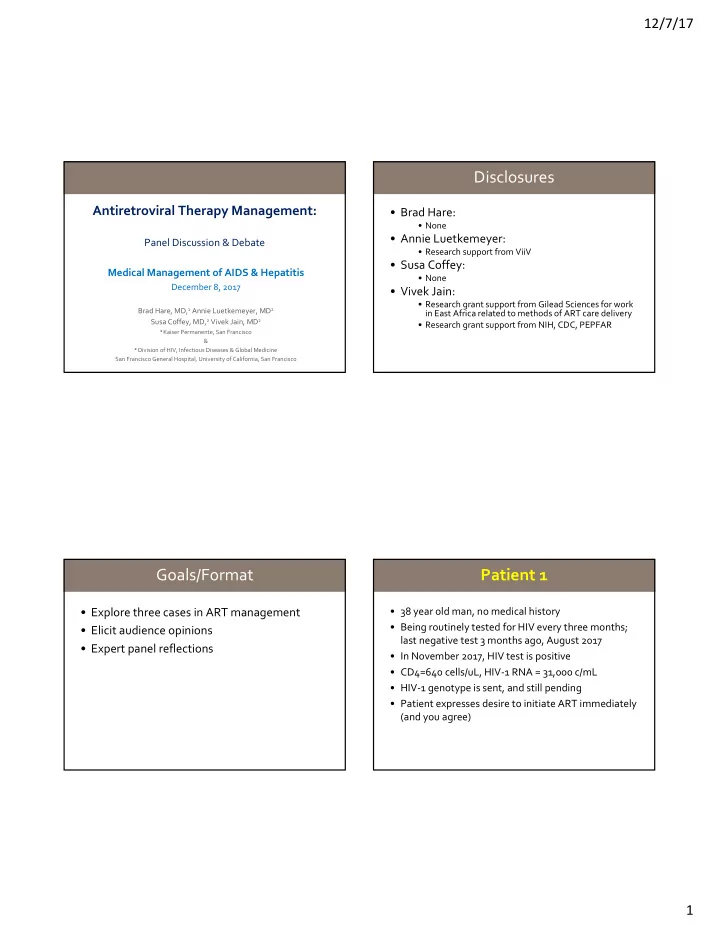
Antiretroviral Therapy Management:

Panel Discussion & Debate Medical Management of AIDS & Hepatitis

December 8, 2017

Brad Hare, MD,1 Annie Luetkemeyer, MD2 Susa Coffey, MD,2 Vivek Jain, MD2

1 Kaiser Permanente, San Francisco

&

2 Division of HIV, Infectious Diseases & Global Medicine

San Francisco General Hospital, University of California, San Francisco

Disclosures

  • Brad Hare:
  • None
  • Annie Luetkemeyer:
  • Research support from ViiV
  • Susa Coffey:
  • None
  • Vivek Jain:
  • Research grant support from Gilead Sciences for work

in East Africa related to methods of ART care delivery

  • Research grant support from NIH, CDC, PEPFAR

Goals/Format

  • Explore three cases in ART management
  • Elicit audience opinions
  • Expert panel reflections

Patient 1

  • 38 year old man, no medical history
  • Being routinely tested for HIV every three months;

last negative test 3 months ago, August 2017

  • In November 2017, HIV test is positive
  • CD4=640 cells/uL, HIV-1 RNA = 31,000 c/mL
  • HIV-1 genotype is sent, and still pending
  • Patient expresses desire to initiate ART immediately

(and you agree)

slide-2
SLIDE 2

12/7/17 2

Audience Preliminary Vote

  • Given the many options for ART, would you

initiate TAF/FTC (Descovy) + dolutegravir (Tivicay)?

– (A) YES, I would give TAF/FTC + DTG. – (B) NO, I would recommend something else.

Case 1:

Susa Coffey

Yes, comfortable initiating TAF/FTC + dolutegravir

Case 1: Starting DTG + TAF/FTC is appropriate

. Pt Pt with early HIV, CD4=640, VL=31,000; genotype is pending.

  • Mountains of data and experience with DTG + 2 NRTIs in

initial ART; preferred regimen

  • If concern for transmitted resistance (R)
  • How likely?
  • How likely to impact this regimen in NEXT 2-3 WEEKS?
  • TDR present in ~15%, NRTI mutation ~7%
  • K65R rare, M184V ~4-5%
  • Major INSTI mutations RARE
  • Almost certainly has fully-active DTG and TAF, fully
  • r perhaps partially effective FTC; this should be sufficient

Menza TW et al, AIDS 2017.

Case 1: Starting DTG + TAF/FTC is appropriate

. Pt Pt with early HIV, CD4=640, VL=31,000; genotype is pending.

  • Assuming resistance to 1 NRTI, should still be

effective

  • Data for DTG + 1 fully- active NRTI
  • Naives:
  • DTG + 3TC:
  • PADDLE, wk 48 VF in 1/20, no mutations
  • ACTG 5353: wk 24 VL <50 in 90%; 89% if BL VL

>100,000. VF with R in 1/120 (adherence issues)

  • Treatment-experienced:
  • DTG + 2NRTIs
  • SAILING: subset on DTG + 2 NRTIs with resistance to

1-2 NRTIs-> Wk 48 NO VF if 0 or 1 fully-active NRTI (0/13)

  • DAWNING: DTG + 2NRTIs (vs LPV/r + 2NRTIs) after VF

with 1st ART regimen->251 pts w/ 1 fully active NRTI, 84% w/ VL <50 at wk 48 (vs 73% of LPV/r); no IN or new RT mutations

Mean BL VL 4.21 log; >100K in 22%

Cahn et al. J IAS 2017. Taiwo BO, IAS 2017. Demaest J, IAS 2014. Aboud M, et al. IAS 2017. Abstract TUAB0105LB.

DAWNING Study

slide-3
SLIDE 3

12/7/17 3

Real-World Risk of Virologic Failure in Pts Starting DTG-Based vs DRV-Based ART

  • Patients who initiated DHHS

Recommended ART from 8/13- 3/17 at 8 CNICS sites (N = 5177)

  • 1229 on DTG or DRV/r with

ABC/3TC, TDF/FTC, or TAF/FTC

Nance R, et al. IDWeek 2017. Abstract 1688. Modified from clinicaloptions.com

†Virologic failure: HIV-1 RNA > 400 c/mL at ≥ 6 mos after initiating ART.

*Cox models adjusted for age, CD4+ cell count, days from last HIV-1 RNA, CNICS site, sex, HBV, HCV, HIV risk factor, and race.

Pts aHR* for VF† of DTG vs DRV (95% CI) All pts § DRV § DTG 0.41 (0.30-0.55) Tx-naive pts (1229) § DRV § DTG 0.32 (0.14-0.75)

  • DTG + TAF/FTC is a

potent, simple, tolerable regimen

  • Likelihood of

transmitted resistance is very low, and risk of VF from transmitted resistance is even lower,

  • esp. in next 2-3 weeks
  • Much clinical experience

from SFGH RAPID ART

Case 1: Counterpoint:

Brad Hare

No, not comfortable initiating TAF/FTC + dolutegravir… Would initiate another regimen

Case 1 (BH)

Pa Patient diagnosed w/HIV in acute care setting, last tested negative 3 months ago, CD4=640, VL VL=31, 31,000, 000, b but g genotype i is s sent a and p pending—do do no not ha have da data. Wo Would you start De Descovy DT DTG or something else

ARV Drug Class % with Major IAS-USA Mutations Most Common Mutations NRTI 8.9 A62V, M41L, M184V, K70R, D67N NNRTI 7.8 K103N, K101E, L100I, V108I, Y188C/L PI 3.2 M46I/L, V321, L90M, I84V, D30N

Buchacz (CROI 2013, #615). HOPS Cohort 1999-2011

  • Transmitted drug resistance still occurs

Case 1 (BH)

Pa Patient diagnosed w/HIV in acute care setting, last tested negative 3 months ago, CD4=640, VL VL=31, 31,000, 000, b but g genotype i is s sent a and p pending—do do no not ha have da data. Wo Would you start De Descovy DT DTG or something else

  • Transmitted drug resistance still
  • ccurs
  • Clinical trials:
  • Participants always have

baseline genotypes to enter

  • Reasonable clinical strategy:
  • Start broad (still simple), wait for

the data, and refine

  • What’s worse: 2-4 weeks of one

extra drug, or a lifetime of generated resistance?

slide-4
SLIDE 4

12/7/17 4

Final Audience Vote

  • Given the many options for ART, would you

initiate TAF/FTC (Descovy) + dolutegravir (Tivicay)?

– (A) YES, I would TAF/FTC + DTG. – (B) NO, I would recommend something else.

Patient 2

  • 56 year old man, no medical co-morbidities
  • Diagnosed with HIV in 2012; initially started

TDF/FTC (Truvada) + ritonavir/darunavir and achieved virologic suppression.

  • Switched Truvada to TAF/FTC (Descovy) in 2016;

maintained RTV/DRV

  • Continuous virologic suppression

Audience Preliminary Vote

  • Would you recommend switching off the

protease inhibitor and switching to an integrase inhibitor? Or stay with current protease inhibitor?

– (A) I would switch the PI to an INSTI. – (B) I would continue the PI.

slide-5
SLIDE 5

12/7/17 5

Case 2:

Annie Luetkemeyer

Would switch to integrase-based regimen

DHHS guidelines 10/17 https://aidsinfo.nih.gov/guidelines

NO Protease inhibitors in Preferred initial ART

Ryom L, et al. CROI 2017. Abstract 128LB.

PI’s associated with:

  • Increase CVD (53% increase in D:A:D

with DRV/r!)

  • Dyslipidemia
  • Metabolic derangement

AND NO current single pill formulation, to boot! NEAT-022: ≥ 50 yrs old or Framingham >10%,

  • n PI/r + NRTI, suppressed x ≥ 6 months, no

documented resistance/virologic failure

  • Non-inferior to PI/r
  • Improved lipid

profile

  • Improved

Framingham score (both ATZ and DRV)

Ryom L, et al. CROI 2017. Abstract 128LB.

Gatell TUAB1012 IAS 2017

Wha What if f pr preexi xisting ng resi sistanc nce? ?

  • SPIRAL study: 282 patients suppressed on PI/r x > 24

weeks, 40% with prior virologic failure

  • RAL-based regimen equivalent to PI/r, virologic failure rare (1
  • vs. 3)
  • DTG more potent than RAL
  • DTG/3TC dual therapy thus far effective in several pilot

switch studies and several pilot treatment initiation studies, thus:

üTAF should have efficacy with DTG even if M184 and 1-2 TAMs present üTransmitted INSTI resistance still very rare.

  • Can get an Genosure Archive if worried

Martinez AIDS 2010;24:1697, DOLAM Blanco EACS 2017, Taiwo EACS 2017, Figueroa IAS 2017, ACTG 5353 Taiwo IAS 2017

Ge Genosure Ar Archive: e: Us Usefu ful a application

  • n
slide-6
SLIDE 6

12/7/17 6 Ge Genos

  • sure Arch

chive: Cautionary tale

Genosure showed

  • RT T369 A/I/V
  • PR L10/I, D60E,

162V, L63 S/C/T Historic genotype:

  • RT M41L, D67N,

L210W, T215Y, V106I, Y181V

  • PR: L10I, M36I/M,

M46L, I54V, L63S, I64V, V82A.

Co Concordance of f Ar Archive with GT

Singh ID Week 2016 Abstract 1507

  • 48 paired samples, % concordance with historical GT was 92% for

Protease Inhibitor resistance and 88% for reverse transciptase.

Toma ICAAC 2015

Case 2: Counterpoint:

Brad Hare

Would stay with PI-based regimen

Case 2 (BH)

TA TAF/FTC + DRV/RTV, suppressed, and you don’t have any GT info 56y 56yo m man n no c co m morbidities, o

  • n A

ART x x7 y 7 years, g good a adherence à sw switch off PI PI to integr grase or stay on PI PI?

  • If it’s not broken, don’t fix it
  • Where are the data for DTG/TDF with M184V? ArchiveDNA test?
  • Want convenience? Symtuza is on the way
slide-7
SLIDE 7

12/7/17 7

Prevalence of Transmitted HIV Drug Resistance in US, 2006-2009

  • Genotypic analysis of samples from newly diagnosed patients in

CDC National HIV Surveillance System (N = 12,668)

Ocfemia MC, et al. CROI 2012. Abstract 730. All cases with sequences Cases classified as recent infections Cases classified as long-standing infections Cases (%) 4 Transmitted Drug Resistance Mutations 1 or more 20 8 12 16 1 class 2 class 3 class NNRTI NRTI PI 15.6 7.8 6.8 4.1

  • Randomized, open-label, active-controlled phase III trial in which

virologically suppressed pts continued a boosted PI + FTC/TDF regimen or switched to DRV/COBI/FTC/TAF single-tablet regimen (N = 1149)

Treatment difference: -0.3% (95% CI: -2.0% to 1.5%)

EM EMERALD ERALD: Switch From Boosted PI + FTC/TDF to DRV/COBI/FTC/TAF in Suppressed Pts

Slide credit: clinicaloptions.com Molina JM, et al. IAS 2017. Abstract TUAB0101. Virologic Rebound

*HIV-1 RNA < 50 copies/mL.

§• No PI or NRTI resistance associated mutations noted (n = 2 genotyped for each treatment group) §• Similar low rates of grade 3/4 AEs, d/c for AEs between treatment groups §• Significant improvements in hip/spine BMD for DRV/COBI/FTC/TAF vs control §• Similar eGFR by serum creatinine between groups (P = .118); increased eGFR by cystatin c with DRV/COBI/ FTC/TAF (P = .026)

Pts (%) 100 80 60 40 20 Virologic Success* Virologic Failure No Virologic Data

Treatment difference: 0.8% (95% CI: -1.7% to 3.3%) 96.3 95.5 0.5 (n = 4) 0.8 (n = 3) 3.1 3.7 1.8 2.1

DRV/COBI/FTC/TAF (n = 763) Boosted PI + FTC/TDF (n = 378)

Wk 24 Virologic Efficacy

AM AMBER: ER: DRV/COBI/FTC/TAF vs DRV/COBI + FTC/TDF for Treatment-Naive Pts

  • 1 treatment-emergent resistance

mutation (M184I/V) observed in DRV/COBI/FTC/TAF arm

  • Similar low rates of grade 3/4 AEs

between treatment groups

  • Lower rate of AE-related d/c for

DRV/COBI/FTC/TAF vs DRV/COBI + FTC/TDF (1.9% vs 4.4%)

  • Hip/spine BMD changes more

favorable with DRV/COBI/FTC/TAF

  • Significantly higher eGFR by serum

creatinine (P < .0001) and cystatin c (P = .001) with DRV/COBI/FTC/TAF

Slide credit: clinicaloptions.co Orkin C, et al. EACS 2017. Abstract PS8/2. Reproduced with permission.

*Primary endpoint: HIV-1 RNA < 50 c/mL by FDA snapshot.

Treatment difference: 2.7% (95% CI: -1.6% to 7.1%)

Virologic Success* HIV-1 RNA ≥ 50 c/mL 91.4 88.4 3.3 (n = 12) 4.4 (n = 16)

Wk 48 Virologic Efficacy

DRV/COBI/FTC/TAF (n = 362) DRV/COBI + FTC/TDF (n = 363)

Pts (%) 100 80 60 40 20

Final Audience Vote

  • Would you recommend switching off the

protease inhibitor and switching to an integrase inhibitor? Or stay with current protease inhibitor?

– (A) I would switch the PI to an INSTI. – (B) I would continue the PI.

slide-8
SLIDE 8

12/7/17 8

Patient 3

  • 65 year old woman with:

– chronic kidney disease (eGFR = 40 mL/min) – severe osteoporosis (DEXA with T-score -3.1 in hip) – coronary artery disease (recent exercise treadmill test positive for ischemia) and HTN: takes ASA 81mg QD, metoprolol 25mg QD, and lisinopril 5mg QD

  • Diagnosed with HIV in 2016 (records unavailable) à started
  • n TAF/FTC (Descovy) + dolutegravir (Tivicay) à virally

suppressed since then

  • You want to switch to a nucleoside-sparing ART regimen for

medical reasons; patient also wants this

Audience Preliminary Vote

  • What type of NRTI-sparing regimen would

you construct?

– (A) I would give a 2-drug NRTI-sparing regimen – (B) I would give a 3-drug NRTI-sparing regimen

Case 3:

Susa Coffey

Would use a 2-drug NRTI-sparing regimen

slide-9
SLIDE 9

12/7/17 9

Case 3 –switch to “NRTI-Sparing” 2-drug ART

.

65 65 yo yo wo woman with CKD (eGFR 40), severe osteopenia, CAD. On stable suppressive TAF/FTC + DTG, ne needs ds to switch h to a NRTI-spa sparing ng regimen. n.

  • Q1: 2 drugs vs 3 drugs?
  • Q2: does 3TC/FTC count as a NRTI? – we can go either

way on this

  • A good 2-drug regimen likely to be sufficient; she is

an excellent candidate:

  • She has proved her ability to adhere closely to ART
  • Stable viral suppression
  • Likely wildtype virus

Case 3 – switch to 2-drug regimen

. 65 65 yo yo wo woman with CKD (eG eGFR 40), 40), severe os

  • steop
  • penia, CAD
  • CAD. On stable suppressive

TA TAF/FTC + DTG, needs to switch to a NRTI-sp spari ring regimen

  • LOTS of good new data!
  • DTG/RPV
  • DTG + 3TC
  • DTG + DRV/r
  • DRV/r + 3TC

Switch to DTG + RPV: SW

SWORD 1/2

Llibre et al. CROI 2017; Seattle, WA. Abstract

  • 44LB. McComsey G, IAS 2017.

Virologic outcomes, Week 48

  • N=1024, viral suppression ≥12

months, stable ART ≥6 mos

  • DTG + RPV non-inferior to CAR,

incl in subgroups (age, gender, race)

  • VF in 2 in dual arm, 1 w/

K101K/E, resuppressed

  • BMD improved on DTG/RPV after

switch from TDF (DEXA substudy)

20 40 60 80 100 Virologic success Virologic non-response No virologic data HIV-1 RNA <50 c/mL, % DTG + RPV (n=513) CAR (n=511)

95 95 <1 1 5 4

aAdjusted for age and baseline 3rd agent.

DTG/RPV approved by FDA Nov 2017 (Juluca): switch from stable ART, VS, no VF, no resistance

Switch to DTG + 3TC (and remember the Naive trials- Case 1)

Study N Baseline Results Ref

LAMIDOL Single arm, prospective,

  • pen label

104 VL <50 x ≥2 yrs, no R Wk 48: VL <50 101/104 -- 1 rebound to 77 c/mL, 1 LTFU, 1 interrupted. No IN resistance, 1 w/ L74V/L.

Joly V, EACS 2017.

DTG/3TC vs DTG mono vs 3-drug RTC 91 VL <50 x ≥12 mos, no VF or resistance to 3TC or INI Wk 24: DTG/3TC: 1 VF (low level VL, no resistance) DTG mono: 2 VF with INI R (this arm stopped)

Blanco JL, EACS 2017.

ASPIRE DTG/3TC vs current ART; RCT 89 VL <50 on any 3-d ART No VF, no R Wk 24: VL <50 in 93% vs 91% Wk 48: 91% vs 89% 1 VF in DTG/3TC, no R

Taiwo BO, EACS 2017.

DTG/3TC vs DRV/r/3TC vs ATV/r/3TC

  • Retrosp. investigator-

selected

183 DTG, 170 DRV, 141 ATV VL <50, no VF with INI resistance Up to 2 yrs VF: 3 (DTG), 6 (DRV), 4 (ATV)

Borghetti, EACS 2017.

DTG/3TC vs historic control

  • Prosp. open label

72 (vs 86 control) Wd 96: VL <50 in 97% in both gps Blips in 1 vs 6

Tau L, EACS 2017.

Single arm, prospective, open label 203 VL <50 ≥6 mos, median 72 mos VF: 0 (295 pt-yrs of f/u) d/c: 12

Maggiolo F, EACS 2017; BMC ID 2017.

Retrospective 105 96% VL <50 Median 23 wks: VL <50 97% (82/84) 1 VL=55, 1 VL=239

Hidalgo- Tenorio C, EACS 2017.

Metaanalysis of 4 DTG/3TC studies 261 VL <50 VF in 1 DTG/3TC, no mutations

Buzzi M, EACS 2017.

slide-10
SLIDE 10

12/7/17 10

INSTI + PI/r or PI/r + 3TC: Switch(2) and Naïve(1) each

PI/r + 3TC N Baseline Results

Ref

DUAL DRV/r + 3TC vs DRV/r + 2 NRTIs RTC open label switch 249 VL <50 x >6 mo on DRV/r + 2 NRTIs, no R TDF/FTC in 75%, ABC/3TC 25% Wk 48: VL <50 in 89% vs 93% VF in n=4 vs 2

  • -2 w/ VL <200, 1 VF at BL, 1 VF during study

No R either arm

Pulido F, CID, 2017.

Metaanalysis of 4 PI/r + 3TC studies 1051 (525 on dual) Wk 48 VL <50: PI/3TC noninferior (4% margin); no diffs by gender, HCV, or PI

Perez-Molina A, EACS 2017.

ANDES DRV/r + 3TC vs DRV/r + TDF/3TC RTC open label Naive 145 Median BL VL 4.6 log, >100,000 in 27% Wk 24: VL <400 in 95% vs 97% On treatment: 100% vs 99% 1 VF in 3-drug arm

Sued O, IAS 2017.

INSTI + PI/r N Baseline Results Ref

NEAT-001 RAL/DRV-r vs DRV/r/TDF/FTC Naive 805 No resistance CD4 <500 Noninferior 96 wks: VL <5 on 89% vs 93%, incr VF in RAL/DRV if VL >100K or CD4 <200 R: 5 with IN mutations, 1 K65R

Raffi F, Lancet 2014.

DTG + DRV/r Switch, single arm 27 Suppressed 48 wks: VL <50 in 25/27 (93%) 1 VF, no resistance

Navarro, J. EACS 2017.

DTG + DRV/r Switch, retrosp. 130 30% with VF Resistance to 1-5 ARV classes or hx VF w/o GT. 17% with DRV RAMS, 11% with INI RAMS 48 weeks: VL <50 in 91% (14 took ARVs BID) No new R mutations

Capetti AF, BMC ID 2017.

Case 3 – switch to 2-drug regimen

  • Already on DTG – let’s keep it
  • Prefer to avoid PIs

ØLargest RTC: DTG + RPV ØAccumulation of data DTG + 3TC

Case 3: Counterpoint:

Annie Luetkemeyer:

Would stick with a 3-drug NRTI-sparing regimen

To Too soon for 2 drug therapy here!

  • The #1 goal for her is to maintain virologic suppression!
  • This patient would not have qualified for SWORD, PADDLE, NEAT

given her comorbidities

  • DTG + 2nd drug is one step away from DTG monotherapy
  • Excellent data to support 3 drug regimens, including NRTI-sparing

regimens

Tashima AIM 2015; 163(12); 908 Fagard IAS 2009, JAIDS 2012; 59(5);489

slide-11
SLIDE 11

12/7/17 11

Final Audience Vote

  • What type of NRTI-sparing regimen would

you construct?

– (A) I would give a 2-drug NRTI-sparing regimen – (B) I would give a 3-drug NRTI-sparing regimen

Acknowledgements

  • Monica Gandhi, MD
  • Oliver Bacon, MD
  • Thank you for participating!