Disclosures New Drugs for Osteoporosis Edward Hsiao receives - - PDF document

disclosures
SMART_READER_LITE
LIVE PREVIEW

Disclosures New Drugs for Osteoporosis Edward Hsiao receives - - PDF document

Disclosures New Drugs for Osteoporosis Edward Hsiao receives research grant support and Bone Disorders from Clementia Pharmaceuticals for unrelated clinical trials. He has no conflicts of interest. Edward Hsiao, MD, PhD This


slide-1
SLIDE 1

1 New Drugs for Osteoporosis and Bone Disorders

Edward Hsiao, MD, PhD

University of California, San Francisco Division of Endocrinology and Metabolism Metabolic Bone Clinic Institute for Human Genetics 2015 UCSF Advances in Internal Medicine

Disclosures

  • Edward Hsiao receives research grant support

from Clementia Pharmaceuticals for unrelated clinical trials. He has no conflicts of interest.

  • This presentation includes discussion of off-

label, investigational use of a commercial product, or drugs that are not FDA approved.

  • Care should be guided by expert opinion and
  • literature. As always, we encourage the

application of sound clinical judgment on a case-by-case basis

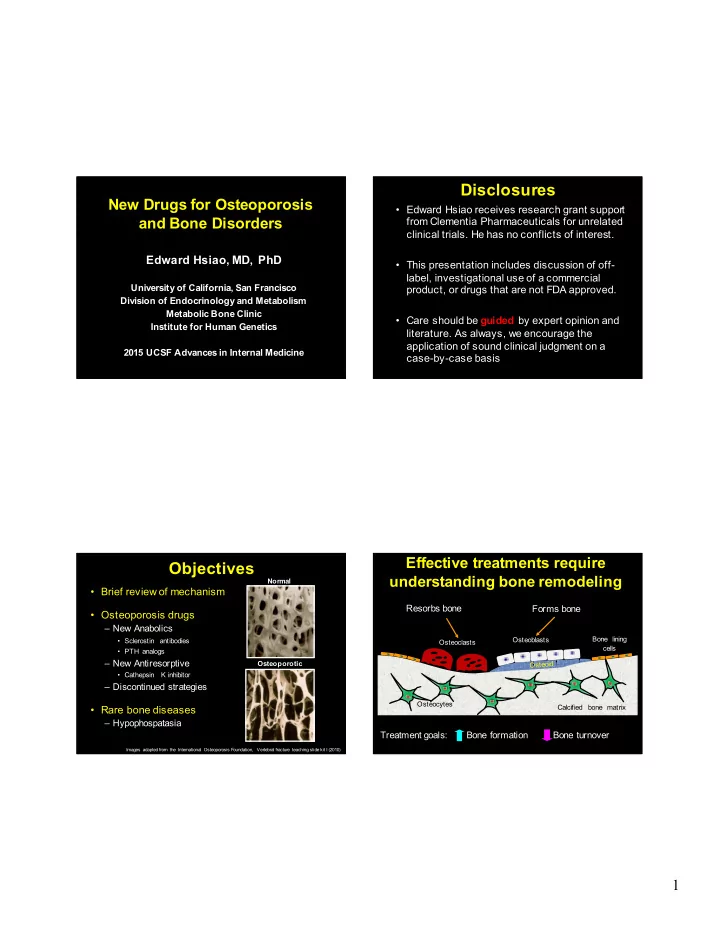
Objectives

  • Brief review of mechanism
  • Osteoporosis drugs

– New Anabolics

  • Sclerostin antibodies
  • PTH analogs

– New Antiresorptive

  • Cathepsin

K inhibitor

– Discontinued strategies

  • Rare bone diseases

– Hypophospatasia

Images adapted from the International Osteoporosis Foundation, Vertebral fracture teaching slide kit I (2010)

Normal Osteoporotic

Effective treatments require understanding bone remodeling

Treatment goals: Bone formation Bone turnover

Osteoclasts Osteocytes Calcified bone matrix Bone lining cells Osteoblasts

Resorbs bone Forms bone

slide-2
SLIDE 2

2 Current Treatments for Osteoporosis

Decrease Bone Turnover

  • Hormone Therapy (HT)
  • SERM/Raloxifene (Evista)
  • Calcitonin (Miacalcin)
  • Bisphosphonates

– Alendronate (Fosamax) – Risedronate (Actonel) – Ibandronate (Boniva) – Zoledronate (Reclast/Aclasta)

  • (Strontium ranelate)
  • RANKL inhibitors

– Denosumab (Prolia)

Increase Bone Formation

  • Parathyroid hormone

(rPTH, Teriparatide)

Recent Changes in Drugs for Osteoporosis

  • Antiresorptives

– Cathepsin K inhibitor

  • Ondanacatib

– New considerations for denosumab – Restrictions on strontium ranelate (in EU market) – Vibration Therapy

  • Anabolics

– Anti-sclerostin antibodies

  • Romosozumab
  • Blomosozunab

– PTHrP analog

  • Abaloparatide

Recent Changes in Drugs for Osteoporosis

  • Antiresorptives

– Cathepsin K inhibitor

  • Ondanacatib

– New considerations for denosumab – Restrictions on strontium ranelate (in EU market) – Vibration Therapy

  • Anabolics

– Anti-sclerostin antibodies

  • Romosozumab
  • Blomosozunab

– PTHrP analog

  • Abaloparatide

Sclerostin is a Key Mediator

  • f Bone Formation

Frizzled LRP5/6 Wnt Sclerostin β-Catenin Activation of bone Formation pathways

X X

Brunkow et al. Am J Hum Gen 2001 Sclerosteosis Normal

slide-3
SLIDE 3

3

Anti-Sclerostin Antibody #1: Romosozumab

  • Romosozumab (Amgen/UCB: AMG785, CDP7851)

– Humanized monoclonal antibody

  • Phase 1 study:

– Single dose of AMG785, 72 men and women; – Peak serum concentration achieved after 1 week sq – Half life of 11-18 days – Dose ranging was done from 0.1-10 mg/kg – 10mg/kg (maximum dose tested)

  • 120-184% increase in P1NP, BSAP, Osteocalcin
  • 54% decrease in CTX
  • Largest BMD effect at day 85
  • +5.3% lumbar spine BMD
  • + 2.8% in total hip BMD

Padhi, et al. JBMR 2011

Romosozumab: Phase I

  • Additional Phase I study

– Multiple doses – 32 postmenopausal women with low bone mass

  • 6 doses, 1-2 mg/kg every 2 weeks, or
  • 3 doses of 2-34 mg/kg every 4 weeks, or

placebo

– 16 healthy men with low bone mass.

  • 1 mg/kg every 2 weeks, or
  • 3 mg/kg every 4 weeks, or placebo

Padhi, et al. J Clin Pharm 2014

Romosuozumab

  • 12 weeks of drug, 12 weeks of followup
  • Appropriate changes in serum markers
  • bserved.
  • No major effect on hip BMD
  • Persistence of effect after dosing stopped

Padhi, et al. J Clin Pharm 2014

Romosozumab: Phase II

  • 419 postmenopausal women

– T score between -2.0 and -3.5 in spine, total hip or femoral neck. – Monthly sq (70, 140, or 210 mg) or every 3 months (140 or 210 mg), for 12 months – Open label comparison to

  • Alendronate 70 mg weekly
  • Teriparatide 20 ug/day
slide-4
SLIDE 4

4

Romosozumab Gives Higher Increase in BMD

  • Every 3 months – same as 70 mg/mo dose

– Approx 5% increase in BMD at spine – Bone formation markers return to normal after 6-12 mo

Romosozumab: Phase III

  • Recent announcements

indicate that it meets goals, but full publications pending

  • STRUCTURE trial* (Sept 2015 press release)

– 436 postmenopausal women previously treated with bisphosphonates – Romosozumab vs teriparatide – Met goals for total hip BMD

  • FRAME trial** (Feb. 2016 press release)

– 7180 patients, 210 mg sq/month – Reduced incidence of new vertebral fractures at 12 and 24 mo – Reduced incidence of clinical fractures at 12 mo – Unclear benefit for non-clinical fractures at 12 and 24 mo.

*STudy evaluating effect of RomosozUmab Compared with Teriparatide in postmenopaUsal women with osteoporosis at high risk for fracture pReviously treated with bisphosphonatE therapy ** FRActure study in postmenopausal woMen with ostEoporosis

Romosozumab Side Effects (Reported in Phase I-III)

  • Injection site reactions
  • No clear increase in serious adverse events
  • ver alendronate, teriparatide
  • 20% develop binding antibodies, with 3%

showing in vitro blocking ability, but subjects still showed biologic response

  • Awaiting results of Phase III for full profile

Anti-sclerostin Antibody #2: Blosozumab

  • Humanized monoclonal antibody

– Eli Lilly (LY2541546)

  • Phase I trials

– Single and multiple dose regimens tolerated up to 750 mg every 2 weeks for 8 wks – 3.4-7.7% increase in lumbar BMD at Day 85

McColm, et al. JBMR 2014

slide-5
SLIDE 5

5

Blosozumab: Phase II

  • 120 postmenopausal women, T score

between -2.0 and -3.5

23996473

Recker, et al. JBMR 2015

Lumbar Spine Total Hip

Blosozumab: Phase II Durability of treatment

  • Followup study for 1 year post treatment

– 88 of 120 women previously studied – Suggests antiresorptive will be needed

Recknor, et al. JBMR 2015

Recent Changes in Drugs for Osteoporosis

  • Antiresorptives

– Cathepsin K inhibitor

  • Ondanacatib

– New considerations for denosumab – Restrictions on strontium ranelate (in EU market) – Vibration Therapy

  • Anabolics

– Anti-sclerostin antibodies

  • Romosozumab
  • Blomosozunab

– PTHrP analog

  • Abaloparatide

Osteoblast Activation by PTHrP:

Parathyroid Hormone Related Protein

Treatment goals: Bone formation Bone turnover

Calcified bone matrix Bone lining cells Osteoblasts

PTH PTHrP PTH/PTHrP Receptor Gs GPCR bone anabolic response

slide-6
SLIDE 6

6 Abaloparatide: A PTHrP analog

  • Synthetic peptide analog of human

PTHrP

  • Phase II:

– 24 weeks of daily sq injections

  • Postmenopausal women
  • 20, 40, or 80 ug vs 20 ug of teriparatide

– Lumbar spine BMD increased 2.8-6.7%, vs 5.5% in teriparatide and 0.8% in placebo – Femoral neck increased 1.4-2.6%, vs. 0.5% in teriparatide and 0.4% in placebo

Leder, et al. JCEM 2015

Abaloparatide: Phase III

  • ACTIVE fracture prevention trial

– 2463 postmenopausal women – 18 mo daily 80 ug abaloparatide vs placebo vs 20 ug teriparatide. – 89% decrease in new fracture rate vs. placebo – Teriparatide showed an 80% decrease

  • No significant differences in wrist fractures
  • Increased BMD in spine and hip at 6, 12, and 18 months

– Major complications: hypercalcemia, and injection site reactions.

  • Extension trial in progress

2015 Endocrine Society poster: LB-OR01-3

Recent Changes in Drugs for Osteoporosis

  • Antiresorptives

– Cathepsin K inhibitor

  • Ondanacatib

– New considerations for denosumab – Restrictions on strontium ranelate (in EU market) – Vibration Therapy

  • Anabolics

– Anti-sclerostin antibodies

  • Romosozumab
  • Blomosozunab

– PTHrP analog

  • Abaloparatide

Cathepsin K: Functions in Osteoclast Resorption Pits

Treatment goals: Bone formation Bone turnover

Osteoclasts Osteocytes

Resorbs bone Cathepsin K

  • secreted by osteoclasts
  • cleaves helical collagen
  • induces bone resorption
slide-7
SLIDE 7

7 Ondanacatib: Anti-Cathepsin K

  • Related to two other Cathepsin K inhibitors

– Relacatib: nonselective inhibitor of K, L, V, and S

  • No clinical information
  • Kumar, et al. Bone 2007 (monkey model)

– Balicatib: showed BMD increases, but had cutaneous adverse events.

  • Adami, et al. JBMR 2006

– Ondanacatib: selective for Cathepsin K and orally bioavailable.

  • Bone, et al. JBMR 2009

Ondanacatib: Phase II

  • 399 postmenopausal women

– Generally well tolerated – No significant major side effects reported

Recent Changes in Drugs for Osteoporosis

  • Antiresorptives

– Cathepsin K inhibitor

  • Ondanacatib

– New considerations for denosumab – Restrictions on strontium ranelate (in EU market) – Vibration Therapy

  • Anabolics

– Anti-sclerostin antibodies

  • Romosozumab
  • Blomosozunab

– PTHrP analog

  • Abaloparatide

Denosumab

  • Human monoclonal

antibody that inhibits RANKL (required for

  • steoclast function and survival)
  • Given 60 mg sq every 6 months over 3 years reduces fracture risk

(FREEDOM) and Freedom extension Vertebral Non- vertebral Hip N (Ref #) Alendronate

(10 mg qd)

0.55 (0.43-0.69) 0.84 (0.74-0.94) 0.60 (0.40-0.92) 12,068 (2) Zoledronate

(5 mg/yr iv)

0.30 (0.24-0.38) 0.75 (0.64-0.87) 0.59 (0.42-0.83) 7,765 (1) Denosumab

(60 mg/6 mo sq)

0.32* (0.26-0.41) 0.80* (0.67-0.95) 0.60 (0.37-0.97) 7868 (3) Relative risk of drug vs. placebo * Hazard ratios (secondary endpoints of study)

  • 1. Black, et al. NEJM 2007 (HORIZON)
  • 2. Wells, et al. Cochrane DB or Syst. Rev. 2008 (CD001155 Alendronate)
  • 3. Cummings, et al. NEJM 2009 (FREEDOM)
slide-8
SLIDE 8

8

Long-term Denosumab Use

  • FREEDOM extension (total of 5 years) just reported, with

persistent gains in BMD and fracture risk (1)

  • Transition from alendronate

to 1 year of denosumab appears safe and may have a slightly improved BMD (no fracture data) (2)

  • Likely cost effective, particularly for patients with low compliance to

bisphosphonates (3,4)

  • Main complications:

– skin infection, urinary tract infection; dermatitis/eczema/rash – ONJ reported in cancer patients receiving high doses (120 mg every 4 weeks)

  • f denosumab (5, 6) and was seen in 2 patients in the FREEDOM extension (1)

– Likely occurs at same rate as bisphosphona tes, during clinical trials

1. Papapoulos, et al. JBMR 2011 2. Kendler, et al. JBMR 2010 3. Jonsson, et al. Ost. Int 2011 (Sweden) 4. Hiligsmann, et al. Pharmacoeconomics 2011 (Belgium) 5. Smith, et al., Lancet 2012 (Prostate cancer) 6. Stopeck, et al. J Clin Oncol 2010 (Breast cancer)

Antiresorptives May Have Direct Anti-Tumor Effects

  • Denosumab

– Increased disease free survival in breast cancer (no

  • verall survival data; vs. placebo) (1)

– Prolongs survival in lung cancer vs. zoledronate (2) – Delay metastasis in prostate cancer (3) probably better than zoledronate (4)

  • Zoledronic Acid

– Does not work as an adjuvant for early breast cancer, but does reduce bone metastases (5)

1: Gnant, et al. Lancet 2015 2: DeCastro, et al. Clinical Lung Cancer 2015 3: Smith et al., Lancet 2012 4: Fizazi, et al Lancet 2011 5: Coleman, et al. Lancet 2014; Coleman NEJM 2011

Meet Thy Neighbor… Recent Changes in Drugs for Osteoporosis

  • Antiresorptives

– Cathepsin K inhibitor

  • Ondanacatib

– New considerations for denosumab – Restrictions on strontium ranelate (in EU market) – Vibration Therapy

  • Anabolics

– Anti-sclerostin antibodies

  • Romosozumab
  • Blomosozunab

– PTHrP analog

  • Abaloparatide
slide-9
SLIDE 9

9

Strontium Ranelate Restrictions in EU Market

  • Was never FDA approved in the US

– Previously approved by the EMA in Europe

  • Often confused with other forms, such as strontium

citrate (available in health food stores)

– Other forms not studied for bone, so unknown efficacy or toxicity

Strontium Ranelate Current Recommendations

  • Reportedly increased incidence of cardiovascular

events in multiple randomized control trials

  • Unclear if this is also seen in real life, as trials may

have had higher proportion of subjects with cardiovascular diase

  • Recommendation to restrict to severe osteoporosis

patients only, and only in patients with low baseline cardiovascular risk (though specifics are still vague)

Vibration Therapy for Osteoporosis?

  • Originally developed for space flight

– Vibrations for 25-30 Hz at 0.3 x g can prevent bone loss

  • deZeptnek, et al. J Rehab Res Dev 2009

– Vibration studies in sheep forelimbs (20 min/day 5 days/week) can increase bone formation in limbs

  • Rubin, et al. Nature 2001

– Seemed potentially useful for osteoporosis

Vibration Therapy is Falling

  • ut of Favor
  • Human trials have been quite variable, with

some suggesting gain but others not

  • Best trial is of 202 postmenopausal women
  • 30 vib/min, 20 min per day, 0.3 x g (low energy)
  • 90 vib/min, 20 min per day, 0.3 x g
  • After 1 year – no difference in BMD
  • Main adverse events: dizziness, fainting due

to passive standing x 20 min.

  • Slatkovska, et al. Ann Int Med 2011
  • Wysocki, et al. Ann Int Med 2011
slide-10
SLIDE 10

10

Vibration Therapy is not FDA Approved

  • Often sold on the internet, and many devices

have higher energies (> 1 x g)

  • Currently, no FDA oversight for devices
  • Being investigated for other situations, such

as spinal cord injury

  • Vibration exposure is regulated in the

workplace as a hazard

  • http://www.cdc.gov/nios h/docs/89-106/89- 106.pdf

Objectives

  • Brief review of mechanism
  • Osteoporosis drugs

– New Anabolics

  • Sclerostin antibodies
  • PTHrP analog

– New Antiresorptive

  • Cathepsin

K inhibitor

– Discontinued strategies

  • Rare bone diseases

– Hypophospatasia

Images adapted from the International Osteoporosis Foundation, Vertebral fracture teaching slide kit I (2010)

Normal Osteoporotic

Hypophosphatasia: treatment by enzyme replacement

  • Deficiency of tissue non-specific alkaline

phosphatase (ALPL/TNSALP)

– Partial or complete loss of function – Hypomineralization, respiratoy compromise – Mild forms may show progressive osteomalacia; poor dentition – Multiple mutations have been identified – Increase pyridoxal 5’ phosphate (PLP), phosphoethanolamine (PLP), and PPi

Whyte, et al. JCEM 2016 Whyte, et al. NEJM 2012

Major Forms of Hypophosphatasia

  • Perinatal – usually autosomal recessive

– Respiratory distress, renal failure, soft bones

  • Adult form – usually partial mutations, heterozygous

– Skeletal manifestations, early dental loss – Low age adjusted alkaline phosphatase

  • Traditional treatments:

– Optimization of calcium and vitamin D – Treatment for craniosynostosis – Experimental treatments with teriparatide to favor mineralization

slide-11
SLIDE 11

11 Asfotase alfa – a new drug for Hypophosphatasia

  • Recombinant TNSAP (ENB-

0040) with a peptide tag to target specifically to bone

– Improved respiratory outcome for invantile form (76% vs 5% from historical controls) – Improved skeletal findings; increased PTH levels, requiring calcium supplements

Whyte, et al. JCEM 2016 Whyte, et al. NEJM 2012

Asfotase Alfa Approval

  • FDA approved for perinatal, infantile,

and juvenile onset hypophosphatasia

  • Also approved in the EU
  • Injections 3-6 times/week
  • Currently being studied for adult HPP

Conclusions

  • Several new medications for osteoporosis and other

bone diseases coming to market soon

  • New anabolic drugs

– Anti Sclerostin Antibodies: Romosozumab and Blosozumab – PTHrP Analog: abaloparatide

  • New anti-resorptive

– Cathepsin K blocker: Ondanacib

  • Novel breakthrough medication for HPP: Asfotase Alfa
  • Continued research on indications and complications

“I hear and I forget. I see and I remember. I do and I understand.” – Confucius

slide-12
SLIDE 12

12

Metabolic Bone Clinic / Institute for Human Genetics Division of Endocrinology and Metabolism University of California, San Francisco P: (415)353-2350 F: (415)353-2337 Edward.hsiao@ucsf.edu / http://www.tiny.ucsf.edu/hsiaolab

Thank you! Additional Resources

Anti SclerostinAntibodies McClung, Michael R, Andreas Grauer, Steven Boonen, Michael A Bolognese, Jacques P Brown, Adolfo Diez-Perez, and

  • thers, ‘Romosozumab in Postmenopausal Women with Low Bone Mineral Density.’, The New England Journal of

Medicine, 370 (2014), 412–20 <http://dx.doi.org/10.1056/NEJMoa1305224> Mccolm, Juliet, Leijun Hu, Theresa Womack, Cheng Cai Tang, and Alan Y. Chiang, ‘Single- and Multiple-Dose Randomized Studies of Blosozumab, a Monoclonal Antibody against Sclerostin, in Healthy Postmenopausal Women’, Journal of Bone and Mineral Research, 29 (2014), 935–43 <http://dx.doi.org/10.1002/jbmr.2092> Padhi, Desmond, Mark Allison, Alan J. Kivitz, Maria J. Gutierrez, Brian Stouch, Christine Wang, and others, ‘Multiple Doses

  • f Sclerostin Antibody Romosozumab in Healthy Men and Postmenopausal Women with Low Bone Mass: A Randomized,

Double-Blind, Placebo-Controlled Study’, Journal of Clinical Pharmacology, 54 (2014), 168–78 <http://dx.doi.org/10.1002/jcph.239> Recker, Robert R., Charles T. Benson, Toshio Matsumoto, Michael A. Bolognese, Deborah A. Robins, Jahangir Alam, and

  • thers, ‘A Randomized, Double-Blind Phase 2 Clinical Trial of Blosozumab, a Sclerostin Antibody, in Postmenopausal

Women with Low Bone Mineral Density’, Journal of Bone and Mineral Research, 30 (2015), 216–24 <http://dx.doi.org/10.1002/jbmr.2351> Recknor, Christopher P., Robert R. Recker, Charles T. Benson, Deborah A. Robins, Alan Y. Chiang, Jahangir Alam, and

  • thers, ‘The Effect of Discontinuing Treatment with Blosozumab: Follow-up Results of a Phase 2 Randomized Clinical Trial

in Postmenopausal Women with Low Bone Mineral Density’, Journal of Bone and Mineral Research, 30 (2015), 1717–25 <http://dx.doi.org/10.1002/jbmr.2489> Sugiyama, Toshihiro, Tetsuya Torio, Tsuyoshi Miyajima, Yoon Taek Kim, and Hiromi Oda, ‘Romosozumab and Blosozumab: Alternative Drugs of Mechanical Strain-Related Stimulus Toward a Cure for Osteoporosis’, Frontiers in Endocrinology, 6 (2015), 10–13 <http://dx.doi.org/10.3389/fendo.2015.00054>

Additional Resources

Abaloparatide Day, Browse By, and Endocrine Society Home, ‘Effects of Abaloparatide on Vertebral and Non-Vertebral Fracture Incidence in Postmenopausal Women with Osteoporosis - Results of the Phase 3 Active Trial’, 36 (2015), 11–14 Leder, Benjamin Z, Louis St L O’Dea, José R Zanchetta, Prasana Kumar, Kathleen Banks, Kathleen McKay, and others, ‘Effects of Abaloparatide, a Human Parathyroid Hormone-Related Peptide Analog, on Bone Mineral Density in Postmenopausal Women with Osteoporosis.’, The Journal of Clinical Endocrinology and Metabolism, 100 (2015), 697–706 <http://dx.doi.org/10.1210/jc.2014-3718> Asfotase Alfa Whyte, Michael P., Cheryl R. Greenberg, Nada J. Salman, Michael B. Bober, William H. McAlister, Deborah Wenkert, and

  • thers, ‘Enzyme-Replacement Therapy in Life-Threatening Hypophosphatasia’, New England Journal of Medicine, 366

(2012), 904–13 <http://dx.doi.org/10.1056/NEJMoa1106173>

Additional Resources

Cathepsin K inhibitors Bone, Henry G, Michael R McClung, Christian Roux, Robert R Recker, John A Eisman, Nadia Verbruggen, and others, ‘Odanacatib, a Cathepsin-K Inhibitor for Osteoporosis: A Two-Year Study in Postmenopausal Women With Low Bone Density’, Journal of Bone and Mineral Research, 25 (2009), 091029141139034–41 <http://dx.doi.org/10.1359/jbmr.091035> Strontium Atteritano, Marco, Antonino Catalano, Domenico Santoro, Antonino Lasco, and Salvatore Benvenga, ‘Effects of Strontium Ranelate on Markers of Cardiovascular Risk in Postmenopausal Osteoporotic Women’, Endocrine, 2015 <http://dx.doi.org/10.1007/s12020-015-0721-8> Donneau, A. F., and J. Y. Reginster, ‘Cardiovascular Safety of Strontium Ranelate: Real-Life Assessment in Clinical Practice’, Osteoporosis International, 25 (2014), 397–98 <http://dx.doi.org/10.1007/s00198-013-2583-3> Reginster, J Y, ‘Cardiac Concerns Associated with Strontium Ranelate’, Expert Opinion on Drug Safety, 13 (2014), 1209– 13 <http://dx.doi.org/10.1517/14740338.2014.939169>
slide-13
SLIDE 13

13

Additional Resources

  • Vibration

therapy:

  • de Zepetnek

JOT, Giangregorio LM, Craven BC. Whole-body vibration as a potential intervention for people with low bone mineral density and osteoporosis: a review. J Rehab Research and Development 2009; 46: 529-542

  • Rubin C, Turner AS, Bain S, Mallinkcrodt

C, McLeod K. Low mechanical signals strengthen long bones. Nature 2001; 412: 603-4

  • Slatkovska

L, Alibhai SMH, Beyene J, Hu H, Demaras A, Cheung AM. Effect of 12 months

  • f whole-body

vibration therapy on bone density and structure in postmenopaus al women. Ann Intern Med 2011; 155: 668-79

  • Wysocki A, Butler M, Shamliyan

T, Kane R. Whole-body vibration therapy for osteoporosis: state of the science. Ann Intern Med 2011; 155: 680-6