Disclosures Introduction to ARV Drug I have no disclosures - - PDF document

disclosures
SMART_READER_LITE
LIVE PREVIEW

Disclosures Introduction to ARV Drug I have no disclosures - - PDF document

12/6/2017 Disclosures Introduction to ARV Drug I have no disclosures Resistance New Clinicians Workshop Susa Coffey, MD Division of HIV, ID and Global Medicine Introduction ARS Question Which resistance test do you order for What this


slide-1
SLIDE 1

12/6/2017 1

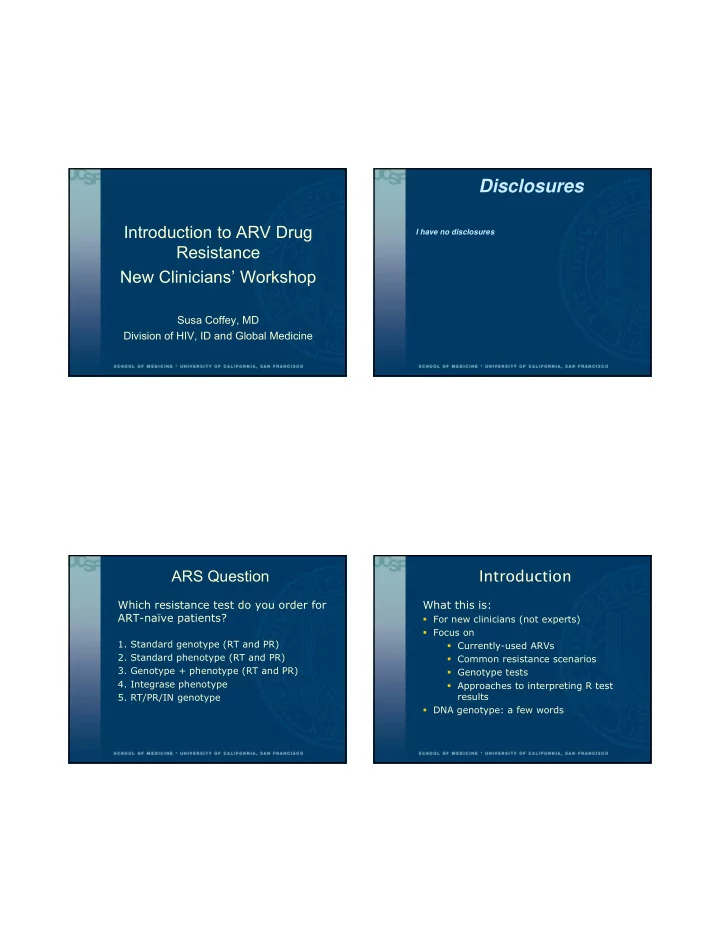
Introduction to ARV Drug Resistance New Clinicians’ Workshop

Susa Coffey, MD Division of HIV, ID and Global Medicine

Disclosures

I have no disclosures

ARS Question

Which resistance test do you order for ART-naïve patients?

  • 1. Standard genotype (RT and PR)
  • 2. Standard phenotype (RT and PR)
  • 3. Genotype + phenotype (RT and PR)
  • 4. Integrase phenotype
  • 5. RT/PR/IN genotype

Introduction

What this is:

  • For new clinicians (not experts)
  • Focus on
  • Currently-used ARVs
  • Common resistance scenarios
  • Genotype tests
  • Approaches to interpreting R test

results

  • DNA genotype: a few words
slide-2
SLIDE 2

12/6/2017 2

Mechanisms of HIV Drug Resistance

  • High rate of HIV replication- 109 virions per day
  • Many mutations and quasi species
  • RT: error-prone, no copyediting
  • In setting of drug pressure with viral replication,

selection of resistant viruses

  • <- Inadequate adherence to ART
  • <- Wrong ARVs (potency), wrong doses (drug levels),

drug-drug interactions, absorption issues, etc.

  • (Corollary: in absence of drug pressure, possible

“disappearance” of mutations [minority populations])

Bottom Line: Assume that once there, always there (archived)

Mechanisms of HIV Drug Resistance

  • Mutations may decrease susceptibility to ARVs,

and cause or contribute to virologic failure

  • (a few mutations may increase susceptibility)
  • Some may also decrease viral fitness
  • Some single mutations severely impact certain

ARVs; but often an accumulation of mutations may be required to significantly reduce virologic response, esp. with NRTIs and PIs

  • Some ARVs may retain residual activity (eg,

3TC/FTC)

  • Cross-resistance within an ARV class is common

When to do Resistance Test: DHHS Recommendations

  • Before ART, at first visit (as close to the time
  • f infection as possible)
  • Resistance mutations more likely to be detected earlier in

the course of HIV infection

  • GT: RT, PR; IN if concern for transmitted INI

resistance

  • Virologic failure – do on failing ARVs or shortly after

d/c (w/in 4 weeks)

  • GT for 1st or 2nd ART, add PT if “known or suspected

complex drug resistance pattern”

  • IN GT if virologic failure on INI
  • Suboptimal virologic response on ART
  • Pregnancy

DHHS Adult/ Adolescent ART Guidelines. July 2016.

Case: Transmitted Drug Resistance

  • 31 yo man with new diagnosis of HIV,

chronicity unknown (no previous HIV test)

  • CD4: 525, HIV RNA: 93,000 c/mL
  • GT: RT - M41L, K103N; PR – L63P
slide-3
SLIDE 3

12/6/2017 3 Prevalence of Transmitted HIV Drug Resistance in US, 2006-2009

Genotypic analysis of samples from newly diagnosed patients in CDC National HIV Surveillance System (N = 12,668)

Ocfemia MCB, et al. CROI 2012. Abstract 730. Menza TW et al, AIDS 2017.

All cases with sequences Cases classified as recent infections Cases classified as long-standing infections 4 Transmitted Drug Resistance Mutations (TDRMs) 1 or more 20 8 12 16 1-class 2-class 3-class NNRTI NRTI PI 15.6% 7.8 6.8 4.1

INSTI: case reports, but no significant transmitted resistance—0.2% in one study in N. Carolina

Transmitted HIV Drug Resistance in MSM, 2010-2012

Banez Ocfemia, XXIV HIV Drug Resistance Workshop, 2015.

Newly diagnosed MSM patients age ≥13 in CDC National HIV Surveillance System, 8 jurisdictions (N = 9,629)

Genotype Test

  • Standard GT examines RT and PR
  • For IN, must order special test
  • With GT, often possible to

predict/anticipate resistance depending on the specific mutations, but is not a direct measure of resistance

Genotype Test

  • A, alanine
  • C, cysteine
  • D, aspartate
  • E, glutamate
  • F, phenyalanine
  • G, glycine
  • H, histidine
  • I, isoleucine
  • K, lysine
  • L, leucine
  • M, methionine
  • N, asparagine
  • P, proline
  • Q, glutamine
  • R, arginine
  • S, serine
  • T, threonine
  • V, valine
  • W, tryptophan
  • Y, tyrosine

M184V

  • First letter: WT

amino acid

  • Number: codon

position

  • Second letter:

mutant amino acid

slide-4
SLIDE 4

12/6/2017 4

Phenotype Test

  • Measures inhibition of viral replication by

individual ARVs in vitro

  • IC50 = concentration of drug required to inhibit

viral replication by 50%

  • Compares patient virus IC50 to that of a

reference strain, -> fold-change in IC50 relative to the reference strain

FC = IC50 patient __ IC50 reference

Phenotype (with GT) Limitations of GT and PT

  • Conventional tests reliably detect

mutant virus that comprises about 20% of the circulating viral quasispecies

  • May miss minority populations
  • HIV RNA must be >500-1,000 c/mL
  • Do not assess interaction of ARVs

NRTI Resistance

  • A number of key mutations for 3TC/FTC,

TDF/TAF, ABC, + numerous others

  • Some single mutations severely impact

viral replication, but with others an accumulation of mutations usually required for high-level resistance

  • (More = worse)
  • Strategy:
  • Know key mutations (below)
  • Look up others
slide-5
SLIDE 5

12/6/2017 5

NRTI Resistance:

M184I/V

  • Selected by 3TC, FTC (sometimes ABC),

cause resistance to 3TC, FTC

  • Very common -- 3TC/FTC have low genetic

barrier to resistance

  • Cross resistance: decreases susceptibility to

ABC, ddI (especially if TAMs)

  • Increases susceptibility to TDF/TAF, AZT, d4T
  • Partially restores activity if TAMs present
  • Decreases viral fitness

NRTI Resistance: K65R

  • Selected by TDF/TAF, ABC, ddI
  • Causes resistance to TDF/TAF, all
  • ther NRTIs except AZT
  • Increases susceptibility to AZT
  • Decreases viral fitness

NRTI Resistance:

TAMs

Thymidine-associated mutations (TAMs)

  • Selected by AZT, d4T
  • Decrease susceptibility to AZT, d4T, TDF/TAF,

ABC; to all NRTIs if numerous

  • Cross resistance: increases with increasing

number of TAMs

  • (More = worse)
  • 2 pathways:
  • M41L, L210W, T215Y (more resistance; incl.

more impact on TDF)

  • D67N, K70R, T215F, K219Q/E

NRTI Resistance: L74V/I

  • Selected by ABC and ddI
  • (L74V sometimes selected by TDF)
  • Resistance to ABC and ddI
  • Increases susceptibility to TDF/TAF,

AZT

slide-6
SLIDE 6

12/6/2017 6

Case 1: PrEP Failure

  • 31 yo MSM on PrEP (TDF/FTC,

Truvada), presents to clinic after absence of 6 months, reports spotty adherence to Truvada. HIV Ab+, HIV RNA 65,000 c/mL.

  • HIV genotype: RT – K65R, M184V; PR –

WT.

Case 2: Audience Response

Which ART regimen would be most likely to be effective?

  • 1. Rilpivirine (RPV)/TAF/FTC (Odefsey)
  • 2. EVG/cobi/TAF/FTC (Genvoya)
  • 3. DTG/ABC/3TC (Tivicay)
  • 4. DRV/r + rilpivirine + TDF/FTC

RT – K65R, M184V PR – WT

Bottom Line: need 3 active ARVs, if possible (especially if ARVs have low genetic barrier to resistance).

NNRTI Resistance

  • Several single mutations confer high-

level resistance to certain NNRTIs; numerous others contribute to resistance

  • Low genetic barrier to resistance (except

etravirine)

  • Cross resistance is common
  • Strategy:
  • Know K103N, Y181///, E138K
  • Look up others
  • Be aware of mutation scoring system for

etravirine (ETR)

NNRTI Resistance: Important Mutations

  • K103N
  • Commonly selected by EFV
  • Emerges early in VF (low genetic barrier to resistance)
  • Resistance to EFV, NVP
  • By itself, does not decrease susceptibility to ETR, RPV
  • Y181I/V/C/F/G/S
  • Selected by NNRTIs
  • Cross resistance to all NNRTIs
  • E138K
  • Selected by RPV
  • Usually occurs with M184I or M184V; this enhances

resistance to RPV

  • Resistance to RPV, cross resistance to EFV, ETR
slide-7
SLIDE 7

12/6/2017 7

Case 2: NNRTI Resistance

  • 53 yo man with VF years ago on

EFV/TDF/FTC (Atripla), now on atazanavir/ritonavir + TDF/FTC; VL <40 c/mL x years. His friends take “one pill a day,” and he requests this.

  • Previous GT (while on EFV/TDF/FTC):

Case 2: NNRTI Resistance

  • Could we use rilpivirine (or etravirine) +

2 NRTIs as his next ART regimen?

  • K103N alone should not affect RPV or ETR
  • Issues:
  • Accuracy of GT?
  • Mutations may fade from view with time

and removal of selective drug pressure

  • GT captures strains that comprise >5-20% of

the circulating viruses

  • Once there, always there: “archived”

mutations

White, KL. Toronto 2013. Abs 87.

Bottom Line: caution in interpreting – consider what may be hidden from view

Case 3: 1st ART Failure

  • 35 yo woman on RPV/TAF/FTC (Odefsey).

HIV RNA suppressed x 2 years, then increases to >5,000 c/mL in setting of several months of OTC PPI use.

  • Genotype:
  • RT - K101E, E138K, Y181C, M184I
  • PR - no mutations

Case 3: Audience Response

Could you use etravirine (ETR) in her next regimen?

  • 1. Yes – should have full activity
  • 2. No – not effective after rilpivirine

failure

  • 3. I need more information

RT: K101E, E138K, Y181C, M184I PR: none

slide-8
SLIDE 8

12/6/2017 8

Etravirine Resistance

Mutation Weight Factor

Vingerhoets J, et al. AIDS. 2010;24:503-14. Tambuyzer et al JAIDS. 2011.

1.0 V90I A98G K101E/H 138G/K/Q 179D/T G190A 1.5 V106I E138A V179F G190S 2.5 L100I K101P Y181C M230L 3 Y181I Y181V Genotypic score %Responders (DUET trial) 0-2 74.4% 2.5-3.5 52% ≥4 38%

Response by ETR weight

Case: RT - K101E, E138K, Y181C, M184I

Bottom line: ETR may not be effective if ETR score >2.

Integrase Inhibitor Resistance

  • Raltegravir and elvitegravir have low-ish

barriers to resistance

  • Several possible mutation pathways
  • Different effects on dolutegravir
  • Dolutegravir primary resistance remains rare,

is not well understood

  • Order integrase genotype (not phenotype) =

special order

  • Important for predicting sensitivity to DTG

Low et al, Antimicrob Agents Chemother. 2009;53:4275-8

Integrase Inhibitor Resistance

  • Strategy:
  • Assume cross-resistance between RAL

and EVG

  • Recognize Q148/// (most damaging to

DTG)

  • Look up all others

Low et al, Antimicrob Agents Chemother. 2009;53:4275-8

Integrase Inhibitor Resistance

Low et al, Antimicrob Agents Chemother. 2009;53:4275-82. Kulkarni R et al, CROI 2013, Abs. 587.

Pathway/mutations Resistance

Raltegravir Q148H/K/R, G140S/A N155H, E92Q Y143R/H/C All INIs (for DTG, Q148 + at least one other) RAL, EVG RAL Elvitegravir E92Q Q148H/K/R, G140S/A T66I N155H, E92Q EVG, RAL, low level DTG All INIs (for DTG, Q148 + at least one other) EVG RAL, EVG

slide-9
SLIDE 9

12/6/2017 9

Integrase Inhibitor Resistance

Dolutegravir (DTG)

  • No significant reported de novo

mutations if used in 3-drug regimen for initial therapy

  • Various mutations if used as

monotherapy

  • Various mutations if used after RAL or

EVG

Case 4: INSTI Resistance

  • 50 yo man, on ATV/r/TDF/FTC for years,

switched to EVG/cobi/TDF/FTC (Stribild) to simplify his ART

  • VL remained <40 c/mL x 9 months, then

increased to 7,200 c/mL

  • GT (incl. integrase) done:

Case 4: INSTI Resistance

Will dolutegravir be potent in his salvage regimen?

  • 1. Yes, these elvitegravir mutations do not

affect DTG

  • 2. No, full cross resistance is likely
  • 3. Possibly, if we increase the dose of DTG to

50 mg BID

INI: G140S, Q148R

Nichols et al, Glasgow 2012, abstract O232

Dolutegravir Resistance

Bottom Line: if Q148 + 0 or 1 other mutation, DTG may be effective (with other active ARVs); use BID dosing

VIKING 3 Study

slide-10
SLIDE 10

12/6/2017 10

PI Resistance

  • Primary/Major mutations
  • Emerge first, decrease antiviral effect
  • Secondary/Minor mutations
  • Emerge later, increase fitness of strains with

primary mutations or further decrease antiviral effect

  • Specific primary and secondary PI mutations,

depending upon PI

  • **Accumulation of mutations usually required

for high-level resistance

  • Cross resistance is complex

PI Resistance

  • Strategy:
  • Be aware of (but don’t memorize) list of

DRV resistance-associated mutations

  • Look up all others

DRV Resistance-Associated Mutations (DRV-RAMs)

  • 11 mutations associated with resistance to

DRV:

  • V11I, V32I, L33F, I47V, I50V, I54L/M, T74P, L76V,

I84V, L89V

  • Once-daily dosing possible if no DRV-RAMS

(ODIN study)

  • BID dosing recommended if ≥1 DRV-RAM
  • DRV response diminished with ≥3 DRV-RAMs

De Meyer et al, AIDS Res Hum Retroviruses. 2008;24:379-388 Cahn et al, AIDS. 2011;25:929-39

Case 5: PI (and other) Resistance

  • 48 yo man, reports that he has been on

“everything” in the past (except INSTIs), sometimes with poor adherence.

  • Historic genotype(s):
  • RT -- M41L, D67N, L210W, T215Y; V106I, Y181V
  • PR -- L10I, L33F, M36I/M, M46L, I54V, L63S,

I64V, V82A

  • 3-class resistance:
  • 4 NRTI mutations (all TAMs)
  • 2 NNRTI mutations
  • 8 PI mutations (any DRV RAMs?)
slide-11
SLIDE 11

12/6/2017 11

Case 4: Apply strategies (2)

Approaching this: be methodical, apply strategies

Assess NRTI resistance:

  • 4 TAMS – affects TDF/TAF, ABC
  • Anything missing?
  • No M184 V/I – why???

Assess NNRTI resistance:

  • 2 NNRTI mutations (incl. Y181)
  • ETR score:
  • 4.5

Case: RT -- M41L, D67N, 210W, T215Y; V106I, Y181V PR -- L10I, L33F, M36I/ M, M46L, I54V, L63S, I64V, V82A 1.0 V90I A98G K101E/ H 138G/K/ Q 179D/T G190A 1.5 V106I E138A V179F G190S 2.5 L100I K101P Y181C M230L 3 Y181I Y181V

PI Resistance

  • Assess PI resistance:
  • Check for DRV resistance-mutations
  • One DRV-RAM: L33F -> DRV/r likely to be

effective but should be given BID

  • Look up all other mutations

Case: RT -- M41L, D67N, L210W, T215Y; V106I, Y181V PR -- L10I, L33F, M36I/ M, M46L, I54V, L63S, I64V, V82A

V11I, V32I, L33F, I47V, I50V, I54L/M, T74P, L76V, I84V, L89V

“Look up other mutations”

Stanford HIV Drug Resistance Database http://hivdb.stanford.edu

Case: RT -- M41L, D67N, 210W, T215Y; V106I, Y181V PR -- L10I, M36I/ M, M46L, I54V, L63S, I64V, V82A

Conclusion: likely resistance to all PIs except DRV – use BID DRV

Case 4, continued

Summary:

3-class resistance:

  • 4 NRTI mutations (TAMs): M41L, D67N,

210W, T215Y

  • cross resistance to TDF, ABC
  • No M184V/I but we will assume it is there
  • 3TC/FTC resistance
  • 2 NNRTI mutations: V106I, Y181V
  • likely resistance to ETR
  • 8 PI mutations (1 DRV RAM)
  • Naïve to INI

What ARVs should we use in the next regimen?

slide-12
SLIDE 12

12/6/2017 12

What ARVs should we use in the next regimen?

  • Integrase inhibitor (DTG or RAL)?
  • Darunavir/r?
  • NNRTI?
  • NRTIs?
  • CCR5 antagonist?

DNA Genotype

Background:

  • Standard resistance test requires

plasma HIV RNA of >500-1,000 c/mL

  • Many patients currently on ART with

VL <40 may have resistance from previous regimens but have no available resistance tests to guide ART changes (eg, simplification)

  • Can we do resistance testing on

archived HIV?

DNA Genotype

DNA genotype test:

  • Amplifies cell-associated HIV-1 proviral

DNA from infected cells (PBMCs)

  • Whole blood samples
  • Analyzes HIV-1 polymerase region by

new generation sequencing technology

Case 6

55 yo man HIV+ 1993, on ART x years Previous ART history unclear – remembers AZT, D4T, 3TC, ABC, DDI, EFV, NVP, IDV, SQV, LVP-r Transferred to this clinic on ATV-r + AZT + TDF/FTC, HIV RNA = ND Changed to ATV-r + RAL + TDF/FTC x 5 years, HIV RNA = ND DNA GT 2016:

  • RT: M184V, K103K/N
  • IN: None
  • PR: L90L/M

Changed to EVG/cobi/TAF/FTC + DRV

slide-13
SLIDE 13

12/6/2017 13

DNA Genotyping – How Accurate?

Toma J. ICAAC. 2015

DNA Genotype

Bottom Line: no clinical data; be cautious re negative results.

Summary

  • Resistance tests at time of diagnosis and if

virologic failure + suspected resistance (usually GT)

  • Resistance: once there always there (archived)
  • Beware of what you don’t see (minority

populations)

  • Look at old resistance reports, treatment

history

  • Read resistance reports methodically
  • **Seek expert advice**
  • Goal of treatment: suppressed HIV RNA for all

Resources

  • Stanford HIV Drug Resistance Database
  • http://hivdb.stanford.edu
  • IAS-USA HIV Drug Resistance Mutations

Figures and User Notes

  • https://www.iasusa.org
  • Clinician Consultation Center
  • (800) 933-3413

Monday – Friday, 9 a.m. – 8 p.m. EST (Free!)