Disclosures Nodal Management in Nothing to disclose Differentiated - - PDF document

disclosures nodal management in
SMART_READER_LITE
LIVE PREVIEW

Disclosures Nodal Management in Nothing to disclose Differentiated - - PDF document

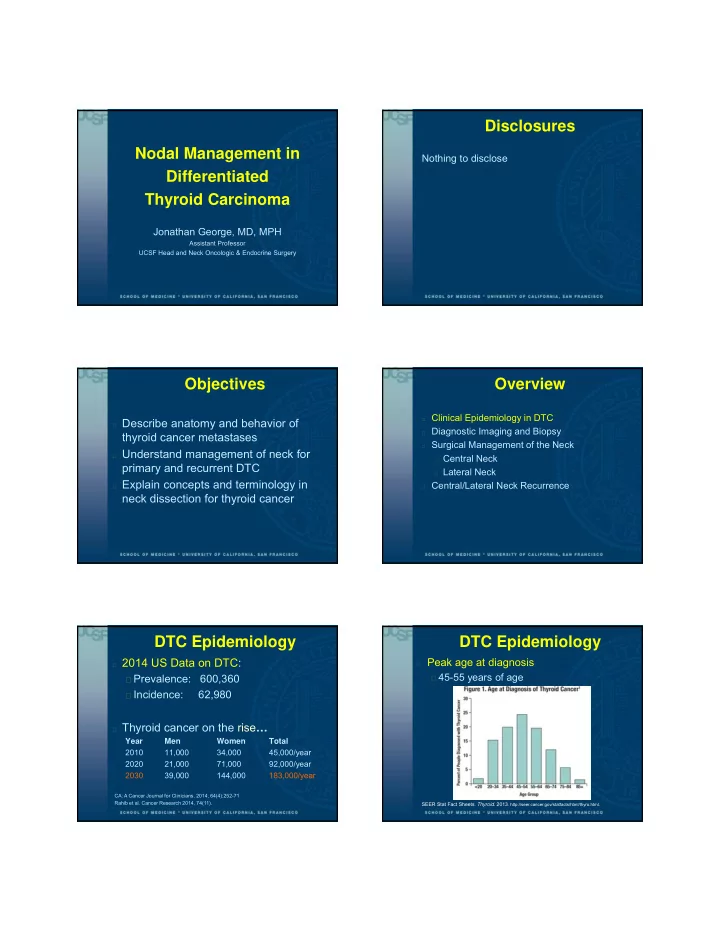
Disclosures Nodal Management in Nothing to disclose Differentiated Thyroid Carcinoma Jonathan George, MD, MPH Assistant Professor UCSF Head and Neck Oncologic & Endocrine Surgery Objectives Overview Clinical Epidemiology in DTC


slide-1
SLIDE 1

Nodal Management in Differentiated Thyroid Carcinoma

Jonathan George, MD, MPH

Assistant Professor UCSF Head and Neck Oncologic & Endocrine Surgery

Disclosures

Nothing to disclose

Describe anatomy and behavior of

thyroid cancer metastases

Understand management of neck for

primary and recurrent DTC

Explain concepts and terminology in

neck dissection for thyroid cancer

Objectives Overview

Clinical Epidemiology in DTC Diagnostic Imaging and Biopsy Surgical Management of the Neck Central Neck Lateral Neck Central/Lateral Neck Recurrence

2014 US Data on DTC:

Prevalence: 600,360 Incidence: 62,980

Thyroid cancer on the rise…

Year Men Women Total 2010 11,000 34,000 45,000/year 2020 21,000 71,000 92,000/year 2030 39,000 144,000 183,000/year

DTC Epidemiology

CA: A Cancer Journal for Clinicians. 2014, 64(4):252-71 Rahib et al. Cancer Research 2014, 74(11). Peak age at diagnosis

45-55 years of age

DTC Epidemiology

SEER Stat Fact Sheets. Thyroid. 2013. http://seer.cancer.gov/statfacts/html/thyro.html.

slide-2
SLIDE 2

DTC Epidemiology

American Cancer Society. Thyroid cancer. 2013.

http://www.cancer.org/acs/groups/cid/documents/webcontent/003144-pdf

Incidence

M F 1975: 3.1 6.4 2010: 7.6 21.5

Mortality

2013 810 1040

DTC Epidemiology

Grogan RH, et al. AAES 34th Annual Meeting, 2013.

5 year Survival

97.7% Recurrence remains a problem

 up to 40%

Mortality

Patients with recurrence  higher mortality

30 year FU (N=2883): Recurrence 30% Mortality 9%

DTC Epidemiology

Ahn HS et al. Korea’s Thyroid Cancer “Epidemic” – Screening and Overdiagnosis. NEJM 371(19), Nov 6 2014.

Increasing worldwide…

15-fold increase in Korea

DTC Epidemiology

Ahn HS et al. Korea’s Thyroid Cancer “Epidemic” – Screening and Overdiagnosis. NEJM 371(19), Nov 6 2014.

…but so is screening

Jury is still out

Risk Group Stratification in DTC

Low risk

Good disease control Good survival

Intermediate risk

Moderate disease control Reasonable survival

High risk

Poor disease control Poor survival

Revised American Thyroid Association Management Guidelines for Patients with Thyroid Nodules and Differentiated Thyroid Cancer. Thyroid. 2009.

Risk Group Stratification in DTC

Intermediate risk

Microscopic extrathyroidal

extension

Lymph node metastasis Aggressive histology Vascular invasion

Revised American Thyroid Association Management Guidelines for Patients with Thyroid Nodules and Differentiated Thyroid Cancer. Thyroid. 2009.

slide-3
SLIDE 3

Regional Nodal Staging of DTC

Nx Regional lymph nodes cannot be assessed N0 No regional lymph node metastasis N1 Regional lymph node metastasis N1a Metastasis to level VI (pretracheal, paratracheal and prelaryngeal/Delphian lymph nodes) N1b Metastasis to unilateral, bilateral or contralateral cervical

  • r superior mediastinal lymph nodes

AJCC Staging in DTC

>45 years

Stage T N M I T1 N0 M0 II T2 N0 M0 III T3 N0 M0 T1-3 N1a M0 IVA T1-3 N1b M0 T4a all N M0 IVB T4b all N M0 IVB all T all N M1

Risk Group Stratification in DTC

Risk of Recurrence Based on Nodal Status

at Presentation

Clinical N0

Range 0-9%, Mean 4%

Clinical N0, Pathologic N1 by Elective ND

Range 4-11.5%, Mean 6%

Clinical N1, Pathologic N1 (clinically apparent)

Range 10-42%, Men 22% Cranshaw, Surg Oncol 2008; Bardet, Eur J Endo 2008; So, Surgery 2010; Wada, Ann Surg 2003.

20-year DSS Age Group N0 N1

<45 yrs 94% 100%* >45 yrs 90% 79%

p = 0.06

Hughes et al. 1996

Lymph Node Metastasis and Survival in DTC

Thyroid Lymphatics

Considerations

Cross-communication of intraglandular lymphatics Extensive bilateral drainage High incidence of regional metastasis Multiple nodal groups at risk Lymphatic channels parallel venous drainage

Regional Lymphatic Metastatic Routes

  • Inferior
  • RLN nodes, paratracheal nodes

 anterior superior mediastinum

  • Superior
  • Prelaryngeal, pretracheal,

paraglandular nodes  low/mid/upper jugular nodes

  • Lateral
  • lower and midjugular nodes 

transverse cervical nodes

  • Posterior
  • RLN, paratracheal 

retropharyngeal, retroesophageal nodes

slide-4
SLIDE 4

Overview

Clinical Epidemiology in DTC Diagnostic Imaging and Biopsy Surgical Management of the Neck Central Neck Lateral Neck Central/Lateral Neck Recurrence Modalities

Ultrasound

Thyroid Central Neck Lateral Neck

Imaging Evaluation

ATA Guidelines 2009

  • R21. Pre-op neck US for all patients

undergoing surgery for a malignant FNA result to stage neck disease. B

Cooper et al. Thyroid 2009.

Moreno et al, Thyroid 2012.

Negative findings predict excellent

long-term regional control and survival

Modalities

Ultrasound

Thyroid Central Neck Lateral Neck

Imaging Evaluation

Modalities

Ultrasound Other

MRI CT Iodine scanning PET/CT

Imaging Evaluation

Modalities

Ultrasound Other

MRI CT Iodine scanning PET/CT

Imaging Evaluation

ATA Guidelines 2009

  • R22. Routine preoperative use of
  • ther imaging studies is not
  • recommended. E

Cooper et al. Thyroid 2009. Modalities

Ultrasound Other

MRI CT Iodine scanning PET/CT

Imaging Evaluation

However… US and CT have improved sensitivity and comparable specificity for nodal disease in thyroid cancer patients than either exam alone.

Kim E. Thyroid 2008.

slide-5
SLIDE 5

Modalities

Ultrasound Other

MRI CT Iodine scanning PET/CT

Imaging Evaluation

CT or MRI

Lymph node metastasis Recurrent disease Vocal cord paralysis Fixation of mass Aerodigestive tract symptoms Modalities

Ultrasound Other

MRI CT Iodine scanning PET/CT

Imaging Evaluation

PET/CT

No role in initial diagnosis of

DTC (incidentalomas only)

Low NPV, sensitivity,

specificity in DTC

Limited role in surveillance Deitlin 1997, Jadvar 1998, Feine 1998, Altenvoerde 1998, Chung 1999, Alnafasi 2000

Nodal Evaluation with FNA

  • US guidance

Reduces non-diagnostic rate

  • Diagnosis of papillary cancer is 99% accurate
  • Use to formulate or change surgical plan

Positive neck FNA Negative neck FNA

  • Caveats:

False negative rate = 1-6%

Overview

Clinical Epidemiology in DTC Diagnostic Imaging and Biopsy Surgical Management of the Neck Central Neck Lateral Neck Central/Lateral Neck Recurrence

Anatomy

  • Levels VI and VII
  • A paramedian bilateral

compartment

  • Defined:

Carotid to carotid Cricoid to innominate Contains

lymphovascular tissue, fat, thymus, parathyroid glands

Central Neck

Anatomy

  • Levels VI and VII
  • A paramedian bilateral

compartment

  • Lymph Node

Components

Pre-cricoid laryngeal

(Delphian)

Paratracheal Retropharyngeal Retroesophageal Pretracheal

Central Neck

slide-6
SLIDE 6

Central Neck Metastasis

  • Mean prevalence in

DTC ~ 60%

  • Independent risk factor

for local recurrence

  • Recurrence rates high

for macroscopic (10- 30%) but not microscopic LN disease

Central Neck

Bardet et al 2008

ATA Consensus Summary

  • Therapeutic CND implies that

nodal metastasis is apparent clinically (preop or intraop) or by imaging (clinically N1a)

R27a: Therapeutic CND for

patients with clinically involved central or lateral neck nodes should accompany total thyroidectomy. B

Central Neck

DL Steward. ATA Surgery Working Group. Thyroid. 2009.

ATA Consensus Summary

  • Prophylactic (Elective) CND

implies nodal metastasis is not detected clinically or by imaging (clinically N0).

R27b: Prophylactic CND (ipsi

  • r bilateral) may be

performed in patients with PTC with clinically uninvolved central neck LNs for advanced tumors (T3/T4) C

Central Neck

DL Steward. ATA Surgery Working Group. Thyroid. 2009.

ATA Consensus Summary

  • Prophylactic (Elective) CND

implies nodal metastasis is not detected clinically or by imaging (clinically N0).

R27c: Near-total or total

thyroidectomy without prophylactic CND may be appropriate for small (T1/T2), non-invasive, clinically node- negative PTCs and most follicular cancer. C

Central Neck

DL Steward. ATA Surgery Working Group. Thyroid. 2009.

ATA Consensus Summary

  • Oncologic Goals in CND

Clear all macro- and

microscopic disease in the central neck

Provide accurate

postoperative staging that may guide treatment and surveillance

Upstages 30-50% of pts

>45 yrs

Central Neck

Hughes et al. Surgery 2010.

ATA Consensus Summary

“’Berry picking’ implies removal

  • nly of the clinically involved

LNs rather than a complete nodal group within the compartment and is not recommended.”

 Comprehensive

Compartmental Dissection

Central Neck

DL Steward. ATA Surgery Working Group. Thyroid. 2009.

slide-7
SLIDE 7

Advanced thyroid primary: T3 or T4a Advanced age Node positivity

cN+, US+, USGFNA+

Advanced histologies

Hurthle cell, Insular, cytopath “features c/w poorly

differentiated carcinoma” (“spindle cells”)

Anaplastic (IVA) Medullary carcinoma

Therapeutic Central Neck Dissection

Indications

Right Central Neck Left Central Neck

High incidence of regional lymphatic spread in

PTC

Level VI metastasis  local recurrence 

higher mortality

CND decreases Tg levels and increases % of

patients with undetectable Tg

Safe procedure in experienced hands

Routine CND

Arguments in Favor

Scheumann 1994, Hughes 1996, Loh 1997, Noguchi 1998, Hay 1999, Sugitani 2004, Lundgren 2006, Doherty 2007

Increased risk Conflicting recurrence & survival data LN metastases are not a factor in MACIS or

AMES staging systems

Elective CND morbidity correlates with

surgeon experience and extent of dissection

Most thyroid surgery not done by high-

volume surgeons

Routine CND

Arguments Against

Overview

Clinical Epidemiology in DTC Diagnostic Imaging and Biopsy Surgical Management of the Neck Central Neck Lateral Neck Central/Lateral Neck Recurrence

slide-8
SLIDE 8

Lateral Neck Metastasis in DTC

ATA Guidelines 2009

  • R28. Therapeutic lateral neck dissection should be

performed for patients with biopsy proven metastatic lateral cervical lymphadenopathy. B

ATA Consensus Review of the Anatomy, Terminology, and Rationale for Lateral Neck Dissection in Differentiated Thyroid Cancers. Thyroid 2012;22(5): 501-8.

Lateral Neck Metastasis in DTC

ATA Guidelines 2009

  • R28. Therapeutic lateral neck dissection should be

performed for patients with biopsy proven metastatic lateral cervical lymphadenopathy. B

Selective neck dissection of levels IIA, III, IV, and VB Routine prophylactic lateral neck dissection not proven

to improve survival

ATA Consensus Review of the Anatomy, Terminology, and Rationale for Lateral Neck Dissection in Differentiated Thyroid Cancers. Thyroid 2012;22(5): 501-8.

Lateral Neck Metastasis in DTC

ATA Guidelines 2009

Biopsy any highly suspicious lymph node in the

lateral neck without regard to size

Comprehensive compartment-oriented neck

dissection

Revision cases: Focus upon levels of

demonstrable recurrence appropriate for lateral neck

Assumes prior LND ATA Consensus Review of the Anatomy, Terminology, and Rationale for Lateral Neck Dissection in Differentiated Thyroid Cancers. Thyroid 2012;22(5): 501-8.

Lateral Neck Metastasis in DTC

Types of Neck Dissection

Selective

Lateral

II, III, IV

Anterior

VI

Comprehensive

II, III, IV, V, VI

Mediastinal

VII

Lateral Neck Metastasis in DTC

Initial Management: Lateral Neck cN+ patient

  • Prove Disease: USgFNA Bx
  • Stage neck: US and MRI
  • Total thyroidectomy with ipsilateral CND + LND
  • Postoperative RAI
  • T4 suppression therapy

Lateral Neck Metastasis in DTC

Management

slide-9
SLIDE 9

Follow-Up Management: Lateral Neck cN+ patient

  • Follow TG levels
  • Surveillance iodine scan
  • Surveillance neck US
  • Suspicious Nodes USgFNA
  • PET for non-iodine avid (I131 -), Tg rising patients
  • Lymphadenectomy for FNA+ disease

Lateral Neck Metastasis in DTC

Management

  • Infection (<1%)
  • Bleeding
  • Chyle leakage
  • Frozen shoulder syndrome
  • Vascular injury
  • Damage to major nervous structures

Hypoglossal, Vagus, Phrenic, Brachial plexus

  • Damage to cervical sensory and greater auricular

nerves

Lateral Neck Metastasis in DTC

Surgical Risks

Hospital

PT (shoulder exercises): Routine post-ND Calcium replacement or supplementation? Treatment of hypothyroidism

Endocrinology Referral

RAI: Post-operative scanning +/- therapy Serum Tg monitoring (with Tg Abs) TSH supression therapy: T3/T4

Surveillance US

Thyroid bed, central + bilateral necks

Lateral Neck Metastasis in DTC

Therapy After Surgery

Overview

Clinical Epidemiology in DTC Diagnostic Imaging and Biopsy Surgical Management of the Neck Central Neck Lateral Neck Central/Lateral Neck Recurrence

Avoiding Central Neck Recurrence

Management Tips

Preoperative Imaging

US; CT or MRI if cN+

Complete thyroidectomy

Leave no gross disease (R0-R1) Leave minimal residual thyroid tissue

Carefully examine the paratracheal bed

Do this in every case Therapeutic CND if nodes are detected

Nerve injury

Failure to locate and remove disease Hypocalcemia

Risk: 0-30% Permanent more common in reoperation Avoid superior parathyroid Parathyroid autotransplantation

Central Neck Recurrence in DTC

Pitfalls of Reoperation

slide-10
SLIDE 10

Palpable neck mass Elevated Tg Surveillance Imaging

US I131 scan PET/CT scan MRI FNA Confirmation

Lateral Neck Metastasis in DTC

Detection of Recurrence

Systematic Preoperative Nodal Evaluation

US with USgFNA Cross-sectional imaging to optimize surgical planning and

identify metastatic disease in unusual locations

Comprehensive Surgical Dissection Post-operative Therapy Re-operation ND

Summary

Systematic Preoperative Nodal Evaluation Comprehensive Surgical Dissection

Primary or recurrent DTC metastatic to neck Levels IIA-VB CND for N1a+, N1b+, high risk cN0

Post-operative Therapy Re-operation ND

Summary

Systematic Preoperative Nodal Evaluation Comprehensive Surgical Dissection Post-operative Therapy

PT, LT4, Calcium, RAI, Surveillance imaging

Re-operation ND

Summary

Systematic Preoperative Nodal Evaluation Comprehensive Surgical Dissection Post-operative Therapy Re-operation ND

Focused re-dissection

Summary