Mesh & Nodal One equation per node Analysis Solve for node - - PowerPoint PPT Presentation

mesh nodal
SMART_READER_LITE
LIVE PREVIEW

Mesh & Nodal One equation per node Analysis Solve for node - - PowerPoint PPT Presentation

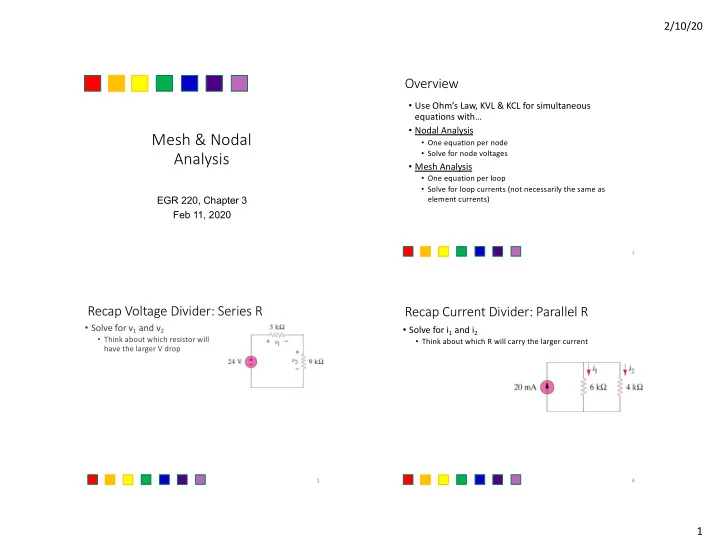
2/10/20 Overview Use Ohms Law, KVL & KCL for simultaneous equations with Nodal Analysis Mesh & Nodal One equation per node Analysis Solve for node voltages Mesh Analysis One equation per loop Solve for


slide-1
SLIDE 1

2/10/20 1

Mesh & Nodal Analysis

EGR 220, Chapter 3 Feb 11, 2020

Overview

  • Use Ohm’s Law, KVL & KCL for simultaneous

equations with…

  • Nodal Analysis
  • One equation per node
  • Solve for node voltages
  • Mesh Analysis
  • One equation per loop
  • Solve for loop currents (not necessarily the same as

element currents)

2

Recap Voltage Divider: Series R

  • Solve for v1 and v2
  • Think about which resistor will

have the larger V drop

3

Recap Current Divider: Parallel R

  • Solve for i1 and i2
  • Think about which R will carry the larger current

4

slide-2
SLIDE 2

2/10/20 2

Write Expressions for I, using Ohm’s Law & “Vdrop ”

5

Write Expressions for I, using Ohm’s Law & “Vdrop ”

6

Nodal Analysis

  • Apply Kirchhoff’s current law to solve for nodal

voltages

1) Label diagram (nodes, all directions)

  • Initial labeling is arbitrary but must be consistent!

2) Obtain equations using KCL and substituting in Ohm’s law 3) Solve equations for nodal voltages

  • Substitutions, linear algebra (matrices), Matlab
  • Note, negative answers indicate polarity is opposite your initial

assumptions and are not incorrect

  • Solution often requires iteration, as first attempt may

not work.

9

Nodal Analysis

  • How do we find v1, v2 and power dissipated in the

resistors?

10

slide-3
SLIDE 3

2/10/20 3

11 12

Concept Check: Voltage Across

  • v1, v2 are voltage values relative to what?
  • What is the voltage across the 4Ω resistor?

13

Mesh Analysis

  • Apply Kirchhoff’s voltage law to solve for loop

(mesh) currents

  • Other law(s), expression(s) to use?
  • Process?

1) 2) 3)

14

slide-4
SLIDE 4

2/10/20 4

Mesh Analysis Warmup

  • How do we find (and label) i through R3?
  • Mesh currents versus element currents (linearity for

resistor behavior; superposition of sources)

15

Mesh Analysis Warmup

If we draw loop currents to be opposing through R3...

16

Mesh Analysis

  • How do we find I1, I2,

I3 and I?

  • Set up equations
  • (be able to write

equations in matrix format)

17

I

Mesh Analysis

  • Write equations for I1, I2, I3 and I

18

I

slide-5
SLIDE 5

2/10/20 5

Use Matlab to solve…

19

>> R = [7 2 1; 2 12 0; 1 0 6] R = 7 2 1 2 12 0 1 0 6 >> V = [8; 6; 2] V = 8 6 2 >> I = inv(R) * V I = 1.0256 0.3291 0.1624

I

Practice Circuit Analysis 1

  • Find all currents and voltages

20

  • Find all currents and voltages

21

Discussion Circuit Analysis

  • How can you find the voltages indicated?

22

  • Compare ability to use

nodal analysis vs. mesh analysis.

slide-6
SLIDE 6

2/10/20 6

  • How to find the voltages indicated?

23

Practice Circuit Analysis 2

  • Find all currents and voltages

24

v2 v1 v3

  • Find all currents and voltages

25

v2 v1 v3

Practice Analysis

26

slide-7
SLIDE 7

2/10/20 7

Practice Analysis

27

Practice Analysis (posted)

  • How would we apply the tools learned so far?
  • KCL à Nodal analysis
  • KVL à Mesh analysis
  • Current or voltage divider with Req?

Practice Analysis Analysis Tools

  • Ohm’s law
  • KVL: Kirchhoff’s voltage law
  • KCL: Kirchhoff’s current law
  • Equivalent resistance
  • Current divider
  • Voltage divider
  • Mesh analysis
  • Nodal analysis

à Exam 1 Through Mesh & Nodal ß

  • Next core theorem: Thevenin Equivalent Circuit

30

slide-8
SLIDE 8

2/10/20 8

Important Notes

  • Read the text book!
  • We have limited in-class time
  • Check out the applets link
  • on webpage from the first week of class
  • Homework
  • show and develop clear thinking
  • learn from the homework

31

Lab 3: Linearity

32

4 2

Lab 3: Superposition

33

Lab 3 Preview

  • Design your own lab – to verify Superposition and

Linearity in circuits

  • Read the chapter to begin learning these analysis

methods

  • Use simple circuits from the chapter to get ideas for

your circuits, to build and test in the lab

  • Pre-lab – design your lab experiment
  • Design it for 1 ¾ hour, allow time for mistakes and learning

as you go, in our 2 ½ hour lab time.

34

slide-9
SLIDE 9

2/10/20 9

Lab 2 Experiments – Find RMultimeter

35

R = 10MΩ

Lab 2 Experiments – Find RMultimeter

36

R = 10kΩ