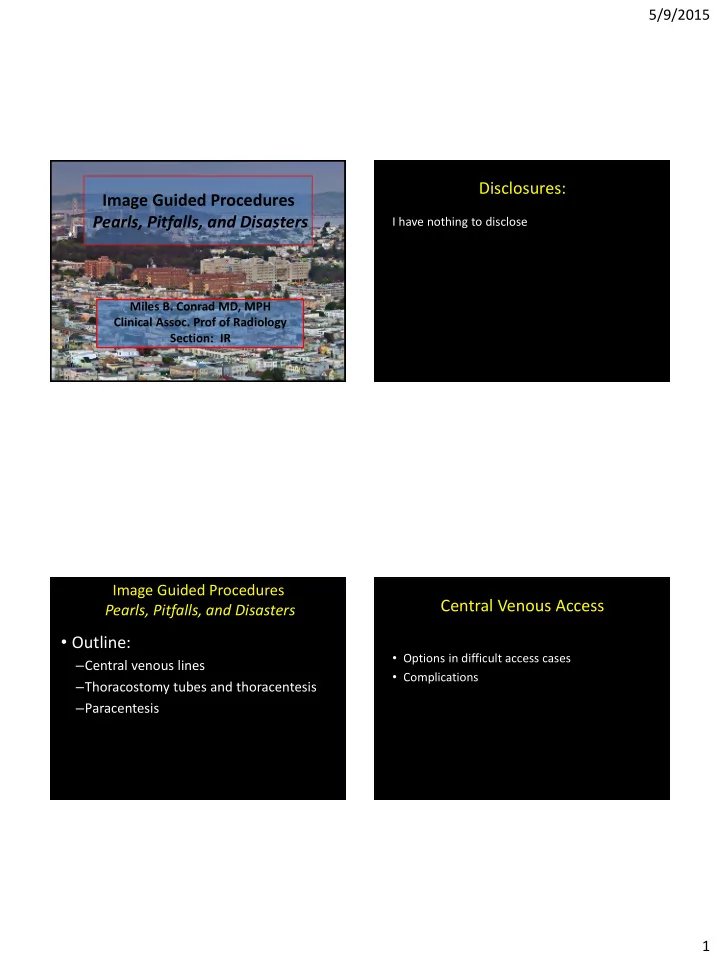
Disclosures: Image Guided Procedures Pearls, Pitfalls, and - - PDF document

disclosures image guided procedures pearls pitfalls and
SMART_READER_LITE
LIVE PREVIEW

Disclosures: Image Guided Procedures Pearls, Pitfalls, and - - PDF document

5/9/2015 Disclosures: Image Guided Procedures Pearls, Pitfalls, and Disasters I have nothing to disclose Miles B. Conrad MD, MPH Clinical Assoc. Prof of Radiology Section: IR Image Guided Procedures Central Venous Access Pearls, Pitfalls,


slide-1
SLIDE 1

5/9/2015 1

Image Guided Procedures Pearls, Pitfalls, and Disasters

Miles B. Conrad MD, MPH Clinical Assoc. Prof of Radiology Section: IR

Disclosures:

I have nothing to disclose

Image Guided Procedures Pearls, Pitfalls, and Disasters

  • Outline:

–Central venous lines –Thoracostomy tubes and thoracentesis –Paracentesis

Central Venous Access

  • Options in difficult access cases
  • Complications
slide-2
SLIDE 2

5/9/2015 2

IJ Access

  • Standard IR practice

– Seems to be safer than subclav for short term access – Long term subclavian access inc rates of subclav. stenosis – Very low chance of ptx in experienced hands

*Crit Care Med. 2002 Feb;30(2):454-60

Subclavian Access

Ultrasound is almost never used…but it works well!!

Indications

  • Thrombosed/occluded IJ’s
  • Prior CV catheters
  • IVDU
  • Neck infections
  • Tracheostomy tubes
  • C collars

Contraindications

  • Ax node dissections
  • Fistulas
  • DVT
  • Long standing catheter need

US Subclavian Access

Infraclavicular view of the Subclavian V. and A

A V

Infraclavicular Subclavian Access

slide-3
SLIDE 3

5/9/2015 3

Infraclavicular Subclavian Access Supraclavicular Subclavian Access

When attempting this, needle tip localization is of paramount importance!

Supraclavicular Subclavian Access

Why?

  • If you can identify subclavian v. better than

with infraclav view

  • Tiny subclavian v.
  • Thrombosed IJ’s

Needle tip localization is key...or this is dangerous

Supraclavicular Subclavian Access

slide-4
SLIDE 4

5/9/2015 4 78 yo F w/ ESRD, failed upper extrem grafts, R pacemaker

Supraclavicular view of R subclav. V.

Supraclav subclav HD cath

IJ’s are out

Be aware of the warning signs of SVC syndrome… Chest wall collaterals portend a difficult access

slide-5
SLIDE 5

5/9/2015 5

Catheter in azygous Catheter in azygous

  • The azygous will reverse

flow and enlarge in infraazygous SVC

  • cclusion

– Very common in pts with chronic catheter pts and dialysis fistulas

slide-6
SLIDE 6

5/9/2015 6

Complications

  • Dilator injuries
  • Malpositioned lines
  • Air embolus
  • Arterial puncture
  • Ptx
  • Loss of wire
  • Infection

Kink, BC vein puncture

Malpositioned line

Catheter in Ao or L SVC?

Earlier CT

Dublicated SVC: 0.3-.5%

slide-7
SLIDE 7

5/9/2015 7

RV

Seen incidentally in up to 50% pts on CT and is usually of no significance This may be a morbid/lethal issue in cardiopulmonary dz or those with R-L shunts

Air Embolus Inadvertent Arterial Line

Jumper s/p R subclav cordis placement

slide-8
SLIDE 8

5/9/2015 8

R Vertebral artery Cordis tip R CCA

These get filled with thrombus

54 yo F s/p L chest wall resection

slide-9
SLIDE 9

5/9/2015 9 Pseudoaneurysm and Brachial a. Embolus

Subclavian Covered Stent s/p attempted R IJ placement

slide-10
SLIDE 10

5/9/2015 10 Presumed alveolar-pleural fistula w/ air leak

Lung re-expanded on LCWS

Likely tear injury to pleura

Consider decreasing negative pressure until lung is up on waterseal

55 yo M w/ sepsis, s/p R IJ line

RIJ cath still around line Wires are usually pushed in due to failure to hold the wire while advancing the dilator or catheter

slide-11
SLIDE 11

5/9/2015 11

Loss of wire Wire retrieval from groin

Alternate IV site: Deep Brachial/Basilic Puncture

Basilic v. Brachial v. Brachial a. . Median n.

The solution for IV access in skin poppers

Traditional angiocaths are too short!

slide-12
SLIDE 12

5/9/2015 12

Pleural Drainage

  • Thoracostomy tubes/Thoracentesis

– Empyema – Efficacy of fibrinolysis of infected pleural effusions

  • tPA and DNAse
  • Bleeding associated with tPA

– Transcostal access techniques

  • Complications

– Malpositioned tubes – Bleeding

Thoracostomy Tubes:

Small bore (6-F to 16-F) Pigtail Catheter Large bore (18-F to 28-F) Thalquick Catheter

Lung abscess: Avoid this! Pleural fluid

CT Underrepresents Septations

Likely will need fibrinolysis…

slide-13
SLIDE 13

5/9/2015 13

NEJM 2011;365:518-26

MIST II Double Blind Trial

  • 10 mg TPA alone
  • 5 mg DNAse alone
  • DNAse + TPA
  • Saline alone
  • Bid tx x 3 days
  • Clamped x 1 hr
  • -17+/- 24.3 (p=0.55)
  • -14.7 +/- 16.3 (p= 0.14)
  • -29.5 +/- 23.3 (p=0.005)
  • -17.2 +/- 19.6

%Δ in pleural opacity from Day 1 to 7 on CXR

SFGH experience: 5% of patients develop severe chest pain and some required elevated level of care

tPA = bad idea

28 yo M s/p GSW to lung s/p wedge resection w/ adjacent hematoma

Massive Hemoptysis

53 yo F w/ ovarian CA

Intercostal artery injury and abdominal chest tube

slide-14
SLIDE 14

5/9/2015 14

Intercostal artery embo

There are many arteries to contend with

Moore E. STR 2004

Walking over a rib does not prevent all bleeding

Supracostal artery

US guided chest tubes require 3 pt. confirmation to avoid abdomen

Wire Liver

  • 1. Visualize needle in fluid
  • 2. Visualize wire in pleura
  • 3. Visualize pigtail in fluid

18 yo M s/p MCA

slide-15
SLIDE 15

5/9/2015 15

Posterior tube Tube in fissure

Tube is clogged

Blind midaxillary line pigtails

  • ften often don’t go to the

anterior apex

Tube Malposition: Delay in Resolution of Ptx

Spontaneous Ptx

slide-16
SLIDE 16

5/9/2015 16

Avoid This:

Case courtesy of Vishal Kumar, MD… he did not do this

Paracentesis

  • Complications:

– Inadvertent puncture of vessel, organ, bowel – Infection: aseptic technique – Post Paracentesis Circulatory Dysfunction (PCD)

Caput Medusa Abdominal wall varices

slide-17
SLIDE 17

5/9/2015 17

Arterial Injury s/p Paracentesis

41 yo M w/ hypotension, 3 pressors, tachy s/p paracentesis, severe pulm HTN, codes if supine or < 45 degrees

Heme Jet

slide-18
SLIDE 18

5/9/2015 18

Vs. ?

Conclusions

  • Lines:

– Alternative line access sites only when very comfortable with seeing needle tip with US – Be weary of pts with long standing indwelling catheters or pacemakers…look for chest wall vessels

  • Pleural access
  • Paracentesis
  • Most complications are avoidable

Dynamic US method is probably safest