Abdominal Vascular Emergencies: No fi nancial disclosures Pearls and - - PDF document

abdominal vascular emergencies no fi nancial disclosures
SMART_READER_LITE
LIVE PREVIEW

Abdominal Vascular Emergencies: No fi nancial disclosures Pearls and - - PDF document

Abdominal Vascular Emergencies: No fi nancial disclosures Pearls and Pitfalls or relationships. Brian Lin, MD, FACEP Kaiser Permanente, San Francisco Emergency Dept Clinical Assistant Professor, UCSF High Risk Emergency


slide-1
SLIDE 1

Abdominal Vascular Emergencies:

Pearls and Pitfalls

Brian Lin, MD, FACEP

Kaiser Permanente, San Francisco Emergency Dept Clinical Assistant Professor, UCSF High Risk Emergency Medicine Hawaii 2014

No financial disclosures

  • r relationships.
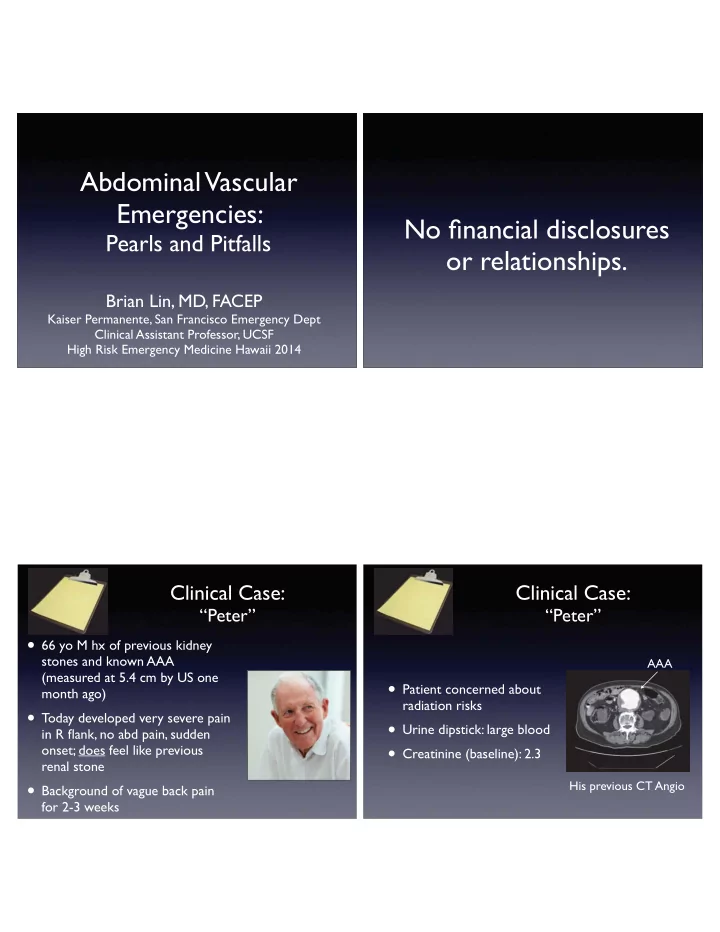
  • 66 yo M hx of previous kidney

stones and known AAA (measured at 5.4 cm by US one month ago)

  • Today developed very severe pain

in R flank, no abd pain, sudden

  • nset; does feel like previous

renal stone

  • Background of vague back pain

for 2-3 weeks

Clinical Case:

“Peter”

  • Patient concerned about

radiation risks

  • Urine dipstick: large blood
  • Creatinine (baseline): 2.3

His previous CT Angio

Clinical Case:

“Peter”

AAA

slide-2
SLIDE 2

Abdominal Vascular Emergencies

Abdominal Aortic Aneurysm (AAA) Aortic Dissection (AD) Acute Mesenteric Ischemia (AMI)

Detection (When/How to Test) Diagnosis (Imaging) Decision (ED Treatment & Consults) ~60 yrs + Concerning hx Pulsatile mass CT angio OR US, CT(-) with clinical picture Volume + (Vasc) Surg

  • r

Die Good Hx, “Weird” Exam Consider Ddimer, US (1) CTA (2) TEE U/S: take a look...

Lower BP! A: Surgery B, complicated: (Vasc) Surgery B: Medicine

Abd pain +elderly +embolic risk +/- lactate CTA Volume, abx, heparin gtt; IR + (Vasc) Surgery

Dx

Strategy

AAA AD AMI

Goals & Objectives

  • History & Physical
  • Serum Biomarkers
  • Diagnostic Imaging

AAA AD AMI

Pearls and Pitfalls related to:

History & Physical

slide-3
SLIDE 3

History

  • Sudden onset

epigastric pain

  • Flank pain or

back pain

  • Syncope

AAA Contained Rupture AAA

  • Flank pain or

back pain

  • Sensitivity: 76%
  • PPV: 43%
  • Positive Likelihood

ratio: 15.6 [CI 8.6-15.6]

Physical Exam:

Abdominal Palpation

JAMA 1999 AAA

Take Home Point #1

Abdominal vascular emergencies don’t always present within the abdomen.

Considering AAA?

Look at the legs!

AAA

slide-4
SLIDE 4

Pitfall:

You have to look!

Symptom/Finding Increased Disease Probability Tearing/Ripping Pain 10.8x (5.2-22.0) Migrating Pain 7.6x (3.6-16.0) Sudden Chest Pain 2.6x (2.0-3.5) Focal Neuro Deficit 33.0x (2.0-549.0) JAMA 2002

Aortic Dissection History:

Positive Likelihood Ratios

AD

  • Retrospective review of confirmed AD cases
  • Only 42% had documentation of

pain quality, radiation, & onset

  • If all 3 asked:
  • If just one omitted:

dx made 91% of the time dx made 49% of the time

Chest 1998

AD

Weird Presentations

AD

slide-5
SLIDE 5

Malperfusion syndromes

Stroke syndromes Pericardial tamponade Myocardial Infarction Renal failure Aortic valve insufficiency Paraplegia Intestinal ischemia Acute Limb Ischemia

AD

Take Home Point #1

Abdominal vascular emergencies don’t always present within the abdomen.

Chest, abdominal, or back pain + findings in unrelated or multiple organ systems = think aortic dissection

Serum Biomarkers

  • 69 yo M with HTN, c/o sudden onset sharp

chest pain radiating to the abdomen

  • EKG: new anterior TWIs Trop 0.00
  • EP considers dissection, but believes it is

ACS hedges and orders a D-dimer while calling medicine admission.

Clinical Case:

“Paul”

consider S h ile calling

slide-6
SLIDE 6

Biomarkers for AD

  • Basis: observational data, cohort studies
  • Potential “rule out” test?
  • Prognostic value?

AD

D- dimer

D-dimer for AD:

  • 7 studies, 298 pts with AD, 436 without
  • Multiple assays; D-dimer cut-off 500 ng/ml
  • Sensitivity ~97%, Specificity 56%, LR (-) 0.06

Current Evidence

Am J Cardiol 2011 AD

3% ?

TF TF TF D- dimer D- dimer D- dimer D- dimer D- dimer

  • dim

D- dimer

D-dimer for AD:

Biochemical Mechanism

AD Intramural Hematoma

TF TF

Aorta

  • False negatives rates in dissection variants/

patient subsets

  • Time of rise, peak, clearance?
  • Prospective studies in undifferentiated CP

D-dimer for AD:

What we need to know

AD

slide-7
SLIDE 7
  • D-dimer >4000.

Results as pt hits medicine floor (2.5 hr turnaround)

  • Goes to CT:

Type A Dissection

Clinical Case 2:

“Paul”

  • Cardiothoracic

Surgery consulted (7 hrs later)

  • Survives surgery;

discharged home; readmitted with complications & died one week later

Clinical Case 2:

“Paul”

Type A Dissection

Take Home Point #2

Serum biomarkers can help you.

…they can also hurt you!

Lactate for Mesenteric Ischemia? Lactate

AMI

  • Common practice: “rule out” mesenteric ischemia
  • Basis: elective surgical pts, case series
slide-8
SLIDE 8

Lactate for Mesenteric Ischemia? L-Lactate

AMI

Lactate D-

  • Common practice: “rule out” mesenteric ischemia
  • Basis: elective surgical pts, case series

L-lactate vs D-lactate

D-lactate

  • Produced by

gut lumen bacteria

  • More specific
  • Elevation not

early

  • Produced by

human cells

  • Non-specific

L-lactate AMI

E.coli

L-Lactate Lactate D-

Biomarker Pitfalls:

Attribution Errors

  • Amylase elevation (27%)
  • LFT elevation (25%)
  • Troponin (TnI) elevation (43%)

J Emerg Med 2012 AMI

Serum biomarkers can help you.

…they can also hurt you!

Take Home Point #2

slide-9
SLIDE 9

Diagnostic Imaging

Detection (When/How to Test) Diagnosis (Imaging) Decision (ED Treatment & Consults) ~60 yrs + Concerning hx Pulsatile mass CTA OR US, CT(-) with clinical picture Volume + (Vasc) Surg

  • r

Die Good Hx, “Weird” Exam Consider Ddimer, US (1) CTA (2) TEE U/S: take a look...

Lower BP! A: Surgery B, complicated: (Vasc) Surgery B: Medicine

Abd pain +elderly +embolic risk +/- lactate CTA Volume, abx, heparin gtt; IR + (Vasc) Surgery

Dx

Strategy

AAA AD AMI

CTA OR OR OR OR OR OR OR OR CTA p (1) CTA (2 (2 (2 (2 (2 (2 (2 (2) T E EE EE EE EE EE E EE EE EE

Definitive Diagnosis

CT angiogram is the test of choice for diagnosis of AAA, aortic dissection, and mesenteric ischemia.

Take Home Point #3

BUT we cannot, and should not, CT scan everybody.

slide-10
SLIDE 10

Radiation Risk is Real

Effective radiation dose (mSv) CXR Equivalents

Number of scans needed to cause a cancer in a 60 yo M

CT Head

2 30 14,680

CT Angiogram Dissection protocol

24 220 840

Smith-Bindman, et al, Arch Int Med 2009

Beyonce says:

“If you like it than you should’ve put a ring on it.”

Brian-say:

“If you don’t like it, than you should’ve put an ultrasound

  • n it.”

Bedside Ultrasound

slide-11
SLIDE 11
  • include Table 3
  • in

in in in n in n in n in in in in in in incl l cl cl cl cl cl c ud d ud ud ud ud ud ud ud d ud d ud ud ud ud ud ud ud d ud ud ud ud ud ud ud ud ude Ta Ta Ta Ta T bl bl bl bl ble 3 Acad Emerg Med 2013

Abd Aortic US:

Identification

Vertebral body Aorta IVC AAA

Abd Aortic US:

Technique

AAA

AortaBifurcation Tapers distally Cephalad Caudal

Abd Aortic US:

Detecting Abnormal

Normal AAA

>3cm <3cm

AAA

slide-12
SLIDE 12

R mid-axillary lateral view increases aortic visualization by 28%

Am J Emerg Med 2013

Right mid axillary view

AAA

Liver IVC Aorta

Abd Aortic US:

Don’t forget to look at the RUQ!

AAA

Free fluid

Ultrasound for AD

...worth a look?

Acad Emerg Med 2010 J Emerg Med 2010 J Emerg Med 2007

AD

slide-13
SLIDE 13

RUQ FAST Parasternal cardiac view Longitudinal abd aorta Intra abdominal aorta Subxiphoid view Suprasternal view

Aortic US Windows

R midaxillary view

AD

Suprasternal Aortic View

  • Used to visualize

aortic arch

  • May show Type A

dissection flap

AD

Suprasternal Aortic View

Normal

AD

Suprasternal Aortic View

Abnormal

Dissection Flap

AD

slide-14
SLIDE 14

Abdominal view

Aorta Longitudinal Dissection Flap

AD

Take Home Point #3

We cannot, and should not, CT scan everybody.

Consider alternative imaging strategies, especially ultrasound!

  • 76 yo F with hx of DM, afib,

previous ischemic CVA, hx

  • f right renal artery

embolism, CKD (cre = 2.3)

  • c/o diffuse pain

She’s sweating, moaning

  • Abd exam: “unimpressive

tenderness”

Clinical Case 3:

“Mary”

  • WBC 14.8K
  • Lactate 4.2
  • Lipase 492
  • INR 1.0
  • Cre = 2.3

Clinical Case 3:

“Mary”

slide-15
SLIDE 15

CT scans, IV contrast, and the beans

  • In confirmed mesenteric

ischemia cases:

  • 90% mortality if CT(-)
  • 42% mortality if CTA
  • CTA Creatinine bumped,

no HD nor mortality Emerg Radiol 2010 Eur J Vasc Endovasc Surg 2012 AMI

Take Home Point #3

We cannot, and should not, CT scan everybody.*

*…but don’t be afraid to scan those who really need it!

  • Patient placed on monitors, 2 large

bore IVs, labs including Type & Cross.

  • Abdominal FAST US reveals no free

fluid and patient hemodynamically stable.

  • Risk/benefit ratio involving the

patient; agree upon CT non-contrast

Clinical Case:

“Peter”

  • CT (-) reveals: 6 mm right

ureteral stone; AAA stable in size and contour with “no signs to suggest rupture”

  • “Given this and alternate

diagnosis, we opted not to continue with CTA.” AAA Non-contrast CT

Clinical Case:

“Peter”

slide-16
SLIDE 16
  • Discharged home with hydrocodone, urine

strainer, urology follow up, return precautions

  • Code status discussed and documented
  • 3 months later: still alive; still no AAA repair

Clinical Case:

“Peter”

Summary

Detection (When/How to Test) Diagnosis (Imaging) Decision (ED Treatment & Consults) ~60 yrs + Concerning hx Pulsatile mass CT angio OR US, CT(-) with clinical picture Volume + (Vasc) Surg

  • r

Die Good Hx, “Weird” Exam Consider Ddimer, US (1) CTA (2) TEE U/S: take a look...

Lower BP! A: Surgery B, complicated: (Vasc) Surgery B: Medicine

Abd pain +elderly +embolic risk +/- lactate CTA Volume, abx, heparin gtt; IR + (Vasc) Surgery

Dx

Strategy

AAA AD AMI

Take Home Points

  • Your history and physical are valuable.
  • Serum biomarkers can help you AND hurt you.
  • Don’t CT scan everyone!

AAA AD AMI

slide-17
SLIDE 17

Thanks!

  • Questions?
  • Question box me, or
  • brian.lin@kp.org
  • Follow me on Twitter:

bwlin720