Disclosures Disclosures Fractures: A. Schwartz A. Schwartz - - PowerPoint PPT Presentation

disclosures disclosures fractures a schwartz a schwartz
SMART_READER_LITE
LIVE PREVIEW

Disclosures Disclosures Fractures: A. Schwartz A. Schwartz - - PowerPoint PPT Presentation

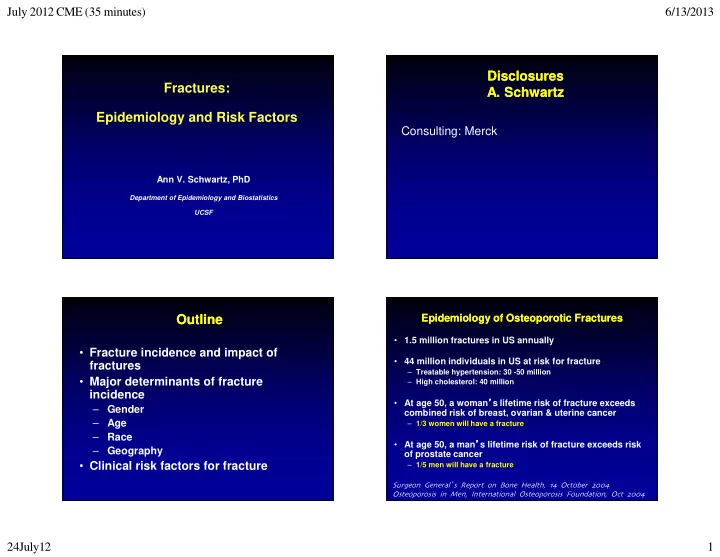
July 2012 CME (35 minutes) 6/13/2013 Disclosures Disclosures Fractures: A. Schwartz A. Schwartz Epidemiology and Risk Factors Consulting: Merck Ann V. Schwartz, PhD Department of Epidemiology and Biostatistics UCSF Epidemiology of


slide-1
SLIDE 1

July 2012 CME (35 minutes) 6/13/2013 24July12 1

Ann V. Schwartz, PhD

Department of Epidemiology and Biostatistics UCSF

Fractures: Epidemiology and Risk Factors Disclosures

  • A. Schwartz

Disclosures

  • A. Schwartz

Consulting: Merck

Outline Outline

  • Fracture incidence and impact of

fractures

  • Major determinants of fracture

incidence

– Gender – Age – Race – Geography

  • Clinical risk factors for fracture

Epidemiology of Osteoporotic Fractures Epidemiology of Osteoporotic Fractures

  • 1.5 million fractures in US annually
  • 44 million individuals in US at risk for fracture

– Treatable hypertension: 30 -50 million – High cholesterol: 40 million

  • At age 50, a woman’

’ ’ ’s lifetime risk of fracture exceeds combined risk of breast, ovarian & uterine cancer

– 1/3 women will have a fracture

  • At age 50, a man’

’ ’ ’s lifetime risk of fracture exceeds risk

  • f prostate cancer

– 1/5 men will have a fracture Surgeon General’s Report on Bone Health, 14 October 2004 Osteoporosis in Men, International Osteoporosis Foundation, Oct 2004

slide-2
SLIDE 2

July 2012 CME (35 minutes) 6/13/2013 24July12 2 Common sites of fracture Common sites of fracture

Spine Hip Wrist

Age (years)

Johansen et al, 1997

20 40 60 80 20 40 60 80 Annual incidence (rate/1000)

Men Women

Overall incidence of fractures Overall incidence of fractures

Cooper C et al. J Bone Miner Res 1992

20% 15% 10% 5% 35–39 > 85 > 85 Age Group, yr 5 year fracture risk

Men Women

Hip Hip Vertebrae Vertebrae Wrist Wrist

5-year Risk of Fracture: Role of Age and Sex 5-year Risk of Fracture: Role of Age and Sex

Cooper C. Am J Med. 1997;103(2A):12S–17S.

40%

Unable to walk independently

30%

Permanent disability

20%

Death within

  • ne year

50%

No longer able to live independently

Hip fractures are associated with increased morbidity and mortality

  • Direct costs: > $10 billion / yr

– Cost of hip fracture > $80,000 per person

slide-3
SLIDE 3

July 2012 CME (35 minutes) 6/13/2013 24July12 3 Impact of Vertebral Fractures Impact of Vertebral Fractures

  • 20% excess mortality in 5 yrs

after fracture

  • Deformity & height loss
  • Acute & chronic pain
  • Pulmonary dysfunction
  • Diminished quality of life:

loss of self-esteem, distorted body image, dependence on narcotic analgesics, sleep disorder, depression, loss of independence

Prospects for the Future ... Prospects for the Future ...

  • Elderly represent fastest growing segment of population
  • By 2020, one-half of US citizens older than 50 will be at

risk for fractures from osteoporosis

Number (000,000)

0-5

Age range (years)

11-15 21-25 31-35 41-45 51-55 61-65 71-75 80+ Men Women

1990

100 200 300 0-5 11-15 21-25 31-35 41-45 51-55 61-65 71-75 80+ 100 200 300

2025

World Population: 1990 and 2025 World Population: 1990 and 2025

Worldwide Distribution of Hip Fractures in Women: 1990 to 2050 Worldwide Distribution of Hip Fractures in Women: 1990 to 2050

Women Women

500 1000 1500 2000 2500 3000 1990 2025 2050

  • N. Am, Europe

Mid East, Asia, Latin Am, Africa Hip Fractures, x1000

slide-4
SLIDE 4

July 2012 CME (35 minutes) 6/13/2013 24July12 4

Rates of hip fracture vary dramatically by region and country Rates of hip fracture vary dramatically by region and country

LTR (years)

Turkey China Hungary China (HK) Portugal Greece Spain France Finland Japan UK Canada Germany Netherlands USA Denmark Italy Australia Iceland Switzerland Norway Sweden

5 10 15 20 25 5 10

Women Men

Geographic Variation — Lifetime Risk of Hip Fracture at Age 50 yrs Geographic Variation — Lifetime Risk of Hip Fracture at Age 50 yrs

Less variation in prevalence of ‘ ‘ ‘ ‘vertebral fractures’ ’ ’ ’ by standard definitions Less variation in prevalence of ‘ ‘ ‘ ‘vertebral fractures’ ’ ’ ’ by standard definitions Lifetime risks of clinical fractures 50 year old white women (U.S.) Lifetime risks of clinical fractures 50 year old white women (U.S.)

Lifetime risk*

  • Hip fracture

17%

  • Wrist fracture

16%

  • Vertebral fracture

16%

  • Any fracture

> 50% Breast cancer 15%

*Refs: Melton; Black; Kanis

slide-5
SLIDE 5

July 2012 CME (35 minutes) 6/13/2013 24July12 5

Lifetime risks of fracture: Impact of gender Lifetime risks of fracture: Impact of gender

Fracture Men (%) Women (%) Hip 6 17 Wrist 3 16 Clinical Vert Fx 5 16 Any 16% > 50%

* Among Caucasians Lifetime Risk at Age 50*

Osteoporosis in Men Osteoporosis in Men

  • 1/5 men over age 50 will suffer
  • steoporotic fracture
  • 30% of hip fractures worldwide

are in men

  • Mortality rates due to fracture

higher in men than women

  • Treatment rates following

fracture are abysmal

Race and rate of hip fractures (age adjusted to U.S.) Race and rate of hip fractures (age adjusted to U.S.)

Race Female Male Caucasian (US) 968 396 Black (US) 214 179 Hispanic (US) 219 97 Asian US (California) 383 116 Japan 227 79 Hong Kong 389 196 Beijing 97 101

Luz Villa, Osteoporosis, 2001. Rates per 100,000 person-years, age-adjusted

Outline Outline

  • Fracture incidence and impact of

fractures

  • Major determinants of fracture

incidence

– Gender – Age – Race – Geography

  • Clinical risk factors for fracture
slide-6
SLIDE 6

July 2012 CME (35 minutes) 6/13/2013 24July12 6

Hip BMD T-score (SD)

  • 3
  • 2
  • 1

1 10 20

50 60 70 80

Age (yrs)

Kanis et al, 2004

Age and BMD Are Independent Risk Factors for Hip Fracture (more later, S. Harris) Age and BMD Are Independent Risk Factors for Hip Fracture (more later, S. Harris) > 5-fold increase in fracture probability from age 50 to 80

Combining BMD with Clinical Risk Factors Combining BMD with Clinical Risk Factors

Lowest Third Middle Third Highest Third

0-2 3-4 >=5 5 10 15 20 25 30 Hip Fx Rate (per 1000 woman-years) Heel BMD # Risk Factors

Cummings et al., NEJM 332(12):767-773, 1995

Combining Risk Factors for Osteoporosis Combining Risk Factors for Osteoporosis

  • In heart disease, risk factors (e.g. BP, lipids,

smoking) play independent role

– Risk factor models and tools are in common clinical use

  • In osteoporosis, growing realization that

BMD doesn’ ’ ’ ’t tell the whole story and that

  • ther risk factors play important (and

independent) role

– T-scores alone are problematic

  • Develop systems for estimating risk based
  • n multiple risk factors

WHO Risk Model (FRAX): Overview WHO Risk Model (FRAX): Overview

  • To be discussed by Dr. Harris
  • Based on 10 year risk of hip or major clinical fracture
  • Combine observational studies from around the world

to define a set of robust risk factors. With and without BMD

  • Make country-specific risk-based diagnostic and

treatment thresholds based on local considerations

slide-7
SLIDE 7

July 2012 CME (35 minutes) 6/13/2013 24July12 7

Risk factors in WHO FRAX calculator Risk factors in WHO FRAX calculator

  • Age, gender, race, geography
  • BMD
  • Previous fracture
  • Parent fractured hip
  • Body Mass Index (BMI) (weight/height2)
  • Current smoking
  • Glucocorticoids
  • Rheumatoid arthritis
  • Alcohol 3+ drinks/day
  • Secondary osteoporosis (if BMD not

included)

Vertebral fractures indicate a very high risk of future fracture Vertebral fractures indicate a very high risk of future fracture

  • 4x risk of more vert fxs
  • 2x risk of other fractures

(vanStaa, Osteop Int 2002)

  • Women with clinical

diagnosis of vertebral fracture have 5-15% 5 yr hip fracture risk!

Not in FRAX

Existing Vertebral Fracture Predictive of Future Vertebral Fracture Independent of BMD Existing Vertebral Fracture Predictive of Future Vertebral Fracture Independent of BMD

1 2 3 4 5 6 Previous Vert Frx No Vert Frx Low BMD Mid BMD High BMD 5.8 3.4 2.3 1.7 1.0 0.2 Risk of New Vertebral Fractures (% / yr)

Ross 1991

Effect of prevalent radiographic vertebral fracture on non-vertebral fracture risk Effect of prevalent radiographic vertebral fracture on non-vertebral fracture risk

1 2 3 4 5 6 No vert fx >1 vert fx

  • 2

Absolute fracture risk (%)

  • 3
  • 4

Femoral neck T-score

Siris et al, Osteop Int 2007

slide-8
SLIDE 8

July 2012 CME (35 minutes) 6/13/2013 24July12 8

Previous non-vertebral fracture predicts future fracture Previous non-vertebral fracture predicts future fracture

  • History of fracture: 1.5-3.0 fold

greater risk of fracture True for

  • any fracture type (ankle, finger)
  • even traumatic fractures
  • especially strong for men
  • Mostly independent of BMD

vanStaa, Osteop Int 2002;13:624-9 Meta-analysis: Klotzbuecher, JBMR 2000;15:721; Kanis Osteop Int 2004

Family history of hip fracture is a strong risk factor for hip fracture Family history of hip fracture is a strong risk factor for hip fracture

  • 2-fold increased risk of

hip fracture

  • Regardless of hip BMD

“ “ “My mother had a spine fracture” ” ” ” or “ “ “ “osteoporosis” ” ” ”: no increased risk.

Guess our risk of hip fracture Guess our risk of hip fracture

Higher weight is protective. Lower weight is strong predictor of hip fracture and of low BMD

Low BMI is a strong risk factor for fracture Low BMI is a strong risk factor for fracture

De Laet et al. 2005

slide-9
SLIDE 9

July 2012 CME (35 minutes) 6/13/2013 24July12 9

Corticosteroids

(more later, J. Graf)

Corticosteroids

(more later, J. Graf)

  • 6-10% loss of spine BMD in 6-12 months of

≥10 mg prednisolone / day

  • Strong (r=-0.6) correlation between

cumulative dose and deficit in spine BMD

  • Clinical guidelines recommend

bisphosphonate therapy to prevent bone loss

Van Staa, Osteop Int 2002

Orstavik et al 2004

Rheumatoid arthritis Rheumatoid arthritis Smoking Smoking

  • Smokers have a 1.4

to 2-fold increased risk of hip fracture.

  • Independent of

BMD.

  • Due to poor health,

weaker muscles & impaired balance

Alcohol and risk of hip fracture Alcohol and risk of hip fracture

  • ≤ 2 drinks/day: no increased risk
  • > 2 / day

– 30-40% increased risk – 6-10/day in men: ~ 5 X risk

  • Greater risk with beer

than wine! (?)

Hoidrup Am J Epidemiol 1999;149:993

slide-10
SLIDE 10

July 2012 CME (35 minutes) 6/13/2013 24July12 10

Risk Factors – Not in FRAX Risk Factors – Not in FRAX

There are strong clinical risk factors for fracture that are not in FRAX.

Highest risk groups Highest risk groups

  • Nursing homes

– 4 to 6% hip fracture per year

  • Post-stroke

– Over 70 years: 3-5% annual hip fracture risk for women and ~2% per year for men

Clinical Risk Factors for Fracture Clinical Risk Factors for Fracture

  • Parkinson’

’ ’ ’s: 2x higher risk (hip)

  • Dementia: 2x higher risk (hip)
  • Diabetes: 80% higher risk (hip)
  • Early menopause (<47 yrs): 70% higher risk

(all)

  • Frequent falls: 80% higher risk (hip)
  • Chair stand as a measure of physical function.

Uses arms to stand: 70% higher risk (hip)

  • Medications that are bad for the bone

– Thyroid meds, TZD’ ’ ’ ’s, aromatase inhibitors, and more..(later)

Surprising Non-Risk Factors Surprising Non-Risk Factors

  • Hair color/skin pigment

Common wisdom: Blonds/light skin higher risk Truth: Blondes & brunettes & redheads seem to have same risk

  • North-South gradient of risk

Common wisdom: Fracture risk increases as you go north Truth: Lower hip fracture risk in north U.S.

slide-11
SLIDE 11

July 2012 CME (35 minutes) 6/13/2013 24July12 11

Summary Summary

  • Fractures are common (and will become

more common), and are associated with significant mordidity, mortality and costs.

  • Fracture risk is multifactorial
  • Strong risk factors (besides BMD) include:

– Older Age – Gender – History of fracture especially vertebral fracture – Maternal history of hip fracture – Low weight

  • Methods for combining risk factors, together

with BMD are now available

Thank you Thank you