Disclosures Complications of Wear or Corrosion of Chrome-Cobalt - - PDF document

disclosures complications of wear or corrosion of chrome
SMART_READER_LITE
LIVE PREVIEW

Disclosures Complications of Wear or Corrosion of Chrome-Cobalt - - PDF document

11/12/2015 Disclosures Complications of Wear or Corrosion of Chrome-Cobalt Index Case of Arthroprosthetic Cobaltism 2006-2009 Hip Implants Author of Index Case Reports AK State Epi, Alaska Medicine, JBJS 2010 Stephen S. Tower, M.D. Board


slide-1
SLIDE 1

11/12/2015 1

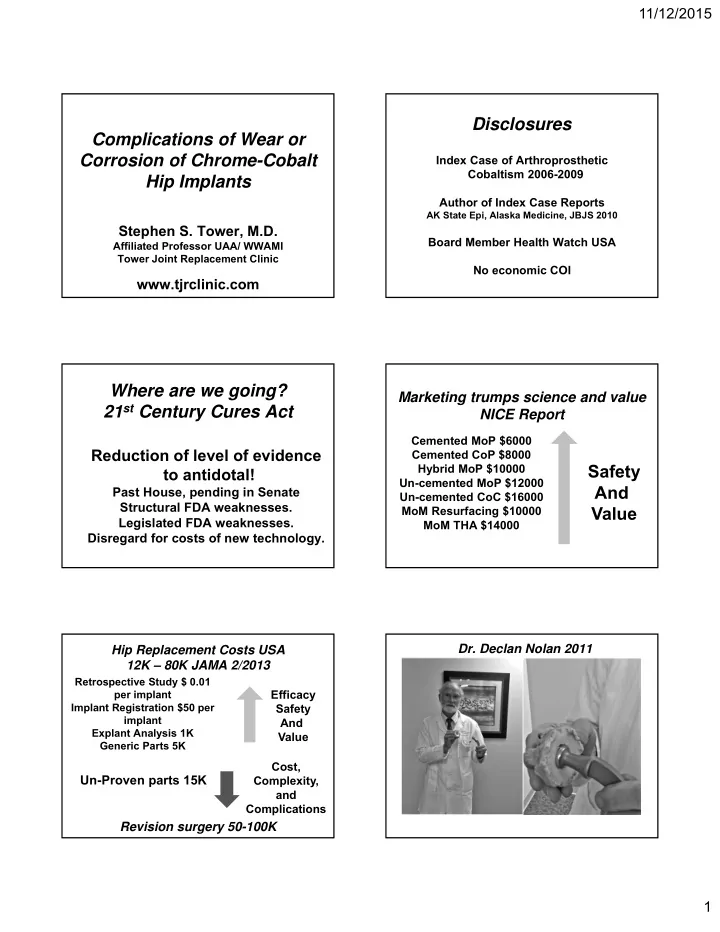
Complications of Wear or Corrosion of Chrome-Cobalt Hip Implants

Stephen S. Tower, M.D.

Affiliated Professor UAA/ WWAMI Tower Joint Replacement Clinic

www.tjrclinic.com

Disclosures

Index Case of Arthroprosthetic Cobaltism 2006-2009 Author of Index Case Reports

AK State Epi, Alaska Medicine, JBJS 2010

Board Member Health Watch USA No economic COI

Where are we going? 21st Century Cures Act

Reduction of level of evidence to antidotal!

Past House, pending in Senate Structural FDA weaknesses. Legislated FDA weaknesses. Disregard for costs of new technology.

Marketing trumps science and value NICE Report

Cemented MoP $6000 Cemented CoP $8000 Hybrid MoP $10000 Un-cemented MoP $12000 Un-cemented CoC $16000 MoM Resurfacing $10000 MoM THA $14000

Safety And Value

Hip Replacement Costs USA 12K – 80K JAMA 2/2013

Retrospective Study $ 0.01 per implant Implant Registration $50 per implant Explant Analysis 1K Generic Parts 5K

Efficacy Safety And Value Cost, Complexity, and Complications

Un-Proven parts 15K Revision surgery 50-100K

  • Dr. Declan Nolan 2011
slide-2
SLIDE 2

11/12/2015 2

The Holy Grail of Hip Replacement

Lasts Forever Instant recovery Pain free Stable No activity limits Not poison the patient

Pre-Market Approved Devices Antecedent Device

510 K Devices

5 Year Revision Rates

Predicate Charnley THA 1970s 2-3% PMA Metal-on-Metal Resurfacing 15% (5x) 510K Metal-on-Metal THA 44% (22x) 510K Modular Neck THA 44% (22x)

2010 Wear of chrome-cobalt hip implants ½-1 million Americans at risk

Systematic Literature Review of 2318 publications we found 25 cases of cobaltism from wear

  • f CrCo hip

implants

A Systematic Review of Systemic Cobaltism after Wear or Corrosion of Chrome-Cobalt Hip Implants BD Gessner, T Steck, E Woelber, SS Tower Journal Public Safety June 2015 Open Access

2015 Taper Corrosion of CrCo Components about 2 million Americans at risk

Osteolysis, Pseudotumor, Sciatica 56 YO active male, 6 years post THA. Popular non-recalled Stryker 32 mm MoP 510K hip. Osteolysis detected with surveillance XR. Minimal Metallosis and Hypercobaltemia (0.9)

slide-3
SLIDE 3

11/12/2015 3

Monitoring Hip Patients at Risk Blood or Urine Cobalt (PBB)

  • 0.2 normal, > 1.0 excess exposure (Industry)
  • 1 small ball Metal-on-Metal THA
  • 2-3 large ball Metal-on-Metal HR or THA
  • 2-10 APRMD, subclinical and mild cobaltism
  • 11-100 subclinical, mild, and moderate cobaltism
  • 101-300 moderate to severe cobaltism
  • 301-1000 extreme manifestations, DEATH (1 case)

Cobalt debris from corrosion likely more toxic than that produced by abrasive wear. Urine levels generally 3-5X Blood Levels

Alaskan Rejuvenate Series Recalled Implant Taper Corrosion

30 revised of about 70 at risk Median [BCo] = 4 PPB 10 with reversible Cobaltism? Mean latency to illness 2 years Mean latency to revision 3 years Population at risk systematically screened

Alaskan Revised MoM Series Metal-on-Metal Wear

35 revised of < 100 at risk Median [BCo] = 40 PPB 10 with reversible Cobaltism? Mean latency to illness 2 years Mean latency to revision 3 years Patients not systematically screened

Alaskan Non-Rejuvenate Series Taper Corrosion

6 revised of about 1000 at risk Median [BCo] = 4 PPB 5 with reversible Cobaltism? Mean latency to illness 5 years Mean latency to revision 7 years Population at risk not systematically screened 40 y/o nurse, missed 2 annual follow-ups but saw surgeon socially 1-2 times a week [BCo] = 63 ppb Reversible Neurocobaltism with 48 months of surplus morbidity

Cobaltism Awareness:

Systematic Monitoring of Patients with MoM Hips Indicated

510K Device Not recalled

46 y/o Pilot F/H PD 2009 Biomet “Magnum” MoM Hips 42 months max DBS & Drugs Onset of hip pain B[Co] = 116 PPB Hips Revised to Ceramic-on-Plastic 2 months post revision B[Co] = 0.7 12 months post-op off DBS & Drugs 2 years post-op off Drugs, lowest DBS setting

Cobaltism Awareness:

Cobaltism may precede Hip Symptoms

510K Device Not recalled

slide-4
SLIDE 4

11/12/2015 4

Rejuvenate Implanted 8/2010

20 months later: progressive fatigue, poor sleep, nausea, weight loss from 140 to120 pounds, deafness, myalgia, cognitive decline, arrhythmia and diastolic dysfunction B[Co] = 11 PPB

Recalled 7/2012 (at 23 months) Explanted after 33 months

Cobaltism Awareness: Systematic Monitoring of Patients at Risk for Taper Corrosion Indicated

510K RECALL

56 y/o male: 6 and 3 years s/p 32 mm CrCo-on-Plastic non-Rejuvenate Stryker Hips Several months left groin pain: [BCo] = 4 PPB Admitted to CCU post screening ECHO for acute asymptomatic proximal aortic dissection

Population at risk 2 million

Popular 510K MoP Hip Not known to be at risk Stryker Accolade

66 year-old attorney, 4 months of left groin pain 8 years post implant, [BCo] of 4 PPB

Metal-on-Plastic Bearing

Chrome-Cobalt modular ball on Ti Alloy Stem

510K Device Zimmer MLT Stem 32 mm CrCo Head Metal-on-Plastic

25 Cases Identified Toxic Progeria 84% Hip Symptoms 75% cranial or peripheral nerve dysfunction 72% diastolic or systolic cardiomyopathy 72% constitutional decline 32% mood or cognitive dysfunction 48% thyropathy Mean BCo 324 (20-1000) Illness Severity correlated with BCo Reversibility Noted in non-fatal cases

A Systematic Review of Systemic Cobaltism after Wear or Corrosion of Chrome-Cobalt Hip Implants

BD Gessner, T Steck, E Woelber, SS Tower Journal Public Safety June 2015 Open Access

Pathophysiology of Periprosthetic and Systemic Toxicity of Chrome- Cobalt Metallosis

Periprosthetic

Immune Cytotoxic

Systemic

Immune Cytotoxic

Type IV Hypersensitivity Periprosthetic Lymphocyte Infiltrates Solid and Cystic Pseudotumors leading to Tissue damage Hip instability Weakness Prosthetic loosening Compression of Neurovascular structures Generally Painful

Periprosthetic Consequences of Immune Response to Chrome-Cobalt Metallosis

slide-5
SLIDE 5

11/12/2015 5

Pseudotumors and Necrosis of Capsule, Tendons and Bone leading to Hip Instability Weakness Prosthetic loosening can be Painful or Painless

Periprosthetic Consequences of Chrome-Cobalt Metallosis

Systemic Immune Response leading to Pseudo septic syndrome Lymphocyte Mutation possibly resulting in Lymphoma and Lymphocytic Leukemia

Systemic Consequences of Immune Response to Chrome-Cobalt Metallosis

Oxidative Stress and Mitochondrial Toxicity leading to Death or Dysfunction of Highly Metabolic Cells resulting in Audio-vestibular and Optic Dysfunction Peripheral Neuropathy Cardiomyopathy Cognitive and Affective Dysfunction Generalized Constitutional Decline Thyropathy

Systemic Consequences of Chrome- Cobalt Related Cytotoxicity

Toxic Progeria

New Hips: 1980-2010 Evolution Science or Marketing Driven?

Larger Heads More Parts Unproved material Unproved design Unanticipated modes

  • f failure

Complications of Hip Implant Chrome-Cobalt Wear & Corrosion

Unexpected Long Latency Significant What went Wrong?

  • Conflict of Interest?
  • Premarket
  • Market
  • Regulation
  • Professional spheres
  • Post Market
slide-6
SLIDE 6

11/12/2015 6 Cost of Metal-Metal Debacle USA

Ten Billion Dollars per year

For non-recalled Hips Companies profit from sale of both primary and revision Implants

Cost of 510K Debacle USA?

A Billion Dollars per year

Design Surgeons of the ASR paid about $20 Million

Monitoring Patients with at-risk hips for hip tissue complications

Annual Blood or Urine Cobalt Level

  • > 1 (3) some wear or corrosion likely
  • > 3 (9) increasing risk of problems cross-sectional

imaging even if no symptoms at hip.

Hip Symptoms (regardless of Cobalt levels)

  • Plain Radiographs
  • Cross-sectional imaging

Monitoring Patients with at-risk hips for Cobaltism

Annual Blood or Urine Cobalt Level

  • > 1 (3) some wear or corrosion likely
  • > 3 (9) increasing risk of problems cross-sectional

imaging even if no symptoms at hip.

  • Through neurologic, cardio-vascular, psychiatric, and

constitutional ROS.

Positive ROS for Cobaltism

  • Base-line audiogram, echocardiogram.
  • Neuro-cognitive testing

Treatment of patients with Hypercobaltemia, Cobaltism, or Hip Complications

Blood cobalt 3-10 no symptoms

  • Baseline cross-sectional imaging of the hip
  • Baseline audiogram, echocardiogram.
  • Baseline neurocognitive testing
  • Every 6 months repeat neurologic, cardio-vascular, psychiatric, and

constitutional ROS and urine and whole blood cobalt level.

Blood cobalt > 10 or Cobaltism or Tissue Damage at the Hip

  • Consider Revision Surgery if patient fit of major operative procedure
  • Chelation might be considered if patient is unfit for major surgery

Cost Explant Analysis 1-2K

Hip Replacement Costs USA 12K – 120K JAMA 2/2013

Retrospective Study $ 0.01 per implant Implant Registration $50 per implant Explant Analysis 1-2K per Explant Generic Parts 5K

Efficacy Safety And Value

Cost, Complexity, and Complications New unproven expensive implants 10-20K premium leads to Revision Surgery 50-150K

slide-7
SLIDE 7

11/12/2015 7

References on Thumb-drive

  • Alaskan Case reports (AK EPI BULL) (JBJS)
  • A Systematic Review of the Literature of Systemic Arthroprosthetic

Cobaltism (Gessner, Steck, Woebler, Tower)

  • APC case reports cardiomyopathy (Allen and Machado)
  • APC case reports multiple organ (Dahms and “House”)
  • APC case reports neurologic (Rizzetti “Loss of Sight and Sound”)
  • Cobalt Cardiomyopathy (Seghizzi)
  • Cobalt Neurotoxicity (Catalani general, Prentice MRI brain changes HRA)
  • Chrome-cobalt debris immunology (Willert, Hallub)
  • Monitoring guidelines (Alaska Medicine, NPS Australia)
  • Toxicology of chrome-cobalt debris (Simonsen, Gill)

Where are we going?

  • 21st Century Cures Act
  • Reduction of level of evidence to

antidotal

  • Past House, pending in Senate
  • Structural FDA weaknesses.
  • Legislated FDA weaknesses.
  • Disregard for costs of new technology.