Disclosure Early Prediction of Chronic Pulmonary Not a cardiologist - - PDF document

disclosure
SMART_READER_LITE
LIVE PREVIEW

Disclosure Early Prediction of Chronic Pulmonary Not a cardiologist - - PDF document

3/12/2019 Disclosure Early Prediction of Chronic Pulmonary Not a cardiologist (sorry!) Hypertension in Preterm Infants and Assessment of Pulmonary Hemodynamics Amish Jain, MBBS, MRCPCH, PhD Staff Neonatologist and Director, TNE Program,


slide-1
SLIDE 1

3/12/2019 1

Early Prediction of Chronic Pulmonary Hypertension in Preterm Infants and Assessment

  • f Pulmonary Hemodynamics

Amish Jain, MBBS, MRCPCH, PhD

Staff Neonatologist and Director, TNE Program, Mount Sinai Hospital Clinician‐Scientist, Lunenfeld Tanenbaum Research Institute, Associate Professor in Pediatrics, University of Toronto

Disclosure

  • Not a cardiologist (sorry!)

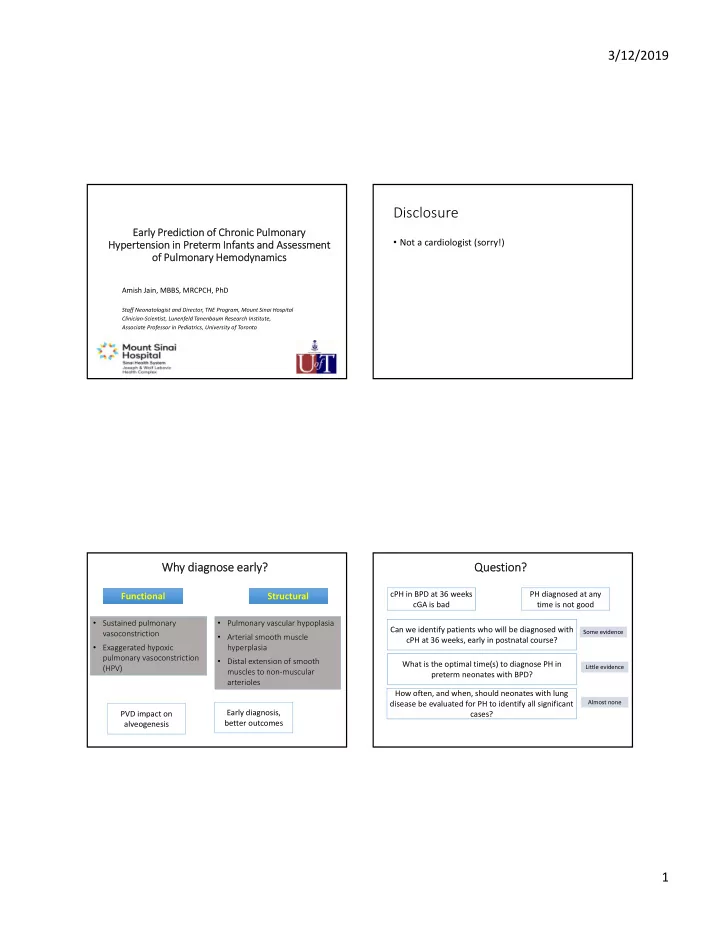
Why diagnose early?

  • Sustained pulmonary

vasoconstriction

  • Exaggerated hypoxic

pulmonary vasoconstriction (HPV)

  • Pulmonary vascular hypoplasia
  • Arterial smooth muscle

hyperplasia

  • Distal extension of smooth

muscles to non‐muscular arterioles

Functional Structural

PVD impact on alveogenesis Early diagnosis, better outcomes

Question?

cPH in BPD at 36 weeks cGA is bad PH diagnosed at any time is not good Can we identify patients who will be diagnosed with cPH at 36 weeks, early in postnatal course? What is the optimal time(s) to diagnose PH in preterm neonates with BPD? How often, and when, should neonates with lung disease be evaluated for PH to identify all significant cases?

Some evidence Little evidence Almost none

slide-2
SLIDE 2

3/12/2019 2

‘Early’ PH studies

4‐6 weeks 10‐14 days 7 days 5‐7 days 3‐14 days 2‐14 days 4‐6 weeks 32 weeks CGA

< 28 weeks, N=120, 10 ePH, 5 PH FiO2 @ 10 days ‐>ePH ‐> BPD ePH≠PH Retrospective – selection bias (343/1172 had a clinical echo) ePH 23% ePH ‐> BPD/mortality ePH≠PH < 30 weeks, N=67, ePH 16% ePH ‐>BPD ePH≠PH (low sEI on late scan) <30 weeks, O2>4 weeks, N=126 ePH 28% (4‐6 weeks) 22% (32 weeks) 17%(36 weeks) [@ any 38%] ePH≠PH

4‐6 weeks 7 days 5‐7 days Day 5‐7 (N=98) 36 weeks (N=164)

slide-3
SLIDE 3

3/12/2019 3

Sensitivity 62% Specificity 61% At day 7, 41% had PH “Early” PH “Late” PH YES NO YES NO

Mortality In‐hospital resp morbidity Post‐discharge resp ?adverse ND Severity of BPD GA/Weight Lung disease (MV/high FiO2 early in course)

We are struggling to identify pulmonary vascular disease in preterm neonates early in NICU course Bhat

  • RV hypertrophy
  • Flat IV septum
  • TR jet
  • ‘elevated’ RV pressure

Diagnostic criteria used

Levy/ Mourani

  • RVSP > 40 mmHg
  • RVSP:SBP > 0.5
  • BD/RL shunt
  • Flat IV septum at end systole

Currently employed diagnostic criteria (flat septum) are unlikely to be effective in identifying cPH kids early in postnatal course

slide-4
SLIDE 4

3/12/2019 4

Echocardiography indices of pulmonary hemodynamic alternations Echocardiography indices of Right heart performance

Exploratory vs. planned diagnostic investigation

Pulse‐wave Doppler of main pulmonary artery

  • Right ventricular ejection time (RVET) = a
  • Pulmonary artery acceleration time (PAAT) = b

‐ inversely related to PVR

  • Pulmonary vascular resistance index (PVRI) = a/b

‐ directly related to PVR a b

Time in milliseconds Velocity (cm/s)

Compliance Resistance

Steady (resistance) vs. Pulsatile (compliance) afterload

slide-5
SLIDE 5

3/12/2019 5

Resistance vs. Compliance

RVOT Doppler Shape

Joye et al PAS 2019

slide-6
SLIDE 6

3/12/2019 6

Early identification of preterm neonates with evolving chronic pulmonary hypertension: utility of functional echocardiographic markers

Sample size: 350 to estimate a sensitivity of 85% with an absolute precision of 0.07