January 28, Week 3 Today: Chapter 2, Constant Accleration Homework - - PowerPoint PPT Presentation

january 28 week 3
SMART_READER_LITE
LIVE PREVIEW

January 28, Week 3 Today: Chapter 2, Constant Accleration Homework - - PowerPoint PPT Presentation

January 28, Week 3 Today: Chapter 2, Constant Accleration Homework Assignment #3 - Due February 1 Mastering Physics: 6 problems from chapter 2. Written Question: 2.88 Box numbers can be found on webpage Wednesday office hours will be 2:30-5:00


slide-1
SLIDE 1

Constant Acceleration January 28, 2013 - p. 1/7
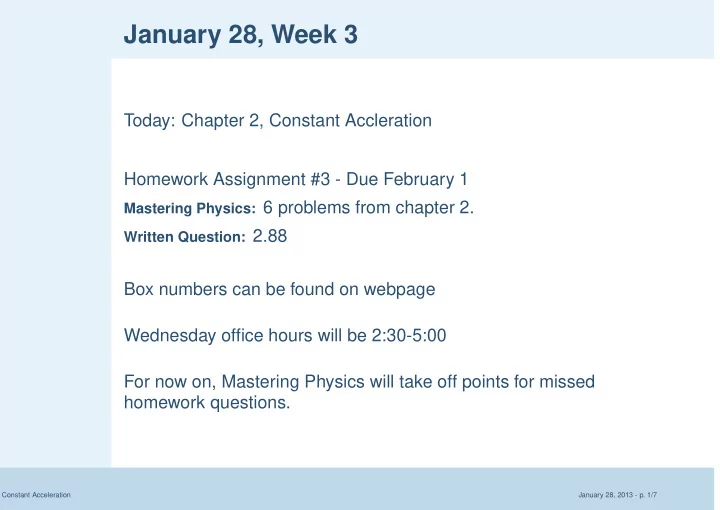
January 28, Week 3

Today: Chapter 2, Constant Accleration Homework Assignment #3 - Due February 1

Mastering Physics: 6 problems from chapter 2. Written Question: 2.88

Box numbers can be found on webpage Wednesday office hours will be 2:30-5:00 For now on, Mastering Physics will take off points for missed homework questions.

slide-2
SLIDE 2

Constant Acceleration January 28, 2013 - p. 2/7

Review

Three physical quantities of kinematics:

slide-3
SLIDE 3

Constant Acceleration January 28, 2013 - p. 2/7

Review

Three physical quantities of kinematics: Position, x - Where an object is located = how far and what direction from origin

slide-4
SLIDE 4

Constant Acceleration January 28, 2013 - p. 2/7

Review

Three physical quantities of kinematics: Position, x - Where an object is located = how far and what direction from origin Velocity, v - How fast an object is going and direction motion = speed and from its current position what direction is it going

  • towards. Also, slope of the position-versus-time graph.
slide-5
SLIDE 5

Constant Acceleration January 28, 2013 - p. 2/7

Review

Three physical quantities of kinematics: Position, x - Where an object is located = how far and what direction from origin Velocity, v - How fast an object is going and direction motion = speed and from its current position what direction is it going

  • towards. Also, slope of the position-versus-time graph.

Acceleration, a - The rate at which velocity is changing. Has same sign as velocity for speeding up. Opposite sign for slowing down. Slope of the velocity-versus-time graph.

slide-6
SLIDE 6

Constant Acceleration January 28, 2013 - p. 3/7

Acceleration Exercise

For the following motion diagram and coordinate system, which

  • f the following are correct signs for its kinematical quantities?

b b b b

slide-7
SLIDE 7

Constant Acceleration January 28, 2013 - p. 3/7

Acceleration Exercise

For the following motion diagram and coordinate system, which

  • f the following are correct signs for its kinematical quantities?

x

b b b b b b b b

slide-8
SLIDE 8

Constant Acceleration January 28, 2013 - p. 3/7

Acceleration Exercise

For the following motion diagram and coordinate system, which

  • f the following are correct signs for its kinematical quantities?

x

b b b b

x vx ax

b b b b

slide-9
SLIDE 9

Constant Acceleration January 28, 2013 - p. 3/7

Acceleration Exercise

For the following motion diagram and coordinate system, which

  • f the following are correct signs for its kinematical quantities?

x

b b b b

x vx ax (a) − + +

b b b b

slide-10
SLIDE 10

Constant Acceleration January 28, 2013 - p. 3/7

Acceleration Exercise

For the following motion diagram and coordinate system, which

  • f the following are correct signs for its kinematical quantities?

x

b b b b

x vx ax (a) − + + (b) − + −

b b b b

slide-11
SLIDE 11

Constant Acceleration January 28, 2013 - p. 3/7

Acceleration Exercise

For the following motion diagram and coordinate system, which

  • f the following are correct signs for its kinematical quantities?

x

b b b b

x vx ax (a) − + + (b) − + − (c) − − +

b b b b

slide-12
SLIDE 12

Constant Acceleration January 28, 2013 - p. 3/7

Acceleration Exercise

For the following motion diagram and coordinate system, which

  • f the following are correct signs for its kinematical quantities?

x

b b b b

x vx ax (a) − + + (b) − + − (c) − − + (d) − − −

b b b b

slide-13
SLIDE 13

Constant Acceleration January 28, 2013 - p. 3/7

Acceleration Exercise

For the following motion diagram and coordinate system, which

  • f the following are correct signs for its kinematical quantities?

x

b b b b

x vx ax (a) − + + (b) − + − (c) − − + (d) − − − (e) + − +

b b b b

slide-14
SLIDE 14

Constant Acceleration January 28, 2013 - p. 3/7

Acceleration Exercise

For the following motion diagram and coordinate system, which

  • f the following are correct signs for its kinematical quantities?

x

b b b b

x vx ax (a) − + + (b) − + − (c) − − + (d) − − − (e) + − +

slide-15
SLIDE 15

Constant Acceleration January 28, 2013 - p. 4/7

Constant Acceleration

For a constant acceleration:

slide-16
SLIDE 16

Constant Acceleration January 28, 2013 - p. 4/7

Constant Acceleration

For a constant acceleration: t ax Acceleration versus time

slide-17
SLIDE 17

Constant Acceleration January 28, 2013 - p. 4/7

Constant Acceleration

For a constant acceleration: t ax Acceleration versus time

slide-18
SLIDE 18

Constant Acceleration January 28, 2013 - p. 4/7

Constant Acceleration

For a constant acceleration: t ax Acceleration versus time t v Velocity versus time

slide-19
SLIDE 19

Constant Acceleration January 28, 2013 - p. 4/7

Constant Acceleration

For a constant acceleration: t ax Acceleration versus time t v Velocity versus time

slide-20
SLIDE 20

Constant Acceleration January 28, 2013 - p. 4/7

Constant Acceleration

For a constant acceleration: t ax Acceleration versus time t v Velocity versus time t x Position versus time

slide-21
SLIDE 21

Constant Acceleration January 28, 2013 - p. 4/7

Constant Acceleration

For a constant acceleration: t ax Acceleration versus time t v Velocity versus time t x Position versus time

slide-22
SLIDE 22

Constant Acceleration January 28, 2013 - p. 4/7

Constant Acceleration

For a constant acceleration: t ax Acceleration versus time t v Velocity versus time v1 t1 v2 t2 t x Position versus time

slide-23
SLIDE 23

Constant Acceleration January 28, 2013 - p. 4/7

Constant Acceleration

For a constant acceleration: t ax Acceleration versus time t v Velocity versus time v1 t1 v2 t2 t x Position versus time (vx)2 = (vx)1 + ax∆t

slide-24
SLIDE 24

Constant Acceleration January 28, 2013 - p. 4/7

Constant Acceleration

For a constant acceleration: t ax Acceleration versus time t v Velocity versus time v1 t1 v2 t2 t x Position versus time x1 t1 x2 t2 (vx)2 = (vx)1 + ax∆t

slide-25
SLIDE 25

Constant Acceleration January 28, 2013 - p. 4/7

Constant Acceleration

For a constant acceleration: t ax Acceleration versus time t v Velocity versus time v1 t1 v2 t2 t x Position versus time x1 t1 x2 t2 (vx)2 = (vx)1 + ax∆t x2 = x1 + (vx)1 ∆t + 1 2ax (∆t)2

slide-26
SLIDE 26

Constant Acceleration January 28, 2013 - p. 4/7

Constant Acceleration

For a constant acceleration: t ax Acceleration versus time t v Velocity versus time v1 t1 v2 t2 t x Position versus time x1 t1 x2 t2 (vx)2 = (vx)1 + ax∆t x2 = x1 + (vx)1 ∆t + 1 2ax (∆t)2 (vx)2

2 = (vx)2 1 + 2ax∆x ← From Algebra

slide-27
SLIDE 27

Constant Acceleration January 28, 2013 - p. 5/7

A Simplification

We can make our equations looks a little simpler by always assuming that the initial time is zero.

slide-28
SLIDE 28

Constant Acceleration January 28, 2013 - p. 5/7

A Simplification

We can make our equations looks a little simpler by always assuming that the initial time is zero. t v Velocity versus time v1 v2 t2 t x Position versus time x1 x2 t2

slide-29
SLIDE 29

Constant Acceleration January 28, 2013 - p. 5/7

A Simplification

We can make our equations looks a little simpler by always assuming that the initial time is zero. t v Velocity versus time v1 v2 t2 t x Position versus time x1 x2 t2 t1 = 0 ⇒ ∆t = t2 − 0 = t2 = t

slide-30
SLIDE 30

Constant Acceleration January 28, 2013 - p. 5/7

A Simplification

We can make our equations looks a little simpler by always assuming that the initial time is zero. t v Velocity versus time v1 v2 t t x Position versus time x1 x2 t t1 = 0 ⇒ ∆t = t2 − 0 = t2 = t

slide-31
SLIDE 31

Constant Acceleration January 28, 2013 - p. 5/7

A Simplification

We can make our equations looks a little simpler by always assuming that the initial time is zero. t v Velocity versus time v1 v2 t t x Position versus time x1 x2 t t1 = 0 ⇒ ∆t = t2 − 0 = t2 = t Better Notation: v2 = vx, x2 = x v1 = v0x, x1 = x0

slide-32
SLIDE 32

Constant Acceleration January 28, 2013 - p. 5/7

A Simplification

We can make our equations looks a little simpler by always assuming that the initial time is zero. t v Velocity versus time v0x vx t t x Position versus time x1 x2 t t1 = 0 ⇒ ∆t = t2 − 0 = t2 = t Better Notation: v2 = vx, x2 = x v1 = v0x, x1 = x0

slide-33
SLIDE 33

Constant Acceleration January 28, 2013 - p. 5/7

A Simplification

We can make our equations looks a little simpler by always assuming that the initial time is zero. t v Velocity versus time v0x vx t t x Position versus time x0 x t t1 = 0 ⇒ ∆t = t2 − 0 = t2 = t Better Notation: v2 = vx, x2 = x v1 = v0x, x1 = x0

slide-34
SLIDE 34

Constant Acceleration January 28, 2013 - p. 5/7

A Simplification

We can make our equations looks a little simpler by always assuming that the initial time is zero. t v Velocity versus time v0x vx t t x Position versus time x0 x t t1 = 0 ⇒ ∆t = t2 − 0 = t2 = t Better Notation: v2 = vx, x2 = x v1 = v0x, x1 = x0 (vx)2 = (vx)1 + ax∆t x2 = x1 + (vx)1 ∆t + 1 2ax (∆t)2 (vx)2

2 = (vx)2 1 + 2ax∆x

slide-35
SLIDE 35

Constant Acceleration January 28, 2013 - p. 5/7

A Simplification

We can make our equations looks a little simpler by always assuming that the initial time is zero. t v Velocity versus time v0x vx t t x Position versus time x0 x t t1 = 0 ⇒ ∆t = t2 − 0 = t2 = t Better Notation: v2 = vx, x2 = x v1 = v0x, x1 = x0 vx = v0x + axt x2 = x1 + (vx)1 ∆t + 1 2ax (∆t)2 (vx)2

2 = (vx)2 1 + 2ax∆x

slide-36
SLIDE 36

Constant Acceleration January 28, 2013 - p. 5/7

A Simplification

We can make our equations looks a little simpler by always assuming that the initial time is zero. t v Velocity versus time v0x vx t t x Position versus time x0 x t t1 = 0 ⇒ ∆t = t2 − 0 = t2 = t Better Notation: v2 = vx, x2 = x v1 = v0x, x1 = x0 vx = v0x + axt x = x0 + (v0x)t + 1 2axt2 (vx)2

2 = (vx)2 1 + 2ax∆x

slide-37
SLIDE 37

Constant Acceleration January 28, 2013 - p. 5/7

A Simplification

We can make our equations looks a little simpler by always assuming that the initial time is zero. t v Velocity versus time v0x vx t t x Position versus time x0 x t t1 = 0 ⇒ ∆t = t2 − 0 = t2 = t Better Notation: v2 = vx, x2 = x v1 = v0x, x1 = x0 vx = v0x + axt x = x0 + (v0x)t + 1 2axt2 v2

x = v2 0x + 2ax (x − x0)

slide-38
SLIDE 38

Constant Acceleration January 28, 2013 - p. 6/7

Example I

x = x0 + (v0x)t + 1 2axt2 vx = v0x + axt v2

x = v2 0x + 2ax (x − x0)

slide-39
SLIDE 39

Constant Acceleration January 28, 2013 - p. 6/7

Example I

x = x0 + (v0x)t + 1 2axt2 vx = v0x + axt v2

x = v2 0x + 2ax (x − x0)

Example: A car is traveling on a straight road with a speed of 30.0 m/s when the driver hits the brakes causing a constant deceleration of 2.5 m/s2. How long does it take and how far does the car go while stopping?

slide-40
SLIDE 40

Constant Acceleration January 28, 2013 - p. 7/7

Problem Solving Exercise

A bicyclist is stopped at a red light. When the light turns green, he accelerates at 0.67 m/s2. To find how long it takes him to cross the 3.2-m-long intersection, we would use which equation of motion?

slide-41
SLIDE 41

Constant Acceleration January 28, 2013 - p. 7/7

Problem Solving Exercise

A bicyclist is stopped at a red light. When the light turns green, he accelerates at 0.67 m/s2. To find how long it takes him to cross the 3.2-m-long intersection, we would use which equation of motion? (a) x = x0 + (v0x)t + 1 2axt2

slide-42
SLIDE 42

Constant Acceleration January 28, 2013 - p. 7/7

Problem Solving Exercise

A bicyclist is stopped at a red light. When the light turns green, he accelerates at 0.67 m/s2. To find how long it takes him to cross the 3.2-m-long intersection, we would use which equation of motion? (a) x = x0 + (v0x)t + 1 2axt2 (b) vx = v0x + axt

slide-43
SLIDE 43

Constant Acceleration January 28, 2013 - p. 7/7

Problem Solving Exercise

A bicyclist is stopped at a red light. When the light turns green, he accelerates at 0.67 m/s2. To find how long it takes him to cross the 3.2-m-long intersection, we would use which equation of motion? (a) x = x0 + (v0x)t + 1 2axt2 (b) vx = v0x + axt (c) v2

x = v2 0x + 2ax (x − x0)

slide-44
SLIDE 44

Constant Acceleration January 28, 2013 - p. 7/7

Problem Solving Exercise

A bicyclist is stopped at a red light. When the light turns green, he accelerates at 0.67 m/s2. To find how long it takes him to cross the 3.2-m-long intersection, we would use which equation of motion? (a) x = x0 + (v0x)t + 1 2axt2 (b) vx = v0x + axt (c) v2

x = v2 0x + 2ax (x − x0)

(d) v = ∆x ∆t

slide-45
SLIDE 45

Constant Acceleration January 28, 2013 - p. 7/7

Problem Solving Exercise

A bicyclist is stopped at a red light. When the light turns green, he accelerates at 0.67 m/s2. To find how long it takes him to cross the 3.2-m-long intersection, we would use which equation of motion? (a) x = x0 + (v0x)t + 1 2axt2 (b) vx = v0x + axt (c) v2

x = v2 0x + 2ax (x − x0)

(d) v = ∆x ∆t (e) None of these.

slide-46
SLIDE 46

Constant Acceleration January 28, 2013 - p. 7/7

Problem Solving Exercise

A bicyclist is stopped at a red light. When the light turns green, he accelerates at 0.67 m/s2. To find how long it takes him to cross the 3.2-m-long intersection, we would use which equation of motion? (a) x = x0 + (v0x)t + 1 2axt2 (b) vx = v0x + axt (c) v2

x = v2 0x + 2ax (x − x0)

(d) v = ∆x ∆t (e) None of these. x0 = 0, x = 3.2 m v0x = 0, ax = 0.67 m/s2